Ito Hirobumi
Japanese statesman and genrō
Years: 1841 - 1909
Prince Itō Hirobumi (October 16, 1841 – October 26, 1909, born Hayashi Risuke and also known as Hirofumi, Hakubun and briefly during his youth Itō Shunsuke) is a Japanese statesman and genrō.
A London-educated samurai of the Chōshū Domain and an influential figure in the early Meiji Restoration government, he chairs the bureau that drafts the Meiji Constitution in the 1880s.
Looking to the West for legal inspiration, Itō rejects the United States Constitution as too liberal and the Spanish Restoration as too despotic before ultimately drawing on the British and German models, especially the Prussian Constitution of 1850.
Dissatisfied with the prominent role of Christianity in European legal traditions, he substitutes references to the more traditionally Japanese concept of kokutai or "national polity", which becomes the constitutional justification for imperial authority.
In 1885, he become Japan's first Prime Minister, an office his constitutional bureau had introduced. He went on to hold the position four times, becoming one of the longest serving PMs in Japanese history, and wielded considerable power even out of office as the occasional head of Emperor Meiji's Privy Council
A monarchist, Itō favors a large, bureaucratic government and opposes the formation of political parties.
His third term in government is ended by the consolidation of the opposition into the Kenseitō party in 1898, prompting him to found the Rikken Seiyūkai party in response.
He resigns his fourth and final ministry in 1901 after growing weary of party politics, but serves as head of the Privy Council twice more before his death.
Itō's foreign policy is ambitious.
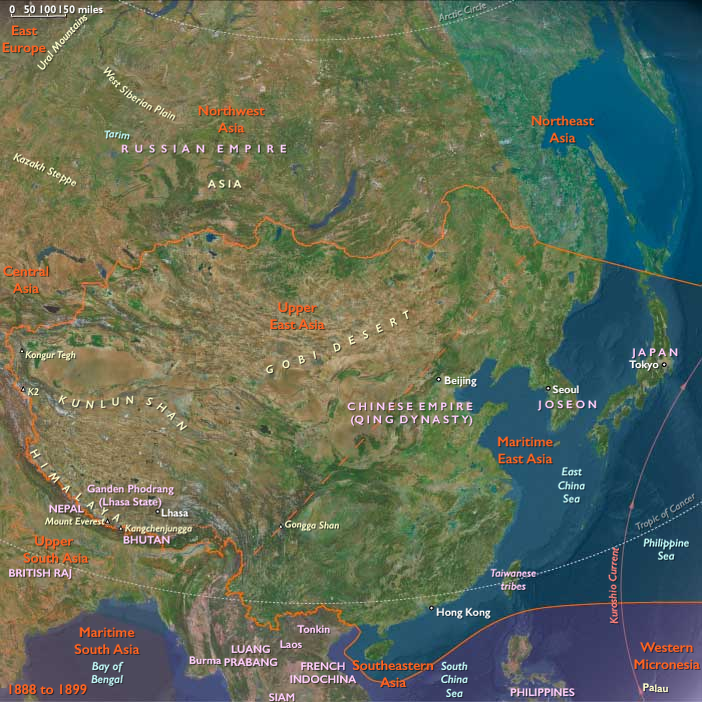
He strengthens diplomatic ties with Western powers including Germany, the United States and especially the United Kingdom. In Asia he oversees the First Sino-Japanese War and negotiates Chinese surrender on terms aggressively favorable to Japan, including the annexation of Taiwan and the release of Korea from the Chinese Imperial tribute system.
Itō seeks to avoid a Russo-Japanese War through the policy of Man-Kan kōkan–surrendering Manchuria to the Russian sphere of influence in exchange for the acceptance of Japanese hegemony in Korea
A diplomatic tour of the United States and Europe brings him to Saint Petersburg in November 1901, where he is unable to find compromise on this matter with Russian authorities.
Soon the government of Katsura Tarō elects to abandon the pursuit of Man-Kan kōkan, and tensions with Russia continue to escalate towards war.
The Japan–Korea Treaty of 1905 makes Itō the first Japanese Resident-General of Korea.
He initially supports the sovereignty of the indigenous Joseon monarchy as a protectorate under Japan, but he eventually accepts and agrees with the increasingly powerful Imperial Japanese Army, which favors the total annexation of Korea, resigning his position as Resident-General and taking a new position as the President of the Privy Council of Japan in 1909.
Four months later, Itō is assassinated by Korean-independence activist and nationalist An Jung-geun in Manchuria.
The annexation process is formalized by another treaty the following year after Ito's death.
Through his daughter Ikuko, Itō is the father-in-law of politician, intellectual and author Suematsu Kenchō.