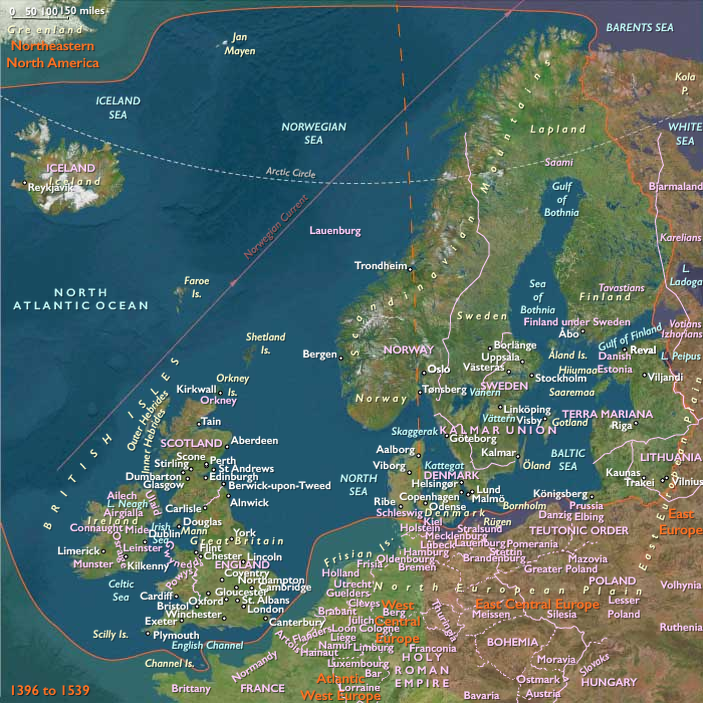
Christian II, king of Denmark from 1513, is the son of King John and his wife, Christina of Saxony.
He was born at Nyborg Castle in 1481 and succeeded his father as king of Denmark and Norway.
Christian descends, through Valdemar I of Sweden, from the House of Eric, and from Catherine, daughter of Inge I of Sweden, as well as from Ingrid Ylva, granddaughter of Sverker I of Sweden.
His soon-to-be rival Gustav Vasa descends only from Sverker II of Sweden and the House of Sverker.
Christian, who had taken part in his father's conquest of Sweden in 1497 and in the fighting of 1501 when Sweden revolted, had been appointed viceroy of Norway in 1506, and had succeeded in maintaining control of this country.
Christian's succession to the throne of Denmark and Norway had been confirmed at the Herredag assembly of notables from the three northern kingdoms, which met at Copenhagen in 1513.
The Swedish delegates said, "We have the choice between peace at home and strife here, or peace here and civil war at home, and we prefer the former."
A decision as to the Swedish succession had therefore been postponed.
A peculiarity, more fatal to him in this aristocratic age than any other, is his fondness for the common people, which had been increased by his passion for a pretty Norwegian girl of Dutch heritage, named Dyveke Sigbritsdatter, who had become his mistress in 1507 or 1509.
On August 12, 1515, Christian had married Isabella of Austria, the granddaughter of Holy Roman Emperor Maximilian I, but he had not given up his liaison with Dyveke, and it is only her death in 1517, under suspicious circumstances, that prevents serious complications with Charles of Habsburg.
Christian believes that the magnate Torben Oxe is guilty of Sigbritsdatter's death.
Oxe is brought to trial at Solbjerg outside Copenhagen in what amounts to a justice-of-the-peace court on vague offenses against his liege lord, Christian II.
The verdict as directed by the king is guilty and the death sentence imposed with the comment, 'your deeds not your words have condemned you'.
Over the strenuous opposition of Oxe's fellow peers, he is executed in late 1517.
Hereafter, the king will lose no opportunity to suppress the nobility and raise commoners to power.
Christian’s chief counselor is Dyveke's mother Sigbrit Willoms, who excels in administrative and commercial affairs.
Christian had first appointed her controller of the Sound Dues of Øresund, and has ultimately committed to her the whole charge of the finances.
A bourgeois herself, it is Sigbrit's constant policy to elevate and extend the influence of the middle classes.
She had soon formed a middle-class inner council centering on her, which competes for power with Rigsraadet itself.
The patricians naturally resent their supersession and nearly every unpopular measure is attributed to the influence of the Dutch comptroller.
Christian was meanwhile preparing for the inevitable war with Sweden, where …