Isaac Komnenos of Cyprus
ruler of Cyprus
Years: 1155 - 1196
Isaac Komnenos or Comnenus (Gc.
1155 – 1195/1196), is the ruler of Cyprus from 1184 to 1191, before Richard I's conquest during the Third Crusade.
Related Events
Filter results
Showing 10 events out of 62 total
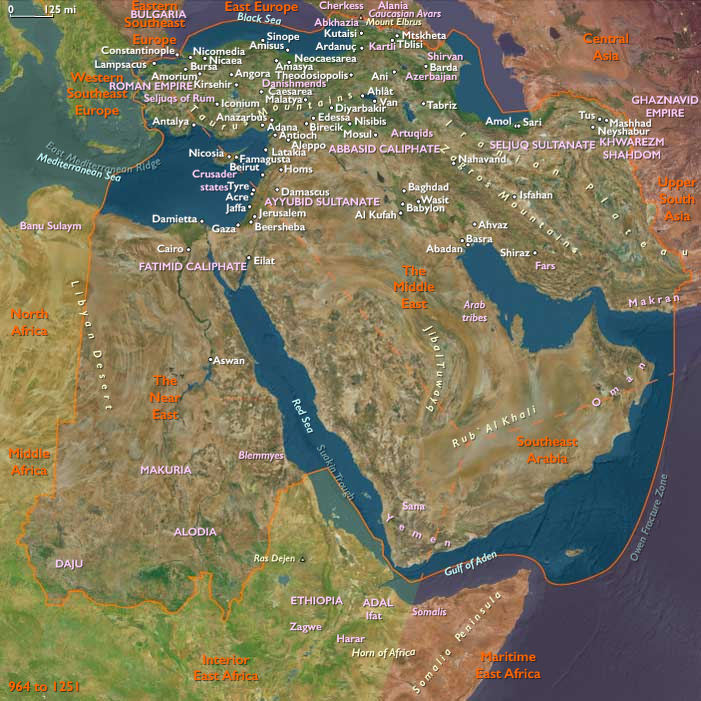
Isaac Komnenos, an imperial governor in the twelfth century, sets himself up in the capital as the emperor of Cyprus, and the authorities in Constantinople are either too weak or too busy to do anything about the usurper.
When an imperial fleet is eventually sent against Cyprus, Komnenos is prepared and, in league with Sicilian pirates, defeats the fleet and retains control of the island.
Komnenos, a tyrant and murderer, is unlamented when swept from power by the king of England, Richard I the Lion-Heart.
Richard, after wintering in Sicily, had set sail en route to the Holy Land as a leader of the Third Crusade, but in April 1191 his fleet is scattered by storms off Cyprus.
Two ships are wrecked off the southern coast, and a third, carrying Richard's fiancee Berengaria of Navarre, seeks shelter in Lemesos (Limassol).
The wrecked ships are plundered and the survivors robbed by the forces of the usurper governor Isaac Komnenos, and the party of the bride-to-be is prevented from obtaining provisions and fresh water.
When Richard arrives and learns of these affronts, he takes time out from crusading, first to marry Berengaria in the chapel of the fortress at Lemesos and then to capture Cyprus and depose Komnenos.
The capture of Cyprus, seemingly a footnote to history, actually proves beneficial to the crusaders whose foothold in the Holy Land has almost been eliminated by the Muslim commander Saladin.
Cyprus will become a strategically important logistic base and will be used as such for the next hundred years.
He then appoints officials to administer Cyprus, leaves a small garrison to enforce his rule, and sails on to the Holy Land.
The Cypriots revolt against their new overlords a short time later.
The revolt is quickly put down, but Richard decides that the island is too much of a burden, so he sells it to the Knights Templar, a Frankish military order whose grand master is a member of Richard's coterie.
Their oppressive, tyrannical rule makes that of the avaricious Komnenos seem mild in comparison.
The people again rebel and suffer a massacre, but their persistence leads the Templars, convinced that they will have no peace on Cyprus, to depart.
Control of the island is turned over to Guy de Lusignan, the controversial ruler of the Latin kingdom of Jerusalem, who evidently agrees to pay Richard the amount still owed him by the Templars.
More than eight hundred years of Roman rule ends as the Frankish Lusignan dynasty establishes a Western feudal system on Cyprus.
Guy de Lusignan lives only two years after assuming control in 1192, but the dynasty that he founds will rule Cyprus as an independent kingdom for more than three centuries.
In religious matters, Lusignan is tolerant of the Cypriot adherence to Orthodoxy, but his brother Amaury, who succeeds him, shows no such liberality.
The stage is hence set for a protracted struggle, which dominates the first half of the Lusignan period.
At issue is the paramountcy of the Roman Catholic Church over the Orthodox church.
Latin sees are established at Famagusta, Limassol, Nicosia, and Paphos; land is appropriated for churches; and authority to collect tithes is granted to the Latins.
Isaac Komnenos, an imperial governor of Cyprus, meanwhile rebels and proclaims himself emperor, resisting attacks from the emperors Andronikos I Komnenos and Isaac II Angelos.
Constantinople's long-standing empire seems, finally, about to collapse.
Baldwin IV's army relieves Kerak from two sieges by Saladin in 1183 and 1184.
A kind of “court party” has formed at Jerusalem around the queen mother, Agnes of Courtenay, her daughter Sibylla, and Agnes' brother, Joscelin III, titular ruler of Edessa, and now includes the Lusignans.
Another group composed mostly of the so-called native barons—old families, notably the Ibelins, Renaud of Sidon, and Raymond III of Tripoli, who through his wife is also lord of Tiberias—often opposes it.
In addition to these internal problems, the Latin Kingdom of Jerusalem is more isolated than ever.
Urgent appeals to the West and the efforts of Pope Alexander III have brought little response.
Relations with the locals are hindered further by the actions of the belligerent Guy de Lusignan, who in 1184 attacks a tribe of Bedouin shepherds who had paid a tribute to the Latins for allowing them the privilege of grazing their sheep.
Guy and his men massacre as many of the tribe as they can and drive away the rest along with their flock.
Baldwin IV finally succumbs to leprosy in March 1185.
His sister Sibylla's six-year-old son inherits the crown as Baldwin V, leaving as regent, according to previous agreement, Raymond III of Tripoli.
Humphrey's stepfather Raynald attempts, after the child king dies in 1186, possibly poisoned by Guy of Lusignan, to persuade him to claim the throne in right of Isabella, whom her mother Dowager Queen Maria Komnena and the Ibelin faction want to crown as soon as possible.
Humphrey, who is at this time about twenty, chooses instead to support Guy, husband of Isabella's half-sister Sibylla, to whom Humphrey has sworn fealty.
Reluctantly, Raynald and the other nobles follow his support, as do the Ibelins, even though Guy, who had arrived in Outremer after 1177, had previously been deprived of the regency by his dying brother-in-law Baldwin IV due to his conduct at the 1183 siege of Kerak.
The court party, supported by Raynald, outmaneuvers the other barons and, disregarding succession arrangements that had been formally drawn up, hastily crowns Sibyl.
Announcing her intention to choose the most worthy noble to be her husband and king, Sybil divorces Guy, only to choose him again as king and husband.
William of Tyre, a Crusade chronicler writing in the late twelfth century, describes sugar as "very necessary for the use and health of mankind".
William’s importance had dwindled with the victory of Agnes and her supporters, and with the accession of Baldwin V, infant son of Sibylla and William of Montferrat.
Baldwin was a sickly child and he died the next year.
He is succeeded in 1186 by his mother Sibylla and her second husband Guy of Lusignan, ruling jointly.
William is probably in failing health by this point.
There had been a new chancellor in May 1185; by October 21, 1186, there is a new archbishop of Tyre, Joscius, a canon and subdeacon of the church of Acre who had become Bishop of Acre on November 23, 1172.
He had been a member of the delegation from the Latin church of the Crusader states at the Third Lateran Council in 1179.
While in Europe, he had also visited France on behalf of King Baldwin IV, to negotiate a marriage between Hugh III, Duke of Burgundy, and Baldwin's sister Sibylla, but the marriage never took place; Sibylla instead married Guy of Lusignan the next year.
Meanwhile Sibylla and Guy have become Queen and King of Jerusalem, against the ambitions of Raymond III of Tripoli, who had hoped to have his own supporters succeed to the throne.

Raynald again breaks a truce with Saladin at the end of 1186 in the midst of near civil war by plundering a caravan in which a sister of Saladin is traveling.
When King Guy asks Raynald to return the stolen property, he refuses, and Saladin replies by proclaiming jihad against the Latin kingdom.