
Isaac Brock
British Army officer and colonial administrator from Guernsey
1769 CE to 1812 CE
Major-General Sir Isaac Brock KB (October 6, 1769 – October 13, 1812) is a British Army officer and colonial administrator from Guernsey.
Brock is assigned to Lower Canada in 1802.
Despite facing desertions and near-mutinies, he commands his regiment in Upper Canada (present-day Ontario) successfully for many years.
He is promoted to major general, and becomes responsible for defending Upper Canada against the United States.
While many in Canada and Britain believe war can be averted, Brock begins to ready the army and militia for what is to come.
When the War of 1812 breaks out, the populace is prepared, and quick victories at Fort Mackinac and Detroit defeat American invasion efforts.
Brock's actions, particularly his success at Detroit, earn him a knighthood, membership in the Order of the Bath, accolades and the sobriquet "The Hero of Upper Canada".
His name is often linked with that of the native leader Tecumseh, although the two men collaborated in person only for a few days.
Brock dies at the Battle of Queenston Heights, which the British win.
World
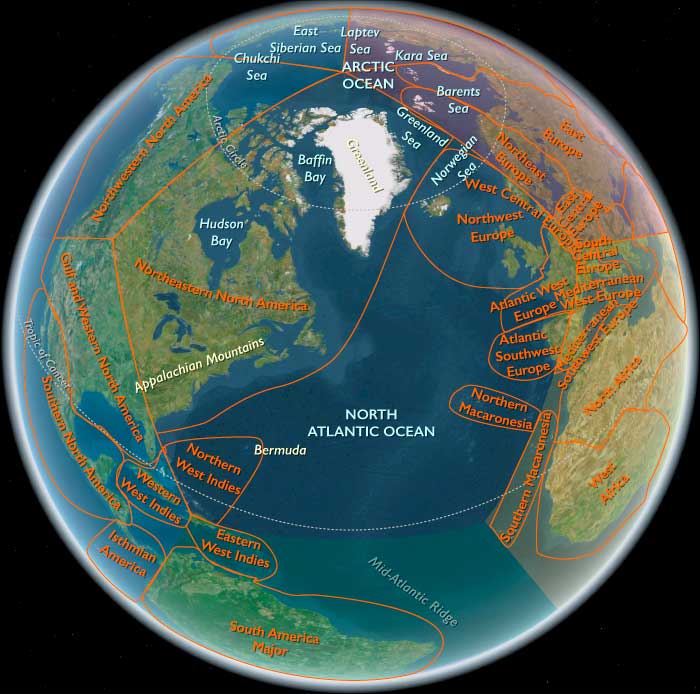
The Atlantic Lands
View →Related Events
Showing 8 events out of 8 total
Although most of these are involved in blockading the French navy and protecting British trade against (usually French) privateers, the Royal Navy still has eighty-five vessels in American waters, counting all British Navy vessels in North American and the Caribbean waters.
However, the Royal Navy's North American squadron based in Halifax, Nova Scotia (which will bear the brunt of the war), numbers one small ship of the line, seven frigates, nine smaller sloops and brigs along with five schooners.
By contrast, the United States Navy comprises eight frigates, fourteen smaller sloops and brigs, and no ships of the line.
The U.S. had embarked on a major shipbuilding program before the war at Sackets Harbor, New York and continues to produce new ships.
Three of the existing American frigates are exceptionally large and powerful for their class, larger than any British frigate in North America.
Whereas the standard British frigate of the time is rated as a thirty-eight gun ship, usually carrying up to fifty guns, with its main battery consisting of eighteen-pounder guns; USS Constitution, President, and United States, in comparison, are rated as forty-four-gun ships, carrying fifty-six to sixty guns with a main battery of twenty-four-pounders.
In response to the U.S. declaration of war, Isaac Brock had issued a proclamation alerting the citizenry in Upper Canada of the state of war and urging all military personnel "to be vigilant in the discharge of their duty" to prevent communication with the enemy and to arrest anyone suspected of helping the Americans.
He had also issued orders to the commander of the British post at Fort St. Joseph to initiate offensive operations against U.S. forces in northern Michigan, who it turns out, were not yet aware of their own government's declaration of war.
The resulting Siege of Fort Mackinac on July 17 had been the first major land engagement of the war, and ended in an easy British victory.
Geography dictates that operations during 1812 and 1813 take place in the west: principally around Lake Erie, near the Niagara River between Lake Erie and Lake Ontario, and near the Saint Lawrence River area and Lake Champlain.
This is the focus of the three-pronged attacks by the Americans in 1812.
Here, British military experience will prevail over inexperienced American commanders.
Although cutting the St. Lawrence River through the capture of Montreal and Quebec would have made Britain's hold in North America unsustainable, the United States begins operations first in the western frontier because of the general popularity here of a war with the British, who have sold arms to those natives opposing the settlers.
The British score an important early success when their detachment at St. Joseph Island, on Lake Huron, learned of the declaration of war before the nearby American garrison at the important trading post at Mackinac Island in Michigan.
A scratch force had landed on the island on July 17, 1812, and mounted a gun overlooking Fort Mackinac.
After the British fired one shot from their gun, the Americans, taken by surprise, had surrendered.
This early victory has encouraged the natives, and large numbers move to help the British at Amherstburg.
The island totally controls access to the Old Northwest, giving the British nominal control of this area, and, more vitally, a monopoly on the fur trade.
Once on Canadian soil, Hull had issued a proclamation ordering all British subjects to surrender, or "the horrors, and calamities of war will stalk before you".
This has led many of the British forces to defect.
The senior British officer in Upper Canada, Major General Isaac Brock, feels that he should take bold measures to calm the settler population in Canada, and to convince the natives who are needed to defend the region that Britain is strong.
Hull, knowing of British-instigated native attacks on other locations, orders the evacuation of the inhabitants of Fort Dearborn (Chicago) to Fort Wayne.
After initially being granted safe passage, the inhabitants (soldiers and civilians) are attacked by Potowatomis on August 15 after traveling only two miles (three point two kilometers) in what is known as the Battle of Fort Dearborn.
The fort is subsequently burned.
Hull, fearing that the British possess superior numbers and that the natives attached to Brock's force will commit massacres if fighting begins, surrenders Detroit without a fight on August 16.
An armistice (arranged by Prévost in the hope the British renunciation of the Orders in Council to which the United States had objected might lead to peace) prevents Brock from invading American territory.
When the armistice ends, the Americans attempt an attack across the Niagara River on October 13, but suffer a crushing defeat at Queenston Heights.
Brock is killed during the battle.
While the professionalism of the American forces will improve by the war's end, British leadership will suffer after Brock's death.
A final attempt in 1812 by American General Henry Dearborn to advance north from Lake Champlain will fail when his militia refuses to advance beyond American territory.
French Canadians, who find the anti-Catholic stance of most of the United States troublesome, and United Empire Loyalists, who had fought for the Crown during the American Revolutionary War, strongly oppose the American invasion.
Many in Upper Canada are recent settlers from the United States who have no obvious loyalties to the Crown; nevertheless, while there are some who sympathize with the invaders, the American forces find strong opposition from men loyal to the Empire.