Indulf
king of Alba
Years: 927 - 952
Ildulb mac Causantín, anglicized as Indulf or Indulph, nicknamed An Ionsaighthigh, "the Aggressor" (died 962) was king of Alba from 954 to 962. He was the son of Constantine II; his mother may have been a daughter of Earl Eadulf I of Bernicia, who was an exile in Scotland.

Related Events
Filter results
Showing 3 events out of 3 total
Northwest Europe (952–963 CE): Political Consolidation and Cultural Vitality
Eadred’s Reign and the End of Norse Rule in York
Between 952 and 954 CE, King Eadred of England continued to consolidate royal power, decisively ending the rule of the Norse king Eric Bloodaxe in Northumbria. After intermittent periods of instability, Eadred’s capture of York in 954 CE permanently dissolved the independent Norse kingdom there, firmly uniting Northumbria under English control and marking a pivotal shift in England's political landscape.
Ascension and Stability Under Edgar the Peaceful
Following Eadred’s death in 955 CE, his young nephew Eadwig ascended to the throne briefly (955–959 CE), marked by internal court disputes. However, his reign swiftly transitioned in 959 CE to that of his younger brother, Edgar the Peaceful (r. 959–975 CE), whose rule quickly restored internal stability. Edgar’s reign is characterized by peace, consolidation of centralized governance, and enhanced administrative efficiency, laying lasting foundations for the late Anglo-Saxon kingdom.
Ireland’s Norse-Gaelic Kingdoms
During this period, Norse-Gaelic kingdoms in Ireland, particularly Dublin and Limerick, flourished economically and culturally despite frequent political instability. Rulers such as Olaf Cuaran of Dublin (first reign 945–947, second reign 952–980 CE) solidified control over their territories, strengthening maritime trade connections with Britain, Scandinavia, and mainland Europe. Dublin’s prominence as a cultural and trading hub grew significantly.
Political Continuity in Alba Under Indulf
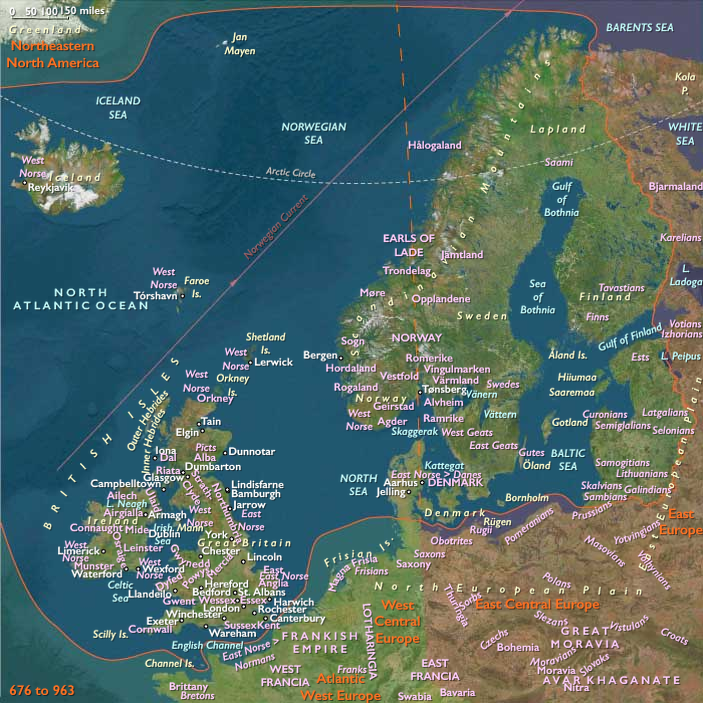
In Scotland, following the death of Malcolm I in 954 CE, his successor Indulf (r. 954–962 CE) continued efforts to consolidate Alba. His reign is notable for successfully capturing Edinburgh (Dunedin), further strengthening Scottish authority in the region. Despite occasional Viking incursions, Indulf maintained stability, facilitating gradual unification and centralization of royal power in Scotland.
Stability and Expansion in the Icelandic Commonwealth
In Iceland, the Commonwealth flourished culturally and politically through the stability provided by the newly established Althing, which mediated disputes and codified laws. Icelandic society continued to mature, developing its distinctive cultural traditions, social institutions, and an increasingly sophisticated legal framework. The settlement era's conclusion fostered a stable, economically robust community, laying groundwork for a vibrant literary and historical culture.
Compilation and Cultural Significance of the Cædmon Manuscript
In Anglo-Saxon England, the period remained culturally significant with continued literary production and manuscript compilation. The so-called Cædmon manuscript, compiled between approximately 930–960 CE, represented a significant scholarly achievement. This collection of Old English religious poetry, featuring works such as Genesis A, Genesis B, Exodus, Daniel, Christ and Satan, and Judith, was illustrative of the cultural vibrancy and intellectual rigor characterizing late Anglo-Saxon monastic scholarship.
Religious Institutions and Cultural Preservation
Monastic centers in England, Scotland, and Ireland remained vibrant hubs of learning, manuscript preservation, and religious life throughout this period. Such institutions safeguarded classical and ecclesiastical texts, maintained educational traditions, and promoted cultural continuity despite regional political turbulence.
Scandinavian Political Dynamics and Continued Migration
In Scandinavia, the death of prominent rulers like Eric Bloodaxe intensified internal power struggles and succession disputes. Instability and political fragmentation in Norway prompted ongoing Norse migrations toward Iceland, the British Isles, and the North Atlantic islands, sustaining the cultural links across the North Atlantic world.
Legacy of the Era
By 963 CE, Northwest Europe had undergone crucial political consolidation, notably with the integration of York under firm English control, the growing stability of Edgar the Peaceful’s reign, and the territorial expansion of Alba under Indulf. At the same time, Ireland's Norse-Gaelic kingdoms retained vibrant economic and cultural roles, while Iceland solidified its unique Commonwealth governance. Scholarly and cultural life, epitomized by the Cædmon manuscript, reflected the rich intellectual atmosphere of the period, marking a significant transitional era towards a more politically centralized and culturally coherent medieval Europe.
Northwest Europe (964–975 CE): Edgar's Reign and Cultural Continuity
Edgar the Peaceful and the Consolidation of England
Between 964 and 975 CE, the rule of Edgar the Peaceful (r. 959–975 CE) brought remarkable stability to England. Edgar's reign is characterized by internal peace, effective administration, and legal reforms. He significantly strengthened royal authority through the establishment of a centralized administrative system, promoting uniform laws and coinage, and ensuring regular assemblies.
Benedictine Reform and Religious Renewal
Edgar strongly supported the Benedictine Reform movement, driven by key ecclesiastical figures such as Dunstan, Archbishop of Canterbury, Oswald, Archbishop of York, and Æthelwold, Bishop of Winchester. This reform aimed at renewing monastic discipline, reviving religious scholarship, and reinforcing ecclesiastical independence and morality. Monastic centers flourished, producing richly illuminated manuscripts and scholarly works.
Coronation at Bath (973 CE)
Edgar’s elaborate coronation in 973 CE at Bath (or possibly Chester, according to some chronicles) symbolized a powerful image of his royal authority and unity among England's diverse kingdoms. The ceremony was marked by elaborate rites and attended by numerous regional leaders, asserting Edgar’s dominance over both Anglo-Saxon and Scandinavian rulers.
Norse-Gaelic Dublin and Viking Power in Ireland
In Ireland, Olaf Cuaran, the Norse-Gaelic King of Dublin (r. 952–980 CE), maintained his rule and prominence. Dublin flourished economically as an essential trade hub connecting Scandinavia, the British Isles, and continental Europe. Olaf frequently engaged in alliances and conflicts with Irish and British leaders, securing his position while contributing to Dublin's ongoing cultural synthesis of Norse and Gaelic traditions.
Scotland Under Dub and Cuilén
After Indulf's death in 962 CE, his successors Dub (962–967 CE) and Cuilén (967–971 CE) faced internal challenges and external pressures from Viking raids. Dub sought to maintain the authority established by his predecessors but was eventually assassinated amid dynastic strife. His successor, Cuilén, faced similar difficulties, highlighting continuing instability in the Scottish kingdom of Alba during this period.
Stability and Maturation of the Icelandic Commonwealth
The Icelandic Commonwealth continued to mature during this era. The Althing, Iceland’s innovative parliamentary assembly, ensured stability by mediating disputes among chieftains. By 975 CE, Iceland had established robust local governance and legal institutions, fostering a distinctively stable and culturally vibrant Norse society.
Scandinavian Dynamics and Continuing Migration
In Scandinavia, ongoing dynastic conflicts, especially in Norway, continued prompting migrations westward. Settlers increasingly moved toward Iceland, the Orkney and Shetland Islands, and regions of northern Britain. These migrations sustained Scandinavian cultural connections throughout Northwest Europe.
Literary and Scholarly Achievements
Monastic centers across England, Scotland, and Ireland maintained vibrant intellectual and cultural activity. Manuscript production and scholarship flourished, preserving important ecclesiastical, literary, and historical texts. Notably, manuscripts such as the earlier Cædmon manuscript, continued to influence religious and cultural life in Anglo-Saxon England.
Legacy of the Era
By 975 CE, Northwest Europe had experienced significant political consolidation and cultural vitality. Edgar’s peaceful and prosperous reign in England established enduring administrative and legal frameworks. Benedictine reforms revitalized religious institutions and cultural scholarship, profoundly influencing Anglo-Saxon society. Concurrently, Norse-Gaelic Dublin thrived economically and culturally, Iceland’s Commonwealth matured, and Scotland navigated ongoing internal complexities. Collectively, these developments profoundly shaped Northwest Europe’s cultural, political, and historical trajectory, setting the stage for the significant changes of the coming decades.
Northwest Europe (976–987 CE): Succession, Strife, and Cultural Resilience
England After Edgar: Succession Crisis and Instability
Following the death of Edgar the Peaceful in 975 CE, England entered a period of considerable turbulence. Edgar's elder son, Edward the Martyr (r. 975–978 CE), ascended to the throne amid controversy and factional rivalry. His brief reign was plagued by political infighting between secular nobles and reform-minded clergy led by Dunstan, Archbishop of Canterbury. This internal conflict culminated in Edward’s assassination at Corfe Castle in 978 CE.
Æthelred the Unready and Early Signs of Weakness
Edward’s death brought his younger half-brother, Æthelred II (r. 978–1016 CE), known as Æthelred the Unready, to power at around age ten. Initially overshadowed by his mother, Ælfthryth, and prominent nobles, Æthelred’s reign quickly revealed vulnerabilities, especially in governance and military preparedness. His rule became increasingly marked by indecisiveness and internal dissent, weakening royal authority.
Renewed Viking Raids and Danish Threat
Exploiting English instability, renewed Viking raids began around 980 CE, intensifying by the decade’s close. Norse raiders, notably under Danish and Norwegian leaders, targeted coastal settlements and monasteries, renewing fears reminiscent of earlier Viking incursions. By 987 CE, Viking attacks had severely tested Æthelred’s government, foreshadowing greater turmoil in subsequent decades.
Dublin Under Olaf Cuaran: Norse-Gaelic Prosperity
In Ireland, Olaf Cuaran, King of Dublin (r. 952–980 CE), maintained prosperous trade networks and maritime power until his abdication following a decisive defeat at the Battle of Tara in 980 CE. After Olaf's departure, Dublin entered a period of political uncertainty but retained significant economic importance as a thriving center of Norse-Gaelic culture and commerce, maintaining vital connections across the Irish Sea and Scandinavia.
Scottish Succession and Rivalries: Kenneth II
After Scottish king Cuilén died in 971 CE, Kenneth II (r. 971–995 CE) emerged as the prominent figure of Alba. His reign was marked by consolidation efforts, territorial expansion, and ongoing internal rivalries. Kenneth sought to strengthen royal authority, solidifying central governance amidst persistent tensions among Scotland’s regional elites, particularly in northern and eastern regions.
Icelandic Commonwealth: Continued Stability and Development
Throughout this period, Iceland’s political and social stability under the decentralized but effective governance of the Althing allowed cultural and economic development. The Icelandic Commonwealth continued to refine its sophisticated legal framework, settling disputes peacefully and fostering a distinctive Norse cultural identity. By 987 CE, Iceland had solidified its unique position as a stable, prosperous community with well-established institutions.
Scandinavian Political Fragmentation and Migration Patterns
In Scandinavia, ongoing dynastic struggles continued, particularly in Norway, prompting further westward migration. Notable numbers of Norse settlers continued to arrive in Iceland, the Faroes, Orkney, Shetland, and northern Britain, reinforcing strong cultural ties between Scandinavia and the Atlantic islands.
Religious and Cultural Scholarship
Monastic and ecclesiastical centers across England, Scotland, and Ireland persisted as essential hubs of religious learning and literary production. The legacy of the earlier Benedictine Reform continued, ensuring vibrant cultural life despite political upheavals. Manuscript preservation and intellectual scholarship remained critical, reflecting continued cultural resilience.
Legacy of the Era
By 987 CE, Northwest Europe had experienced critical transitions marked by significant political challenges and ongoing cultural vibrancy. England’s internal strife under Æthelred foreshadowed prolonged instability, exacerbated by renewed Viking threats. Conversely, Norse-Gaelic Dublin maintained its prominence despite political uncertainty, while Scotland saw strengthened royal authority under Kenneth II. Meanwhile, Iceland's Commonwealth matured into a stable polity. Collectively, these developments emphasized both vulnerability and resilience, laying essential foundations for subsequent historical changes in Northwest Europe.