Hilary of Poitiers
bishop of Poitiers
Years: 300 - 368
Hilary of Poitiers (c. 300 – c. 368) is Bishop of Poitiers and is a Doctor of the Church.
He is sometimes referred to as the "Hammer of the Arians" (Latin: Malleus Arianorum) and the "Athanasius of the West."
His name comes from the Latin word for happy or cheerful.
His optional memorial in the Roman Catholic calendar of saints is 13 January.
In the past, when this date was occupied by the Octave Day of the Epiphany, his feast day was moved to 14 January.

Related Events
Filter results
Showing 7 events out of 7 total
Mediterranean West Europe (244–387 CE): Imperial Challenges, Christianization, and Cultural Transformations
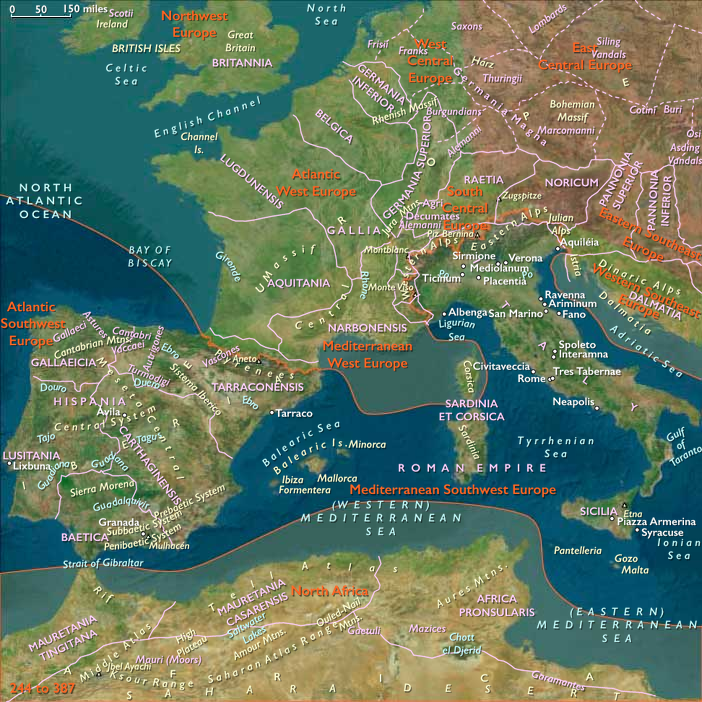
Between 244 and 387 CE, Mediterranean West Europe—encompassing southern France (below an imaginary line from approximately 43.03476° N, 1.17208° W to 46.45234° N, 6.07689° E), Corsica, and Monaco—undergoes significant transformations amid imperial challenges, the spread of Christianity, and shifting cultural dynamics. The stability of previous centuries gradually gives way to internal tensions and external threats, influencing regional society profoundly.
Economic Pressures and Administrative Strains
Throughout this era, Mediterranean West Europe faces increased economic pressures due to higher taxation and administrative burdens imposed by the central Roman government. Economic disparities grow between wealthy urban elites and rural populations, leading to localized unrest and challenges to Roman governance. Major cities like Massalia (Marseille), Nemausus (Nîmes), and Arelate (Arles) continue to flourish, though increasingly taxed by economic demands from Rome.
Military Tensions and Defensive Measures
External threats, particularly Germanic incursions and piracy, necessitate enhanced military defenses and fortifications throughout the region. Coastal defenses around cities such as Massalia and Monaco are strengthened to protect vital maritime trade routes. The presence of Roman legions in the region becomes more pronounced, marking a shift towards increased militarization and defensive readiness.
Spread of Christianity
This era witnesses the significant expansion of Christianity across southern France and Corsica. Initially limited to urban centers, Christianity rapidly permeates rural areas as well. Early Christian communities establish churches and episcopal sees, notably in prominent cities like Arles, which emerges as a significant Christian hub. By the late fourth century, Christian leaders like Hilary of Poitiers and Martin of Tours influence the region profoundly, advocating for religious reform and the establishment of monastic traditions.
Cultural and Religious Transformations
Cultural life during this period reflects increasing Christian influence while still accommodating traditional Roman practices. Pagan temples begin to decline, repurposed as Christian churches or abandoned. Religious and cultural festivals evolve, combining Roman traditions with emerging Christian observances. This blending creates a unique cultural landscape that shapes the region's identity.
Administrative Reforms and Regional Autonomy
In response to growing challenges, the Roman administration implements structural reforms aimed at improving governance efficiency and local responsiveness. Provinces within Mediterranean West Europe gain greater administrative autonomy, allowing local officials more direct control over regional matters. These changes help maintain stability despite mounting pressures, preserving the region's economic and social coherence.
Prelude to Late Antiquity
By 387 CE, Mediterranean West Europe stands at the threshold of Late Antiquity, having experienced profound transformations economically, socially, and religiously. The spread of Christianity, increasing administrative autonomy, and evolving defensive strategies position the region uniquely for the transitions that will follow in subsequent centuries, laying a complex foundation for future historical developments.
Atlantic West Europe, 328–339: Strengthening Imperial and Religious Structures
Political and Military Developments
-
Constantine’s Final Reforms (328–337)
-
Emperor Constantine I further centralized administrative power, solidifying imperial control across Atlantic West Europe from his residence in Trier.
-
Constantine strengthened frontier fortifications along the Rhine, significantly reducing incursions by Germanic tribes and ensuring regional security.
-
-
Succession and Division (337–339)
-
Constantine’s death in 337 led to a temporary power vacuum and subsequent division of the empire among his sons (Constantine II, Constantius II, and Constans).
-
Constantine II initially ruled over Gaul, Britain, and Hispania, with Trier continuing as a major political and military center.
-
Economic and Social Developments
-
Continued Urban and Economic Growth
-
Urban centers, notably Trier, Bordeaux, Poitiers, and Lyon, flourished economically, benefiting from stability, imperial patronage, and trade networks.
-
The wine industry, especially around Bordeaux, continued its expansion, becoming increasingly vital to the region’s economic integration into Mediterranean trade routes.
-
-
Rural Prosperity and Agricultural Productivity
-
Large rural estates (villae) prospered under stable imperial rule, generating agricultural surpluses, which further encouraged economic stability and population growth in the region.
-
Cultural and Religious Developments
-
Christianity as Imperial Religion
-
Constantine’s patronage resulted in Christianity's rapid institutionalization throughout Atlantic West Europe, with increased construction of churches, basilicas, and Christian schools in cities like Trier, Poitiers, and Lyon.
-
The prominent roles of bishops grew stronger, combining civic authority and spiritual influence, notably evident with figures like Hilary of Poitiers (though he would rise to prominence slightly later).
-
-
Persisting Pagan Traditions
-
While Christianity advanced dramatically in urban areas, traditional Roman religious practices remained significant in rural communities, revealing a cultural continuity and coexistence during this transitional period.
-
Significance
The era 328–339 saw the continuation and deepening of Constantine’s reforms, dramatically shaping Atlantic West Europe. The imperial division after 337 introduced new political complexities, but the fundamental economic prosperity and Christian cultural shift remained securely established.
Atlantic West Europe, 352–363: Imperial Struggles and Religious Transformation
Political and Military Developments
-
Rise and Fall of Emperor Constantius II
-
After defeating the usurper Magnentius in 353, Constantius II reunited the Western Roman Empire, including Gaul, under his sole authority.
-
Constantius II faced persistent challenges along the Rhine frontier, engaging in campaigns against Germanic tribes, particularly the Alemanni, who intensified raids into Alsace and central Gaul.
-
-
Julian's Military and Administrative Reforms
-
In 355, Constantius appointed his cousin Julian (the Apostate) as Caesar in Gaul, with authority centered in Paris.
-
Julian undertook effective military and administrative reforms, successfully defending the Rhine frontier and achieving notable victories, including the Battle of Strasbourg (Argentoratum) in 357, significantly strengthening the Roman presence in Alsace.
-
Economic and Social Developments
-
Recovery and Stability
-
Julian’s successful military campaigns brought stability, allowing urban centers like Bordeaux, Paris, and Trier to prosper economically.
-
Agricultural productivity and trade networks stabilized, bolstered by Julian’s reduction of taxes and administrative reforms aimed at improving provincial governance.
-
-
Social Reforms under Julian
-
Julian promoted traditional Roman civic values and attempted to reverse social and religious changes brought about by Christianity, resulting in a brief resurgence of pagan cultural traditions among elites.
-
Cultural and Religious Developments
-
Julian’s Pagan Revival
-
Julian actively sought to revive traditional Roman religious practices, reducing the privileges Christianity had enjoyed under previous emperors. His reforms briefly challenged the Christianization trend across Atlantic West Europe.
-
Despite Julian's policies, Christianity had already become deeply entrenched in urban and rural communities, limiting the long-term impact of his revival efforts.
-
-
Christian Resilience and Bishops’ Influence
-
Christian bishops maintained significant influence and moral authority in cities such as Poitiers (under Bishop Hilary) and Tours (soon to be the site of Martin of Tours' influential episcopate).
-
Christianity continued to expand at the grassroots level, demonstrating resilience in the face of Julian’s policies.
-
Significance
Between 352 and 363, Atlantic West Europe experienced significant military stabilization and temporary cultural upheaval due to Julian’s pagan revival. Julian’s death in 363 would set the stage for Christianity’s definitive establishment as the region’s dominant religion in subsequent decades.
Hilary of Poitiers: Defender of Nicene Christianity and Opponent of Arianism (c. 300–368 CE)
Hilary of Poitiers, born in Poitiers at the end of the 3rd century CE, was a highly educated pagan aristocrat who, after extensive study of the Old and New Testament, converted to Christianity, along with his wife and daughter (traditionally named Saint Abra). His deep learning, including a rare knowledge of Greek for a Western Christian of the time, would make him one of the most influential theologians of the 4th century CE, particularly in the fight against Arianism.
1. Hilary Becomes Bishop of Poitiers (c. 353 CE)
- Around 353 CE, the citizens of Poitiers, impressed by his wisdom and character, unanimously elected him bishop, despite the fact that he was still married (clerical celibacy was not universally required at this time).
- His tenure came at a critical moment when Arianism was spreading rapidly in the Western Church, largely due to the support of Emperor Constantius II.
- Recognizing the threat to Nicene Christianity, Hilary became one of the leading defenders of the doctrine of the Trinity.
2. Hilary’s Opposition to Arianism and Imperial Persecution
- One of Hilary’s first actions as bishop was to organize the excommunication of key Arian leaders, including:
- Saturninus, the Arian bishop of Arles.
- Ursacius and Valens, two of the most influential Arian theologians and imperial supporters.
- Around 355 CE, he wrote a letter to Emperor Constantius II, known as Ad Constantium Augustum liber primus, denouncing the emperor’s role in persecuting Nicene Christians.
- Instead of achieving reconciliation, his defiance led to his exile.
3. Exile to Phrygia and Writings on the Trinity (356–360 CE)
- At the Synod of Béziers (356 CE), called by Constantius II to settle the Arian controversy, Hilary was condemned and exiled to Phrygia (modern-day Turkey), along with Rhodanus, bishop of Toulouse.
- During his nearly four years in exile, Hilary used the time to write extensively, producing:
- De Trinitate – A detailed theological work defending the doctrine of the Holy Trinity, refuting Arian Christology.
- De Synodis – A historical account of the Arian controversy, attempting to clarify the theological positions of different factions.
- Hymns – He is one of the first Latin hymn writers, using poetry to convey orthodox doctrine.
4. Legacy: Defender of Orthodoxy and Later Recognition as a Church Father
- Eventually, Hilary was recalled from exile and continued his fight against Arianism until his death around 368 CE.
- His writings and theological contributions significantly influenced later Church doctrine, earning him the title “Athanasius of the West” for his staunch defense of Nicene Christianity.
- He was later recognized as a Doctor of the Church, and his legacy as a defender of Trinitarian orthodoxy remains influential in Christian theology.
Hilary’s intellectual depth, theological rigor, and resistance to imperial interference in Church matters made him one of the most important figures in the Arian controversy, securing his place as one of the great Church Fathers of Late Antiquity.
Liberius had acceded to the papacy in 352.
However, when Liberius was banished in 353 by the Arianist emperor Constantius II for refusing to subscribe the sentence of condemnation against Athanasius of Alexandria, Felix II had been installed as antipope.
At the end of an exile of more than two years, the emperor had recalled Liberius; but, as Felix was the official occupant of the Roman See, a year had passed before Liberius was sent to Rome.
It was the emperor's intention that Liberius should govern the Church jointly with Felix, but on the arrival of Liberius, the Roman people had expelled Felix.
Neither Liberius nor Felix had taken part in the Council of Rimini in 359.
Following the death of Constantius in 361, Liberius annuls the decrees of that assembly, but, with the concurrence of bishops Athanasius and Hilary, retains the bishops who had signed and then withdrawn their adherence.
Saint Martin of Tours: Soldier, Monk, and Bishop (c. 316–397 CE)
Martin of Tours, a former Roman soldier from Pannonia, became one of the most revered Christian figures in Late Antiquity, known for his acts of charity, monastic leadership, and opposition to military service as a Christian. His life exemplified the transition of the Roman world toward Christian values, marking him as a central figure in early medieval Christianity.
1. Martin’s Background and Military Service
- Born in Pannonia (modern Hungary) around 316 CE, Martin was the son of a Roman officer, making him legally required to serve in the Roman army.
- He was stationed in Gaul, where he likely served as a cavalry officer.
- As he deepened in Christian faith, Martin struggled with the idea of bearing arms, believing that a "soldier of Christ" should not fight against fellow Christians.
2. The Cloak-Sharing Incident at Amiens
- By tradition, while still a soldier, Martin encountered a naked beggar at the gates of Amiens.
- In an act of compassion, he cut his military cloak in half, giving one part to the beggar.
- That night, he had a vision of Christ wearing the cloak, confirming his faith and deepening his commitment to Christian service.
3. Leaving the Military and Joining Hilary of Poitiers (c. 360 CE)
- Around 360 CE, Martin joined Hilary of Poitiers, the staunch defender of Nicene Christianity against Arianism.
- Hilary had been exiled due to his opposition to Arianism but returned in 361 CE.
- Martin established the monastery of Ligugé, the first monastery in Gaul, laying the foundation for Western monasticism.
4. Martin’s Legacy in Gaul
- He later became Bishop of Tours (c. 371 CE) and continued his missionary work, converting the rural population of Gaul to Christianity.
- He was a strong advocate for monastic life, influencing the rise of monasteries throughout Gaul.
- His refusal to support military force in religious matters set an important precedent in Christian ethics.
5. Conclusion: A Symbol of Christian Compassion and Monasticism
- Saint Martin’s life reflected the transformation of the Roman Empire from a militarized pagan state to a Christianized world.
- His charitable actions, rejection of violence, and commitment to monasticism made him one of the most venerated saints of medieval Europe.
- His legacy continued through the spread of monastic traditions and the growing influence of Christian ideals in Roman and medieval society.
Through his acts of kindness, spiritual leadership, and monastic foundation, Martin of Tours became a symbol of Christian piety and service, inspiring generations of believers and monks throughout Europe.
Atlantic West Europe, 364–375: Consolidation, Religious Establishment, and Frontier Challenges
Political and Military Developments
-
Valentinian I's Stabilization of the West
-
In 364, Valentinian I became emperor of the Western Roman Empire, with Gaul as a key part of his territories. He re-established Trier as a significant imperial capital, reinforcing central authority in Atlantic West Europe.
-
Valentinian reinforced frontier defenses along the Rhine, launching successful military campaigns against Germanic tribes, notably the Alemanni, ensuring relative stability in Alsace, Burgundy, and northern Gaul.
-
-
Emergence of Future Power Centers
-
Increased fortifications and military infrastructure in frontier regions (Alsace, Trier, central France) set the foundation for future medieval power structures, providing security against persistent external threats.
-
Economic and Social Developments
-
Agricultural Prosperity and Urban Stability
-
The period saw improved economic conditions and continued agricultural productivity. Cities such as Bordeaux, Trier, and Paris thrived, benefiting from trade and increased security.
-
Stable imperial governance under Valentinian I helped maintain urban infrastructures, fostering continued social stability despite periodic frontier disruptions.
-
-
Social and Civic Reforms
-
Valentinian introduced administrative reforms to reduce corruption and abuses of power by local officials. These measures aimed to improve governance efficiency, contributing to a relatively stable and prosperous society in Gaul.
-
Religious and Cultural Developments
-
Christianity's Ascendance
-
Following Julian's brief pagan revival, Christianity rapidly consolidated its dominant position across Gaul. Bishops like Hilary of Poitiers and Martin of Tours (appointed Bishop of Tours around 371) rose to prominence, significantly shaping the religious landscape.
-
Martin of Tours became especially influential, promoting monasticism and evangelizing rural populations, greatly contributing to Christianity's deep integration into regional culture and society.
-
-
Monasticism and Religious Influence
-
Martin founded monasteries and hermitages that became centers of learning, charity, and religious devotion, deeply embedding Christianity within both urban and rural communities.
-
Significance
Between 364 and 375, Atlantic West Europe enjoyed relative stability under Valentinian I, witnessing substantial religious consolidation and socioeconomic strengthening. This era set foundational structures—military, administrative, and religious—that would profoundly shape the region’s subsequent historical trajectory.