Henry IV of England
King of England
Years: 1366 - 1413
Henry IV (15 April 1366 – 20 March 1413) is King of England and Lord of Ireland (1399–1413).
He is the tenth King of England of the House of Plantagenet and also asserts his grandfather's claim to the title King of France.
He is born at Bolingbroke Castle in Lincolnshire, hence his other name, Henry (of) Bolingbroke.
His father, John of Gaunt, is the third son of Edward III, and enjoys a position of considerable influence during much of the reign of Henry's cousin Richard II, whom Henry eventually deposes.
Henry's mother is Blanche, heiress to the considerable Lancaster estates; thus he becomes the first King of England from the Lancaster branch of the Plantagenets.

Related Events
Filter results
Showing 10 events out of 79 total
Philippa of Lancaster and the Anglo-Portuguese Alliance (1387–1430)
In 1387, Philippa of Lancaster, daughter of John of Gaunt, married King João I of Portugal, sealing the Anglo-Portuguese alliance, one of the longest-standing diplomatic alliances in history. Through this union, João and Philippa became the parents of a remarkable generation of princes, whom poet Luís de Camões would later call the "marvelous generation", responsible for leading Portugal into its golden age.
Philippa’s Influence: Education, Morality, and Commerce
Philippa brought to the Portuguese court the Anglo-Norman tradition of aristocratic education, ensuring her children received a rigorous intellectual and moral upbringing. She reformed the royal court, instilling strict standards of morality and discipline, shaping Portugal’s royal culture for generations.
Beyond courtly influence, Philippa also provided royal patronage for English commercial interests, fostering trade between Portugal and England. English merchants supplied cod and cloth, while Portuguese traders exported wine, cork, salt, and olive oil through English warehouses in Porto, strengthening economic ties between the two nations.
The "Marvelous Generation" and Their Achievements
Philippa’s sons were among the most accomplished figures in Portuguese history:
- Duarte (Edward I of Portugal) – A scholar-king, he authored moral treatises and ruled as King of Portugal from 1433 until his death in 1438.
- Pedro, Duke of Coimbra – A well-traveled intellectual, deeply interested in history and governance, who later served as regent of Portugal after Duarte’s death.
- Fernando, the Saint Prince – A crusader, he participated in the failed 1437 attack on Tangier, where he was captured and later died in captivity.
- Henrique (Prince Henry the Navigator) – Master of the Order of Avis, he became the driving force behind Portugal’s early voyages of discovery, laying the groundwork for the Age of Exploration.
Philippa’s Enduring Legacy
Philippa of Lancaster’s legacy extended beyond diplomacy; through her court reforms, patronage, and maternal influence, she shaped the cultural, political, and economic foundations of Portugal’s golden age. Her children’s military, intellectual, and exploratory achievements propelled Portugal to the forefront of European expansion and discovery in the 15th and 16th centuries.
The Anglo-Portuguese Alliance and the Treaty of Windsor (1386–1387)
English support for the House of Avis during Portugal’s crisis of succession in the 1380s laid the foundation for a long-lasting alliance between Portugal and England, shaping Portuguese foreign policy for the next five centuries.
The Treaty of Windsor (May 1386)
In May 1386, the Treaty of Windsor formally confirmed the Anglo-Portuguese alliance, which had been forged through English aid at the Battle of Aljubarrota (1385). The treaty established a "pact of perpetual friendship", guaranteeing mutual military and commercial cooperation between the two kingdoms. It remains one of the oldest standing alliances in history.
John of Gaunt’s Castilian Campaign (1387)
In 1387, John of Gaunt, Duke of Lancaster, son of Edward III of England and father of Henry IV, launched an expeditionary campaign in Galicia, seeking to press his claim to the Castilian throne with Portuguese support.
- Despite his military presence, Gaunt failed to gain the support of the Castilian nobility, who remained loyal to the rival claimant, King John I of Castile.
- Unable to secure his objective, Gaunt negotiated a settlement and returned to England with a cash compensation, effectively ending his campaign.
Although the Castilian venture did not succeed, the Anglo-Portuguese alliance endured, providing Portugal with a powerful ally in its struggles against Castile and securing key commercial and military advantages for centuries to come.
King Richard, following the death of his mother, Joan of Kent, in 1385, and resentful of his regents, had begun to take control of England, appointing his friends to high office.
He has offended much of the English populace with his high-handed style of government, disinterest in the French war, and reliance on these few young friends, especially Michael de la Pole, earl of Suffolk, who Richard names chancellor, and Robert de Vere, earl of Oxford, who Richard makes Duke of Ireland.
Following the departure of Richard’s uncle, John of Gaunt, for Spain, the “Merciless” Parliament of 1386, packed by several barons under the leadership of the the king’s uncle, Thomas of Woodstock, Duke of Gloucester, meets under the threat of rebellion by the king's five leading opponents, known as the Lords Appellant—Gloucester; Gaunt's son, Henry Bolingbroke; the earl of Arundel; the earl of Warwick; and the earl of Nottingham—who bring charges of treason against Oxford.
Suffolk is impeached and a council is imposed on the king, despite Richard's charges of treason.
Oxford assembles four thousand men in 1387 and confronts Gloucester and the earl of Derby at Radcot Bridge.
Oxford's line breaks and he escapes but several other royal officers are captured and executed or forced into exile by the Lords Apellant, who until 1389 will virtually rule England.
A series of truces had halted any further significant fighting between Scotland and England but on April 19, 1388, English envoys sent to Scotland to again extend the ceasefire return to Richard's court empty-handed—by April 29, Robert II is conducting a council in Edinburgh to authorize renewed conflict with England.
Because land is equivalent to power, these powerful men can try to claim the crown.
The autocratic and arrogant methods of Richard II only serve to alienate the nobility more, and his forceful dispossession in 1399 by Henry IV increased the turmoil.
Henry spends much of his reign defending himself against plots, rebellions and assassination attempts.
Rebellions continue throughout the first ten years of Henry's reign, including the revolt of Owain Glyndŵr, who declares himself Prince of Wales in 1400, and the rebellion of Henry Percy, 1st Earl of Northumberland.
The king's success in putting down these rebellions is due partly to the military ability of his eldest son, Henry of Monmouth, who later becomes king (though the son manages to seize much effective power from his father in 1410).
He renews hostilities with France and began a set of military campaigns which are considered a new phase of the Hundred Years War, referred to as the Lancastrian War.
He wins several notable victories over the French, including at the Battle of Agincourt.
In the Treaty of Troyes, Henry V is given the power to succeed the current ruler of France, Charles VI of France.
The Treaty also provides that he will marry Charles VI's daughter, Catherine of Valois.
They marry in 1421.
Henry dies of dysentery in 1422, leaving a number of unfulfilled plans, including his plan to take over as King of France. (Another unfulfilled plan was to lead a new crusade to retake Jerusalem from the Muslims.)
English military conflicts during this period are usually with domestic neighbors such as the Welsh, Irish and Scots, and include the Hundred Years' War against the French and their Scottish allies.
Notable English victories in the Hundred Years' War include Crécy and Agincourt.
The final defeat of the uprising led by the Welsh prince, Owain Glyndŵr, in 1412 by Prince Henry (who later becomes Henry V) represents the last major armed attempt by the Welsh to throw off English rule.
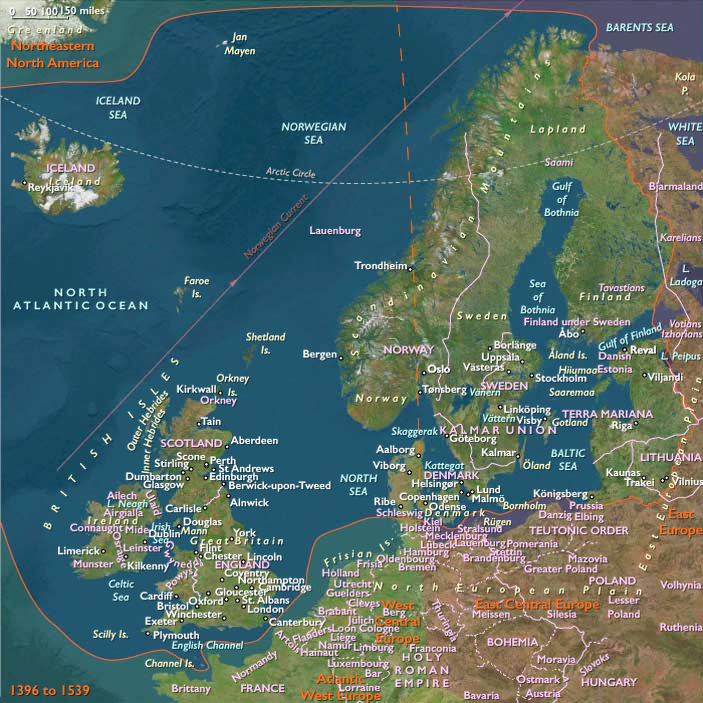
Northwest Europe (1396–1407 CE): Dynastic Shifts and Cultural Transformations
England: Dynastic Struggles and Internal Rebellions
The political turmoil under Richard II reached a climax in 1399 when the king was overthrown by his cousin, Henry Bolingbroke, who ascended the throne as Henry IV. Richard's deposition underscored the fragility of royal authority, setting the stage for the later Wars of the Roses. Henry IV's early reign was marred by internal unrest, notably the Epiphany Rising of 1400, a failed attempt to restore Richard II, who subsequently died under suspicious circumstances.
Religious dissent continued through the activities of the Lollards, followers of the late John Wycliffe, who died in 1384. Their critical stance on church wealth and clerical authority led to increasing persecution under Henry IV, as the crown sought stability through suppressing heresy. A significant Welsh uprising, known as the Glyndŵr Rising, began in 1400, led by Owain Glyndŵr, representing a major effort by the Welsh to assert independence from English dominance.
Scotland: Internal Conflict and Dynastic Crisis
In Scotland, Robert III faced persistent border conflicts with England and deep internal divisions. His rule saw growing tensions involving his brother, the Duke of Albany. In 1402, Robert's heir, David Stewart, Duke of Rothesay, died under suspicious circumstances while imprisoned by Albany, deepening the kingdom's political uncertainty and dynastic instability.
Ireland: Gaelic Dominance and Anglo-Norman Weakness
Gaelic chieftains such as the powerful O'Neill and O'Brien clans further solidified their control, diminishing English authority confined within The Pale. Gaelic culture and traditional laws dominated, reinforcing regional independence and the enduring legacy of Gaelic autonomy.
Scandinavia: Formation of the Kalmar Union
The political alignment of Denmark, Norway, and Sweden was consolidated under Queen Margaret I, culminating in the establishment of the Kalmar Union in 1397. This union reshaped Scandinavian politics by uniting these kingdoms under a single monarchy, enhancing royal centralization and regional cooperation.
Iceland: Literary Resilience Amid Political Changes
Despite political subordination within the Kalmar Union, Iceland preserved its literary and cultural traditions. Sagas such as Njal's Saga (completed circa 1290, still influential) continued to circulate, emphasizing Iceland’s intellectual resilience and distinct cultural identity.
Social and Economic Shifts: Post-Plague Realignment
The devastating Black Death, which had reached England in 1348, dramatically reshaped Northwest Europe's socio-economic landscape. By 1400, England's population had plummeted from approximately seven million to two million. This demographic collapse allowed peasants greater leverage in negotiating wages and conditions, weakening traditional feudal structures and contributing to long-term economic transformation.
Cultural Innovations: Architecture and Music
Despite political unrest, cultural achievements flourished. The ongoing construction of York Minster, progressing in the Perpendicular Gothic architectural style, symbolized enduring religious devotion and societal resilience. In music, English composers like John Dunstaple and Leonel Power advanced musical composition through innovative mass-ordinary cycles and pioneering use of harmonic intervals (thirds and sixths), employing the cantus firmus technique extensively.
Legacy of the Era
By 1407 CE, Northwest Europe had experienced profound political upheavals, religious tensions, and notable cultural achievements. Dynastic struggles in England and Scotland, Gaelic consolidation in Ireland, the formation of the Kalmar Union, and resilient cultural expressions in architecture and music collectively marked a significant transitional era, shaping regional identities and laying foundations for future developments.
The Lords Appellant, a group of powerful barons who had come together during the 1380s to seize political control of England from King Richard II, are called so because its members claim simply to be appealing to the King for good government (their major complaint had been Richard's decision to make peace with France).
The Lords are led by Thomas of Woodstock, 1st Duke of Gloucester (youngest son of King Edward III and thus King Richard's uncle), Richard Fitzalan, 11th Earl of Arundel, and Thomas de Beauchamp, Earl of Warwick; the group also involves the Earl of Nottingham, as well as Richard's cousin, the Earl of Derby and Northampton, Henry Bolingbroke.
The Lords Appellant in 1387 had launched an armed rebellion against King Richard and defeated his forces at Radcot Bridge, outside Oxford.
They had maintained Richard as a figurehead with little real power, and impeached, imprisoned, exiled, or executed most of his court.
For example, Richard's Chancellor, the Earl of Suffolk, had been impeached in 1386, and the Duke of Ireland had been stripped of his titles and exiled.
Richard's uncle and supporter, John of Gaunt, the Duke of Lancaster, had returned from Spain in 1389 and Richard has since been able to rebuild his power gradually.
With national stability secured, Richard had begun negotiating a permanent peace with France.
A proposal put forward in 1393 would have greatly expanded the territory of Aquitaine possessed by the English crown.
However, the plan failed because it included a requirement that the English king pay homage to the King of France—a condition that proved unacceptable to the English public.
Instead, in 1396, a truce is agreed to, which is to last twenty eight years.
The truce is hugely unpopular at home in spite of the dividends that peace bring to the kingdom.
As part of the truce, the childless Richard agrees to marry Isabella, daughter of Charles VI of France by Isabella of Bavaria-Ingolstadt, when she comes of age.
There are some misgivings about the betrothal, in particular because the princess is only six years old, and thus will not be able to produce an heir to the throne of England for many years.
Isabella is moved to Wallingford Castle for protection while Richard campaigns in Ireland.
Although the union is political, the twenty-nine-year-old Richard and his child consort will develop a mutually respectful relationship.