Henry II of England
King of England
Years: 1133 - 1189
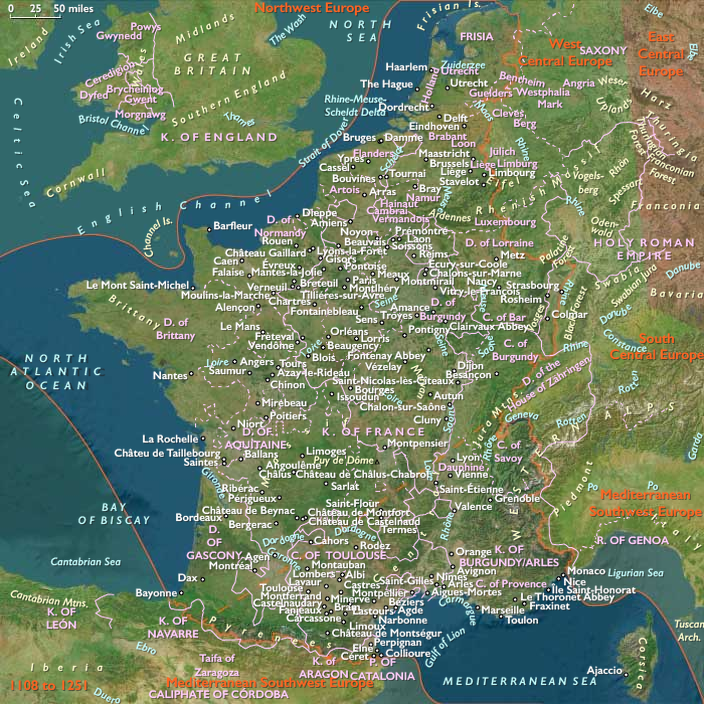
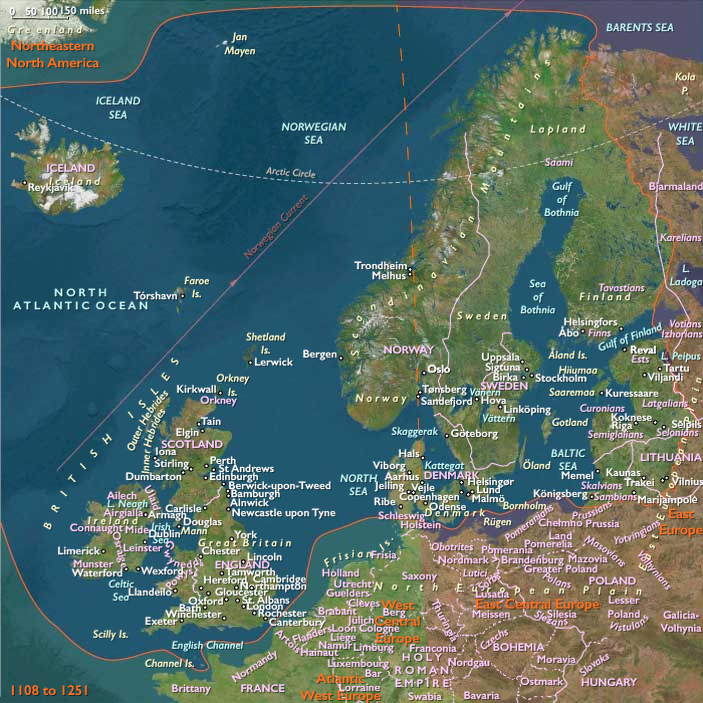
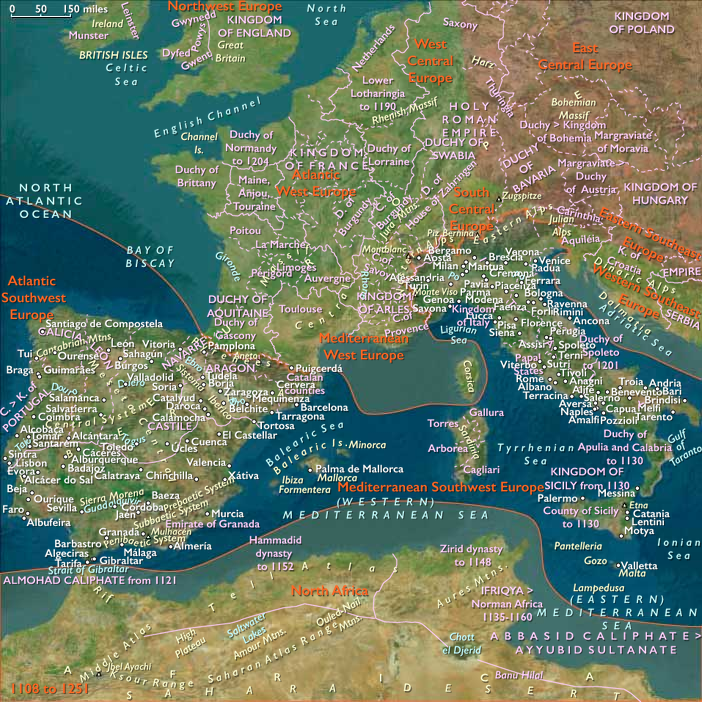
Henry II (5 March 1133 – 6 July 1189), also known as Henry Curtmantle (French: Court-manteau), Henry FitzEmpress or Henry Plantagenet, rules as Count of Anjou, Count of Maine, Duke of Normandy, Duke of Aquitaine, Count of Nantes, King of England (1154–89) and Lord of Ireland; at various times, he also controls Wales, Scotland and Brittany.
Henry is the son of Geoffrey of Anjou and Matilda, who is the daughter of King Henry I and takes the title of Empress from her first marriage.
He becomes actively involved by the age of 14 in his mother's efforts to claim the throne of England, and is made the Duke of Normandy at 17.
He inherits Anjou in 1151 and shortly afterwards marries Eleanor of Aquitaine, whose marriage to the French king Louis VII had recently been annulled.
King Stephen agrees to a peace treaty after Henry's military expedition to England in 1153, and he inherits the kingdom on Stephen's death a year later.
Still quite young, he now controls what will later be called the Angevin empire, stretching across much of western Europe.
Henry is an energetic and sometimes ruthless ruler, driven by a desire to restore the lands and privileges of his royal grandfather, Henry I.
During the early years of the younger Henry's reign, he restores the royal administration in England, reestablishes hegemony over Wales and gains full control over his lands in Anjou, Maine and Touraine.
Henry soon comes into conflict with Louis VII and the two rulers fight what has been termed a "cold war" over several decades.
Henry expands his empire, often at Louis's expense, taking Brittany and pushing east into central France and south into Toulouse; despite numerous peace conferences and treaties no lasting agreement is reached.
Although Henry usually works well with the local hierarchies of the Church, his desire to reform England's relationship with the Church leads to conflict with his former friend Thomas Becket, the Archbishop of Canterbury.
This controversy lasts for much of the 1160s and results in Becket's death in 1170.
As Henry's reign progresses, he has many children with Eleanor, and tensions over the future inheritance of the empire begin to emerge, encouraged first by Louis VII and then Louis's son and successor Philip Augustus.
In 1173, Henry's heir, "Young Henry", rebels in protest against his father; he is joined by his brothers Richard and Geoffrey and by their mother, Eleanor.
France, Scotland, Flanders and Boulogne ally with the rebels against Henry.
The Great Revolt spreads across Henry's lands and is only defeated by his vigorous military action and talented local commanders, many of them "new men" appointed for their loyalty and administrative skills.
Henry is mostly generous in victory and appears for the moment to be at the height of his powers, but Young Henry and Geoffrey revolt again in 1183, resulting in Young Henry's death.
Despite invading Ireland to provide lands for his youngest son John, Henry struggles to find ways to satisfy all his sons' desires for land and immediate power.
Philip successfully plays on Richard's fears that Henry would make John king, and a final rebellion breaks out in 1189.
Decisively defeated by Philip and Richard and suffering from a bleeding ulcer, Henry retreats to Chinon in Anjou, where he dies.
Henry's empire quickly collapses during the reign of his youngest son John.
Many of the changes Henry introduces during his long rule, however, have long-term consequences.
Henry's legal changes are generally considered to have laid the basis for the English Common Law, while his intervention in Brittany, Wales and Scotland shapes the development of their societies and governmental systems.
Historical interpretations of Henry's reign have changed considerably over time.
In the 18th century, scholars argued that Henry was a driving force in the creation of a genuinely English monarchy and, ultimately, a unified Britain.
During the Victorian expansion of the British empire, historians were keenly interested in the formation of Henry's own empire, but they also expressed concern over his private life and treatment of Becket.
Late-20th-century historians have combined British and French historical accounts of Henry, challenging earlier Anglocentric interpretations of his reign.