Henry II, Count of Nassau-Breda
a count of the House of Nassau
Years: 1483 - 1538
Count Henry III of Nassau-Dillenburg-Dietz (January 12, 1483, Siegen – September 14, 1538, Breda), Lord (from 1530 Baron) of Breda, Lord of the Lek, of Dietz, etc., is a count of the House of Nassau.
He is the son of Count John V of Nassau-Dillenburg and Elisabeth of Hesse-Marburg.
His younger brother is William I, Count of Nassau-Dillenburg (the father of William the Silent).


Related Events
Filter results
Showing 10 events out of 12 total
France Prepares for Covert Conflict Against Charles V (December 1520)
In December 1520, King Francis I of France cautiously initiates preparations for war against Emperor Charles V, taking careful measures to avoid openly violating the fragile peace enforced by Henry VIII of England. Henry had previously declared his readiness to intervene militarily against whichever party first breached the tenuous peace between the major European powers.
To circumvent this obstacle, Francis opts for covert military actions rather than a formal declaration of war. He orchestrates carefully concealed incursions against Imperial and Spanish territories, employing indirect means to mask French involvement.
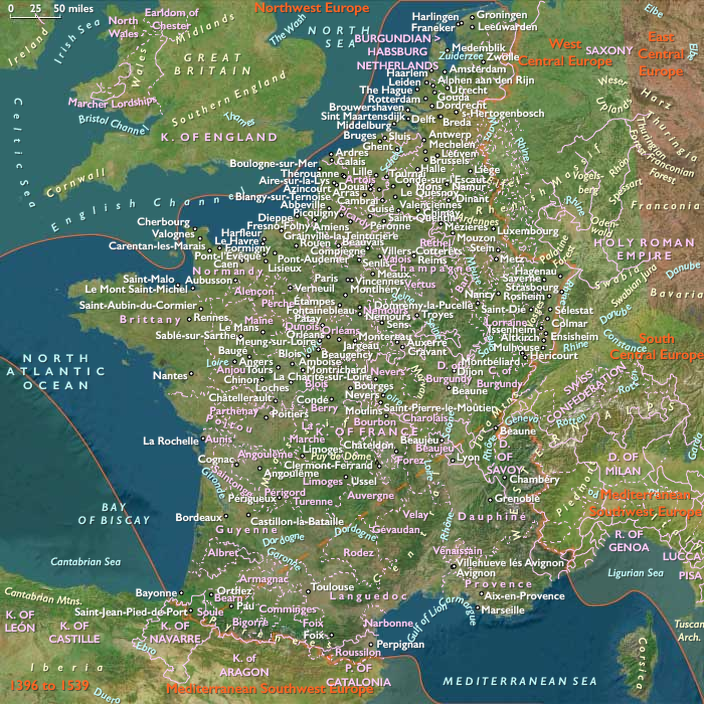
One such assault, intended to destabilize Imperial holdings, is entrusted to Robert de la Marck, who is instructed to lead an attack along the strategically vital Meuse River. Concurrently, Francis coordinates a simultaneous military advance in the south, leveraging an allied French-Navarrese army tasked with reconquering the fortress town of Saint-Jean-Pied-de-Port and subsequently launching an offensive through Navarre, thereby exerting pressure on Spanish holdings and further complicating Charles's strategic position.
The Emperor, simultaneously with his promulgation of the Edict of Worms against Martin Luther, promises the Pope the restoration of Parma and Piacenza to the Medici and of Milan to the Sforza.
Leo, needing the Imperial mandate for his campaign against what he views as a dangerous heresy, promises to assist in expelling the French from Lombardy, leaving Francis with only the Republic of Venice for an ally.
Imperial Invasion of Northern France: Henry of Nassau's Campaign (June 1521)
In June 1521, amid rising tensions marking the renewal of conflict between Francis I of France and Emperor Charles V, imperial armies under the command of Henry of Nassau launch an aggressive invasion into northern France, opening a decisive phase of the Italian War of 1521–1526.
The invading Imperial forces devastate strategically important French frontier towns, including Ardres and ...
...Mouzon, both razed to the ground. Subsequently, ...
...they lay siege to Tournai, which had been returned to French rule only recently in 1518, following brief English occupation after the Battle of the Spurs (1513). The choice to attack these particular cities demonstrates clear Imperial intent: Ardres holds symbolic importance as the site near the recent diplomatic pageantry of the Field of the Cloth of Gold (1520), while Tournai is a critical economic and military stronghold.
This northern invasion, initiated by Henry of Nassau, aligns strategically with Emperor Charles V's broader geopolitical ambition of weakening French influence in the Low Countries and asserting dominance along the Franco-Imperial frontier. The incursion exposes France's vulnerability in its northern territories, places substantial pressure on Francis I, and contributes significantly to destabilizing the fragile peace of Western Europe.
The immediate consequence of this invasion is a marked escalation of hostilities between Charles V and Francis I, drawing England deeper into continental affairs, as Henry VIII increasingly aligns with Imperial interests against France. Over the longer term, this aggressive opening sets the stage for further Imperial-French confrontations, prolonging and intensifying the Italian Wars, deeply influencing the geopolitical balance of Atlantic West Europe throughout the early sixteenth century.
The Failed Navarrese-French Invasion and the Battle of Noáin (1521)
In 1521, Henry d'Albret, the eighteen-year-old King of Navarre, attempted to reclaim his kingdom, which had been invaded and annexed by Ferdinand II of Aragon in 1512. Although Henry was the nominal leader of the campaign, the French army provided the bulk of the troops, funding, and leadership, with André de Foix serving as the de facto commander.
However, despite initial victories, the French-Navarrese offensive ultimately collapsed, with the decisive Battle of Noáin (Esquiroz) on June 30, 1521, sealing the fate of Upper Navarre under Spanish rule.
The French-Navarrese Strategy and Initial Gains
- In early 1521, France launched a multi-front war against Spain, including an offensive along the Meuse River, which was supposed to draw Spanish forces away from the Pyrenees.
- Henry d'Albret and André de Foix led a French-Navarrese army into the Pyrenees, aiming to recapture Navarre and expel Spanish forces.
- Pamplona fell to the French on May 20, 1521, marking a significant initial success.
Spanish Counterattack and the Battle of Noáin (June 30, 1521)
- Spain quickly mobilized reinforcements, with Charles V sending troops under the command of Iñigo de Loyola and the Duke of Nájera.
- The Meuse offensive was driven back by Henry of Nassau, freeing Spanish forces to concentrate on Navarre.
- On June 30, 1521, at Esquiroz (near Noáin), the Spanish army decisively defeated the French-Navarrese force.
- The French suffered heavy casualties, and their entire army was routed.
- André de Foix was captured, further demoralizing the Navarrese resistance.
Aftermath: The End of Navarrese Independence
- With the defeat at Noáin, Spanish troops swiftly recaptured all of Upper Navarre.
- Henry d'Albret fled to Lower Navarre, which remained independent under French protection.
- The dream of restoring an independent Navarre south of the Pyrenees was effectively shattered, as Castilian rule was now cemented in Upper Navarre.
Conclusion: A Final Attempt at Restoration Fails
The French-backed invasion of Navarre in 1521 was the last serious attempt to reclaim the kingdom from Spanish control. Although briefly successful in retaking Pamplona, the defeat at the Battle of Noáin on June 30, 1521, ensured that Upper Navarre remained permanently part of the Crown of Castile, while Lower Navarre continued as an independent French-aligned kingdom.
Siege of Mézières: Imperial Advance Halted by Bayard and Montmorency (1521)
In 1521, as part of the escalating hostilities marking the Italian War of 1521–1526, an Imperial army commanded by the prominent military leader Franz von Sickingen advances aggressively into Picardy, targeting the critical fortress city of Mézières (now part of Charleville-Mézières). Sickingen's campaign aims to penetrate deep into northern France, exert pressure on King Francis I, and further destabilize the French frontier.
However, the Imperial forces meet unexpectedly fierce resistance at Mézières. The city's defense is led by the legendary knight, Pierre Terrail, Seigneur de Bayard, famed throughout Europe as the embodiment of chivalric virtue, and by the rising military commander Anne de Montmorency, who later emerges as a leading French statesman. Despite intense bombardments and sustained assaults, the French defenders stubbornly hold their ground, repelling each Imperial attempt to breach the city's walls.
The successful defense of Mézières has important strategic and symbolic consequences. Forced to withdraw by the determined resistance, Sickingen's troops retreat, leaving behind a significant Imperial setback. This defensive victory buys critical time for Francis I, allowing the king to assemble and mobilize French forces capable of effectively countering the Imperial invasion.
The siege’s significance extends beyond the immediate military outcome. By successfully resisting Imperial aggression, Bayard and Montmorency bolster the French morale at a precarious moment and reaffirm the resilience of the French frontier. For Montmorency, his prominent role in the defense solidifies his reputation, launching him into a prominent military and political career. For Bayard, already renowned for his valor, this defense further cements his legendary status.
In a broader context, the failure at Mézières disrupts Imperial momentum, preventing Emperor Charles V from exploiting initial gains in Picardy. This turning point thus shapes the ensuing phase of the war, confirming the French capacity for sustained resistance despite intense military pressure.
The Missed Opportunity at Valenciennes: Francis I Hesitates Before Charles V (1521)
On October 22, 1521, during the critical early phase of the Italian War of 1521–1526, King Francis I of France and Holy Roman Emperor Charles V come face to face near the strategic city of Valenciennes. The encounter offers Francis a potentially decisive opportunity to strike directly at the main Imperial army and possibly capture or decisively defeat Charles himself.
The French army, numerically strong and eager for battle, includes prominent commanders such as Charles III, Duke of Bourbon, who passionately urges immediate action. However, despite Bourbon's counsel, Francis hesitates—possibly uncertain about the enemy's precise strength or wary of the potential risks of a major engagement. This hesitation proves critical: it allows Charles V to reassess his position and promptly begin a strategic retreat.
By the time Francis resolves to attack, heavy seasonal rains begin, severely hampering French mobility and undermining any effective pursuit of the retreating Imperial forces. Thus, Charles V successfully extricates his army from a perilous situation without a significant battle.
Francis's hesitation at Valenciennes is widely viewed by contemporaries and historians alike as a crucial missed opportunity. Had he engaged promptly, Francis might have delivered a decisive blow to Charles V's forces, potentially altering the war’s trajectory. Instead, the failure to engage reinforces Imperial morale, solidifies Charles’s cautious strategy, and undercuts Bourbon’s trust in the French King's military judgment—factors that will significantly impact the political and military developments of the ensuing years.
French-Navarrese Capture of Fuenterrabía (October 1521): A Strategic Victory in the Franco-Spanish War
In late October 1521, French-Navarrese forces under Admiral Guillaume Gouffier, Lord of Bonnivet, and Claude of Lorraine successfully seized Fuenterrabía (Hondarribia), a key fortress town at the mouth of the Bidasoa River, on the Franco-Spanish border. This marked a significant strategic victory for France and Navarre in their war against Emperor Charles V and provided a foothold in northern Spain that would remain in French hands for the next two years.
Strategic Importance of Fuenterrabía
- Fuenterrabía controlled the Bidasoa River, which formed a natural border between France and Spain, making it a critical military and trade route.
- The town was heavily fortified, and its capture opened a direct path into Castile for future French incursions.
- The French saw Fuenterrabía as a potential base for further efforts to reclaim Navarre and challenge Spanish dominance in the region.
The French-Navarrese Offensive and Capture of Fuenterrabía
- After the defeat of the Navarrese-French army at the Battle of Noáin (June 30, 1521), King Henry II of Navarre and his allies shifted focus to border strongholds.
- French forces under Bonnivet and Claude of Lorraine maneuvered extensively before launching a successful attack on Fuenterrabía in October 1521.
- The siege and subsequent capture of the city provided France with an advantageous position for the next phase of the conflict.
Consequences of the French-Navarrese Victory
-
A New Front Against Spain
- Holding Fuenterrabía gave the French a launching point for future offensives into Spain.
- It forced Charles V to devote more troops to defending the border, stretching Spanish military resources.
-
Prolonged French Occupation (1521–1524)
- The French held Fuenterrabía for two years, making it one of their longest-lasting territorial gains in the conflict.
- However, Spanish forces constantly harassed the French garrison, leading to continued instability in the region.
-
Symbolic and Political Impact
- The capture of Fuenterrabía boosted morale for Navarrese loyalists in exile, keeping hopes alive for the eventual reconquest of Navarre.
- It also weakened Charles V’s hold over northern Spain, forcing the Habsburgs to commit additional troops to Iberia.
Conclusion: A Temporary but Significant French Victory
The capture of Fuenterrabía in October 1521 was one of the most notable successes of the French-Navarrese alliance against Charles V. Although not enough to restore Navarre, it gave France a strategic foothold in Spainthat would remain in their hands until 1524, when Charles V’s forces would finally retake the city. This event underscored the continued struggle for control over the Pyrenean frontier and the ongoing tensions between France and Spain over Navarre.
The Fall of Tournai to the Imperial Army (November 1521)
In late November 1521, the strategic city of Tournai, then under French control, falls to the Imperial forces commanded by Henry of Nassau, marking a significant territorial loss for France in the early stages of the Italian War of 1521–1526. The siege is part of a broader Imperial campaign aimed at weakening French influence and consolidating Habsburg power across the Low Countries.
Tournai, historically important for its strategic location controlling key trade and military routes, had previously been taken by Henry VIII of England in 1513, and subsequently returned to France by treaty in 1518. Its capture by Imperial forces underscores the shifting balance of power and the intensity of rivalry between Charles V and Francis I.
Long-term Significance
The Imperial capture of Tournai decisively removes this contested frontier city from French control for nearly three centuries. It remains a Habsburg possession under successive Spanish and Austrian rule until the French revolutionary armies reconquer it in 1795. The loss of Tournai in 1521 thus symbolizes both the erosion of French territorial ambitions in the Low Countries and the rise of a strengthened, more consolidated Habsburg dominion—one that will endure as a focal point of European conflict and diplomacy for centuries.