Henry I of England
King of England
Years: 1068 - 1135
Henry I (c. 1068 – 1 December 1135), also known as Henry Beauclerc, is King of England from 1100 to 1135.
Henry is the fourth son of William the Conqueror and is educated in Latin and the liberal arts.
On William's death in 1087, Henry's older brothers William Rufus and Robert Curthose inherit England and Normandy respectively, but Henry is left landless.
Henry purchases the County of Cotentin in western Normandy from Robert, but is deposed by William and Robert in 1091.
Henry gradually rebuilds his power base in the Cotentin and allies himself with William against Robert.
Henry is on hand when William dies in a hunting accident in 1100, and he seizes the English throne, promising at his coronation to correct many of William's less popular policies.
Henry marries Matilda of Scotland, but continues to have a large number of mistresses, by whom he has many illegitimate children.
Henry's control of England is disputed by Robert, who invades in 1101.
The campaign ends in a negotiated settlement that confirms Henry as king.
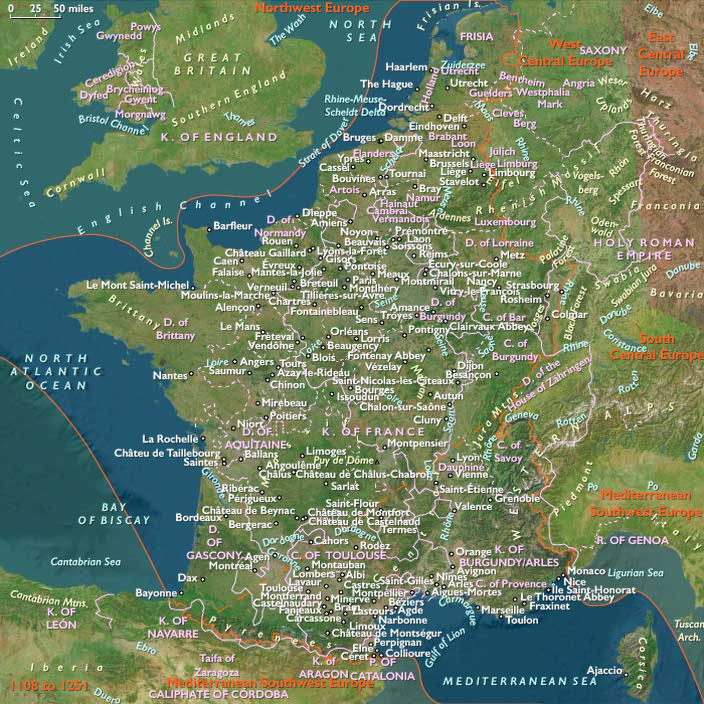
The peace is short lived and Henry invades the Duchy of Normandy in 1105 and 1106, finally defeating Robert at the Battle of Tinchebray.
Henry keeps Robert imprisoned for the rest of his life.
Henry's control of Normandy is challenged by Louis VI of France, Baldwin of Flanders and Fulk of Anjou, who promotes the rival claims of Robert's son, William Clito, and supports a major rebellion in the Duchy between 1116 and 1119.
Following Henry's victory at the Battle of Brémule, a favorable peace settlement is agreed with Louis in 1120.
Henry is a harsh but effective ruler, skillfully manipulating the barons in England and Normandy.
In England, he draws on the existing Anglo-Saxon system of justice, local government and taxation, but strengthens it with additional institutions, including the royal exchequer and itinerant justices.
Normandy is also governed through a growing system of justices and an exchequer.
Many of the officials that run Henry's system are "new men", relatively low born individuals who rise up the ranks as administrators.
Henry encourages ecclesiastical reform, but becomes embroiled in the investiture controversy in 1101 with Archbishop Anselm of Canterbury, which is resolved through a compromise solution in 1105.
He supports the Cluniac order and plays a major role in the selection of the senior clergy in England and Normandy.
Henry's only legitimate son and heir, William Adelin, drowns in the White Ship disaster of 1120, throwing the royal succession into doubt.
Henry takes a second wife, Adeliza, in the hope of having another son, but their marriage proves childless.
In response to this, Henry declares his daughter, Matilda, as his heir and marries her to Geoffrey of Anjou.
Relationships between Henry and the couple become strained, and fighting breaks out along the border with Anjou.
Henry diedson 1 December 1135 after a week of illness.
Despite his plans for Matilda, the King is succeeded by his nephew, Stephen of Blois, resulting in a period of civil war known as the Anarchy.