Haakon V of Norway
King of Norway
Years: 1270 - 1319
Haakon V Magnusson (1270 – 8 May 1319) (Old Norse: Hákon Magnússon; Norwegian: Håkon Magnusson) is king of Norway from 1299 until 1319.
Related Events
Filter results
Showing 5 events out of 5 total
At the same time, a movement to make Magnus King of Sweden proves successful, and both the kings of Sweden and of Denmark are elected to the throne by their respective nobles.
Thus, with his election to the throne of Sweden, both Sweden and Norway are united under King Magnus VII.
Northwest Europe (1288–1299 CE): Succession, Warfare, and Legal Innovation
England: Continued Consolidation and Scottish Intervention
Edward I continued to strengthen his dominion, increasingly asserting influence over Scotland following the Scottish succession crisis after Alexander III's death. In 1290, the death of Margaret, Maid of Norway, Alexander's granddaughter and last heir, left Scotland without a direct ruler, prompting Edward I to arbitrate among competing Scottish nobles in the Great Cause (1291–1292). Edward selected John Balliol as King of Scots, but his heavy-handed interference led to widespread Scottish resentment and rebellion, culminating in open conflict and Edward's invasion of Scotland in 1296. Edward decisively defeated Scottish forces at the Battle of Dunbar, captured Edinburgh, and temporarily subdued Scotland, seizing the symbolic Stone of Scone.
Scotland: Crisis and National Resistance
The period after 1288 was dominated by Scotland's succession crisis, foreign intervention, and resistance. After Edward's conquest and subjugation of Scotland in 1296, William Wallace emerged as a leader of national resistance, famously defeating English forces at the Battle of Stirling Bridge in 1297. However, Wallace's subsequent defeat at the Battle of Falkirk in 1298 restored temporary English dominance, prolonging the struggle for Scottish independence.
Ireland: Persistent Gaelic-Norman Rivalries
Norman influence remained dominant around major coastal towns, while the Gaelic Irish persistently resisted Norman expansion in Ulster and Connacht. This period was marked by continuous clashes, reinforcing the pattern of fragmented control and limiting effective Norman centralization.
Denmark: Turmoil and Royal Intrigue
The reign of Eric V Klipping ended abruptly when he was assassinated in 1286, plunging Denmark into internal conflict. His successor, Eric VI Menved, took the throne amid accusations and political intrigue, dealing with prolonged internal rebellions and disputes with neighboring principalities throughout the decade. Nonetheless, he strove to strengthen royal authority and stability through legal reforms and administrative consolidation.
Norway: Haakon V and Continued Legal Advances
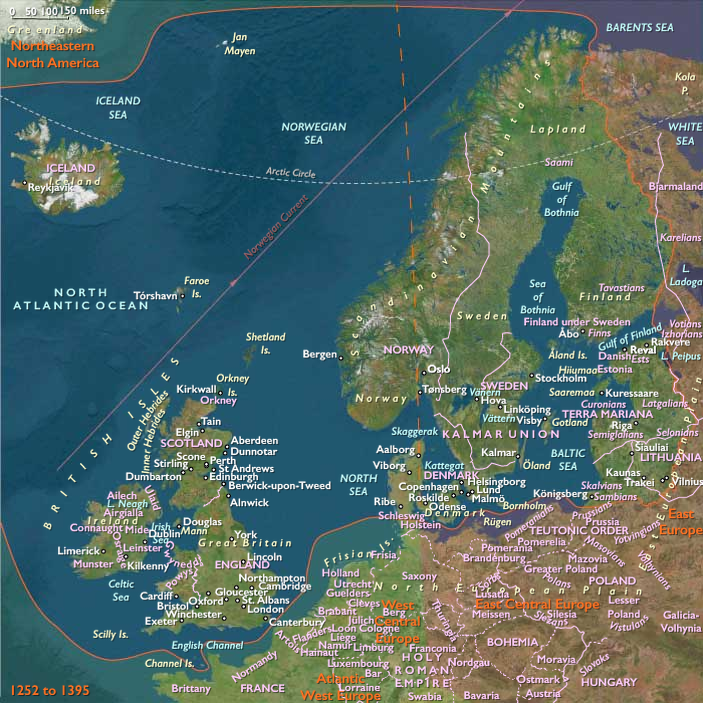
Following the death of Magnus VI Lagabøte in 1280, Norway transitioned through the brief reign of Eric II Magnusson (1280–1299), and subsequently his brother Haakon V. Haakon continued Magnus's emphasis on strengthening royal authority and administrative structures, furthering the establishment of a robust and centralized monarchy.
Iceland: Cultural and Political Resilience
Despite continued Norwegian dominance, Icelandic intellectual and literary traditions flourished. The Althing, though influenced by external powers, continued to function as a crucial institution, embodying Iceland's cultural resilience and autonomy. Saga literature, including the widespread circulation of works like Njal's Saga and the Völsunga saga, remained central to Icelandic identity and cultural expression.
Economic and Urban Development
Economic growth persisted across Northwest Europe, driven by dynamic trade in wool, timber, and luxury goods. Major cities—London, Bruges, Bergen, and Dublin—continued their infrastructural and commercial expansion, serving as thriving hubs of trade and cultural exchange.
Religious and Scholarly Influence
The influence of mendicant orders like the Dominicans and Franciscans remained strong, enhancing educational and religious life. Intellectual activity continued, building upon the earlier contributions of Roger Bacon and Robert Grosseteste, with scholastic traditions influencing emerging academic communities across Northwest Europe.
Literary and Cultural Flourishing
The popularity of Middle English romances such as Havelok the Dane signaled ongoing literary development, emphasizing themes of ideal kingship, social justice, and the lived experiences of everyday people, reflecting a complex and increasingly sophisticated literary culture.
Legacy of the Era
By 1299 CE, Northwest Europe had experienced significant developments: the turbulent conquest and rebellion in Scotland, the continuing Gaelic resistance in Ireland, internal strife in Denmark, the enduring Norwegian commitment to legal centralization, and Iceland’s robust cultural legacy. Collectively, these factors underscored the ongoing transformation toward powerful, centralized states and distinct national identities, setting the stage for later medieval developments.

The first construction on the Akershus Fortress, built to protect Christanstad, started around the late 1290s, by King Haakon V, replacing Tønsberg as one of the two most important Norwegian castles of the period (the other being Båhus).
It is constructed in response to an earlier attack on the city by the Norwegian nobleman, Earl Alv Erlingsson of Sarpsborg.
The first work on the royal fortress on Oslo’s small Akershus Peninsula had started around the late 1290s under King Håkon V, replacing Tønsberg as one of the two most important Norwegian castles of the period (the other being Båhus).
It had been constructed in response to an earlier attack on Oslo by the Norwegian nobleman Earl Alv Erlingsson of Sarpsborg.
The fortress is first used in battle in 1308, when it is besieged by the Swedish duke Erik of Södermanland, who later in the same year wins the Swedish throne.
The immediate proximity of the sea is a key feature, for naval power is a vital military force as the majority of Norwegian commerce in this period is by sea.
The fortress is strategically important for the capital, and therefore, Norway as well.
Whoever rules Akershus fortress rules Norway.
Northwest Europe (1312–1323 CE): Consolidation, Conflict, and Cultural Vitality
Scotland and England: Battle for Independence
The era was defined by intensified Scottish resistance against English dominance, culminating dramatically at the Battle of Bannockburn in 1314, where Robert the Bruce decisively defeated Edward II's forces. This pivotal victory not only reaffirmed Scotland’s sovereignty but also significantly bolstered Bruce’s legitimacy as king. The subsequent Declaration of Arbroath in 1320, an appeal to Pope John XXII, eloquently articulated Scottish national identity and independence, influencing later conceptions of sovereignty.
Ireland: Continued Gaelic Resilience and Norman Decline
Ireland remained politically fragmented, with the Gaelic lords effectively resisting Norman consolidation. The Gaelic resurgence was particularly evident in territories like Ulster and Connacht, where traditional Gaelic power structures reinforced their authority. The Normans’ inability to extend beyond the Pale and coastal towns highlighted the continued resilience of indigenous governance.
Denmark: Internal Strife and Royal Consolidation
Under the reign of Eric VI Menved, Denmark faced internal unrest and fiscal crises, exacerbated by costly foreign conflicts and domestic revolts. His successor, Christopher II, who ascended in 1320, struggled to maintain royal power amidst growing noble opposition and economic strain. Despite these challenges, centralizing reforms and administrative restructuring efforts continued, albeit with limited success.
Norway: Strengthening Central Authority
Norway, under the firm rule of Haakon V Magnusson, further solidified its territorial integrity and central governance. Haakon continued reforms in administration, enhancing royal authority and establishing a more cohesive national identity. His reign laid foundations for stable governance that supported economic and cultural growth throughout the kingdom.
Iceland: Literary and Cultural Flourishing
In Iceland, the literary and cultural renaissance persisted robustly. The era saw the continued compilation and creation of sagas, poetry, and historical texts that preserved and celebrated Icelandic heritage. The production of key manuscripts, including continued expansions of works such as Hauksbók, underscored the vibrancy and resilience of Icelandic cultural life, even as Norwegian political influence increased.
Economic and Urban Developments
Trade and commerce continued to drive economic prosperity, reinforcing the significance of key urban centers such as London, Bruges, Bergen, and Dublin. Merchants benefited from expanded networks dealing in wool, fish, timber, and luxury items, facilitating significant urban and architectural growth. This economic vitality reinforced the interconnectedness and prosperity of Northwest Europe.
Religious Influence and Scholarly Pursuits
The period continued to witness the influential presence of religious orders like the Dominicans and Franciscans, who were pivotal in advancing education and theological discourse. Intellectual life flourished, building upon the foundations laid by previous scholars such as Roger Bacon and Robert Grosseteste, reinforcing a robust scholastic tradition characterized by vigorous theological, philosophical, and scientific inquiry.
Artistic Expression and Cultural Ambitions
Gothic architectural projects, prominently illustrated by ongoing construction at monumental sites such as York Minster, continued to reflect the artistic ambitions and cultural sophistication of the era. Literary contributions, including romances like Havelok the Dane, provided insightful portrayals of social ideals, governance, and everyday life, demonstrating a vibrant cultural milieu.
Legacy of the Era
By 1323 CE, Northwest Europe had made considerable strides in political consolidation, cultural resilience, and economic strength. Scotland's assertion of independence, Ireland’s enduring Gaelic traditions, Denmark’s struggles and reforms, Norway’s strengthened central governance, and Iceland’s cultural achievements collectively defined this era. These developments significantly shaped regional identities, governance structures, and cultural legacies for subsequent medieval generations.