Haakon IV of Norway
King of Norway
Years: 1204 - 1263
Haakon Haakonsson (c. March/April 1204 – 16 December 1263), sometimes called Haakon the Old in contrast to his son with the same name, and known in modern regnal lists as Haakon IV, is the King of Norway from 1217 to 1263.
His reign lasts for 46 years, longer than any Norwegian king before him.
Haakon was born into the troubled civil war era in Norway, but his reign eventually manages to put an end to the internal conflicts.
At the start of his reign, during his minority, his later rival Earl Skule Bårdsson serves as regent.
As a king of the birkebeiner faction, Haakon defeats the uprising of the final bagler royal pretender, Sigurd Ribbung, in 1227.
He puts a definitive end to the civil war era when he has Skule Bårdsson killed in 1240, a year after he had himself proclaimed king in opposition to Haakon.
Haakon thereafter formally appoints his own son as his co-regent.
Under Haakon's rule, medieval Norway is considered to have reached its zenith or golden age.
His reputation and formidable naval fleet allow him to maintain friendships with both the Pope and the Holy Roman Emperor, despite their conflict.
Heis at different points offered the Imperial Crown by the Pope, the Irish High Kingship by a delegation of Irish kings, and the command of the French crusader fleet by the French king.
He amplifies the influence of European culture in Norway by importing and translating contemporary European literature into Old Norse, and by constructing monumental European-style stone buildings.
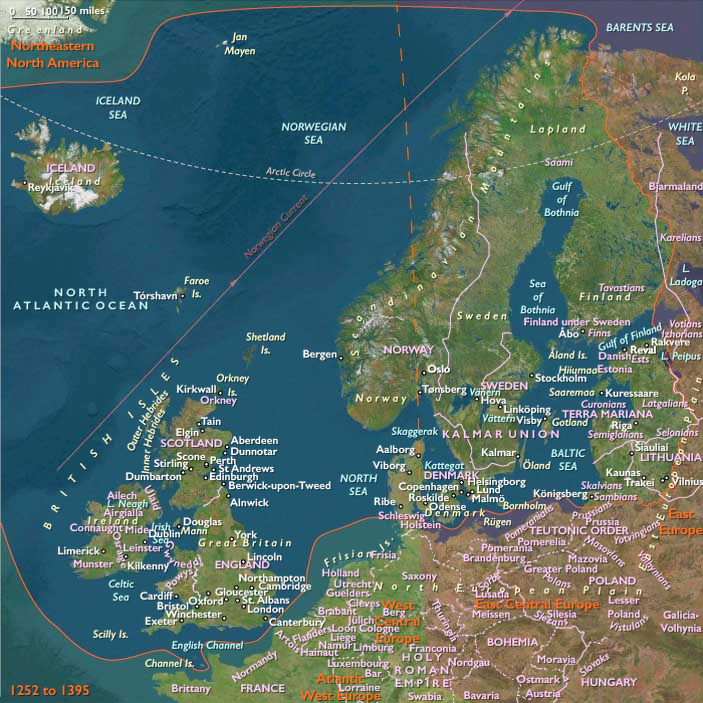
In conjunction with this, he employs an active and aggressive foreign policy, and at the end of his rule adds Iceland and the Norse Greenland community to his kingdom, leaving Norway at its territorial height.
Although he for the moment manages to secure Norwegian control of the islands off the northern and western shores of Great Britain, he fells ill and dies when wintering in Orkney following some military engagements with the expanding Scottish kingdom.

Related Events
Filter results
Showing 10 events out of 19 total
Northwest Europe (1216–1227 CE): Consolidation and New Realities
England: Restoration and Governance
The death of King John in 1216 brought his young son, Henry III (r. 1216–1272), to the throne under regency, leading to the stabilization of English politics after the turmoil surrounding Magna Carta. Regent William Marshal, one of the most respected knights in Europe, successfully defended the young king’s reign, defeating rebellious barons and French invaders at the decisive Battle of Lincoln in 1217. The reissued Magna Carta in 1225, under Henry III, marked a pivotal moment in solidifying its place in English law and governance.
Scotland: Strengthening Royal Authority
Under Alexander II (r. 1214–1249), Scotland experienced growing royal authority and territorial consolidation. Alexander maintained Scotland’s independence from English influence, expanding royal control northward and westward, reducing the power of local magnates, and further centralizing governance. His diplomatic strategies and political marriages also reinforced Scotland's international position.
Ireland: Norman Settlements and Irish Resistance
Ireland continued to see the deepening of Anglo-Norman control, with increased fortifications and town-building activities strengthening the Norman presence. Native Gaelic resistance persisted, particularly in regions less accessible to Norman power, maintaining a complex political landscape. The interplay of Norman authority and indigenous resilience defined the era.
Denmark: Challenges to Baltic Dominance
Despite Valdemar II’s earlier successes, his rule encountered significant setbacks during this period. Captured in 1223 by his vassal, Count Henry of Schwerin, Valdemar was imprisoned until 1225, significantly weakening Danish influence in the Baltic. Upon his release, Denmark was compelled to concede territories and influence, limiting further expansion.
Norway: Steps Toward Stability
The death of King Inge Bårdsson in 1217 led to the ascent of the young Håkon IV Håkonsson (r. 1217–1263), who, under regency initially, gradually brought stability to a fragmented Norway. By 1223, Håkon’s regency began consolidating power, significantly diminishing internal conflicts and laying the groundwork for a more unified Norwegian state.
Iceland: Cultural and Political Continuity
Iceland maintained its political independence and cultural richness during this period, governed by the Althing, its traditional assembly. The era continued the flourishing tradition of saga writing and historical recording, preserving an invaluable literary heritage. The society, largely free of external conflicts, remained culturally vibrant and politically autonomous.
Economic and Cultural Developments
Trade and economic activity grew steadily, with merchants from England, Flanders, and the Baltic states actively engaged in commerce. Commodities like wool, fish, timber, and increasingly popular imported spices and luxury goods continued to shape the economies of Northwest Europe, enhancing urban growth and prosperity.
Religious Orders and Education
The Dominican Order, founded in the previous decade, established itself significantly during this era, emphasizing preaching, education, and combating heresies. Alongside existing monastic communities, these mendicant friars began influencing urban centers profoundly, fostering intellectual debate, education, and religious reform.
Legacy of the Era
By 1227 CE, Northwest Europe had emerged from a period of turmoil into greater stability. England had solidified its constitutional frameworks; Scotland strengthened royal authority; Ireland navigated Norman control and Gaelic resistance; Denmark faced setbacks limiting its Baltic dominance; Norway began the path toward internal unity; and Iceland sustained its distinctive political and cultural identity. These developments collectively established lasting political, economic, and cultural frameworks for future generations.
Brother Robert, a cleric working in Norway, adapts several French literary works into Old Norse during the reign of King Haakon IV of Norway (1217–1263).
The most important of these, Tristrams saga ok Ísöndar, based on Thomas of Britain's Tristan, is notable as the only example of Thomas's "courtly branch" of the Tristan and Iseult legend that has survived in its entirety.
It is the earliest Scandinavian version of the story, and is thought to be the first Norwegian adaptation of an Old French work.
Its success may have inspired the spate of translations during King Haakon's reign.
King Inge of Norway falls ill in Nidaros in 1217 and appoints his younger half-brother, Skule Bårdsson, earl and leader of the army.
Inge dies on April 23 and is buried in Nidaros Cathedral.
He is succeeded as king by the thirteen-year-old Haakon Haakonsson, an illegitimate grandson of king Sverre, who had been raised at the courts of king Inge and earl Haakon since they became aware of his existence in 1206.
Skule will continue as earl and de facto ruler for the next few years.
Northwest Europe (1228–1239 CE): Stability, Expansion, and Cultural Flourishing
England: Governance and Diplomacy
The reign of Henry III (r. 1216–1272) continued to solidify, as he emerged from regency and began exercising personal authority. His rule was characterized by ongoing negotiations with the baronial class and consolidating royal power, reinforced by his diplomatic marriage in 1236 to Eleanor of Provence, which strengthened international ties. Henry's governance, however, remained challenged by financial pressures and baronial tensions, foreshadowing future conflicts.
Scotland: Territorial Consolidation
Under Alexander II (r. 1214–1249), Scotland further expanded royal authority northward and westward into the Highlands and Isles. His military and diplomatic endeavors, including successful campaigns against rebellious nobles, further secured his internal power and continued to bolster Scotland's independence from English interference.
Ireland: Anglo-Norman Integration and Gaelic Resilience
The Anglo-Norman presence deepened, characterized by the expansion of feudal holdings, fortifications, and towns. However, significant Gaelic resistance persisted, especially in regions like Connacht and Ulster, highlighting the ongoing tension and complex integration between Anglo-Norman settlers and the indigenous Gaelic population.
Denmark: Reassertion and Renewal
Following his release from imprisonment, Valdemar II (r. 1202–1241) worked to restore Denmark’s dominance. While territories lost were difficult to fully reclaim, Valdemar's administration refocused on internal governance and maintaining influence through strategic diplomacy and consolidation of existing holdings.
Norway: Centralization and Cultural Renaissance
Håkon IV Håkonsson (r. 1217–1263) further consolidated Norway, reducing internal conflicts significantly by 1239. He enhanced royal authority and fostered economic growth through trade expansion, particularly with England and continental Europe. Cultural prosperity continued as the translation and adaptation of continental literature into Old Norse flourished, highlighted by Brother Robert’s literary adaptations, significantly enriching Norwegian literary traditions.
Iceland: Literary and Cultural Prosperity
Iceland remained politically autonomous under its traditional governance through the Althing, and experienced continued literary vibrancy. The period saw further growth of Icelandic saga traditions and historical literature, notably through the ongoing works of Snorri Sturluson. His contributions continued to profoundly shape Icelandic identity and cultural heritage.
Economic and Trade Expansion
Commerce across Northwest Europe expanded markedly during this era. England, Flanders, Denmark, and Norway were actively engaged in increasingly sophisticated trade networks. Commodities like wool, timber, fish, and exotic spices such as sugar, cinnamon, ginger, and nutmeg were traded extensively, bolstering urban growth and economic prosperity throughout the region.
Religious Influence and Education
The Dominican Order firmly established itself during this era, significantly influencing religious life, education, and intellectual discourse. Dominican friars became prominent educators and preachers, significantly shaping theological thought and urban spiritual life across Northwest Europe, fostering reform and scholarly exchange.
Legacy of the Era
By 1239 CE, Northwest Europe experienced enhanced stability, economic growth, and cultural enrichment. England navigated the challenges of royal governance; Scotland expanded and strengthened its territorial and royal authority; Ireland continued the complex interplay between Anglo-Norman settlers and Gaelic traditions; Denmark focused on internal stabilization and renewal; Norway achieved internal unity and cultural prosperity; and Iceland continued its rich literary and cultural traditions. Collectively, these developments provided a robust foundation for the political, economic, and cultural trajectories of Northwest Europe in subsequent decades.
The Norse jarls of Orkney, through their holdings as Earls of Caithness, have, unusually, owed allegiance both to Norway for Orkney and to the Scottish crown from about 1100 onward.
The line of Norse earls, unbroken since Rognvald, had ended in 1231 with Jon Haraldsson's murder in Thurs.
The Earldom of Caithness has been granted to Magnus, second son of the Earl of Angus, whom Haakon IV of Norway in 1236 confirms as Earl of Orkney.
Northwest Europe (1240–1251 CE): Authority, Conflict, and Cultural Dynamism
England: Growing Tensions and Governance
The reign of Henry III (r. 1216–1272) continued to face internal challenges, as baronial frustrations over royal extravagance, foreign favoritism, and heavy taxation increased. Tensions peaked around 1242 with the unsuccessful campaign in France at Taillebourg and Saintes, weakening Henry’s financial and political standing. Despite these setbacks, Henry actively promoted architectural and cultural endeavors, including major expansions of Westminster Abbey.
Scotland: Further Consolidation and Diplomacy
Alexander II (r. 1214–1249) maintained his focus on consolidating Scottish territorial integrity. His diplomatic relations, especially with England, remained cautiously cooperative, facilitating periods of relative stability. Alexander's policies ensured internal coherence, although the Isles and northern territories still posed intermittent challenges.
Ireland: Integration, Resistance, and Conflict
The Anglo-Norman lords further entrenched their position through fortified towns and feudal holdings, but Gaelic resistance notably increased in response to aggressive Norman expansion, especially in Connacht and Ulster. Native Irish rulers asserted their authority more vigorously, underscoring the enduring Gaelic defiance.
Denmark: End of an Era and New Challenges
The death of Valdemar II in 1241 marked the end of an era of stability. His son, Eric IV (r. 1241–1250), struggled with internal dissent and familial rivalry, weakening central royal authority. Eric's reign was characterized by internal strife, which severely impacted the cohesion and effectiveness of the Danish monarchy.
Norway: Consolidation and International Prestige
Håkon IV Håkonsson (r. 1217–1263) reached new heights of influence and international recognition, enhancing Norway’s diplomatic relations with England, Scotland, and continental Europe. Håkon actively supported intellectual exchanges and patronized literary activities, solidifying Norway's cultural prominence within Northwest Europe.
Iceland: Governance and Literary Achievement
Iceland continued to thrive under the traditional governance of the Althing, maintaining autonomy and stability. The literary and historical traditions flourished significantly, driven by the works of figures such as Sturla Þórðarson, nephew of Snorri Sturluson, who made significant contributions to saga literature and Icelandic historiography.
Economic Networks and Urban Growth
Trade in wool, timber, fish, and spices continued to expand and deepen, reinforcing urban centers such as London, Bruges, Bergen, and Dublin as critical trade hubs. Increased prosperity facilitated significant urban development, infrastructure projects, and cultural exchanges across Northwest Europe.
Religious and Educational Influence
The Dominican and Franciscan orders continued to expand their influence, driving educational and spiritual renewal. Their involvement in education intensified, establishing scholastic traditions and fostering a vibrant intellectual climate. These mendicant orders actively engaged in urban communities, significantly shaping religious practice and discourse.
Legacy of the Era
By 1251 CE, Northwest Europe experienced an era of intensified political dynamics, economic prosperity, and cultural vitality. England confronted escalating baronial tensions; Scotland further secured its territorial control; Ireland balanced Norman settlement and Gaelic resurgence; Denmark faced challenges to royal cohesion; Norway gained prominence through diplomatic and cultural achievements; and Iceland solidified its legacy of literary excellence. Collectively, these developments set the stage for significant transformations in governance, culture, and economic life in the decades to follow.
Various rebellions and the rival claims of the late Norwegian king's brother, Earl Skule Baardson, had severely limited the power of King Haakon IV.
Skule at the traditional Thing (Øyrating) in Trøndelag during 1239 had allowed his supporters to proclaim him king of Norway.
Skulehas also tried, unsuccessfully, to win his other son-in-law, jarl Knut Haakonsson, to his side.
He had raised a military host against King Haakon and won a battle at Låka in Nannestad, but lost in Oslo.
His party is called the Vårbelgs, a reference to spring pelts of bad quality fur for poor people.
Skule is defeated in May 1240 by King Haakon and his supporters.
He seeks refuge in Elgeseter Priory in Nidaros but Haakon's men burn down the monastery and kill him.
With Skule’s death, the civil war era comes to an end.
Snorri Sturluson, active in the violent political struggles of his time, has served three terms as law speaker of the Icelandic commonwealth.
The sixty-two year old poet, historian, and diplomat is killed on September 23, 1241, at the instigation of King Haakon IV of Norway.
Louis IX Prepares for the Seventh Crusade (1245–1248): Diplomatic and Administrative Measures
It took three years (1245–1248) before King Louis IX of France was fully prepared to embark on the Seventh Crusade (1248–1254). During this time, he undertook extensive diplomatic, financial, and administrative efforts to ensure the success of his expedition.
Preparations for the Crusade
-
Securing Peace with England
- Louis arranged a truce with Henry III of England, ensuring that French lands would not be attacked during his absence.
- However, due to his preoccupation with spiritual matters, he failed to seal the truce with a decisive peace treaty, leaving room for future conflicts between England and France.
-
Arranging Transport for the Crusade
- Genoa and Marseilles were contracted to provide ships for transporting crusaders to the Mediterranean.
- This logistical arrangement was crucial, as previous Crusades had suffered from disorganization and lack of adequate naval transport.
-
Raising Funds
- Louis raised funds from his royal domain and taxed the towns to finance the crusade.
- Unlike many rulers who relied heavily on the Church or foreign loans, Louis was meticulous in ensuring financial stability before embarking.
-
Administrative Reforms: The Enquêteurs
- Before departing, Louis dispatched royal commissioners called enquêteurs to investigate and correct governmental abuses across France.
- This measure reflected his deep concern for justice and strengthened the Capetian administration, ensuring good governance in his absence.
-
Failed Attempt to Recruit Haakon IV of Norway
- Louis invited Haakon IV of Norway to join the Crusade, seeking broader European participation.
- The English chronicler Matthew Paris was sent as an ambassador to Norway.
- However, Haakon declined the offer, and Louis failed to gain Scandinavian support for his expedition.
Departure for the Seventh Crusade (August 1248)
- In August 1248, Louis IX finally set sail for the Mediterranean, leading one of the most organized and well-funded Crusades in history.
- Before leaving, he appointed his capable mother, Blanche of Castile, as regent, entrusting her with the governance of France.
Consequences of Louis IX’s Departure
- His failure to secure a lasting peace with England would later contribute to renewed hostilities between the two kingdoms.
- His domestic reforms, including the work of the enquêteurs, helped strengthen the French monarchy, leading to a more centralized and efficient administration.
- Despite its impressive preparation, the Seventh Crusade would ultimately fail militarily, with Louis IX being captured in Egypt in 1250.
Louis IX’s three years of preparation (1245–1248) demonstrated his dedication, meticulous planning, and strong governance, ensuring France remained stable while he embarked on one of the last great medieval crusading campaigns.
Scots king Alexander II dies on his flagship during his 1249 attempt to wrest the Hebrides from Norway.
His seven year old son by Mary of Courcy assumes the throne as Alexander III.
Henry III of England takes advantage of the situation by attempting to establish suzerainty over Scotland, but the bishop of St. Andrews, supported by Pope Innocent IV, prevents it.