Northwest Europe (1912–1923): War, Transformation, and New Realities
Prelude to Global Conflict: Social and Political Tensions (1912–1914)
Between 1912 and 1914, Britain grappled with intense internal divisions and external uncertainties. The question of Irish Home Rule returned forcefully to British politics, as Prime Minister H. H. Asquith’s Liberal government introduced a new Home Rule Bill in 1912. This bill provoked vehement opposition among Protestant Unionists in Ulster, who threatened civil war to maintain union with Britain, forming the paramilitary Ulster Volunteers. In response, Irish nationalists organized the Irish Volunteers, deepening sectarian divisions and presaging violent confrontation.
Simultaneously, women’s suffrage campaigns reached new intensity, as Emmeline Pankhurst’s militant Women’s Social and Political Union (WSPU) escalated their tactics—arson, window-breaking, hunger strikes—to demand political equality, forcing public debate on gender roles and voting rights.
Internationally, Britain’s strategic anxieties intensified due to Germany’s escalating naval competition. The costly naval arms race—exemplified by rapid battleship construction and the iconic HMS Dreadnought class—strained British finances and heightened public fears of looming conflict.
The First World War (1914–1918): Catastrophe and Sacrifice
The assassination of Austria’s Archduke Franz Ferdinand in June 1914 triggered Europe’s descent into war, fundamentally transforming Britain and Europe. Initially reluctant, Britain entered World War I following Germany’s violation of Belgian neutrality in August 1914.
Britain mobilized rapidly, deploying the British Expeditionary Force (BEF) to Belgium and France, joining Allies France and Russia against Germany, Austria-Hungary, and the Ottoman Empire. The British public and press initially welcomed war with patriotic fervor, expecting a swift victory.
Instead, the conflict evolved into a protracted stalemate defined by trench warfare. British soldiers faced unimaginable hardship, suffering massive casualties in devastating battles such as:
-
Battle of the Somme (1916): over 420,000 British casualties.
-
Battle of Passchendaele (Third Ypres, 1917): infamous for mud, misery, and heavy losses.
-
Gallipoli Campaign (1915–16): a costly failure against Ottoman forces, particularly devastating for troops from Australia and New Zealand.
Britain’s war effort demanded unprecedented domestic mobilization. Women entered factories and workplaces traditionally dominated by men, dramatically altering gender roles and challenging social conventions. The government assumed greater economic control, implementing conscription from 1916, rationing, censorship, and propaganda to sustain national morale and wartime production.
The German U-boat campaign threatened Britain’s maritime lifelines, nearly forcing Britain’s surrender through starvation. Eventually, American entry into the war (1917) decisively tipped the balance against Germany.
Post-War Upheaval: Economic, Social, and Political Change (1918–1923)
World War I’s devastating human and economic costs reshaped Britain profoundly. Nearly one million British and Empire servicemen died, with countless wounded, physically and psychologically. Britain faced unprecedented economic dislocation, heavy debt, inflation, and industrial unrest.
Politically, wartime coalition leader David Lloyd George emerged victorious from the 1918 “Coupon Election”, promising to "make Germany pay." Britain played a major role in negotiating the punitive Treaty of Versailles (1919), imposing heavy reparations and territorial losses on Germany—later seen by historians as seeding future instability.
Domestically, major democratic reforms resulted from wartime sacrifice. The Representation of the People Act (1918) granted universal male suffrage (over 21) and enfranchised women over 30 meeting property qualifications, marking a milestone victory for the suffrage movement.
Ireland: From Home Rule Crisis to Independence (1916–1923)
The Irish struggle reached a climax during and after the war. The Easter Rising (1916), led by nationalist leaders like Patrick Pearse and James Connolly, though quickly suppressed, sparked renewed militancy and radical nationalism across Ireland.
From 1919–1921, the Irish War of Independence erupted, pitting the Irish Republican Army (IRA) against British forces. Violence and guerrilla warfare compelled Britain, under Lloyd George, to negotiate the Anglo-Irish Treaty (1921), granting dominion status to the Irish Free State but controversially partitioning Northern Ireland as part of the United Kingdom. This partition entrenched sectarian divisions and set the stage for later conflicts. Subsequently, the Irish Civil War (1922–23) broke out among nationalists over acceptance of the treaty, resulting in further tragedy.
The Rise of Labour and Changing Political Landscape
The post-war period profoundly altered Britain’s political landscape. Labour Party’s electoral support surged, becoming the official opposition in 1918. Labour leader Ramsay MacDonald consolidated working-class and progressive middle-class support, challenging traditional Liberal-Conservative dominance.
The Liberal Party dramatically declined, weakened by internal divisions dating back to the pre-war Home Rule crisis and suffrage movements. Lloyd George’s wartime coalition collapsed by 1922, and Labour would soon form its first government under MacDonald in 1924, fundamentally reshaping British politics.
Economic and Social Disruption: Post-war Britain’s Challenges
Britain’s economy struggled severely post-war. Returning soldiers faced unemployment, while industrial sectors—especially coal mining, shipbuilding, and textiles—experienced chronic decline amid international competition. Worker discontent intensified, leading to frequent strikes, culminating later in the General Strike (1926). Wartime debts, inflation, and struggling export markets imposed severe economic hardship and compelled policymakers to reconsider traditional laissez-faire economics.
Socially, the war accelerated major cultural transformations. Women's wartime contributions decisively advanced women’s rights, shifting public attitudes about gender roles and employment. Class distinctions remained strong but increasingly contested, reflecting wartime sacrifices and democratic aspirations.
Imperial Strains and Diplomatic Realignments
Britain emerged victorious but financially weakened and diplomatically challenged. Imperial tensions increased, notably in India, Egypt, and the Middle East. The British Empire expanded territorially—acquiring mandates in Palestine and Iraq—but faced intensified anti-colonial movements. British policymakers increasingly struggled to reconcile global commitments with declining economic strength.
In Europe, Britain remained wary of German resurgence, initially supporting the Versailles settlement. Yet diplomatic shifts gradually emerged, with growing apprehension toward Bolshevik Russia and uncertainties about future German intentions, foreshadowing interwar diplomatic complexities.
Cultural Transformations and the Aftermath of War
Culturally, World War I profoundly affected British society, reshaping attitudes toward class, authority, religion, and tradition. The Arts and Crafts Movement continued influencing design and aesthetics, but wartime trauma fostered new literary modernism. Poets and writers like Wilfred Owen, Siegfried Sassoon, and later Virginia Woolf, profoundly articulated disillusionment, loss, and the questioning of pre-war certainties.
Technological advancements, notably automobiles, radio, cinema, and early aviation, began reshaping everyday life and leisure, signaling Britain's transition to modernity.
Scandinavian Developments and Icelandic Independence (1918)
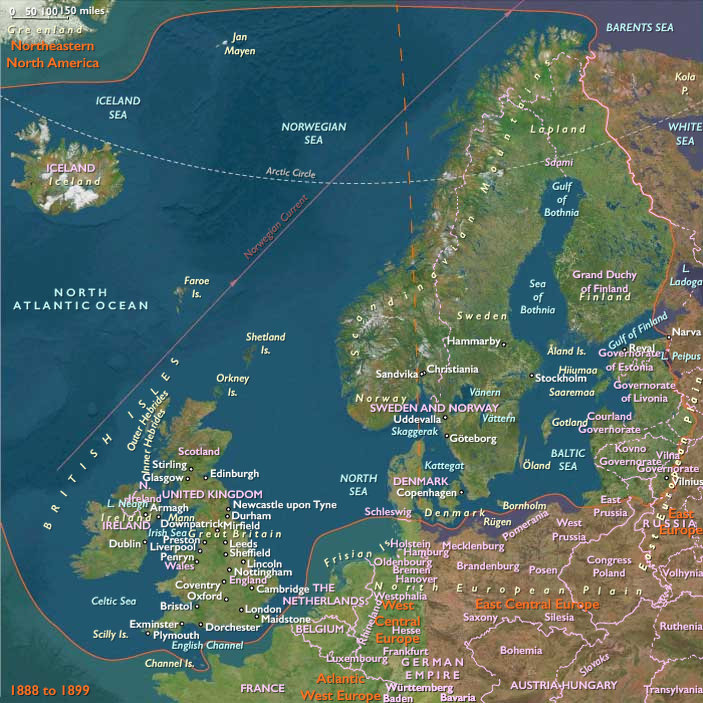
In Northern Europe, Iceland achieved significant political autonomy, signing the Danish-Icelandic Act of Union (1918), becoming an independent kingdom in personal union with Denmark. Norway continued stable development following independence (1905), while Denmark and Sweden remained neutral during WWI, navigating wartime shortages but avoiding direct involvement.
Conclusion: The Great War’s Legacy and Transition to Modern Britain
From 1912 to 1923, Northwest Europe—especially Britain—endured transformational upheaval. World War I fundamentally reshaped Britain socially, economically, politically, and culturally. Wartime sacrifices advanced democracy, reshaped gender roles, and stimulated political realignments, notably Labour’s ascendancy and Liberal decline. Irish independence dramatically altered Britain's internal dynamics, while post-war economic hardships revealed severe challenges ahead.
Imperial overstretch became increasingly evident, while cultural modernism and technological innovation signaled profound societal changes. The Edwardian optimism and Victorian confidence that preceded the war gave way to sober reflection, disillusionment, and recognition of modern uncertainties. This turbulent decade thus set Britain and Northwest Europe on an irreversible course toward twentieth-century modernity, shaped profoundly by the legacy of war and transformation.