Guo Jia
Chinese strategist and advisor
Years: 170 - 207
Guo Jia (170–207) is a strategist and advisor to the warlord Cao Cao during the late Han Dynasty period of Chinese history.
During his eleven years of service, Guo Jia's brilliance greatly aids Cao Cao in his victories over rival warlords Lü Bu and Yuan Shao, as well as chief of the Wuhuan tribe, Tadun.
As a result, he is one of the most trusted and favored subjects of Cao Cao.
Related Events
Filter results
Showing 8 events out of 8 total
Cao Cao, in preparation for a campaign far to the north of the imperial heartland, has put Dong Zhao in charge of digging two canals, the Pinglu Trench ("Pacify-the-Caitiffs Trench") and the Quanzhou Trench, from the autumn of 206 to spring of 207 so he can use these waterways to ship supplies to the north.
While these works are under way, some generals try to dissuade Cao Cao from campaigning so far to the north in case of an attack from the south, fearing that Liu Bei would certainly persuade Liu Biao, the Governor of Jing Province, to raid Xu City, Cao’s capital.
However, Cao Cao's strategist Guo Jia urges a swift attack, opining that the Wuhuan, being so far away from the Chinese heartland, are deluded by a false sense of security and can be defeated and destroyed in a quick attack.
Otherwise, the Yuan brothers and the Wuhuan would cause trouble, and the newly settled northern provinces would be lost.
Further, Liu Biao would then not be persuaded by Liu Bei, who he does not trust in any case, to launch an attack on Xu City.
Cao Cao agrees with Guo Jia's analysis, and in the summer of 207, Cao personally marches his army to Yijing (present-day Yi County, Hebei) and makes the city his base camp for the campaign.
From here, …
…Cao advances to Wuzhong (present-day Ji County, Tianjin), where the local leader Tian Chou submits to him.
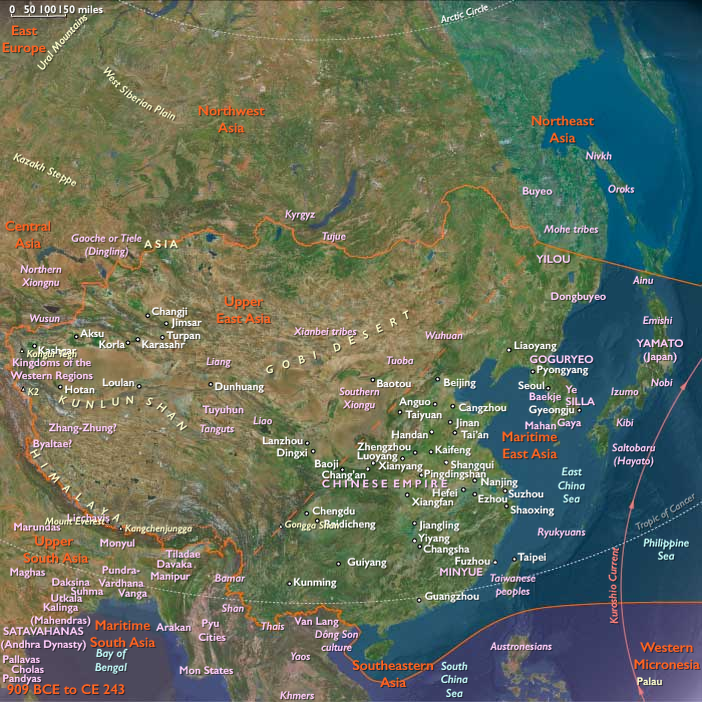
The base of Wuhuan power is located at Liucheng ( in present-day Xingcheng, Liaoning), and the obvious line of attack from Wuzhong is through the plains along the coastline of the Bohai Sea.
The monsoon season sets in, however, in the seventh lunar month, and the heavy rains flood the low-lying areas and drench the roads in mud, making the terrain impassible.
The Wuhuan also anticipate such an attack route and hold the river crossings, and for some time Cao Cao's army cannot advance.
Cao Cao turns for advice to Tian Chou, who is familiar with the area and has had run-ins with the Wuhuan before.
Tian Chou advises Cao Cao of a disused road that leads to the abandoned Former Han frontier lands, whence the army could march through undefended territory and attack the Wuhuan where they least expected it.
Cao Cao, most pleased, accepts the plan and leads his army back (presumably to Wuzhong).
He has his men erect signs on the roads by the water, stating "It is the middle of summer, and the road is impassable. We are waiting for autumn or winter to resume the advance."
Enemy scouts see the sign and apparently believe that Cao Cao had really retreated.
As Tian Chou had predicted, the Wuhuan are convinced that any force that cannot advance through the plains has to turn back.
Cao Cao takes Guo Jia’s suggestion that "swiftness is the key in war" and that he should leave the baggage behind and make a forced march with light troops to take the enemy by surprise, since carrying too much baggage bogs the army down and alerts the enemy of the army's presence.
With Tian Chou leading the way, Cao Cao leads a light force to embark on what has been called one of his most remarkable military adventures of his career.
They climb the hills of Xuwu (west of present-day Zunhua, Hebei), …
…exit the Chinese frontiers through Lulong Pass (present-day Xifeng Pass) into the upper valley of the Luan River, and march through difficult terrain for over five hundred li.
Turning east at Pinggang (near present-day Pingquan County, Hebei), the expedition force crosses the grazing fields of the Xianbei and reenters the mountain ranges that serve as the Later Han Dynasty's borders.
Cao Cao's men have by now flanked Tadun's defensive positions and are advancing on a line to the sea that will divide the enemy territory in two.
Tadun and his allies, as Cao Cao's army reaches the valley of Daling River by autumn in the eighth lunar month, realize what is happening, hastily withdraw from their prepared positions, and gather to face Cao Cao to the north.
With tens of thousands of men gathered, Tadun, along with Yuan Shang, Yuan Xi, and the two Wuhuan chanyu Louban and Wuyan, meet Cao Cao's army at White Wolf Mountain (near present-day Lingyuan, Liaoning).
The encounter is sudden for both parties.
Faced with superior numbers and the baggage left in the rear, Cao Cao's lightly armored men become afraid.
The Wuhuan, on the other hand, are evidently unprepared for battle as they are not in proper formations, nor do they attempt to take the initiative by harassing Cao Cao's march.
Undaunted, Cao Cao climbs a slope to observe the enemy's formations.
He sees that the Wuhuan are in disorder, and immediately unleashes his soldiers to exploit this weakness.
With general Zhang Liao leading the offensive, the light force swiftly defeats the Wuhuan cavalry, and Cao Chun's brigade captures Tadun.
Within a short time, Tadun and many of his men are killed and the battle is over.
Over two hundred thousand Chinese settlers and Wuhuan tribesmen surrender to Cao Cao.
In a single engagement, Cao Cao has broken the back of Wuhuan resistance.
…

The Yuan brothers and the surviving Wuhuan leaders, Supuyan, Louban, Wuyan and others, flee east with a few thousand horses to Liaodong (eastern Liaoning), where the warlord Gongsun Kang enjoys some degree of independence from the Han Dynasty imperial court due to Liaodong's distance from the capital and the chaotic state in China.
In the ninth lunar month, Cao Cao continues his march into Liucheng, and here he halts, making no intention to attack Liaodong despite the urgings of his subordinates.
He later explains that applying pressure to Liaodong may have bound Yuan Shang and Gongsun Kang against him, but if he left them to their own devices, they would quarrel among themselves.
A few days after Yuan Shang and Yuan Xi arrive in Liaodong, Gongsun Kang arranges to see them.
Yuan Shang plots to kill Gongsun Kang and take his territory for the Yuans, but Gongsun Kang strikes first, killing the brothers and sending their heads to Cao Cao.
The Wuhuan leaders who follow the Yuans are not spared either and all are decapitated.
Cao Cao returns after this victory to the North China Plain following a particularly difficult withdrawal from Liucheng, where the coldness of early winter, shortage of food, and drought all take their toil on Cao Cao's men.
He then rewards and compliments those councilors who had advised against the Wuhuan campaign earlier, acknowledging that the venture had been dangerous and risky and he had been blessed by fortune.
Indeed, Liu Bei had tried to persuade Liu Biao to attack while Cao Cao was away in the north, although, as Guo Jia had predicted, Liu Biao did not take the opportunity and later regretted this decision.