Guillem d' Areny-Plandolit
Andorran nobleman and politician
Years: 1822 - 1876
Guillem Maria d'Areny i de Plandolit, 3rd baron of Senaller and Gramenet, (19 February 1822 – 23 February 1876) was an Andorran nobleman and politician.
Related Events
Filter results
Showing 4 events out of 4 total
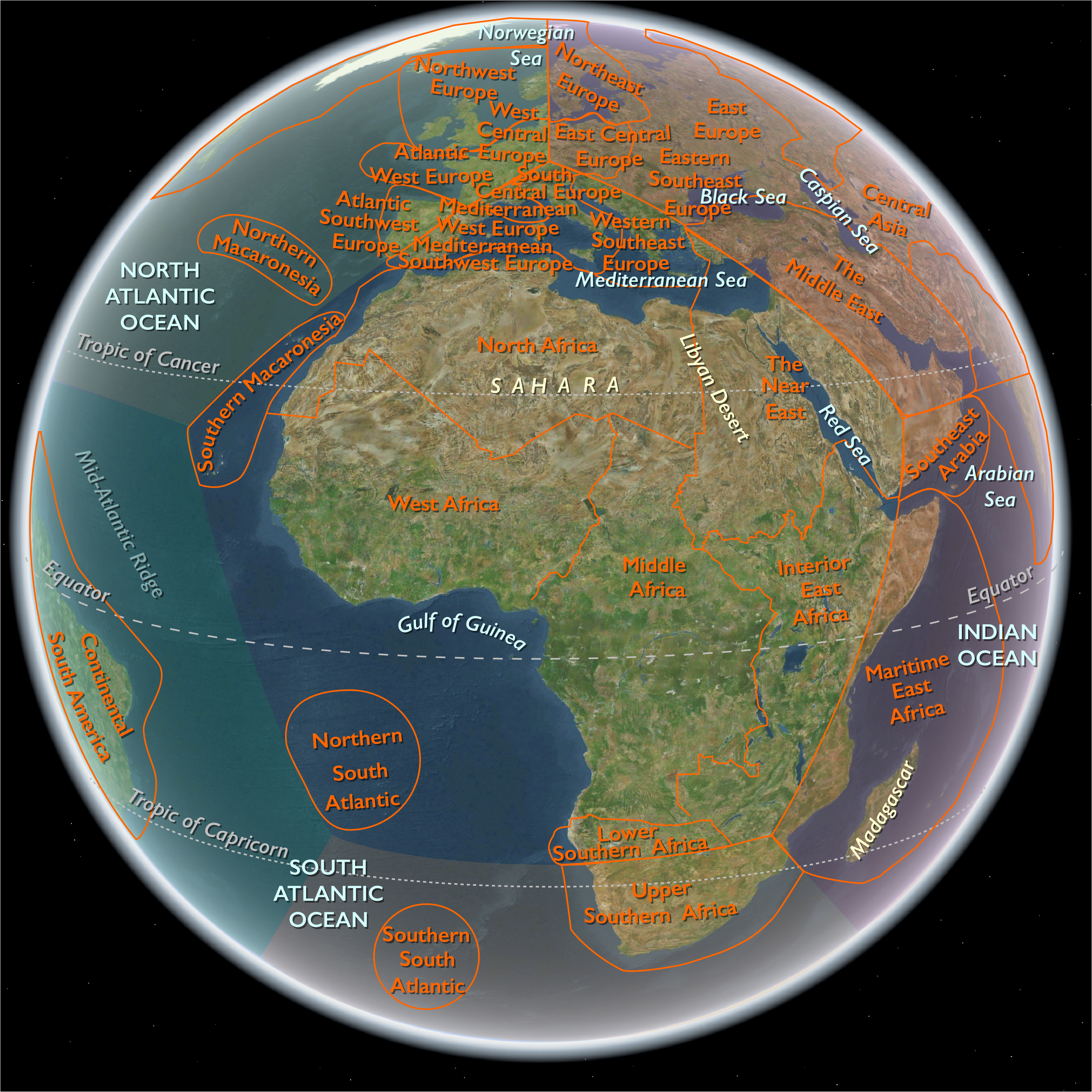
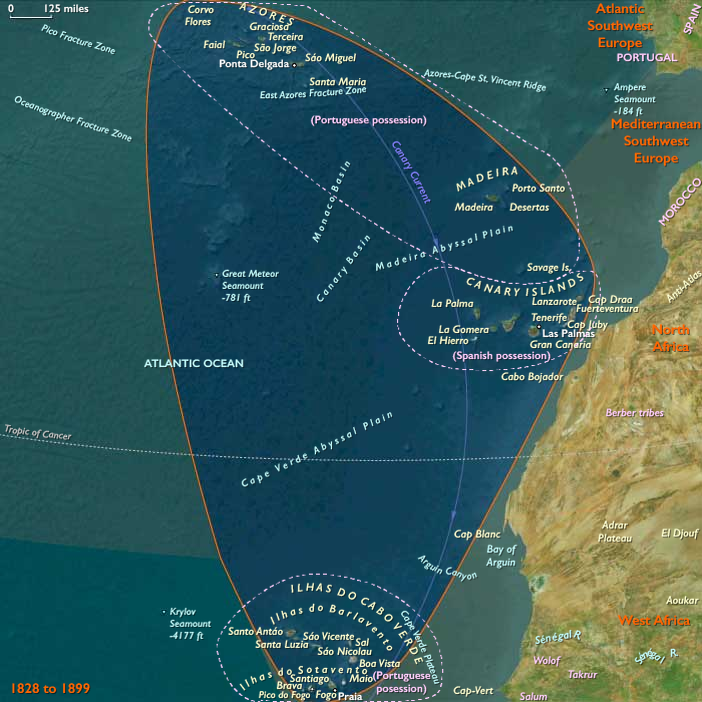
Mediterranean Southwest Europe (1828–1971 CE): Nation-Building, Dictatorship, and the Reinvention of Mediterranean Economies
Geography & Environmental Context
Mediterranean Southwest Europe encompasses Italy (including Sardinia and Sicily), Malta, southeastern Spain (Andalusia, Murcia, Valencia, Catalonia’s southern coast, and the Balearic Islands). Anchors include the Po Valley and northern Italian plain, the Apennines, Mount Vesuvius and Etna, the Sicilian interior, the Ebro and Guadalquivir valleys, the Balearic archipelagos, and Malta’s limestone plateaus. This is a region of rugged Mediterranean coastlines, volcanic soils, and irrigated plains that supported agriculture, industry, and rapidly growing urban centers such as Rome, Milan, Naples, Palermo, Barcelona, Valencia, Seville, Palma de Mallorca, and Valletta.
Climate & Environmental Shifts
The climate remained characteristically Mediterranean: hot, dry summers and cool, wet winters. Drought cycles in Andalusia and Sicily produced periodic crop failures in the 19th century, while devastating floods affected northern Italy (notably the Adige flood of 1882). Volcanic eruptions at Etna and Vesuvius (most famously 1906 and 1944) threatened nearby settlements. Reforestation and irrigation works expanded in the 20th century, particularly under Fascist Italy’s land reclamation schemes (Pontine Marshes) and Spain’s Franco-era irrigation projects.
Subsistence & Settlement
-
Agriculture:
-
Italy: Wheat in the south; olives, vines, and citrus across peninsular and insular zones; dairy and maize in the Po Valley.
-
Spain: Wheat, citrus, rice (Valencia), and olives; Andalusia’s latifundia coexisted with smallholders.
-
Malta: Dryland farming of wheat and barley with reliance on imported food.
-
-
Industry:
-
Italy’s “industrial triangle” (Milan–Turin–Genoa) became Europe’s key steel, textile, and automotive hub.
-
Barcelona developed as Spain’s textile and industrial center.
-
Naples, Palermo, Andalusian cities lagged behind, locked in agrarian economies.
-
-
Urban growth: Rome became Italy’s capital (1871); Barcelona and Valencia expanded port industry; Valletta was transformed by British naval dominance. By the mid-20th century, rapid urbanization created sprawling suburbs and modernist housing.
Technology & Material Culture
-
Transport: Railways (Piedmont, Catalonia, Andalusia, Naples–Rome) and modern ports transformed connectivity in the 19th century. After WWII, motorways and airports (Milan Malpensa, Rome Fiumicino, Barcelona El Prat, Palma de Mallorca) anchored tourism.
-
Industry & energy: Coal in Asturias and Sardinia; hydroelectric in the Alps and Pyrenees; Fiat (Turin) symbolized Italian industrial growth; postwar petrochemicals reshaped Sicilian and Andalusian coasts.
-
Everyday life: Rural material culture—stone farmhouses, terraced vineyards, hand looms—gave way to urban consumer goods: radios, Vespa scooters, Fiat cars, and televisions by the 1960s.
Movement & Interaction Corridors
-
Migration:
-
19th century: Italians emigrated en masse to the Americas (Argentina, Brazil, the U.S.), and Spaniards to Cuba, Mexico, and Argentina.
-
20th century: Postwar flows sent workers to France, Germany, Switzerland, and Belgium; remittances fueled local economies.
-
-
Colonial ties:
-
Spain retained colonies in Africa until mid-20th century; Italy pursued expansion (Libya, East Africa, Albania, Dodecanese).
-
Malta, as a British fortress colony, was central in Mediterranean naval strategy until independence (1964).
-
-
Tourism: Began in the 19th century with aristocratic visits to Naples, Sicily, and the Balearics; exploded in the 1950s–60s with charter flights to Mallorca, Ibiza, Costa del Sol, Amalfi, and Capri.
-
War corridors: Italian unification wars (Risorgimento), Spanish Civil War (1936–1939), both World Wars, and Cold War naval deployments in Malta all militarized the region.
Cultural & Symbolic Expressions
-
Nationalism: Italy’s Risorgimento (Mazzini, Garibaldi, Cavour) culminated in unification (1861–1871). Spain oscillated between monarchy, republic, dictatorship, and Franco’s authoritarianism (1939–1975). Malta blended Catholic and British influences, asserting independence mid-century.
-
Arts & literature: Italian Romanticism (Verdi), Futurism, and postwar neorealist cinema (Rossellini, De Sica). Spanish cultural figures (Goya’s late works, Gaudí’s Barcelona architecture, Picasso, Miró, Lorca) shaped global modernism.
-
Religion & tradition: Catholicism dominated, with papal authority central in Italy; local fiestas, processions, and Mediterranean folk traditions persisted.
-
Tourist imagery: Romantic depictions of Capri, Amalfi, and Andalusia, later mass-marketed as sun-and-sea resorts, reshaped cultural perception of the Mediterranean.
Environmental Adaptation & Resilience
-
Agrarian reform: Land reforms in Italy (1950s–60s) and Spain (Franco’s agrarian policy) redistributed holdings, though inequality persisted.
-
Irrigation: Expansion of canals and reservoirs modernized citrus and rice production in Valencia and Sicily.
-
Terracing: Maintained soil fertility in hilly regions; mechanization after 1950 reduced reliance on labor-intensive terrace farming.
-
Urban resilience: Cities devastated in WWII (Naples, Rome, Barcelona, Valletta) were rebuilt with modernist architecture and new transport systems.
Political & Military Shocks
-
Italy: Unification (1861–71); Fascist rule (1922–43); WWII defeat and transition to republic (1946).
-
Spain: Carlist Wars; colonial loss in 1898; Civil War (1936–39) leading to Franco’s dictatorship; neutrality in WWII; tourism-led development by the 1960s.
-
Malta: Great Siege memories lived on under British rule; WWII bombardments earned it the George Cross; independence achieved in 1964.
-
Allied & Axis strategy: Mediterranean ports and islands were pivotal in both World Wars, especially Sicily, Malta, and Gibraltar’s approaches.
Transition
Between 1828 and 1971, Mediterranean Southwest Europe moved from agrarian economies under monarchy and empire toward industrialization, dictatorship, and postwar integration. Italy unified and industrialized unevenly, its north surging ahead while the south lagged. Spain suffered civil war and Francoist repression, yet by the 1960s pivoted toward mass tourism. Malta endured as a fortress colony, emerging into independence. Across the region, emigration and remittances provided lifelines, while the rise of modern tourism, consumer culture, and European integration marked the final transformation of this Mediterranean arc into a keystone of 20th-century Europe.
Southwest Europe (1828–1971 CE)
Nationhood, Civil War, and the Making of Modern Iberia
Geography & Environmental Context
Southwest Europe comprises two fixed subregions:
-
Mediterranean Southwest Europe — Italy (including Sardinia and Sicily), Malta, southeastern Spain, and the Balearic Islands.
-
Atlantic Southwest Europe — northern Spain and central to northern Portugal, including Lisbon, the Tagus Valley, and the Cantabrian Mountains.
Anchors include the Apennines, the Po and Ebro valleys, the Italian Peninsula’s volcanic south, the Tagus, Douro, and Guadalquivir rivers, and key coastal and urban centers—Rome, Naples, Milan, Barcelona, Valencia, Lisbon, and Porto. The region bridges the Atlantic and Mediterranean, uniting maritime trade routes, mountain frontiers, and deep agricultural basins that have long sustained dense populations and layered civilizations.
Climate & Environmental Shifts
A Mediterranean climate of hot, dry summers and mild, wet winters dominated much of the south, while the northwest’s Atlantic façade received abundant rainfall. Deforestation and soil exhaustion from centuries of cultivation gave way to reforestation and terracing programs in the 19th century. Earthquakes occasionally struck southern Italy and Portugal’s coast. By the mid-20th century, irrigation and dam projects modernized agriculture, while industrialization, urban air pollution, and rural depopulation reshaped landscapes.
Subsistence & Settlement
-
Agriculture: Grain, olives, vines, and citrus remained staples; the 19th century saw agrarian reforms and consolidation under liberal monarchies. Mechanization and fertilizers expanded yields by mid-century, but sharecropping and land inequality persisted in southern Italy, Sicily, and Spain.
-
Urbanization: Lisbon, Barcelona, Milan, Rome, and Naples grew as administrative and industrial centers. Northern Italy industrialized rapidly after unification, while southern regions lagged.
-
Migration: Seasonal and transatlantic migration (to the Americas and later to northern Europe) served as economic safety valves. After WWII, internal migration filled factory towns in northern Italy and Catalonia.
-
Fishing and maritime trade: Coastal economies thrived on shipbuilding, sardine and tuna fisheries, and maritime commerce linking the Atlantic and Mediterranean basins.
Technology & Material Culture
Railways (Lisbon–Madrid, Milan–Turin, Naples–Rome) and telegraphs in the 19th century integrated national markets. Industrialization centered on textiles, steel, and shipbuilding, while southern agrarian zones remained semifeudal. After WWII, infrastructure and consumer industries (automobiles, household goods) expanded under European reconstruction aid. Architecture ranged from neoclassical state projects to fascist monumentalism and postwar modernism. Artistic modernism flourished: Gaudí’s Catalan designs, Marinetti’s Futurism, and Morandi’s minimalist painting exemplified divergent paths to modernity.
Movement & Interaction Corridors
-
Maritime corridors: The Mediterranean and Atlantic coasts connected ports like Genoa, Barcelona, and Lisbon to imperial routes across Africa and the Americas.
-
Rail and road networks: Bound the interior to ports; after 1950, highways and airports tied Iberia and Italy to Western Europe’s tourism boom.
-
Labor migration: Italians and Portuguese joined transatlantic migrations to Brazil, Argentina, and the U.S.; by the 1960s, many worked in France, Germany, and Switzerland.
-
Tourism routes: The French and Italian Rivieras, Spanish Balearics, and Portuguese Algarve became global tourist zones after WWII.
Cultural & Symbolic Expressions
Romantic nationalism merged with Catholic revival and liberal reform.
-
Italy: Giuseppe Verdi’s operas and Garibaldi’s campaigns symbolized unification (Risorgimento). Postwar cinema—Rossellini, De Sica, Fellini—portrayed social reconstruction.
-
Spain: Writers and artists such as Goya, Unamuno, and Picasso reflected political trauma and creative rebellion; Flamenco and Andalusian folk arts embodied enduring regional identities.
-
Portugal: Fado captured nostalgia under authoritarian rule; poets like Fernando Pessoa gave voice to existential modernism.
-
Malta and the Balearics: Maritime cultures blended Catholic ritual, seafaring craft, and multilingual exchange.
Catholicism remained culturally dominant, yet anticlerical movements and republicanism spurred secular education and reform.
Environmental Adaptation & Resilience
Irrigation and terrace maintenance stabilized fragile mountain agriculture; coastal marshes were drained; reforestation curbed erosion. Postwar hydroelectric and dam projects (notably on the Tagus and Po) modernized water and power supply. Cooperative farming and later Common Market integration improved productivity. Rural depopulation and emigration altered traditional village structures but relieved demographic pressure on marginal lands.
Political & Military Shocks
-
Liberal revolutions: Spain and Portugal alternated between monarchy and republic amid 19th-century liberal uprisings.
-
Italian Unification (Risorgimento, 1848–71) created a single kingdom under Victor Emmanuel II; regional disparities persisted.
-
Republics and dictatorships:
-
Spain’s First Republic (1873–74) failed amid instability; the Second Republic (1931–39) collapsed in the Spanish Civil War, leading to Francisco Franco’s dictatorship (1939–75).
-
Portugal’s Estado Novo, founded by António Salazar (1933), maintained corporatist authoritarianism until the Carnation Revolution (1974).
-
Italy’s Fascist regime under Mussolini (1922–43) joined the Axis powers; postwar reconstruction created a republic (1946).
-
-
World Wars: Italy fought on both sides; Spain and Portugal remained neutral in WWII but served as refuges and transit corridors.
-
Decolonization: Italy lost Libya, Eritrea, and Somaliland; Portugal clung to its African colonies; Spain withdrew from Morocco’s protectorate (1956).
-
Cold War: Italy and Portugal joined NATO (1949); Spain aligned with the U.S. (1953 agreements) despite Franco’s isolation.
Transition
Between 1828 and 1971, Southwest Europe traversed the arc from agrarian monarchies and fragmented kingdoms to industrial, authoritarian, and democratic states. The Risorgimento, Iberian revolutions, and postwar transitions forged modern nations marked by stark contrasts—prosperous industrial norths and impoverished rural souths, deep religiosity and militant secularism, dictatorship and democracy. The rebuilding after WWII brought integration into Western alliances and the first wave of tourism-led growth. By 1971, the region—its olive terraces, factory belts, and crowded ports—stood as both the southern pillar of Western Europe and a crossroads of lingering empires and emerging modern identities.
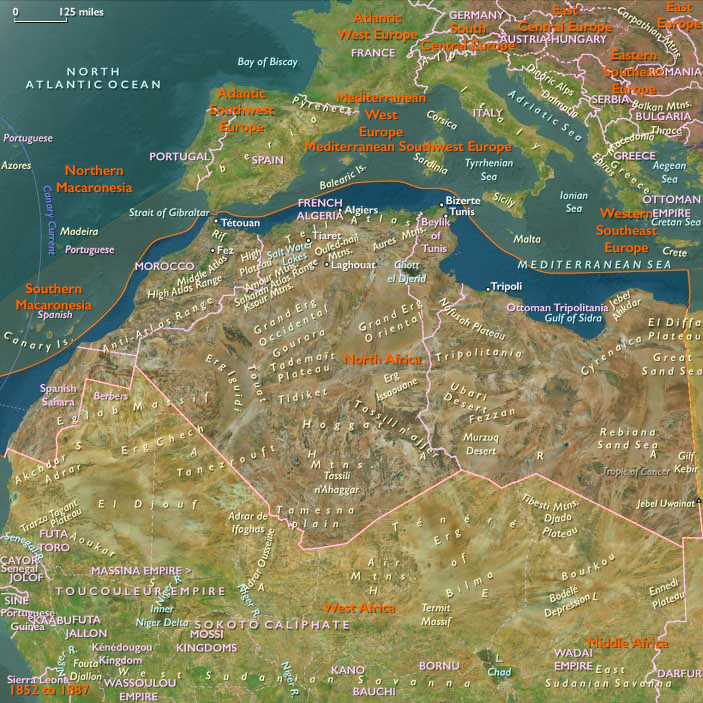
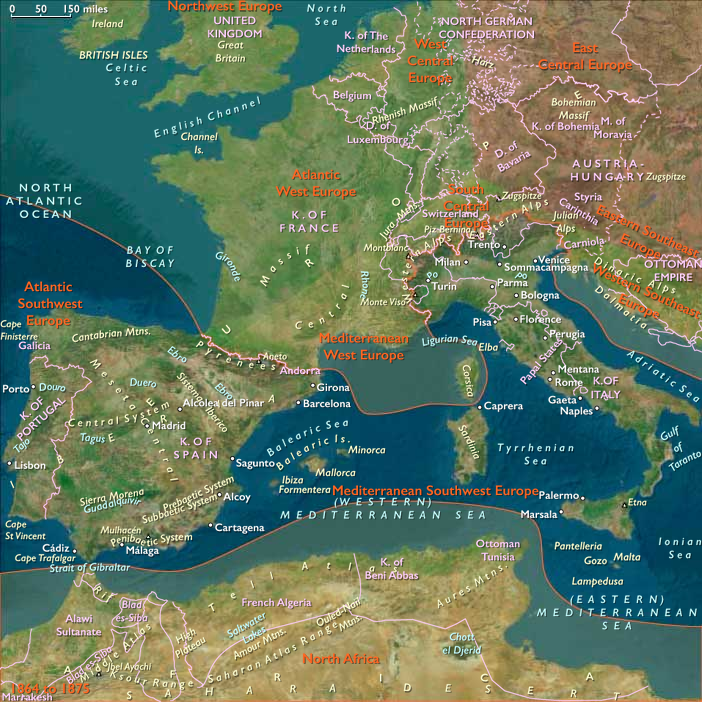
Mediterranean Southwest Europe (1864–1875 CE): Turbulent Transitions and National Consolidations
The era from 1864 to 1875 CE across Mediterranean Southwest Europe—including the Italian Peninsula, southern and eastern Spain, southern Portugal, Andorra, the Balearic Islands, Sicily, Sardinia, and Malta—is characterized by significant political realignments, national consolidations, cultural developments, and socio-political upheaval.
Completion of Italian Unification and the "Roman Question"
Italian unification nears completion during this period, prominently marked by the final annexation of Rome in 1870. When France withdraws its protective garrisons from Rome amidst the Franco-Prussian War, Piedmont-led Italian forces occupy the city after minimal resistance by papal troops. Pope Pius IX retreats to the Vatican, becoming a self-proclaimed "prisoner in the Vatican." Although the newly established Italian government guarantees papal sovereignty within Vatican walls, the pope refuses to acknowledge Italy’s authority over Rome. The "Roman Question"—the unresolved dispute over temporal power and church-state relations—persists as a significant political issue until 1929.
Following Rome’s annexation, Victor Emmanuel II moves Italy’s capital permanently from Florence to Rome in 1871, symbolically concluding the Risorgimento. The former papal residence, the Quirinal Palace, becomes the official royal palace for Italy’s monarchy.
Spain: The Revolution of 1868 and the Bourbon Restoration
Spain endures dramatic political shifts beginning with the Revolution of 1868, leading to the abdication of Queen Isabella II. Instability follows as various forms of governance rapidly succeed each other:
-
A brief period of Liberal Monarchy (1870–1873) under Amadeo I of Savoy, who faces isolation and abdicates after his short, ineffective reign.
-
The tumultuous First Spanish Republic (1873–1874) attempts federal decentralization but collapses quickly amid regional rebellions and internal chaos.
-
A military intervention facilitates the Restoration of the Bourbon monarchy in 1875 under Alfonso XII, who, trained at Britain’s Sandhurst Military Academy, promises stability, proclaiming himself a "Spaniard, Catholic, and Liberal."
The political instability highlights divisions between Moderate liberals advocating constitutional monarchy and Progressives favoring broader democratic reforms, laying the foundation for enduring tensions within Spanish politics.
Andorra's Reforms and Economic Progress
In 1866, Andorra undergoes significant political reform led by the influential syndic Guillem d'Areny-Plandolit. The aristocratic oligarchy is replaced by the Council General, which modernizes governance with broader electoral representation. This New Reform (Nova Reforma) ratified by Andorra’s Co-Princes strengthens national identity and economic modernization, ushering in infrastructure projects, hotels, telegraph lines, and nascent tourism, setting the stage for future prosperity.
Malta: British Colonial Stability
Under British rule since 1814, Malta experiences ongoing infrastructural developments, reinforcing its strategic role in Mediterranean geopolitics. Although colonial tensions occasionally arise, Malta’s economy continues to stabilize and flourish, primarily driven by its maritime and naval significance to British imperial interests.
Cultural Continuity and Romanticism
Culturally, Romantic influences remain strong, particularly in Italy, where Giuseppe Verdi’s operas continue to embody nationalistic fervor and cultural pride. Romantic ideals permeate artistic expression across the region, emphasizing emotional intensity, historical themes, and national identities, thereby enriching Mediterranean Southwest Europe's cultural landscape.
Conclusion: Political Realignments and National Identity
The era from 1864 to 1875 CE signifies critical transitions in Mediterranean Southwest Europe, marked by Italy’s final steps towards unification, Spain’s turbulent experimentation with governance, Andorra’s political reforms, and Malta’s strategic stabilization. These developments reshape the region’s political landscape and national identities, setting the stage for subsequent historical dynamics
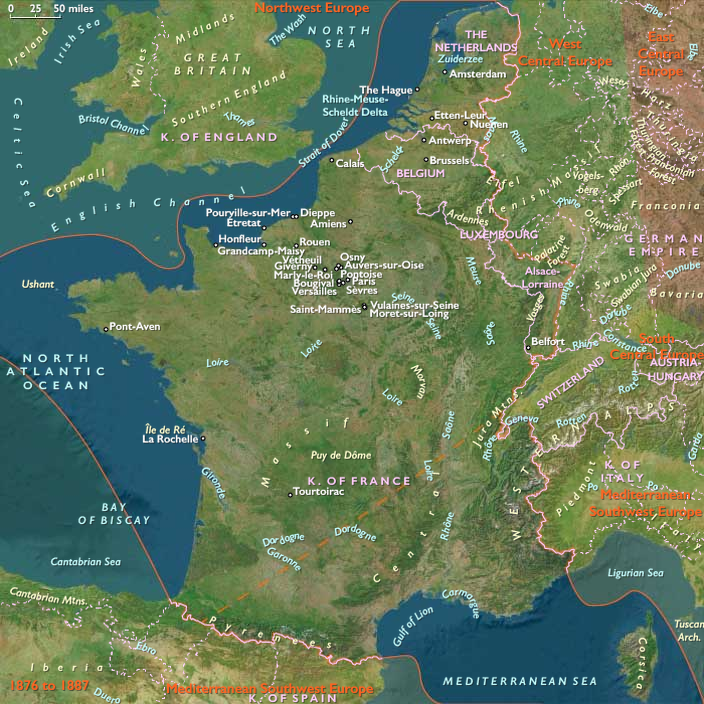
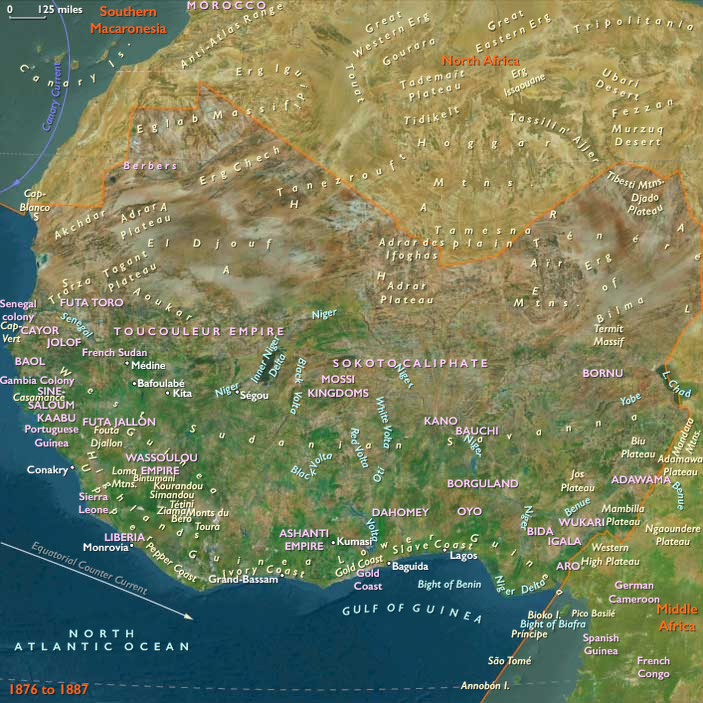
Mediterranean Southwest Europe (1876–1887 CE): Political Consolidation, Cultural Revival, and Economic Tensions
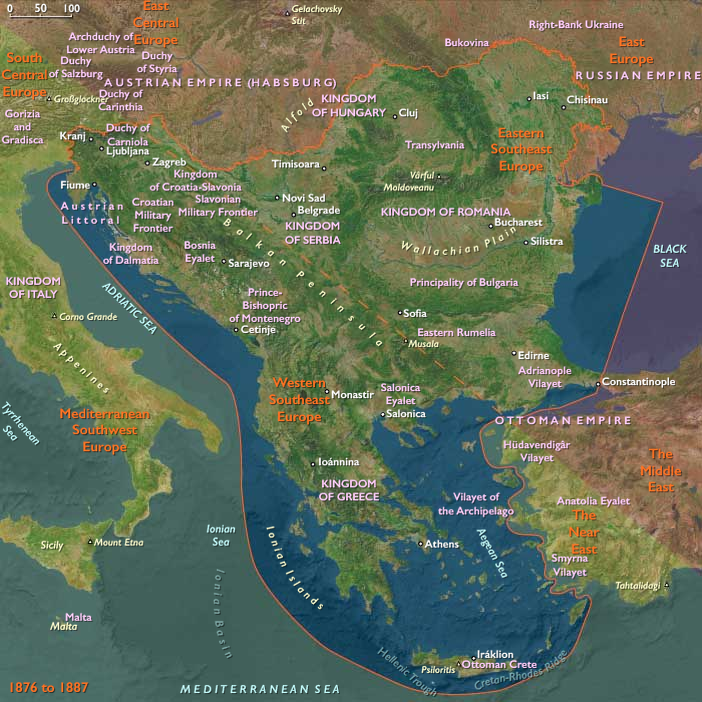
The era from 1876 to 1887 CE in Mediterranean Southwest Europe—encompassing the Italian Peninsula, southern and eastern Spain, southern Portugal, Andorra, the Balearic Islands, Sicily, Sardinia, and Malta—witnesses the consolidation of national states, the emergence of cultural revival movements, and significant economic tensions and transformations.
Spain: Restoration Stability and Political Manipulation
Following the Bourbon Restoration under Alfonso XII (r. 1875–1885), Spain experiences relative stability but at the expense of genuine democratic governance. The political system, inspired by the British model, quickly devolves into a tightly controlled two-party mechanism marked by electoral manipulation and patronage. Local political bosses, or caciques, dominate electoral outcomes through extensive patronage networks, ensuring predictable alternations between Conservative and Liberal parties. Although superficially stable, this arrangement fosters political cynicism and undermines genuine democratic participation.
Upon Alfonso XII's death in 1885, Spain enters a regency period under his widow, Maria Cristina of Austria, governing on behalf of their unborn son, Alfonso XIII, whose birth in 1886 secures dynastic continuity. The young king's future reign promises to be fraught with the inherited weaknesses of Spain's manipulated political system and unresolved regional tensions.
Italy: Consolidation as a Great Power
The Kingdom of Italy solidifies its status as a significant European power during this period. Governed under the constitutional framework provided by the Albertine Statute of 1848, Italy continues its pursuit of liberal parliamentary governance. However, while Northern Italy rapidly industrializes, contributing to national wealth and prestige, Southern Italy and rural regions remain economically stagnant and politically marginalized. This economic imbalance fuels widespread emigration, creating influential Italian diasporas abroad, and energizes the growth of the Italian Socialist Party, which begins to challenge traditional political elites.
Culturally, Italy continues to flourish, particularly through the operatic works of Giuseppe Verdi, whose grand operas embody the Romantic ideal and significantly contribute to the strengthening of national identity.
Andorra: National Awakening and Economic Conflict
In Andorra, significant cultural and economic developments characterize this era. The principality actively participates in the Catalan Renaixença, a cultural revival celebrating Catalan language and identity. Notable literary figures such as Jacint Verdaguer reside in Andorra, contributing to the growing cultural and national consciousness.
Economically, tensions arise in 1880–1881 when the authorities of Andorra's Co-Princes ban casinos and gambling establishments, provoking a popular uprising known as the Revolution of 1881. Revolutionaries, led by figures like Joan Pla i Calvo and Pere Baró i Mas, temporarily seize power, promoting casino and spa resort developments funded by foreign capital. However, loyalist forces swiftly suppress the revolution through the Treaty of the Bridge of Escalls, leading to renewed political uncertainty and economic debates that divide the populace.
Malta: Continued Stability under British Rule
Malta remains relatively stable under British colonial rule, experiencing economic growth and infrastructure expansion due to its strategic naval position. The island continues to benefit from British investment, with sustained emphasis on maritime trade and defense, although underlying tensions regarding colonial governance and local identity occasionally surface.
Conclusion: Stability, Culture, and Emerging Challenges
The years 1876 to 1887 in Mediterranean Southwest Europe highlight contrasting developments: Spain's manipulated political stability, Italy's economic divides alongside cultural flourishing, Andorra's national and economic tensions, and Malta’s colonial stability. Collectively, these dynamics underscore the region's complex evolution as it navigates political realignments, cultural revivals, and economic transformations, setting the stage for future challenges and opportunities.