Guillaume de Nogaret
councilor and keeper of the seal to Philip IV of France
Years: 1260 - 1313
Guillaume de Nogaret or William of Nogaret (1260–1313) was councillor and keeper of the seal to Philip IV of France.

Related Events
Filter results
Showing 10 events out of 13 total
Pope Innocent III Deposes King John and Empowers Philip II to Invade England (1212–1213 CE)
By the end of 1212, Pope Innocent III, having exhausted diplomatic negotiations with King John of England, formally deposed him, marking one of the most severe papal actions against a European monarch.
In January 1213, Innocent entrusted Philip II of France with executing the sentence, effectively granting him papal sanction to invade England and depose John.
John’s Conflict with the Papacy
-
John’s troubles with the Church began in 1205, when he refused to accept Innocent III’s candidate, Stephen Langton, as Archbishop of Canterbury.
-
The dispute escalated to:
- A papal interdict on England (1208–1214), forbidding church services and sacraments.
- John’s personal excommunication (1209).
- Continued negotiations, which John persistently ignored or undermined.
-
By late 1212, Innocent had run out of patience. He declared John unfit to rule, citing his tyrannical governance, defiance of the Church, and oppression of his subjects.
Philip II’s Role and Plans for Invasion
- Innocent granted Philip II the authority to invade England to enforce the deposition.
- Philip began assembling an invasion fleet, planning to land in England, depose John, and place his own son, Prince Louis, on the English throne.
- This posed an existential threat to John’s rule, as many of his English barons already resented his taxation and failed military campaigns.
Consequences and John’s Drastic Response
-
Facing imminent invasion, John realized he could not fight both Philip and his own rebellious barons.
-
In May 1213, he dramatically submitted to Innocent III, agreeing to:
- Accept Stephen Langton as Archbishop.
- Surrender England and Ireland as papal fiefs and receive them back as a vassal of the Pope, effectively making England a papal vassal state.
- Pay annual tribute to Rome, securing papal protection.
-
This maneuver outmaneuvered Philip, as Innocent immediately revoked the invasion order, forcing Philip to abandon his plans.
John’s submission to the Papacy in 1213 was a masterstroke of political survival, but it did not prevent growing baronial unrest, which would soon culminate in the rebellion that led to Magna Carta in 1215.
Pope Innocent III's Final Ultimatum to King John (February 1213)
By February 1213, after years of defiance from King John of England, Pope Innocent III issued a final ultimatum, threatening stronger measures unless John submitted to papal authority. This marked the climax of a long struggle between the English king and the Papacy over the appointment of Stephen Langton as Archbishop of Canterbury.
The Papal Threat and Its Implications
-
Further Church Sanctions
- England had already been under interdict since 1208, forbidding church services and sacraments.
- John himself had been excommunicated in 1209, meaning he was cut off from the Church and Christian sacraments.
- Now, Innocent III threatened even stronger measures, including:
- Declaring John’s subjects free from allegiance to him.
- Authorizing his deposition and replacement by another ruler.
-
Authorization of Philip II’s Invasion
- Pope Innocent formally empowered Philip II of France to invade England to execute John’s deposition.
- Philip had already been preparing an invasion fleet, aiming to install his son Prince Louis as King of England.
- If John continued to resist, Philip would be justified not just as an enemy of England but as a champion of the Church.
John’s Submission to the Papacy (May 1213)
- Realizing that he could not fight both Philip II and his own rebellious barons, John submitted to the Pope in May 1213.
- He publicly surrendered England and Ireland to Pope Innocent III, receiving them back as a papal fief and agreeing to pay an annual tribute to Rome.
- This outmaneuvered Philip II, as Innocent immediately revoked the invasion order, depriving Philip of a justification for war.
Consequences of John’s Submission
- England became a papal vassal state, securing papal protection but humiliating John in the eyes of his nobles.
- Philip II lost his excuse to invade England, forcing him to redirect his ambitions elsewhere.
- Baronial resentment in England intensified, leading to the rebellion that resulted in Magna Carta (1215).
John’s political survival in 1213 was a masterstroke of diplomacy, but it came at the cost of further alienating his nobility, setting the stage for internal unrest and the eventual baronial revolt.
Philip II’s Final Preparations for the Invasion of England (1213 CE)
By 1213, Philip II of France was making final preparations for his long-planned invasion of England, seeking to depose King John and install his own son, Prince Louis (the future Louis VIII), on the English throne. To ensure full support from his vassals and papal legitimacy, Philip carefully framed his attack as a religious crusade, denouncing John as an enemy of the Church.
Philip’s Assembly at Soissons and the Resistance from Flanders
- Philip summoned his French barons to an assembly at Soissons, presenting the invasion as a holy war sanctioned by the Pope.
- The meeting was well attended, but Ferdinand, Count of Flanders, refused to participate, still furious over the loss of Aire and Saint-Omer, which had been seized by Philip’s son, Prince Louis (Louis the Lion).
- Ferdinand demanded the return of his lost towns before committing his forces, creating a diplomatic challenge for Philip.
Philip’s Political Maneuvering: Reconciling with Ingeborg of Denmark
- To bolster his claim to the English throne, Philip announced his reconciliation with his estranged wife, Ingeborg of Denmark, whom he had rejected since their marriage in 1193.
- This move was not driven by sentiment, but by calculated political strategy:
- The Popes had been pressuring Philip to take her back, and this move would win papal favor for his invasion.
- Ingeborg’s Danish royal connections provided Philip with a potential claim to the English throne, as England and Denmark had historical ties through Cnut the Great's North Sea Empire.
Support from the French Nobility and the Papacy
- The French barons fully backed Philip’s plan, agreeing to gather their forces for the campaign.
- Throughout this time, Philip remained in close contact with Pandulf Masca, the Papal Legate, who encouraged the invasion, as John had already been declared deposed by Pope Innocent III.
Outcome: The Collapse of the Invasion Plans
- Despite Philip’s meticulous preparations, his planned invasion was abruptly halted when John made a dramatic submission to the Pope in May 1213.
- John surrendered his kingdom to Pope Innocent III, making England a papal vassal state, thereby removing Philip’s justification for invasion.
- The Pope revoked Philip’s permission to attack, leaving the assembled French forces without a target.
- Instead of invading England, Philip redirected his forces to fight against Flanders, leading to the Battle of Bouvines in 1214, where he won one of his greatest victories.
Philip’s assembly at Soissons in 1213 marked the peak of Capetian ambitions for the conquest of England, but John’s unexpected submission to the Pope forced Philip to abandon his plans, shifting his focus back to the conflict in continental Europe.
Pandulf is also holding secret discussions with King John.
Advising the English king of his precarious predicament, he persuades John to abandon his opposition to Papal investiture and agree to accept the Papal Legate's decision in any ecclesiastical disputes as final.
In return, the Pope agrees to accept the Kingdom of England and the Lordship of Ireland as Papal fiefs, which John will rule as the Pope's vassal, and for which John will do homage to the Pope.
Philip II’s Planned Invasion of England Halted and Redirected Against Flanders (1213 CE)
No sooner had King John of England submitted to Pope Innocent III in May 1213, thereby making England a vassal of the Holy See, than Papal Legate Pandulf Masca informed Philip II of France that he must abandon his invasion of England.
Despite Philip’s meticulous preparations, the Pope’s new stance rendered the invasion illegitimate, as attacking a now-faithful vassal of the Church was deemed a mortal sin.
Philip’s Arguments for Continuing the Invasion
Philip made several desperate arguments to Pandulf:
- His war plans had been sanctioned by the Pope himself, and he had proceeded under papal authority.
- The invasion was in defense of the Church, since John had long been an enemy of the Papacy.
- He had spent an enormous fortune preparing for the expedition.
- He had been promised a Plenary Indulgence, meaning his campaign was considered a Crusade in all but name.
However, Pandulf refused to be moved. With John now under papal protection, an attack on England was no longer justifiable.
Pandulf’s Alternative Target: Flanders
With his grand plan for an English conquest foiled, Philip II turned his forces against Flanders.
- The Count of Flanders, Ferdinand of Portugal, had resisted Philip’s authority, previously refusing to support the English invasion.
- He had denied Philip the right to attack England while John was still excommunicated, which Philip and Pandulf now framed as disobedience.
- Pandulf advised Philip to punish Flanders instead, turning the assembled French invasion force against the Flemish.
- Philip, eager for a new campaign, accepted the suggestion without hesitation and quickly marched his army into Flanders.
The French Fleet Moves to Damme
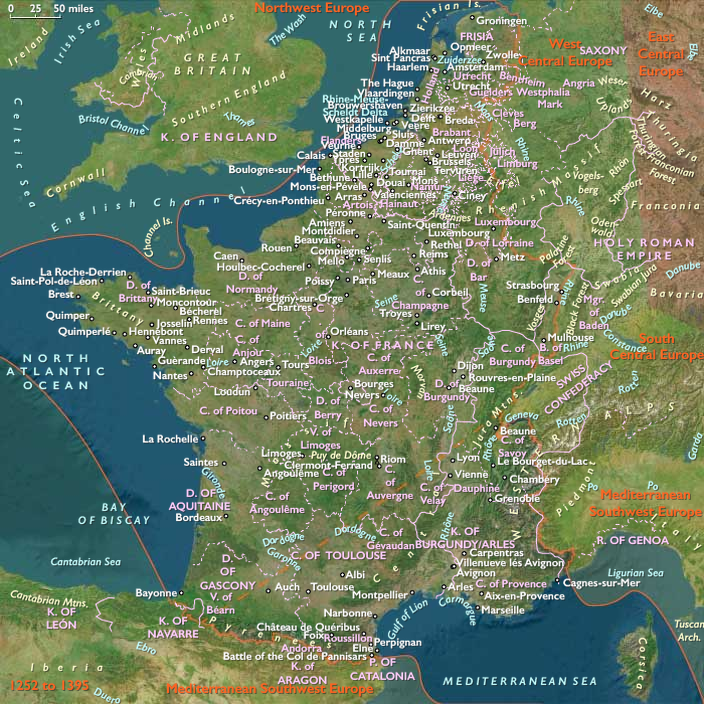
- The French fleet, reportedly numbering some 1,700 ships, first proceeded to Gravelines, then to the harbor of Damme, a key Flemish port on the North Sea.
- Philip planned to use Damme as a naval base for his Flemish campaign, intending to conquer and punish Flanders.
Consequences and the Shift to the Battle of Bouvines (1214)
- Philip’s failed invasion of England led him to focus on consolidating his power in Flanders.
- This decision ultimately resulted in the Battle of Bouvines in 1214, where Philip achieved one of his greatest military victories against the Anglo-Flemish-German coalition.
- The redirection of Philip’s forces played a crucial role in shaping the power balance in Western Europe, securing Capetian dominance in France.
Philip’s eager acceptance of Pandulf’s alternative target—Flanders—demonstrates his adaptability, turning what could have been a major setback into a new opportunity for conquest and expansion.
Philip II’s Campaign in Flanders and the English Blockade at Damme (1213 CE)
After Philip II of France abandoned his planned invasion of England, he redirected his army against Flanders, punishing Count Ferdinand of Portugal for his defiance. The French army marched through Cassel, Ypres, and Bruges, before laying siege to Ghent, one of the largest and most important Flemish cities.
The English Naval Attack on Damme
- As Philip’s forces besieged Ghent, news arrived that the English fleet had struck a devastating blow at Damme, where Philip had stationed his invasion fleet.
- English forces captured many of Philip’s ships while the remaining vessels were trapped in the harbor under heavy blockade.
- With his naval forces effectively neutralized, Philip’s ability to move troops or supplies by sea was crippled.
John’s Ransom and the Financial Windfall
- Meanwhile, King John of England capitalized on his success, securing 30,000 marks in ransom payments from the Flemish hostages he had taken from the cities he had captured.
- This massive sum reinforced John’s treasury, giving him the financial resources to continue the war.
Consequences for Philip and the Flemish Campaign
- The loss of his fleet at Damme forced Philip to abandon plans for further naval operations, significantly weakening his strategic position.
- The blockade of the French fleet allowed English forces to maintain control of the English Channel, preventing Philip from launching future invasions of England.
- While Philip’s land campaign continued, his naval setback limited his ability to sustain operations in Flanders against John’s allies.
This failed naval engagement at Damme (1213) was a key moment in the conflict, as John’s strategic success at sea forced Philip to alter his plans, shifting the war’s focus toward land battles in Flanders—ultimately culminating in the Battle of Bouvines in 1214.