Guangwu
emperor of the Han Dynasty
Years: 13BCE - 57
Emperor Guangwu (13 January 5 BCE – 29 March 57), born Liu Xiu, was an emperor of the Chinese Han Dynasty, restorer of the dynasty in CE 25 and thus founder of the Later Han or Eastern Han (the restored Han Dynasty).
He rules over parts of China at first, and through suppression and conquest of regional warlords, the whole of China is consolidated by the time of his death in 57.
Liu Xiu is one of the many descendants of the Han imperial family.
Following the usurpation of the Han throne by Wang Mang and the ensuing civil war during the disintegration of Wang's short-lived Xin Dynasty, he emerges as one of several descendants of the fallen dynasty claiming the imperial throne.
After assembling forces and proclaiming himself emperor in the face of competitors, he is able to defeat his rivals, destroy the peasant army of the Chimei, known for their disorganization and marauding, and finally reunify the whole of China in CE 36.
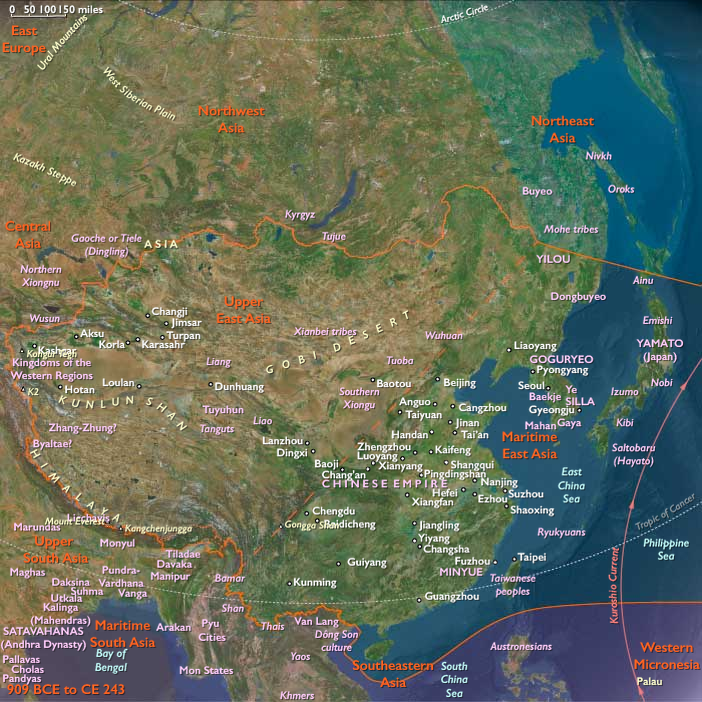
He establishes his capital in Luoyang, 335 kilometers (208 mi) east of the former capital Chang'an, ushering in the Later/Eastern Han Dynasty.
He implements some reforms (notably land reform, albeit not very successfully) aimed at correcting some of the structural imbalances responsible for the downfall of the Former/Western Han.
His reforms give a new 200-year lease on life to the Han Dynasty.
Emperor Guangwu's campaigns features many able generals, but curiously, he lacks major strategists.
That may very well be because he himself appears to be a brilliant strategist; he often instructs his generals as to strategy from afar, and his predictions generally are accurate.
This is often emulated by later emperors who fancy themselves great strategists but who actually lack Emperor Guangwu's brilliance—usually to disastrous results.
Also fairly unique among emperors in Chinese history is Emperor Guangwu's combination of decisiveness and mercy.
He often seeks out peaceful means rather than bellicose means of putting areas under his control.
He is, in particular, one of the rare examples of a founding emperor of a dynasty who, after his rule is secure, does not kill, out of jealousy or paranoia, any of the generals or officials who had contributed to his victories .