Gruffudd ap Cynan
King of Gwynedd
Years: 1055 - 1137
Gruffudd ap Cynan (c. 1055 – 1137) is King of Gwynedd from 1081 until his death in 1137.
In the course of a long and eventful life, he becomes a key figure in Welsh resistance to Norman rule, and is remembered as King of all Wales.
As a descendant of Rhodri Mawr, Gruffudd ap Cynan is a senior member of the princely house of Aberffraw.
Through his mother, Gruffudd hads close family connections with the Norse settlement around Dublin and he frequently uses Ireland as a refuge and as a source of troops.
He three times gains the throne of Gwynedd and then loses it again before regaining it once more in 1099 and this time keeping power until his death.
Gruffudd lays the foundations that will be built upon by his son Owain Gwynedd and his great-grandson Llywelyn the Great.
Related Events
Filter results
Showing 10 events out of 11 total
Gruffydd ap Cynan is a descendant of the traditional ruling house of Gwynedd, and had previously made an attempt to claim the kingdom in 1075, but had been defeated by Trahaearn ap Caradog and forced to take refuge in Ireland.
Having gathered a force of Danes and Irishmen to support his claim, Gruffydd launches an invasion in 1081, from Waterford in Ireland.
He lands not in Gwynedd but further south near St. David's (in what will become the Paladin of Pembrokeshire).
At the church of St. David's, he meets with Rhys ap Tewdwr, king of Deheubarth, who had shortly before been driven from power by Caradog ap Gruffydd of Glamorgan and Gwent helped by Meilir ap Rhiwallon of Powys and Gruffydd's old nemesis Trahaearn ap Caradog of Gwynedd.
Gruffydd and Rhys make a pact and set forth to give battle.
The battle of Mynydd Carn takes place about a day's march north of St David's.
In the evening Gruffydd and Rhys came up with the forces led by Trahaearn and Caradog ap Gruffydd, who are reported to have had Norman arbalisters in their army.
According to his biography, Gruffydd ap Cynan, insisted on an immediate attack, overruling Rhys who wished to wait until the following morning.
The result is a complete victory for Gruffydd ap Cynan and Rhys ap Tewdwr, with Trahaearn ap Caradog, Caradog ap Gruffydd and Meilir ap Rhiwallon all being killed.
Gruffydd ap Cynan gains control of Gwynedd, and despite later being captured and imprisoned by the Normans for some years, will escape and reigned until 1137, becoming one of the most successful leaders of Gwynedd.
Rhys ap Tewdwr regains Deheubarth and will reign until 1093.
These two are later to play a prominent part in Welsh resistance to the Normans.
The immediate aftermath of the battle helps the Normans, who take advantage quickly of this internal Welsh struggle which has weakened all the major Welsh kingdoms and killed three of their leaders.
Later this year, William the Conqueror becomes the first Norman King to enter Wales and signals his power by marching straight through modern day South Wales along to St. David's, where he receives homage from Rhys ap Tewdwr, who accepts William's overlordship.
The death of Caradog ap Gruffydd splits his kingdom, leaving it in disarray and helping to ensure Norman dominance of the lowlands of Gwent and Glamorgan, leading to the effective collapse of what had formerly been one of the most powerful Welsh kingdoms.

The Normans, following their invasion of England in 1066, and the subsequent conquest of large parts of Wales, had proceeded towards North Wales in the late eleventh century.
While the Normans had experienced a setback in 1094, the Norman earls Hugh of Montgomery and Hugh d'Avranches finally manage to conquer North Wales and Anglesey in 1098, forcing Gruffudd ap Cynan, King of Gwynedd, to flee to Ireland.
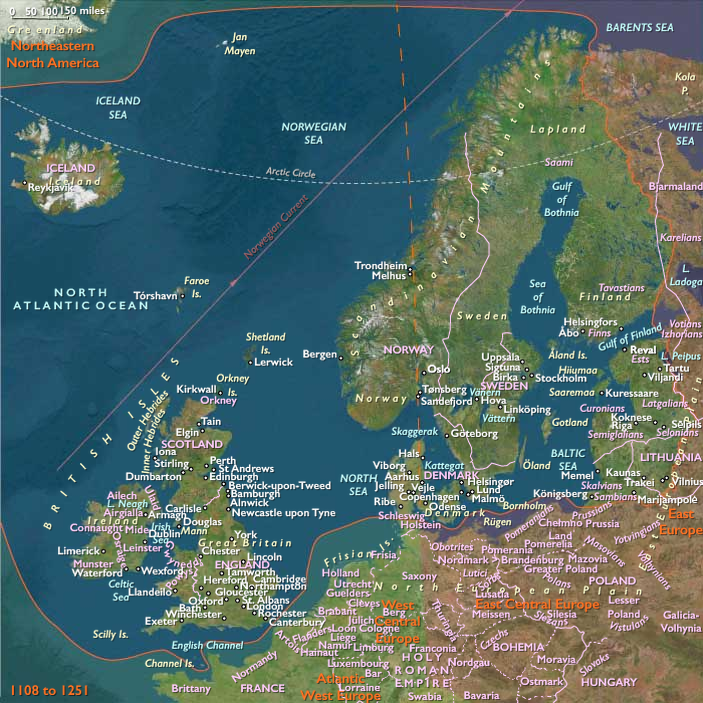
The Norwegian king Magnus Barefoot goes on an expedition with a large fleet into the Irish Sea early in 1098, seeking to assert Norwegian rule over the Kingdom of the Isles.
After he has subdued most of the Isles and set up his base on Mann, he goes further south and appears with six ships (according to the English chronicler Orderic Vitalis), off the coast of Anglesey, only a few days after the Norman capture.
According to Orderic Vitalis, Magnus enters the Menai Strait with a red shield on the mast, which is the usual sign to signal peace and trade.
While Magnus may have sought trade, or to get provisions for his ships, he may also have intended to take possession of the island as a base for further operations.
When Magnus approaches Anglesey in June or July, the Normans do not permit him to land.
The fighting starts with the two sides shooting arrows at each other, the Norwegians while still onboard their ships, and the Normans while standing on the shore.
As the Normans prepare to attack the Norwegians, Hugh of Montgomery, who is fully armored except for an opening for his eyes, is shot through one eye with an arrow and dies instantly.
Contemporary non-Norse sources all agree that Magnus Barefoot himself was responsible for the shot, while the Norse sagas are somewhat less inclined to attribute the decisive shot to Magnus alone, noting that his shot hit Hugh almost simultaneously with that of another of his men.
Since some sources indicates that Magnus regretted the deed when he realized who he had killed, Magnus may originally have been interested in alliances with the Normans.
The Normans retreated from Anglesey to England following the defeat.
Magnus also conquers the Isle of Man, …
…the Hebrides, and …
…the Orkney Islands in 1098.
The Norse jarls from this point forward twill owe allegiance both to Norway for Orkney and to the Scottish crown through their holdings as Mormaers of Caithness.
The Welsh consider the Norwegians their liberators following the Norwegian victory against the Normans, but Magnus regards Anglesey as part of the Kingdom of the Isles and takes the island as a Norwegian possession.
Since the Norwegians never settle on the island, Anglesey reverts to Welsh control in 1099 when Gruffudd ap Cynan returns from Ireland.
The Norwegian control is at best nominal hereafter,but as Gruffudd awards Magnus with great rewards and honor, and during Magnus' second expedition in 1102 allows him to cut as much timber as he wanted, Magnus may possibly have reasserted the overlordship over Gruffudd formerly held by Godred Crovan, and thereby received the submission of Gwynedd.
Owain, the eldest son of Cadwgan ap Bleddyn, prince of part of Powys,is first recorded in 1106, when he killed Meurig and Griffri, the sons of Trahaearn ap Caradog, who held lands in Arwystli.
Owain's father Cadwgan in 1109, had given a great feast at his court in Ceredigion, and at this feast Owain was told of the beauty of Nest, whose husband Gerald of Windsor holds the castle of Cenarth Bychan (possibly Cilgerran Castle).
He had decided to visit Cenarth Bychan to see for himself, and having done so fell in love with Nest and determined to have her.
Owain and fifteen companions one night at Christmas 1109 burrowed underneath the gate to get into the castle then rushed in to abduct Nest and her children and set fire to the castle.
Her husband, Gerald, had fled through a garderobe.
Owain's actions lead to his father being confronted with an invasion, as the justiciar of Shropshire, Richard de Beaumais, has promised the members of the cadet branches of the ruling house of Powys extensive lands if they will attack Cadwgan and Owain.
Owain had fled to Ireland while Cadwgan surrendered to King Henry I of England and lost all his lands.
Ceredigion is later returned to Cadwgan, under the condition of paying a fine of one hundred pounds and promising to have nothing more to do with Owain.
Owain had soon returned to Powys from Ireland and made an alliance with Madog ap Rhiryd.
The king had responded by releasing Owain's uncle, Iorwerth ap Bleddyn, from captivity in 1110 and returning the rule of Powys to him.
Owain had been driven out of Powys by Iorwerth and retreated to Ceredigion, whence he made raids on Dyfed, selling his captives in the Irish slave markets.
He also killed a prominent member of the Flemish colony, William of Brabant.
King Henry had responded by stripping Cadwgan of all his lands and forcing him to live as an exile in England, while Owain again fled to Ireland.
However Iorwerth had been killed by Owain's ally Madog ap Rhiryd in 1111 and the rule of Powys was returned to Cadwgan, who was allowed to recall Owain.
When Cadwgan was also killed by Madog the same year, Owain had become ruler of much of Powys.
He employs his uncle Maredudd ap Bleddyn as penteulu (captain of the guard), and in 1113 Maredudd is able to capture Madog ap Rhiryd and send him to Owain.
Owain takes vengeance for the killing of his father by blinding Madog.
The situation in Wales is meanwhile deteriorating.
Henry had conducted a campaign in South Wales in 1108, pushing out royal power in the region and colonizing the area around Pembroke with Flemings.
Some of the resident Norman lords are under attack by 1114, while in Mid-Wales, Owain ap Cadwgan has blinded one of the political hostages he is holding, and in North Wales Gruffudd ap Cynan threatens the power of the Earl of Chester.
In an attack mainly aimed against Gruffydd ap Cynan, Henry sends three armies into Wales this year, with Gilbert Fitz Richard leading a force from the south, Alexander, King of Scotland, pressing from the north and Henry himself advancing into Mid-Wales.
Owain and Gruffudd sue for peace, and Henry accepts a political compromise.
Henry reinforced the Welsh Marches with his own appointees, strengthening the border territories.
After peace terms have been agreed, Henry takes Owain with him when he visits Normandy later this year and knights him.
Nest had borne Owain two sons, Llywelyn and Einion, before eventually being returned to her husband Gerald of Windsor.
Owain returns with the Henry in 1115 and in 1116 takes to arms to assist the king in putting down the rebellion of Gruffydd ap Rhys of Deheubarth.
Gerald, who is fighting on the same side, takes the opportunity for vengeance, attacking Owain when he has only ninety men with him and killing him.
Most of Powys now passes to his uncle, Maredudd.