Grigory Potemkin
Russian military leader, statesman, nobleman and favorite of Catherine the Great
Years: 1739 - 1791
Prince Grigory Aleksandrovich Potemkin-Tavricheski (October 11 [O.S. September 30] 1739 – October 16 [O.S. October 5] 1791) is a Russian military leader, statesman, nobleman and favorite of Catherine the Great.
He dies during negotiations over the Treaty of Jassy, which ends a war with the Ottoman Empire that he had overseen.
Potemkin was born into a family of middle-income noble landowners.
He first attracts Catherine's favor for helping in her 1762 coup, then distinguishes himself as a military commander in the Russo-Turkish War (1768–1774).
He becomes Catherine's lover, favorite and possibly her consort.
After their passion cools, he remains her lifelong friend and favored statesman.
Catherine obtains for him the title of Prince of the Holy Roman Empire and gives him the title of Prince of the Russian Empire among many others: he is both a Grand Admiral and the head of all of Russia's land and irregular forces.
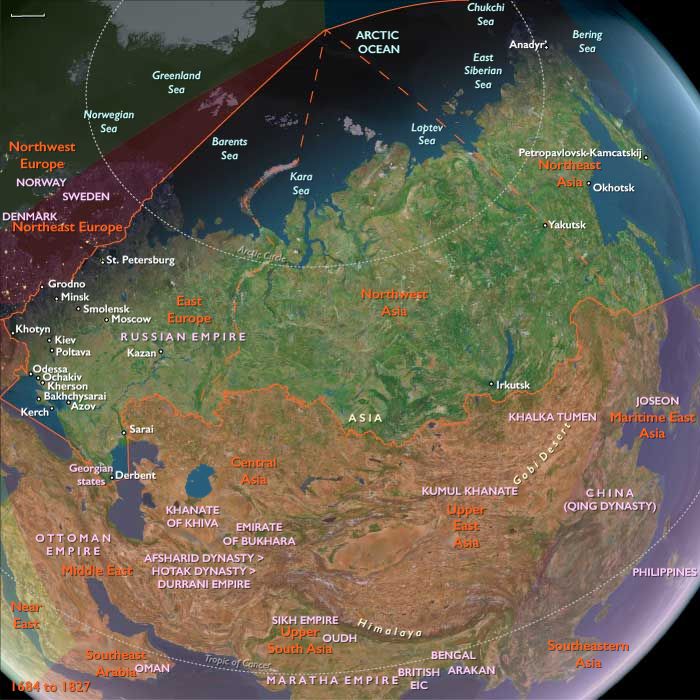
Potemkin's defining achievements include the peaceful annexation of the Crimea (1783) and the successful second Russo-Turkish War (1787–1792).
The fall of Ottoman stronghold Izmail that he orchestrates prompts Gavrila Derzhavin and Osip Kozlovsky to write Russia's first national anthem, "Let the thunder of victory sound!".
In 1774, Potemkin becomes the governor-general of Russia's new southern provinces.
An absolute ruler, he works to colonize the wild steppes, controversially dealing firmly with the Cossacks who live there.
He founds the towns of Kherson, Nikolayev, Sevastopol, and Ekaterinoslav (now Dnipropetrovsk).
Ports in the region become bases for his new Black Sea Fleet.
His rule in the south is associated with the "Potemkin village", a largely fictional method of ruse involving the construction of painted façades to mimic real villages, full of happy, well-fed people, for visiting officials to see.
Potemkin is known for his love of women, gambling and material wealth; he oversees the construction of many historically significant buildings, including the Tauride Palace in St. Petersburg.
A century after Potemkin's death, his name will be given to the Battleship Potemkin, which features in the 1905 Russian Revolution and is fictionalized in Battleship Potemkin, a silent film by Sergey Eisenstein.