Gonzalo Guerrero
Spanish sailor and warrior under a Maya lord
Years: 1486 - 1536
Gonzalo Guerrero (also known as Gonzalo Marinero, Gonzalo de Aroca and Gonzalo de Aroza) is a sailor from Palos, in Spain who shipwrecks along the Yucatán Peninsula and is taken as a slave by the local Maya.
Earning his freedom, Guerrero becomes a respected warrior under a Maya Lord and raises three of the first mestizo children in Mexico and presumably the first mixed children of the mainland Americas.
Little is known of his early life.
Related Events
Filter results
Showing 5 events out of 5 total
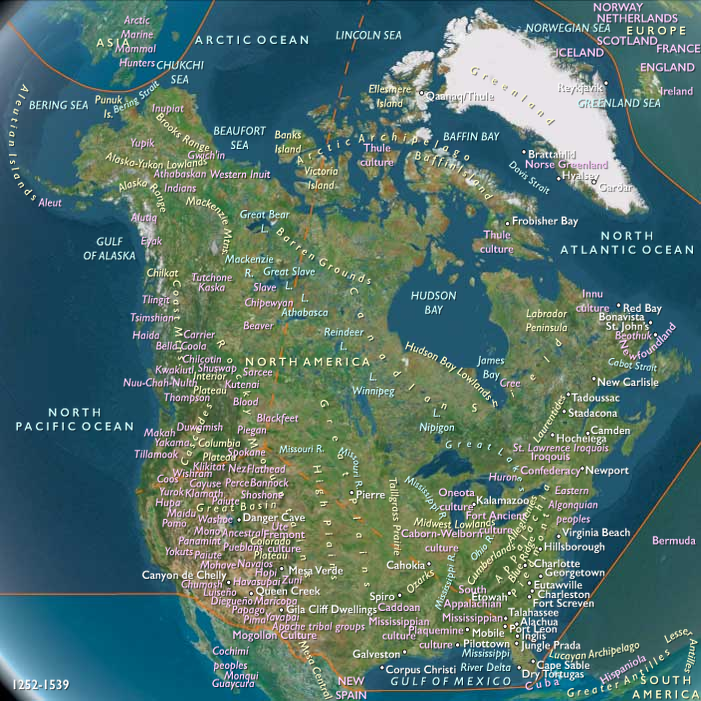
The Spanish caravel Santa María de la Barca had set sail along the Central American coast under the command of Pedro de Valdivia in 1511.
The ship was sailing to Santo Domingo from Darién to inform the colonial authorities there of ongoing conflict between conquistadors Diego de Nicuesa and Vasco Nuñez de Balboa in Darién.
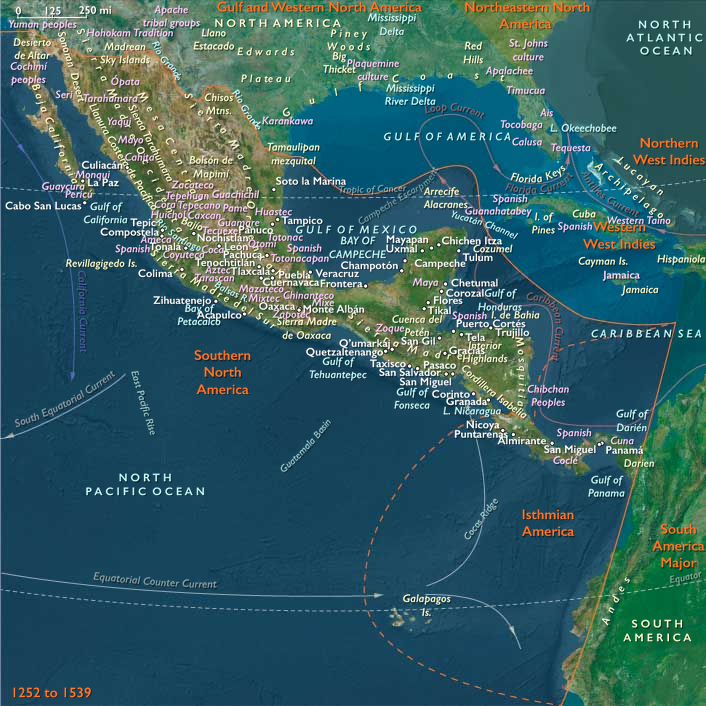
The ship had foundered upon a reef known as Las Víboras ("The Vipers") or, alternatively, Los Alacranes ("The Scorpions"), somewhere off Jamaica.
There were just twenty survivors from the wreck, including Captain Valdivia, Gerónimo de Aguilar and Gonzalo Guerrero.
They set themselves adrift in one of the ship's boats, with bad oars and no sail; after thirteen days during which half of the survivors died, they made landfall upon the coast of Yucatán, where they were seized by Halach Uinik, a Maya lord.
Captain Valdivia had been sacrificed with four of his companions, their flesh served at a feast.
Aguilar and Guerrero had been held prisoner and fattened for killing, together with five or six of their shipmates.
Aguilar and Guerrero had managed to escape their captors and fled to a neighboring lord who was an enemy of Halach Uinik; he took them prisoner and kept them as slaves.
After a time, Gonzalo Guerrero had been passed as a slave to the lord Nachan Can of Chetumal.
Guerrero has become completely Mayanized and serves his new lord with such loyalty that he is married to one of Nachan Chan's daughters, Zazil Ha, by whom he will have three children.
By 1514, Guerrero has achieved the rank of nacom, a war leader who serves against Nachan Chan's enemies.
Two decades of Spanish conquest and slavery have depleted the indigenous population of the West Indies.
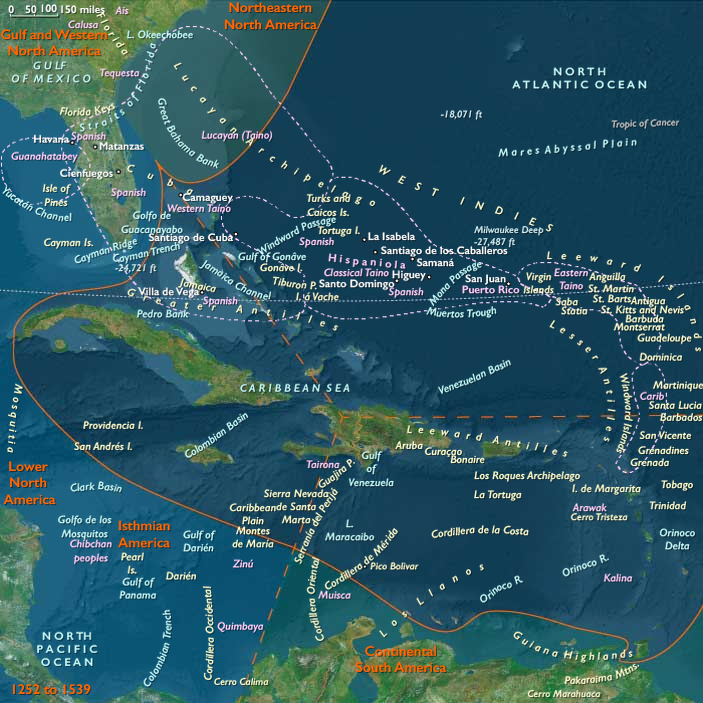
Cuban Governor Diego de Velázquez, hoping to establish a colony that might supply mineral riches and a replacement slave labor force, has sent a slave-hunting military expedition to the mainland under Francisco Hernandez de Córdoba.
Escaping a two-day storm of Cuba’s western tip, the expedition had sailed through twenty-one days of fair weather and calm seas after, which they spot the Maya-occupied Yucatán coast and, some six miles from the the coast and visible from the ships, the first large populated center seen by Europeans in the Americas, with the first solidly built buildings: this is possibly near the site of present Chetumal.
The Spaniards, who evoke the Muslims in all that is developed but not Christian, speak of this first city they discover in America as El gran Cairo, as they later are to refer to pyramids or other religious buildings as mezquitas, "mosques".
It is reasonable to designate this moment as the discovery of Yucatán—even "of Mexico", if one uses "Mexico" in the sense of the borders of the modern nation state—but it should be noted that Hernández's expeditionaries are not the first Spaniards to tread on Yucatán.
In 1511 a boat of the fleet of Diego de Nicuesa, which was returning to Hispaniola, was wrecked near the coast of Yucatán, and some of its occupants had managed to save themselves.
At the moment in which the soldiers of Hernández see and name El gran Cairo, two of those shipwrecked sailors, Gerónimo de Aguilar and Gonzalo Guerrero, are living in the area of Campeche, speaking the Mayan dialect of the area, and Gonzalo Guerrero even seems to have been governing an indigenous community.
Nicuesa's shipwrecked sailors who had not been not sacrificed or worked to death by their Maya captors had ended up enslaved.
The two boats of shallower draft go on ahead to investigate whether they could anchor securely near land.
Expedition member Bernal Diaz dates March 4, 1517 as the first encounter with the Indians of Yucatán, who approach these boats in ten large canoes (called pirogues), using both sails and oars.
Making themselves understood by signs—the first interpreters, Julián and Melchior, sare obtained by precisely this expedition — the Indians, always with "smiling face and every appearance of friendliness", communicate to the Spaniards that the next day more pirogues will come to bring the recent arrivals to land.
This moment in which the Indians come up to the Spanish boats and accept strings of green beads and other trifles fashioned for this purpose is one of the few peaceful contacts that Hernández's group will have with the Indians, and even these gestures of peace are feigned on the part of the Indians.
The following day, as promised, the natives return with more canoes, to transfer the Spaniards to land.
They are alarmed that the shore is full of natives, and that consequently the landing might prove to be dangerous.
Nonetheless, they land as they are asked to by their until-now friendly host, the cacique (chief) of El Gran Cairo, deciding however to land en masse using also their own launches as a precaution.
It also appears they armed themselves with crossbows and muskets (escopetas); "fifteen crossbows and ten muskets", if we credit the remarkably precise memory of Bernal Díaz del Castillo.
The Spaniards' fears are almost immediately confirmed.
The chief had prepared an ambush for the Spaniards as they approached the town.
They are attacked by a multitude of Indians, armed with pikes, bucklers, slings (Bernal says slings; Diego de Landa denies that the Indians of Yucatán were familiar with slings; he says they threw stones with their right hand, using the left to aim; but the sling was known in other parts of Mesoamerica, and the testimony of those at whom the stones were aimed seems worth crediting), arrows launched from a bow, and cotton armor.
Only the surprise resulting from the effectiveness of the Spaniards' weapons—swords, crossbows, and firearms—puts the more numerous Indians to flight, and allows the Spaniards to re-embark, having suffered the first injuries of the expedition.
as a result of which at least two soldiers will die.
During this battle of Catoche two things occur that are to greatly influence future events.
The first is the capture of two Indians, taken back on board the Spanish ships.
These individuals, who once baptized into the Roman Catholic faith, will receive the names Julianillo and Melchorejo (anglicized to Julián and Melchior), will later become the first Maya language interpreters for the Spanish, on Juan de Grijalva's subsequent expedition.
The second originates from the curiosity and valor of the cleric González, chaplain of the group, who having landed with the soldiers, undertakes to explore—and plunder—a pyramid and some adoratorios while his companions are trying to save their lives.
González has the first view of Maya idols and he brings away with him pieces "half of gold, and the rest copper", which in all ways will suffice to excite the covetousness of the Spaniards of Cuba upon the expedition's return.
After the soldiers return to the ships, the navigator Antón de Alaminos imposes slow and vigilant navigation, moving only by day, because he is certain that Yucatán is an island.
The stores of potable water casks and jugs are not of the quality required for long voyages ("we were too poor to buy good ones", laments Bernal); the casks are constantly losing water and they also fail to keep it fresh, so de Córdoba's ships need to replenish their supplies ashore.
The Spaniards have already noted that the region seems to be devoid of freshwater rivers.
Fifteen days after the battle at Catoche, the expedition lands to fill their water vessels near a Maya village they call Lázaro (after St Lazarus' Sunday, the day of their landing; "The proper Indian name for it is Campeche", clarifies Bernal).
Once again they are approached by Indians appearing to be peaceable, and the now-suspicious Spaniards maintain a heavy guard on their disembarked forces.
During an uneasy meeting, the local Indians repeat a word (according to Bernal) that ought to have been enigmatic to the Spaniards: "Castilan".
This curious incident of the Indians apparently knowing the Spaniards' own word for themselves they will later attribute to the presence of the shipwrecked voyagers of de Nicuesa's unfortunate 1511 fleet.
Unknown to de Córdoba's men, the two remaining survivors, Jerónimo de Aguilar and Gonzalo Guerrero, are living only several days' walk from the present site.
The Spaniards will not learn of these two men until the expedition of Hernán Cortés, two years later.
The Spaniards find a solidly built well used by the Indians to provide themselves with fresh water, with which they are invited fill their casks and jugs.
The Indians, again with friendly aspect and manner, bring them to their village, where once more they can see solid constructions and many idols (Bernal alludes to the painted figures of serpents on the walls, so characteristic of Mesoamerica).
They also meet their first priests, with their white tunics and their long hair impregnated with human blood.
This is the end of the Indians' friendly conduct: they convoke a great number of warriors and order them to burn some dry reeds, indicating to the Spaniards that if they aren't gone before the fire goes out, they will be attacked.
Hernández's men decide to retreat to the boats with their casks and jugs of water before the Indians can attack them, leaving safely behind them the discovery of Campeche.
Hernán Cortés had sailed with eleven ships, thirteen horses, a small number of cannon, and about six hundred and thirty men (including thirty crossbowmen and twelve arquebusiers, wielding an early form of firearm), a doctor, several carpenters, at least eight women, a few hundred Cuban Arawak indigenous and some Africans, both freedmen and slaves.
Landing on the Yucatan Peninsula in Mayan territory, he spends some time at Cozumel island, trying to convert the locals to Christianity and achieving mixed results.
The Grijalva and Cortés expeditions have both been received peacefully by the Maya of Cozumel, unlike the expeditions’ experiences on other parts of the mainland.
Cortés destroys some of the Maya idols on Cozumel and replaces them with an image of the Virgin Mary, but even so the native inhabitants of the island will continue to help the Spanish resupply their ships with food and water so they can continue their voyages.
While at Cozumel, Cortés hears reports of bearded men among a neighboring tribe.
Cortés sends messengers to these reported castilianos, who turned out to be the survivors of the Spanish shipwreck that had occurred in 1511, Gerónimo de Aguilar and Gonzalo Guerrero.
Aguilar, a Spanish Franciscan priest, has spent eight years in captivity with the Maya.
His continued fidelity to his religious vows had led him to refuse the offers of women made to him by the chief.
Aguilar petitions the chief to be allowed leave to join with his former countrymen, and he is released and makes his way to Cortés's ships.
According to Bernal Díaz, Aguilar relayed that before coming he had unsuccessfully attempted to persuade Guerrero to leave as well.
Guerrero had declined on the basis that he was by now well-assimilated with the Maya culture, had a Maya wife and three children, and as looked upon as a figure of rank within the Maya settlement of Chetumal where he lives.
Although Guerrero's later fate is somewhat uncertain, it appears that for some years he will continue to fight alongside the Maya forces against Spanish incursions, providing military counsel and encouraging resistance; it is speculated that he may have been killed in a later battle.
Aguilar demonstrates his fidelity to his faith by correctly identifying the day of week, from a steadfast following of his breviary, which he had been able to keep through all the years of his captivity.
Having become quite fluent in the the Chontal Maya language as well as some other indigenous languages, will prove to be a valuable asset for Cortés as a translator—a skill of particular significance to the later conquest of the Aztec Empire that is to be the end result of Cortés' expedition.
Cortés formally claims the land for the Spanish crown in March 1519.