Godfrid, Duke of Frisia
Duke of Frisia
Years: 840 - 885
Godfrid, Godafrid, Gudfrid, or Gottfrid (murdered June 885) is a Danish Viking leader of the late ninth century.
He had probably been with the Great Heathen Army.
He descends on the continent, and becomes a vassal of the emperor Charles the Fat, controlling most of Frisia between 882 and 885.
Related Events
Filter results
Showing 4 events out of 4 total
The Fragmentation of Middle Francia and the End of Viking Rule in Frisia (843–900)
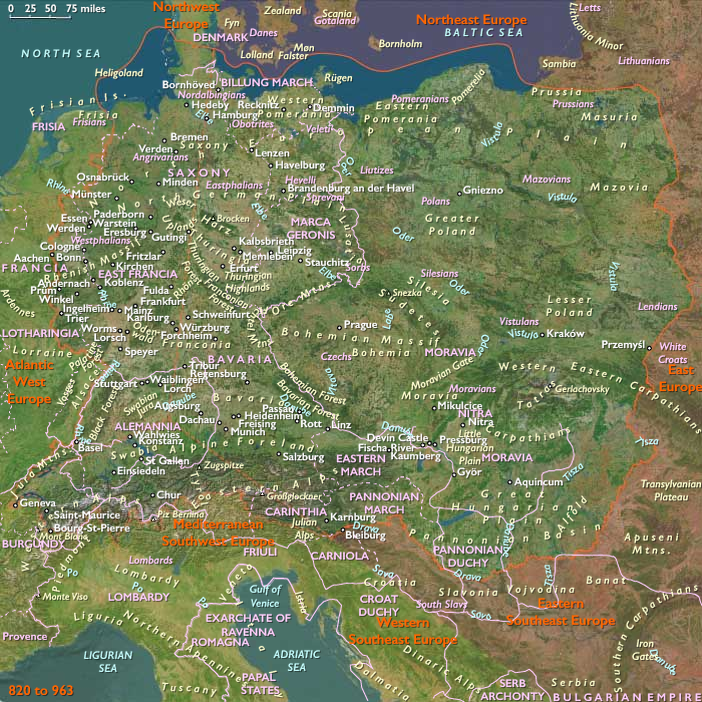
Following the Treaty of Verdun (843), the Carolingian Empire is divided into three distinct kingdoms:
- West Francia → The precursor to modern France.
- East Francia → The precursor to modern Germany and Austria.
- Middle Francia → A weak and politically unstable kingdom stretching from Frisia in the north to Italy in the south, including the Low Countries.
Viking Control in Frisia (850–885)
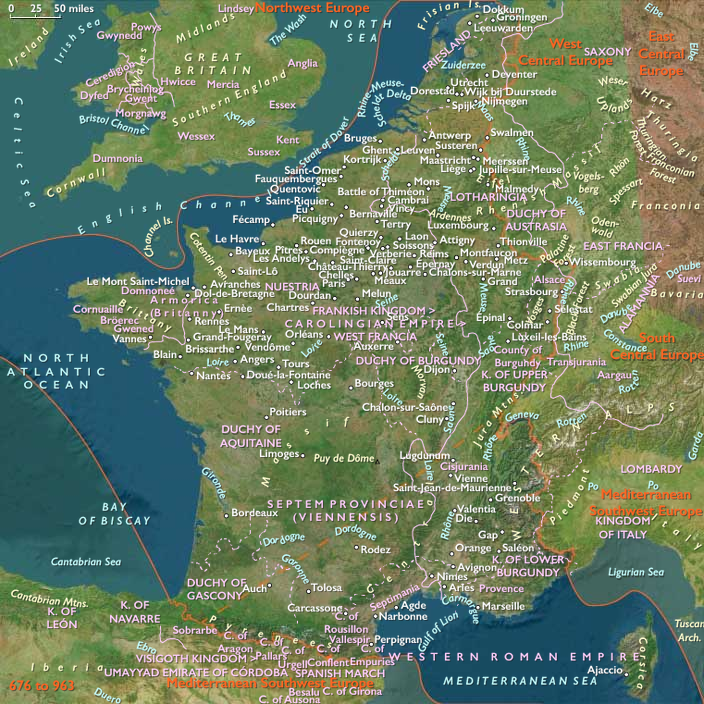
- Around 850, Lothair I of Middle Francia, unable to defend his northern territories from Viking incursions, acknowledges Rorik of Dorestad, a Danish Viking leader, as ruler of most of Frisia in exchange for his nominal loyalty.
- When Middle Francia is partitioned in 855, the northern lands pass to Lothair II, forming Lotharingia.
- After Lothair II’s death in 869, Lotharingia is divided into Upper and Lower Lotharingia, with the Low Countries becoming part of East Francia in 870 (under the Treaty of Meerssen). However, despite this formal annexation, the region remains effectively under Viking control, as Frisian and Frankish towns are frequently raided.
The Rise and Fall of Viking Rule in Frisia
- In 879, another Viking leader, Godfrid, Duke of Frisia, launches new raids on the Frisian lands, further destabilizing Frankish authority.
- The inability of West and East Francia to maintain control over Frisia allows local noblemen to take up the fight against Viking rule.
- Among these rising local leaders is Gerolf of Holland, who emerges as a key figure in the struggle for power.
The End of Viking Rule: Gerolf of Holland and the Assassination of Godfrid
- In 885, Gerolf, alongside other Frankish nobles, helps assassinate Godfrid, marking the end of Viking dominance in Frisia.
- In recognition of his role, Gerolf assumes lordship over Frisia, further cementing the transition from Carolingian royal rule to local noble governance.
The Legacy: The Fragmentation of Lower Lotharingia
- With the decline of central authority and the failure of East Francia to enforce its rule, Lower Lotharingia begins to fragment into semi-independent feudal states.
- The power vacuum left by the Carolingians and the Viking invasions strengthens the territorial lords, paving the way for the formation of the medieval Dutch and Flemish counties.
- Over time, these emerging feudal domains—such as Holland, Flanders, Brabant, and Gelre—will form the foundation of the medieval Low Countries, ultimately shaping the region’s future as an independent political entity.
Thus, what began as Carolingian instability and Viking incursions in the 9th century ultimately leads to the rise of regional feudal states, setting the stage for the later development of the Netherlands and Belgium.
The Battle of Thimeon (879): Louis the Younger's Victory Against the Vikings
By 879, Viking incursions into the Frankish kingdoms had reached a new level of intensity, particularly along the Scheldt River and deeper into the Carolingian heartlands. Norsemen from England had established permanent settlements along the river, using them as staging grounds for further attacks.
The Viking Threat in East Francia and West Francia (879)
- Since the summer of 879, Vikings had been increasing their attacks on the Frankish kingdom, raiding deep into the interior.
- West Francia under Louis III and Carloman II suffered the greatest devastation, with Viking forces sacking cities, monasteries, and trade centers.
- East Francia, ruled by Louis the Younger, also came under heavy Viking pressure, particularly along the Rhine and its tributaries.
Louis the Younger's Response and the Treaty of Ribemont (879)
- Christmas 879 → Louis the Younger celebrates the holiday at Frankfurt am Main, then meets with the West Frankish kings, Louis III and Carloman II, to negotiate a settlement of territorial claims.
- The Treaty of Ribemont → Signed in early 880, the treaty cements the division of Lotharingia, ensuring East Francia retains the region.
- With his borders secure from West Francia, Louis the Younger turns north to confront the Viking settlement on the Scheldt River.
The Battle of Thimeon (879)
- Louis leads his army northward, targeting Viking strongholds in the Low Countries.
- The two sides clash near Thimeon, close to modern Charleroi, Belgium.
- The battle is a decisive Frankish victory, with an estimated 5,000 Vikings killed—one of the largest losses suffered by Norse forces in the Frankish world.
- However, the victory comes at a heavy cost:
- Hugh of Saxony, Louis' only surviving son, is killed in battle.
- Hugh, an illegitimate son, had been a prominent military leader, serving as Count of Saxony and fighting border skirmishes against both Vikings and Hungarians.
Aftermath and Impact of the Battle
- The Viking settlement on the Scheldt is weakened but not fully eradicated—future raids continue in the 880s and 890s.
- Louis the Younger, devastated by the loss of his son, has no surviving heirs, creating uncertainty over East Francia’s succession.
- The Treaty of Ribemont (880), signed shortly after, secures Lotharingia for East Francia, ensuring that West Francia does not benefit from his victory.
- The Viking threat remains, though Louis' strong defense of his kingdom serves as an example for future Frankish rulers facing Norse incursions.
The Battle of Thimeon (879) represents one of the most significant victories against Viking forces in East Francia, but the death of Hugh of Saxony leaves Louis the Younger's kingdom vulnerable, setting the stage for further instability in the Carolingian world.

The Viking Siege of Asselt (882) and the Controversial Treaty of Charles the Fat
In 882, Emperor Charles the Fat gathers a large Frankish army at Worms to confront the Vikings encamped at Asselt on the Meuse in Frisia. This campaign, intended to drive the Norse invaders from Carolingian lands, ultimately results in a controversial treaty with Viking leaders Godfrid and Sigifrid, shaping Charles’ historical reputation.
The Frankish Military Campaign Against the Vikings
- Following his return from Italy and assumption of the East Frankish throne in Regensburg (early May 882), Charles takes immediate action against the Viking threat in Frisia.
- An army is assembled consisting of:
- Franks, Alemanni, Bavarii, Thuringii, Saxons, and Lombards.
- The campaign strategy:
- Lombards, Alemanni, and Franks move up the Rhine on the western bank.
- Bavarians march along the eastern bank and cross the Rhine at Andernach.
- Arnulf of Carinthia (Bavarians) and Henry of Franconia (Franks) are sent ahead to ambush the Norsemen.
The Siege of Asselt and the Unexpected Truce
According to the Mainz continuation of the Annales Fuldenses:
- The Frankish army is on the verge of capturing the Viking camp, but Charles is persuaded by Liutward of Vercelli (allegedly bribed by the Vikings) to accept peace terms instead of pressing the attack.
- Charles meets Viking envoys, leading to negotiations instead of outright battle.
- Godfrid is granted the Kennemerland (formerly ruled by Rorik of Dorestad) as a vassal of Charles.
- Sigifrid is paid Danegeld, with some funds taken from church treasuries.
Alternative Account from the Bavarian Continuation of the Annales Fuldenses
- The ambush fails due to treachery, delaying the Frankish assault.
- The twelve-day siege is broken by disease from rotting corpses and a violent hailstorm.
- Godfrid swears oaths to Charles, promising never again to raid the empire, and is baptized, with Charles serving as his godfather.
Aftermath and Contemporary Reactions
- Charles disperses his army at Koblenz, bringing an end to the campaign.
- The Mainz continuator of the Annales Fuldenses presents the event as a humiliating failure, blaming Charles for weakness and bribery, possibly due to the influence of Liutbert of Mainz, who had been dismissed from court.
- Other sources, including the Bavarian continuation, offer a less critical perspective, portraying the negotiations as a pragmatic response to unforeseen difficulties.
- Contemporaries do not widely view the campaign as a disaster, but later historians emphasize Charles’ diplomatic approach as an example of Carolingian weakness against Viking aggression.
Significance and Legacy
- The treaty of Asselt (882) is part of a larger Carolingian pattern of dealing with Vikings, alternating between military action, payments, and territorial concessions.
- Charles the Fat’s reputation for weakness largely stems from this campaign and its depiction in the Mainz annals, though his diplomatic approach was consistent with previous Frankish rulers.
- The continued Norse presence in Frisia reflects the ongoing fragmentation of Carolingian rule, as Viking leaders are increasingly integrated into the Frankish political system.
Though Charles' campaign at Asselt did not result in a decisive victory, it was not universally seen as a failure at the time. However, the perception of Charles as an ineffective ruler, shaped by contemporary political rivalries and later historical interpretations, has come to define his legacy.
The Fall of Godfrid and Hugh of Alsace: The Conference at Spijk (885)
By 885, Emperor Charles the Fat finds himself increasingly threatened by Viking incursions and the ambitions of his own nobles. Among those he fears most are:
- Godfrid, the Viking ruler of Frisia, who had previously sworn allegiance to Charles but remained a dangerous and unpredictable figure.
- Hugh, Duke of Alsace, Lothair II’s illegitimate son, who posed a potential rival for power in Lotharingia.
To neutralize both threats, Charles arranges a conference at Spijk, near Lobith (modern-day Netherlands), where he lures Godfrid into a trap.
The Conference at Spijk (885) and the Fall of Godfrid
- Charles summons Godfrid under the pretense of negotiations, likely promising him new lands or recognition of his rule in Frisia.
- When Godfrid arrives at Spijk, he falls into the emperor’s ambush.
- The Viking leader is captured and executed, eliminating one of the most formidable Norse warlords in the region.
The Fate of Hugh of Alsace
- Hugh, who had allied himself with Godfrid, is also betrayed and captured at Spijk.
- As punishment, he is blinded and sent to the monastery of Prüm, removing him as a political threat in Lotharingia.
Impact of the 885 Betrayal
- Charles the Fat temporarily secures Frisia, weakening Viking influence in the region.
- The blinding of Hugh removes a powerful Carolingian rival, consolidating Charles’ control over Lotharingia.
- However, Charles’ tactics of deception and treachery further alienate the Frankish nobility, many of whom are already disillusioned with his rule.
- The Viking threat is not eradicated—even as Godfrid is killed, other Norse warbands continue their raids into Francia, culminating in the Siege of Paris later that year.
A Short-Lived Victory
Though Charles successfully eliminates two dangerous rivals, his failure to strengthen his empire means that his rule remains fragile. His passive handling of Viking invasions, particularly the Siege of Paris (885–886), will soon lead to his deposition in 887, marking the final collapse of a united Carolingian Empire.