Godfrey of Bouillon
Frankish knight; one of the leaders of the First Crusade
Years: 1060 - 1100
Godfrey of Bouillon (c. 1060 – July 18, 1100) was a medieval Frankish knight who was one of the leaders of the First Crusade from 1096 until his death.
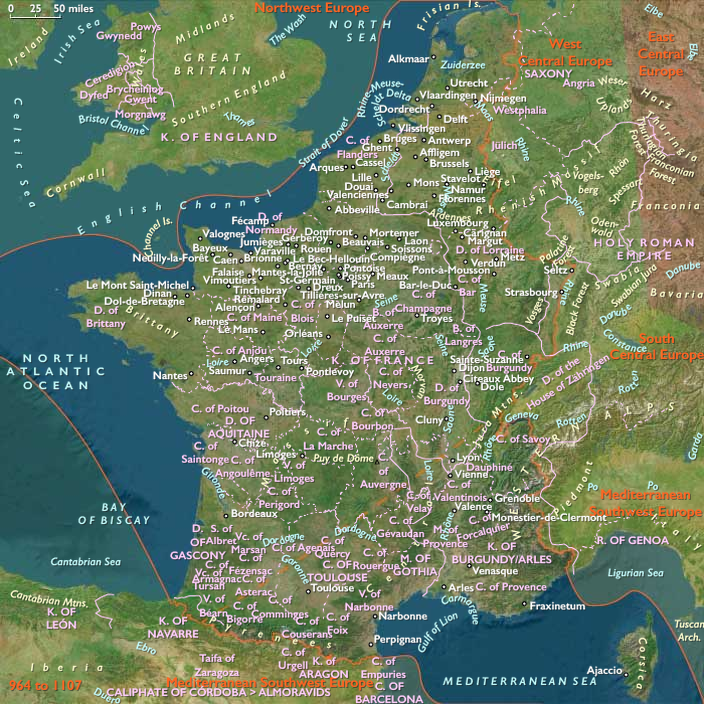
He was the Lord of Bouillon, from which he took his byname, from 1076 and the Duke of Lower Lorraine from 1087.
After the successful siege of Jerusalem in 1099, Godfrey became the first ruler of the Kingdom of Jerusalem, although he refused the title "King"; as he believed that the true King of Jerusalem was Christ.



Related Events
Filter results
Showing 10 events out of 93 total
Godfrey of Bouillon Reclaims Lower Lorraine (1087) and His Rise in the Holy Roman Empire
After a long struggle, Godfrey of Bouillon finally secured the Duchy of Lower Lorraine in 1087, proving his loyalty and military ability to Holy Roman Emperor Henry IV. His path to power was not straightforward, as he had to fight for his rightful inheritance, navigate the investiture controversy, and resist rival claims from within and outside his family.
Early Life and Family Background
- Born around 1060, Godfrey was the second son of Eustace II, Count of Boulogne, and Ida of Lorraine, the daughter of Godfrey the Bearded, Duke of Lower Lorraine.
- His birthplace was likely Boulogne-sur-Mer, though some sources claim Baisy in Lower Lorraine.
- As a second son, Godfrey initially had fewer prospects and seemed destined to be a minor noble in the service of a more powerful lord.
The Struggle for Lower Lorraine (1076–1087)
-
Godfrey's Uncle Names Him Heir (1076)
- Godfrey’s maternal uncle, Godfrey IV ("the Hunchback"), Duke of Lower Lorraine, died childless in 1076 and named his nephew as heir.
- However, Emperor Henry IV refused to grant him the duchy outright, instead appointing his own son as duke and leaving Godfrey only with Bouillon and the Margraviate of Antwerp.
- This was a test of Godfrey’s loyalty and abilities, as Lower Lorraine was a crucial imperial buffer statebetween France and the Holy Roman Empire.
-
Service to Emperor Henry IV (1076–1082)
- Despite being denied his full inheritance, Godfrey remained loyal to Henry IV, supporting him during the investiture controversy against Pope Gregory VII.
- He fought alongside Henry IV in Germany against the anti-king Rudolf of Swabia and later participated in Henry’s campaign in Italy, where Rome was captured from the pope in 1084.
-
Excluded from His Inheritance and Facing Rival Claims (1082–1087)
- Godfrey was excluded from his ducal inheritance until 1082, struggling to hold onto Bouillon and Antwerp.
- Matilda of Tuscany, widow of his uncle Godfrey the Hunchback, laid claim to parts of his lands, creating further disputes.
- Meanwhile, external enemies attempted to seize parts of his domain.
- His brothers, Eustace III of Boulogne and Baldwin II of Boulogne, came to his aid, helping him resist these challenges.
Godfrey Secures Lower Lorraine (1087)
- By 1087, Godfrey had proven his loyalty and military capabilities to Emperor Henry IV, who finally granted him the full Duchy of Lower Lorraine.
- His rule solidified the imperial influence over this critical frontier duchy, which buffered France from the Holy Roman Empire.
Legacy and Future Role
- Now firmly established as Duke of Lower Lorraine, Godfrey became one of the most important lords of the Holy Roman Empire.
- He would later achieve lasting fame as one of the leaders of the First Crusade (1096–1099), where he played a decisive role in the conquest of Jerusalem.
- His tenacity in securing his inheritance foreshadowed the determination he would later display in the Crusades.
The reclamation of Lower Lorraine in 1087 was a major turning point in Godfrey of Bouillon’s life, marking his ascendancy in imperial politics and setting the stage for his legendary role in the Crusades.
Conrad, born on February 12, 1074, at Hersfeld Abbey while his father, Henry IV, was fighting against the Saxon Rebellion, had been baptized in the abbey three days later.
After his victory against the Saxons, Henry had arranged for an assembly at Goslar on Christmas Day 1075 to swear an oath recognizing Conrad as his successor.
After the death of Duke Godfrey IV of Lower Lorraine on February 22, 1076, Henry had refused to appoint the late duke's own choice of successor, his nephew, Godfrey of Bouillon, and instead named his two-year-old son Duke of Lower Lorraine.
He did appoint Albert III of Namur, the deceased duke's brother-in-law, as his son vice-duke (vicedux) to perform the daily functions of government.
He also allowed the march of Antwerp to pass to Godfrey of Bouillon.
The total absence of Conrad from his duchy has caused or abetted the decline of ducal authority in it.
In 1082, while Conrad was in Italy, the peace of God had been introduced into the diocese of Liège.
Conrad had passed Christmas 1076 at Besançon with his parents.
Early the next year, he had accompanied his father across the Alps on the way to Canossa, because there was no one in Germany to whom Henry could have entrusted his son.
Conrad had subscribed to his first royal charter in 1079.
When Henry returned to Germany, Conrad had remained in Italy to act as a pledge to the imperialist party there.
He had been placed in the care of Archbishop Tedald of Milan and Bishop Denis of Piacenza, both excommunicated prelates and opponents of Pope Gregory VII.
In October 1080, Conrad had been present in the camp when a force from northern Italy defeated the troops of Marchioness Matilda of Tuscany near Mantua.
The Saxon lords who had supported the kingship of the late Rudolf of Swabia against Henry gathered in December 1080 "to discuss the state of their kingdom [Saxony]" in Bruno of Merseburg's words.
Henry had sent envoys to the Saxons asking them to accept his son Conrad as their king, and in exchange he promised never to enter Saxony.
(Conrad was apparently back in Germany.)
Otto of Northeim, speaking for the Saxons, "desired neither the son nor the father" since he had "often seen a bad calf begotten by a bad ox."
Henry had in December 1080 entered Italy, where he endeavored to wed his son to a daughter of Robert Guiscard.
He had offered Robert the march of Fermo as well, but no marriage could be agreed to since the duke had refused to do homage for his duchy of Apulia.
Again Henry left Conrad in Italy (July 1081), this time in the care of the lay princes "to watch over the province for him", according to the Annales Brunwilarenses and Annales Patherbrunnenses.
Conrad had returned to Germany in 1087 and, on May 30, had been crowned king in Aachen by Archbishop Sigwin of Cologne.
The ceremony was attended by Albert of Namur, Godfrey of Bouillon and Duke Magnus of Saxony, according to the Annales Weissenburgenses.
The last reference to Conrad as duke of Lower Lotharingia (dux Lothariorum) comes from a charter issued at Aachen shortly before his coronation, after which Henry had appointed Godfrey of Bouillon duke in his place.
On December 27, shortly after Conrad’s departure from Germany, his mother dies at thirty-six in Mainz.
By January 1088, Conrad has returned to Italy, with Bishop Ogerius of Ivrea as his chancellor and advisor.
The passing of Bertha perhaps provokes the rupture between Conrad and his father.
Sigwin von Are, a deacon in Cologne appointed archbishop here by the Emperor Henry IV in 1076, has remained a staunch supporter of Henry throughout the Investiture Controversy.
He had proclaimed the Peace of God in 1083, only the second bishop in Germany to do so.
He had rebuilt the church of Santa Maria in Cologne after it burned down in 1085, and on May 30, 1087, had crowned Henry's son Conrad King of Germany in Aachen.
He dies in Cologne and is buried in Cologne Cathedral.
Shortly after his death, he will begin to be called called "Sigwin the Pious."
…Euchaita and …
Jewish communities in the Rhineland (north of the main departure areas at Neuss, Wevelinghoven, Altenahr, Xanten and Moers) had been attacked in June and July 1095, but the leadership and membership of these crusader groups was not chronicled.
Some Jews have dispersed eastward to escape the persecution.
On top of the general Catholic suspicion of Jews at this time, when the thousands of French members of the People's Crusade arrive at the Rhine, they have run out of provisions.
To restock their supplies, they begin to plunder Jewish food and property while attempting to force them to convert to Catholicism.
In general, the crusader mobs do not fear any retribution as the local courts do not have the jurisdiction to pursue them past their locality nor the ability to identify and prosecute individuals out of the mob.
The pleas of the clergy are ignored on similar grounds (no cases against individuals are brought forward for excommunication) and the mob believes that anyone preaching mercy to the Jews is only doing so because they had succumbed to Jewish bribery.
Not all crusaders who have run out of supplies resort to murder; some, like Peter the Hermit, use extortion instead.
While no sources claim he preached against the Jews, he carries a letter with him from the Jews of France to the community at Trier.
The letter urges them to supply provisions to Peter and his men.
The Solomon bar Simson Chronicle records that they were so terrified by Peter’s appearance at the gates that they readily agreed to supply his needs.
Whatever Peter's own position on the Jews is, men claiming to follow after him feel free to massacre Jews on their own initiative, to pillage their possessions.
Bishop Egelbert of Trier, after being attacked by a mob on April 10, 1096, and threatened with death, offers to save all Jews who are willing to be baptized.
Most Jews choose to drown themselves instead.
Philip I’s Marital Scandal, Excommunication, and the Role of Hugh of Vermandois in the First Crusade (1092–1096)
By 1092, Philip I of France had become entangled in a scandalous affair that led to his excommunication and further complicated his relationship with Pope Urban II. His brother, Hugh of Vermandois, however, emerged as a key figure in the First Crusade, despite Philip’s own inability to participate due to his excommunication. Meanwhile, the Crusade triggered widespread anti-Jewish violence in France and the Rhineland, as religious fervor and millenarian expectations fueled persecution.
Philip I’s Marital Scandal and Excommunication (1092–1095)
- Philip married Bertha of Holland in 1072, and she bore him the necessary heir, Louis VI.
- However, in 1092, Philip fell in love with Bertrade de Montfort, who was already married to Fulk IV of Anjou.
- Philip repudiated Bertha (claiming she was “too fat”) and married Bertrade on May 15, 1092, despite her existing marriage.
- In 1094, Hugh, Archbishop of Lyon, excommunicated Philip for adultery and bigamy.
- At the Council of Clermont in November 1095, Pope Urban II renewed the excommunication, formally severing Philip from the Church.
Philip’s Position on the First Crusade and Hugh of Vermandois’ Role (1096)
- Because of his excommunication, Philip was unable to join the First Crusade, despite its origination at the Council of Clermont in his own kingdom.
- However, Philip’s brother, Hugh of Vermandois, became a leading participant in the Crusade, possibly to restore the family’s standing with the Church.
- In early 1096, Philip and Hugh discussed the Crusade, but Philip remained politically distant due to his conflict with the pope.
- Hugh was reportedly influenced to take the cross after witnessing a lunar eclipse on February 11, 1096, which he interpreted as a divine sign.
- Unlike other Crusader leaders who traveled by land, Hugh’s army departed France in the summer of 1096, crossed into Italy, and sailed across the Adriatic to reach the Byzantine Empire.
Jewish Persecutions in France and the Rhineland (1096)
- The Crusade triggered widespread anti-Jewish violence, beginning in France before spreading to the Rhineland.
- Sigebert of Gembloux wrote that Crusaders believed Jewish communities should convert before the war for the Lord began.
- The first outbreaks of violence occurred in France, where Crusaders attacked Jewish communities in Rouen, Paris, and other cities.
- A contemporary chronicle from Mainz describes how the Jews of France, fearing for their safety, sent letters to the Jewish communities along the Rhine, warning them of impending danger.
- The Jewish leaders in Mainz responded with a call for fasting and prayer, recognizing the grave threat posed by the Crusaders.
Significance and Consequences
- Philip’s excommunication prevented him from playing a major role in the First Crusade, but his brother Hugh of Vermandois ensured Capetian representation in the campaign.
- The anti-Jewish violence of 1096 marked one of the first large-scale massacres of European Jews, setting a precedent for future Crusader attacks on Jewish communities.
- Philip’s marital scandal and subsequent fallout with the papacy weakened his political authority, but he remained King of France, eventually reconciling with the Church years later.
Although Philip I himself could not join the First Crusade, his brother Hugh of Vermandois played a prominent role, while the Crusade’s religious fervor fueled devastating Jewish persecutions across France and Germany.
The largest of these “peoples’ crusades,” and the one most involved in attacking Jews, is that led by Count Emicho of Leiningen, on his way to join the Crusade led by Peter the Hermit.
Setting off in the early summer of 1096, an army of around ten thousand men, women and children proceed through the Rhine valley, towards the Main River and then to the Danube.
Emicho is joined by William the Carpenter and Drogo of Nesle, among others from the Rhineland, eastern France, Lorraine, Flanders and even England.
Emperor Henry IV, absent in southern Italy, had ordered the Jews to be protected when he learned of Emicho's intent.
After some Jews were killed at Metz in May, John, Bishop of Speyer had given shelter to the Jewish inhabitants.
Still, eleven Jews of Speyer are slain on May 3 by Emicho’s crusaders.
Count Emico attacks the synagogue at Speyer, but the Bishop of Speyer calls out his army, and the crusaders depart.
The Bishop of Worms also attempts to shelter Jews, but the crusaders break in to his episcopal palace and kill the Jews inside on May 18, regardless of age or sex.
Kalonymus Ben Meshullam, head of the Jewish community of Mainz, is said to have sent a messenger to King Henry IV in Italy, in consequence of which the king promulgated an order throughout his realm to the effect that the Jews were not to be molested.
However, he, together with fifty-three others, who had taken refuge in the palace of Bishop Adalbert of Worms from the Crusaders, put themselves to death rather than fall into the hands of the enemy during the Worms massacre.
At least eight hundred Jews are massacred in Worms when they refuse Catholic baptism.
One Jew, Simcha bar Isaac Hakohen, on May 25 pretends to submit to baptism.
As he enters the church, he attacks the priest, and is "torn to bits" by the crowd.
News of Emicho's crusade spreads quickly, and he is prevented from entering Mainz on May 25 by Bishop Ruthard.
Emicho also takes an offering of gold raised by the Jews of Mainz in hope to gain his favor and their safety.
Bishop Ruthard tries to protect the Jews by hiding them in his lightly fortified palace.
Nevertheless Emicho does not prevent his followers from entering the city on May 27 and a massacre follows.
Many among the Christian business class (the burghers) in Mainz, have working ties with Jews and give them shelter from the mobs (as the burghers in Prague also do).
The Mainz burghers join with the militia of the bishop and the burgrave (the town's military governor) in fighting off the first waves of crusaders.
This stand has to be abandoned when crusaders continue to arrive in ever greater numbers,and the militia of the bishop together with the bishop himself flees and leaves the Jews to be slaughtered by the crusaders Despite the example of the burghers, many ordinary citizens in Mainz and other the towns are caught up in the frenzy and joined in the persecution and pillaging.
Mainz is the site of the greatest violence, with at least eleven hundred Jews and (possibly more) being killed by troops under Clarambaud and Thomas.
The idea of suicide, normally abhorrent, is considered acceptable or even preferable under these circumstances.
One man, named Isaac, is forcefully converted, together with his two daughters and a friend called Uriah, but later, wracked with guilt, kills his family and burns himself alive in his house.
Another woman, Rachel, kills her four children with her own hands so that they will not be cruelly killed by the crusaders.
Emicho arrives on May 29 at Cologne, where most Jews had already left or were hiding in Christian houses.
The Bishop later escorts them to towns under his protection.
In Cologne, other smaller bands of crusaders meet Emicho, and they leave with quite a lot of money taken from the Jews here.
Emicho continues towards Hungary, soon joined by some Swabians.