Gnaeus Julius Agricola
Roman general
Years: 40 - 93
Gnaeus Julius Agricola (June 13, 40 – August 23, 93) is a Roman general responsible for much of the Roman conquest of Britain.
His biography, the De vita et moribus Iulii Agricolae, is the first published work of his son-in-law, the historian Tacitus, and is the source for most of what is known about him.
Born to a noted political family, Agricola begins his military career in Britain, serving under governor Gaius Suetonius Paulinus.
His subsequent career sees him serve in a variety of positions; he is appointed quaestor in Asia province in 64, then Plebeian Tribune in 66, and praetor in 68.
He supports Vespasian during the Year of the Four Emperors (69), and is given a military command in Britain when the latter becomes emperor.
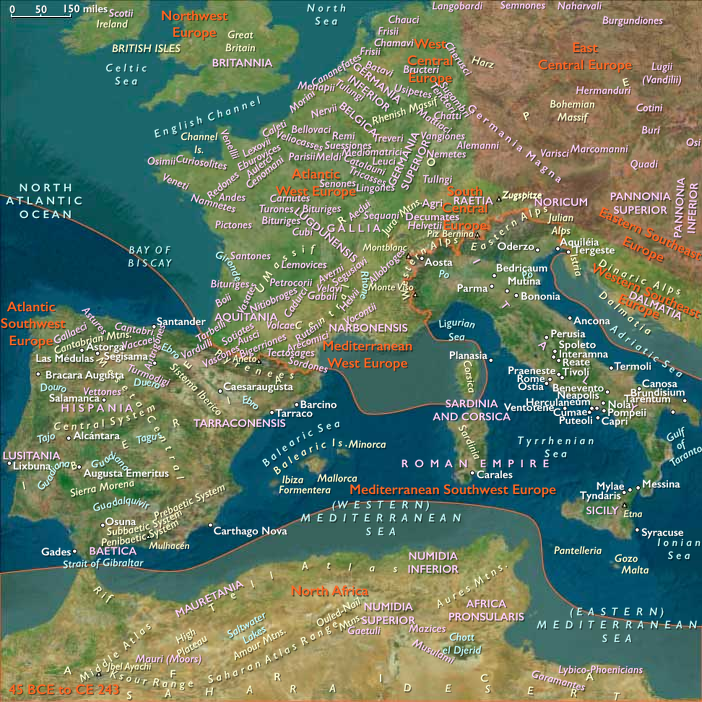
When his command ens in 73 he is made patrician in Rome and appointed governor of Gallia Aquitania.
He is made consul and governor of Britannia in 77.
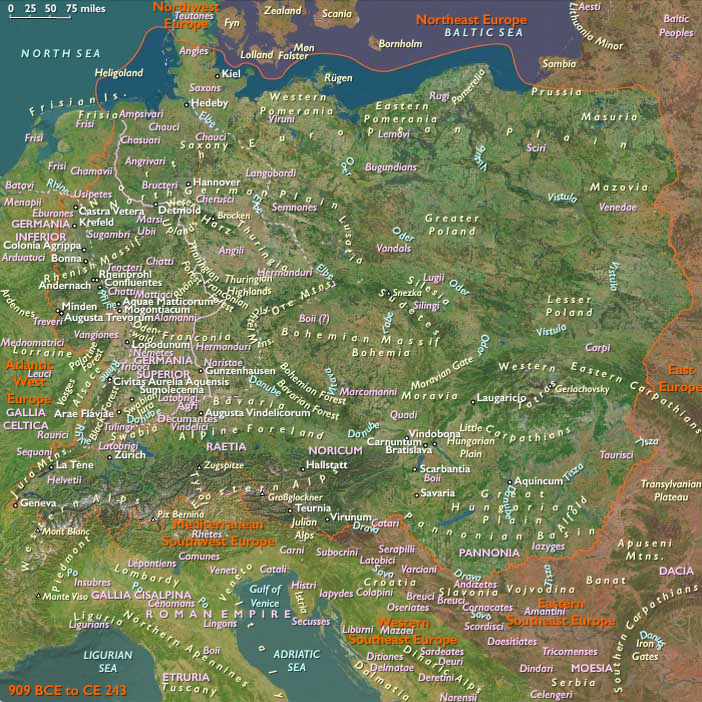
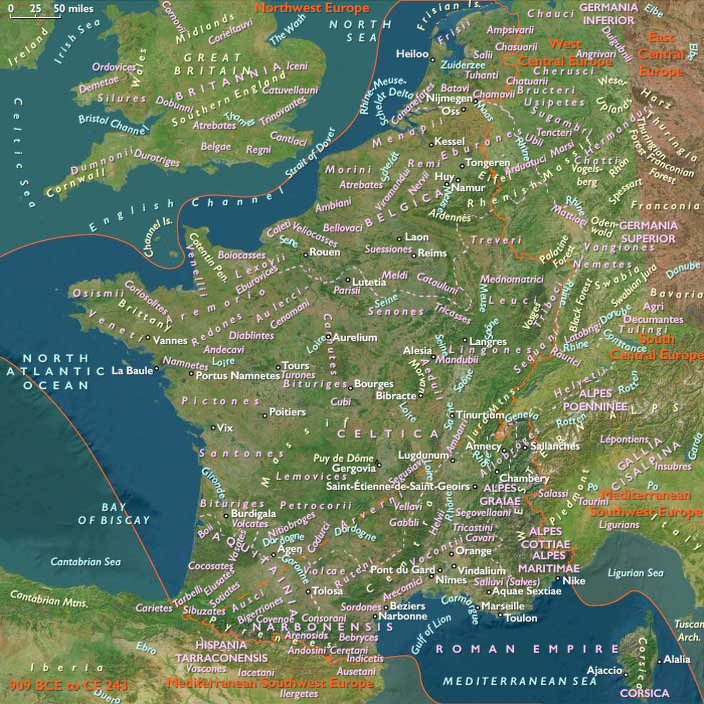
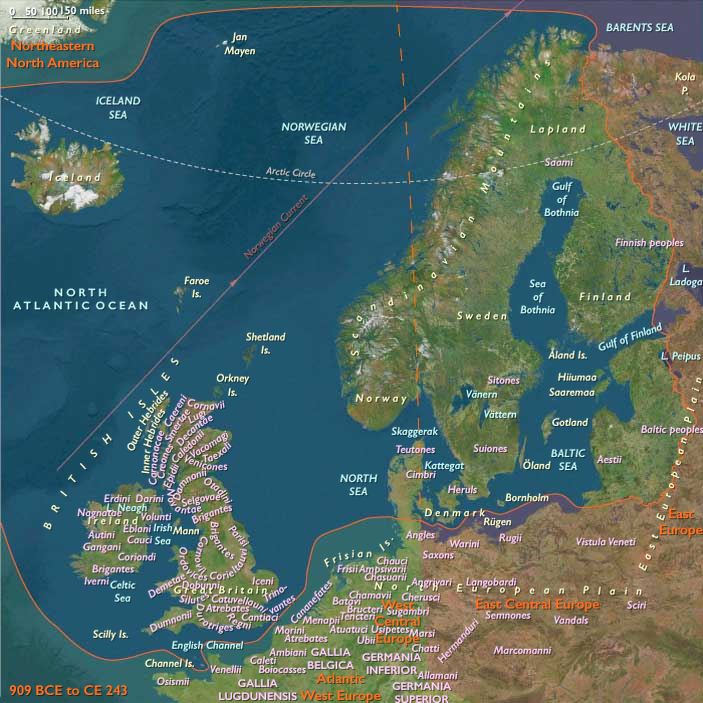
While there, he conquers much of what is now Wales and northern England, and ventures into lowland Scotland, where he establishes Roman dominance for a time.
Some speculate that he may have launched an expedition into Ireland as well.
He is recalled from Britain in 85 after an unusually lengthy service, and thereafter retires from military and public life.
Related Events
Filter results
Showing 10 events out of 20 total
He also leads a campaign into Scotland, but from these conquests he is recalled by the Emperor Domitian.
Verulamium (St. Albans), which had grown into a substantial town in the past decade, is sacked and burnt: a black ash layer has been recorded by archaeologists, thus confirming the Roman written record.
In the three settlements destroyed, between seventy and eighty thousand people are said to have been killed.
Tacitus says that the Britons had no interest in taking or selling prisoners, only in slaughter by gibbet, fire, or cross.
Dio's account gives more detail; that the noblest women were impaled on spikes and had their breasts cut off and sewn to their mouths, "to the accompaniment of sacrifices, banquets, and wanton behavior" in sacred places, particularly the groves of Andraste.
Tacitus, the most important Roman historian of this period, took a particular interest in Britain as Gnaeus Julius Agricola, his father-in-law and the subject of his first book, served there three times.
Agricola was a military tribune under Suetonius Paulinus, which almost certainly gave Tacitus an eyewitness source for Boudica's revolt.
Cassius Dio's account is only known from an epitome, and his sources are uncertain.
He is generally agreed to have based his account on that of Tacitus, but he simplifies the sequence of events and adds details, such as the calling in of loans, that Tacitus does not mention.
Suetonius regroups with his own Legio XIV Gemina, some vexillationes (detachments) of the XX Valeria Victrix, and any available auxiliaries, while Boudica's army continue their assault in Verulamium.
IX Hispana had been routed trying to relieve Camulodunum, and the prefect of Legio II Augusta, Poenius Postumus, stationed near Exeter, ignores the call, but nonetheless the governor is able to call on almost ten thousand men.
He takes a stand at an unidentified location, probably in the West Midlands somewhere along the Roman road now known as Watling Street, in a defile with a wood behind him—but his men are heavily outnumbered.
Dio says that, even if they were lined up one deep, they would not have extended the length of Boudica's line.
By now the rebel forces are said to have numbered two hundred and thirty thousand, however, this number should be treated with skepticism—Dio's account is known only from a late epitome, and ancient sources commonly exaggerate enemy numbers.
Boudica exhorts her troops from her chariot, her daughters beside her.
Tacitus gives her a short speech in which she presents herself not as an aristocrat avenging her lost wealth, but as an ordinary person, avenging her lost freedom, her battered body, and the abused chastity of her daughters.
She said their cause was just, and the deities were on their side; the one legion that had dared to face them had been destroyed.
She, a woman, is resolved to win or die; if the men want to live in slavery, that is their choice.
However, the lack of maneuverability of the British forces, combined with lack of open-field tactics to command these numbers, puts them at a disadvantage to the Romans, who are skilled at open combat due to their superior equipment and discipline.
Also, the narrowness of the field means that Boudica can put forth only as many troops as the Romans can at a given time.
First, the Romans stand their ground and used volleys of pila (heavy javelins) to kill thousands of Britons who are rushing toward the Roman lines.
The Roman soldiers, having used up their pila, are now able to engage Boudica's second wave in the open.
As the Romans advance in a wedge formation, the Britons attempt to flee, but are impeded by the presence of their own families, whom they have stationed in a ring of wagons at the edge of the battlefield, and are slaughtered.
This is not the first instance of this tactic—the women of the Cimbri, in the Battle of Vercellae against Gaius Marius, were stationed in a line of wagons and acted as a last line of defense.
Ariovistus of the Suebi is reported to have done the same thing in his battle against Julius Caesar.
Tacitus reports that "according to one report almost eighty thousand Britons fell" compared with only four hundred Romans.
According to Tacitus in his Annals, Boudica poisoned herself, though in the Agricola, which was written almost twenty years prior, he mentions nothing of suicide and attributes the end of the revolt to socordiam (indolence); Dio says she fell sick and died and then was given a lavish burial; though this may be a convenient way to remove her from the story.
Considering Dio must have read Tacitus, it is worth noting he mentions nothing about suicide (which was also how Postumus and Nero ended their lives).
Postumus, on hearing of the Roman victory, falls on his sword.
Suetonius conducts punitive operations.

Cerialis is appointed governor of Britain in 71, bringing the II Adiutrix with him to the province.
He is supported by Gnaeus Julius Agricola, commander of XX Valeria Victrix.
As governor, Cerialis campaigns against the Brigantes of northern England.
Gnaeus Julius Agricola, a general who had begun his career in Roman public life as a military tribune, serving in Britain under Gaius Suetonius Paulinus from 58 to 62, is Frontinus’ replacement as governor of Britannica in 78.
He was probably attached to the Legio II Augusta, but had been chosen to serve on Suetonius's staff and thus almost certainly had participated in the suppression of Boudica's uprising in 61.
Returning from Britain to Rome in 62, he had married Domitia Decidiana, a woman of noble birth.
Their first child was a son.
Agricola was appointed to the quaestorship for 64, which he served in the province of Asia under the corrupt proconsul Salvius Titianus.
While he was there his daughter, Julia Agricola, was born, but his son died shortly afterwards.
He was tribune of the plebs in 66 and praetor in 68, during which time he was ordered by Galba to take an inventory of the temple treasures.
In June 68, when the emperor Nero was deposed and committed suicide, and the period of civil war known as the Year of the Four Emperors began, Galba had succeeded Nero, but was murdered in early 69 by Otho, who took the throne.
Agricola's mother was murdered on her estate in Liguria by Otho's marauding fleet.
Hearing of Vespasian's bid for the empire, Agricola had immediately given him his support.
After Vespasian had established himself as emperor, Agricola had been appointed to the command of the Legio XX Valeria Victrix, stationed in Britain, in place of Marcus Roscius Coelius, who had stirred up a mutiny against the governor, Marcus Vettius Bolanus.
Britain had suffered revolt during the year of civil war, and Bolanus was a mild governor.
Agricola had reimposed discipline on the legion and helped to consolidate Roman rule.
Bolanus had been replaced in 71 by the more aggressive Quintus Petillius Cerialis, and Agricola had been able to display his talents as a commander in campaigns against the Brigantes.
When his command ended in 75, Agricola had been enrolled as a patrician and appointed to govern Gallia Aquitania.
He had been recalled to Rome in 76 or 77 and been appointed suffect consul, and had betrothed his daughter to Tacitus.
The following year Tacitus and Julia marry; Agricola is appointed to the College of Pontiffs, and returns to Britain for a third time, as its governor.
Arriving in midsummer of 77, Agricola finds that the Ordovices of north Wales have virtually destroyed the Roman cavalry stationed in their territory.
He immediately moves against them and defeats them.
He then moves north to the island of Mona (Anglesey), which had previously been reduced by Suetonius Paulinus in 61 but must have been regained by the Britons in the meantime, and forces its inhabitants to sue for peace.
Agricola, who establishes a good reputation as an administrator as well as a commander by reforming the widely corrupt corn levy, introduces romanizing measures, encouraging communities to build towns on the Roman model and educating the sons of the native nobility in the Roman manner.
Additionally, Titus visited Pompeii once after the eruption and again the following year.
During the second visit, …
…in spring of CE 80, a fire breaks out in Rome, burning large parts of the city for three days and three nights.
Although the extent of the damage is not as disastrous as during the Great Fire of 64—crucially sparing the many districts of insulae—Cassius Dio records a long list of important public buildings that were destroyed, including Agrippa's Pantheon, the Temple of Jupiter, the Diribitorium, parts of Pompey's Theater and the Saepta Julia among others.
Once again, Titus personally compensates for the damaged regions.
According to Suetonius, a plague similarly struck during the fire.
The nature of the disease, however, or the death toll are unknown.
Meanwhile war has resumed in Britannia, where Agricola pushes further into Caledonia and manages to establish several forts there.
As a result of his actions, Titus receives the title of Imperator for the fifteenth time.
Titus’s reign also sees the rebellion led by Terentius Maximus, one of several false Neros who continue to appear throughout the 70s.
In addition, sources state that Titus discovered that his brother Domitian was plotting against him but refused to have him killed or banished.
Practice of the imperial cult is revived by Titus, though apparently it met with some difficulty as Vespasian was not deified until six months after his death.
To further honor and glorify the Flavian dynasty, foundations are laid for what will later become the Temple of Vespasian and Titus, which will bes finished by Domitian.
Construction of the Flavian Amphitheater, presently better known as the Colosseum, had begun in 70 under Vespasian and is finally completed in 80 under Titus.
In addition to providing spectacular entertainments to the Roman populace, the building is also conceived as a gigantic triumphal monument to commemorate the military achievements of the Flavians during the Jewish wars.
Adjacent to the amphitheater, within the precinct of Nero's Golden House, Titus had also ordered the construction of a new public bathhouse, which is to bear his name.
Construction of this building is hastily finished to coincide with the completion of the Flavian Amphitheater.
The Colosseum features an immense oval superstructure standing 160 feet high (49 meters) and covers an area 118 feet long (615 meters) by 510 feet wide (156 meters).
The exterior walls are of travertine, the inner walls of tufa, and the vaulting of the ramped seating area of monolithic concrete.
Seventy-six of the eighty bays function as entryways, so that circulation is easy.
The arches of its four-story outer wall are framed by superimposed orders: Roman Doric on the ground floor, Ionic above that, and Corinthian on the third level.
The fourth story, embellished with Corinthian pilasters, carries wooden masts from which an awning (“velarium”) is suspended to shield spectators from the sun.
Marble and wooden seating for up to about fifty thousand spectators surrounds an arena 86 meters by 280 feet by 175 feet (54 meters).
The arena’s floor is built of heavy wooden planks; chambers below house animals for the games, passed from there to the arena by means of special corridors and counterbalanced elevators.
The flooring can be removed and the entire area flooded for mock naval battles.
The Romans build a fort at the site of present Caernarfon, a seaport on the Menai Strait in northwestern Wales in about 80.
The Roman fort, called Segontium, is established to aid in the subjugation of the Ordovices as part of the Roman conquest of Britain.