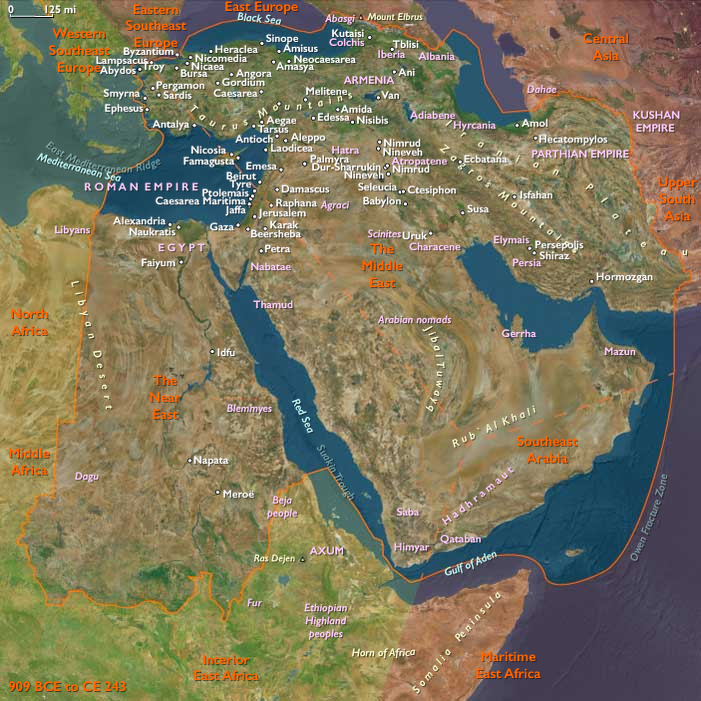
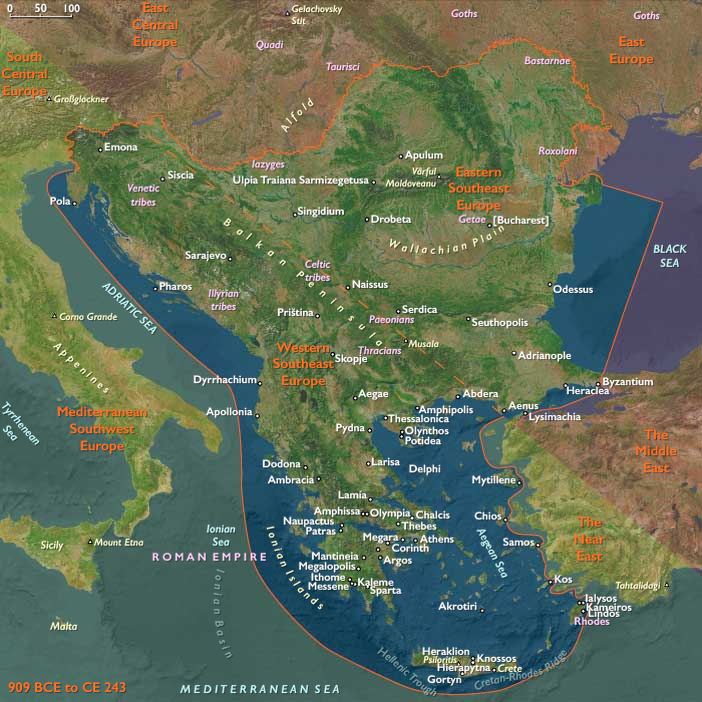
Cassius and Brutus, having usurped control of most of the Eastern provinces, including Macedonia, Asia Minor, and Syria, combine their armies, cross the Hellespont, march through Thrace, and encamp near Philippi (near present Kavalla) in Macedonia.
The combined armies, with forces roughly equal those of their opponents, lie astride the Via Egnatia to the west of Philippi, their position being partly protected by a marsh.
Their intention is to starve out the enemy, but they are forced into an engagement.
Brutus is successful against Octavian's camp, but Cassius, defeated by Antony's successful attack on the camp, gives up all for lost and orders his freedman Pindarus to slay him.
He is mourned by Brutus as "the Last of the Romans" and buried at Thasos.
Brutus, against his better judgment, fights a second action about three weeks later, on October 23, in which he is routed; despairing of restoring the republican cause, he too commits suicide, leaving the triumvirate in control of the Roman Republic.
Plutarch reports that Antony covered Brutus' body with a purple garment as a sign of respect: they had been friends.
He remembered that Brutus had placed as a condition for his joining the plot to assassinate Caesar that the life of Antony should be spared.
Many other young Roman aristocrats lost their life in the battle or committed suicide after the defeat, including the son of great orator Hortensius, and Marcus Porcius Cato (II) (the son of Cato the younger), and Marcus Livius Drusus Claudianus (the father of Livia, who became Octavian’s wife).
Porcia, Brutus’ wife, reportedly also killed herself by swallowing a red-hot coal when she received news of the defeat. (According to Plutarch [Brutus 53 para 2], there is some dispute as to whether this is the case: Plutarch states that there is a letter in existence that was allegedly written by Brutus mourning the manner of her death.)
Some of the nobles who are able to escape negotiate their surrender to Antony and enter his service (among them Marcus Calpurnius Bibulus and Marcus Valerius Messalla Corvinus).
Apparently, the nobles do not want to deal with the young and merciless Octavian. (Mark Antony will later use the examples of these battles as a means to belittle Octavian, as both battles had been decisively won with the use of Antony's forces.
In addition to claiming responsibility for both victories, Antony will also brand Octavian as a coward for handing over his direct military control to his boyhood friend, Marcus Vipsanius Agrippa, instead.)
Sextus Pompeius in 44 following the assassination of Caesar had come to terms with Mark Antony and been given a naval command, but in August 43 he had been outlawed.
Despite the fact the Sextus is controlling Sicily and Domitius Ahenobarbus still commands the republican fleet, the republican resistance had been definitely crushed at Philippi.
The remains of the Liberators’ army are rounded up and roughly fourteen thousand men are enrolled into the triumvirs’ army.
Old veterans are discharged back to Italy, but some of the veterans remain in the town of Philippi, which becomes a Roman colony (this will later be reinforced by Augustus).
After the battle, a new arrangement is made between the members of the Second Triumvirate, who agree to divide the empire.
Antony proceeds to take up the administration of the eastern provinces.