Georg Forster
German naturalist, ethnologist, travel writer, journalist, and revolutionary
Years: 1754 - 1794
Johann Georg Adam Forster (November 27, 1754 – January 10, 1794) is a German naturalist, ethnologist, travel writer, journalist, and revolutionary.
At an early age, he accompanies his father on several scientific expeditions, including James Cook's second voyage to the Pacific.
His report from that journey, A Voyage Round the World, contributes significantly to the ethnology of the people of Polynesia and remains a respected work.
As a result of the report, Forster is admitted to the Royal Society at the early age of twenty-two and comes to be considered one of the founders of modern scientific travel literature.
After returning to continental Europe, Forster turns toward academia.
He travels to Paris to seek out a discussion with the American revolutionary Benjamin Franklin in 1777.
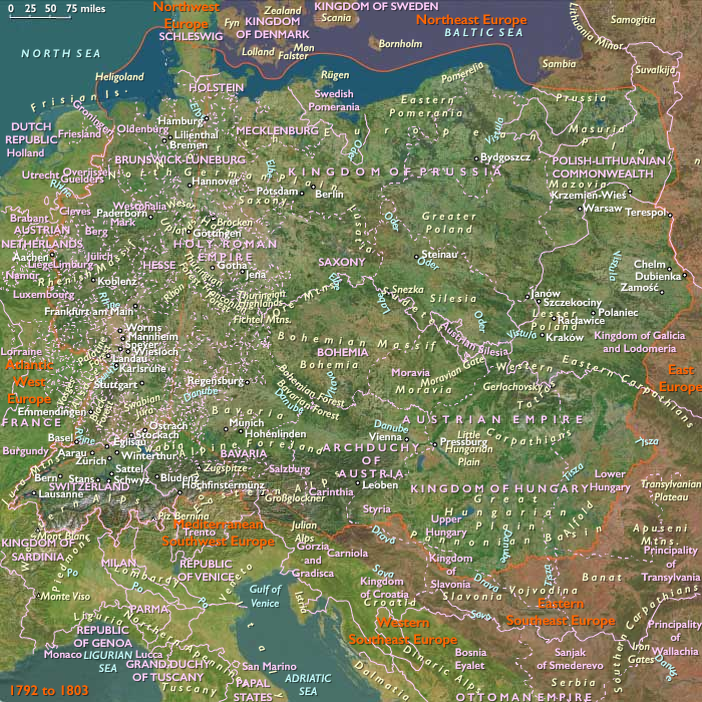
He teaches natural history at the Collegium Carolinum in Kassel (1778–1784), and later at Academy of Vilna (Vilnius University) (1784–1787).
He then (1788) becaomes head librarian at the University of Mainz.
Most of his scientific work during this time consists of essays on botany and ethnology, but he also prefaces and translates many books about travels and explorations, including a German translation of Cook's diaries.
Forster is a central figure of the Enlightenment in Germany, and corresponds with most of its adherents, including his close friend Georg Christoph Lichtenberg.
His ideas and personality influence Alexander von Humboldt, one of the great scientists of the 19th century.
When the French take control of Mainz in 1792, Forster becomes one of the founders of the Jacobin Club there and goes on to play a leading role in the Mainz Republic, the earliest republican state in Germany.
During July 1793 and while he is in Paris as a delegate of the young Mainz Republic, Prussian and Austrian coalition forces regain control of the city and Forster is declared an outlaw.
Unable to return to Germany and separated from his friends and family, he dies in Paris of illness in early 1794.