Genghis Khan
Supreme Khan of the Mongols
Years: 1162 - 1227
Genghis Khan (1162?
– August 1227), born Temujin, is the founder and Great Khan (emperor) of the Mongol Empire, which became the largest contiguous empire in history after his demise.
He comes to power by uniting many of the nomadic tribes of northeast Asia.
After founding the Mongol Empire and being proclaimed "Genghis Khan", he starts the Mongol invasions that result in the conquest of most of Eurasia.
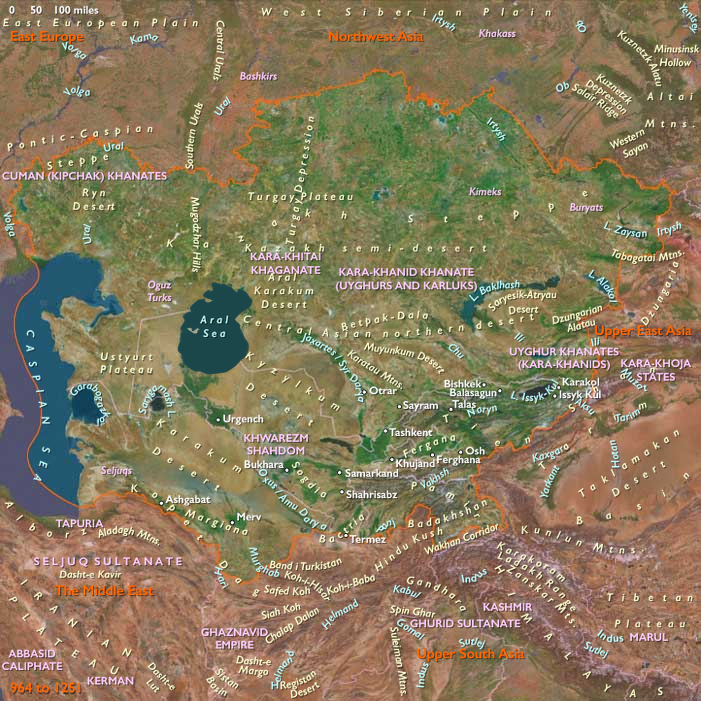
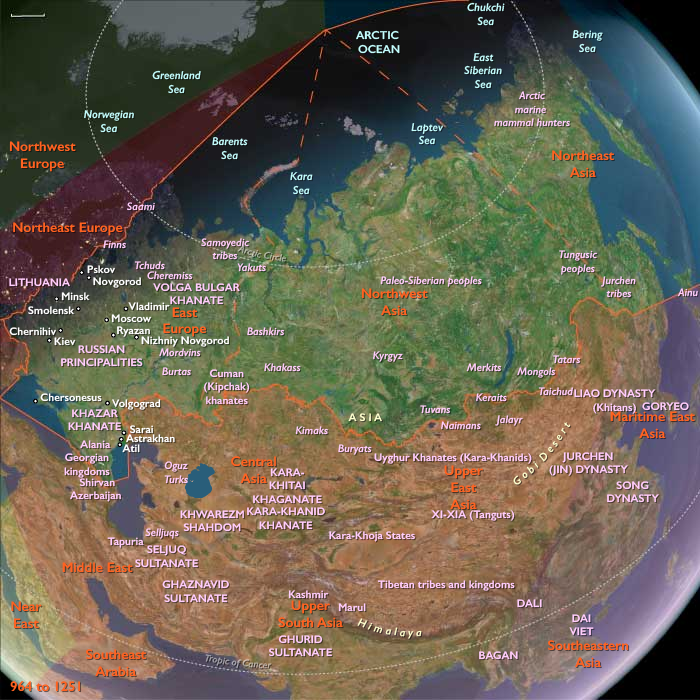
These include raids or invasions of the Kara-Khitan Khanate, Caucasus, Khwarezmid Empire, Western Xia and Jin dynasties.
These campaigns are often accompanied by wholesale massacres of the civilian populations – especially in Khwarezmia.
By the end of his life, the Mongol Empire occupies a substantial portion of Central Asia and China.
Before Genghis Khan dies, he assigns Ögedei Khan as his successor and splits his empire into khanates among his sons and grandsons.
He dies in 1227 after defeating the Western Xia.
He is buried in an unmarked grave somewhere in Mongolia at an unknown location.
His descendants go on to stretch the Mongol Empire across most of Eurasia by conquering or creating vassal states out of all of modern-day China, Korea, the Caucasus, Central Asian countries, and substantial portions of modern Eastern Europe, Russia and the Middle East.
Many of these invasions repeat the earlier large-scale slaughters of local populations.
As a result, Genghis Khan and his empire have a fearsome reputation in local histories.
Beyond his military accomplishments, Genghis Khan also advances the Mongol Empire in other ways.
He decrees the adoption of the Uyghur script as the Mongol Empire's writing system.
He also promotes religious tolerance in the Mongol Empire, and creates a unified empire from the nomadic tribes of northeast Asia.
Present-day Mongolians regard him as the founding father of Mongolia.