Gelawdewos
Emperor of Ethiopia
Years: 1521 - 1559
Gelawdewos ("Claudius"; 1521/1522 - March 23, 1559) is nəgusä nägäst (throne name Asnaf Sagad I, "to whom the peaks bow"; September 3, 1540 - March 23, 1559) of Ethiopia, and a member of the Solomonic dynasty.
He is a younger son of Dawit II by Sabla Wengel.
Related Events
Filter results
Showing 10 events out of 22 total
The emperor Gelawdewos (reigned 1540-59), joining with a small number of Portuguese soldiers requested earlier by Lebna Dengel, is finally able to defeat the Muslim forces and kill Grahn.
The death of the charismatic Grahn destroys the unity of the Muslim forces that had been created by their leader's successes, skill, and reputation as a warrior and religious figure.
Ethiopia's Christian armies slowly push the Muslims back and regain control of the highlands.
Ethiopians have suffered extraordinary material and moral losses during the struggle against Grahn, and it will be decades or even centuries before they will recover fully.
The memory of the bitter war against Grahn remains vivid even today.
The Oromo migration results, in a more immediate sense, in a weakening of both Christian and Muslim power and drives a wedge between the two faiths along the eastern edge of the highlands.
In the Christian kingdom, Oromo groups infiltrate large areas in the east and south, with large numbers settling in Shewa and adjacent parts of the central highlands.
Others penetrate as far north as eastern Tigray.
The effect of the Oromo migrations is to leave the Ethiopian state fragmented and much reduced in size, with an alien population in its midst.
Hereafter, the Oromo play a major role in the internal dynamics of Ethiopia, both assimilating and being assimilated as they are slowly incorporated into the Christian kingdom.
In the south, the Sidama fiercely resist the Oromo, but, as in the central and northern highlands, they are compelled to yield at least some territory.
In the east, the Oromo sweep up to and even beyond Harar, dealing a devastating blow to what remains of Adal and contributing in a major way to its decline.
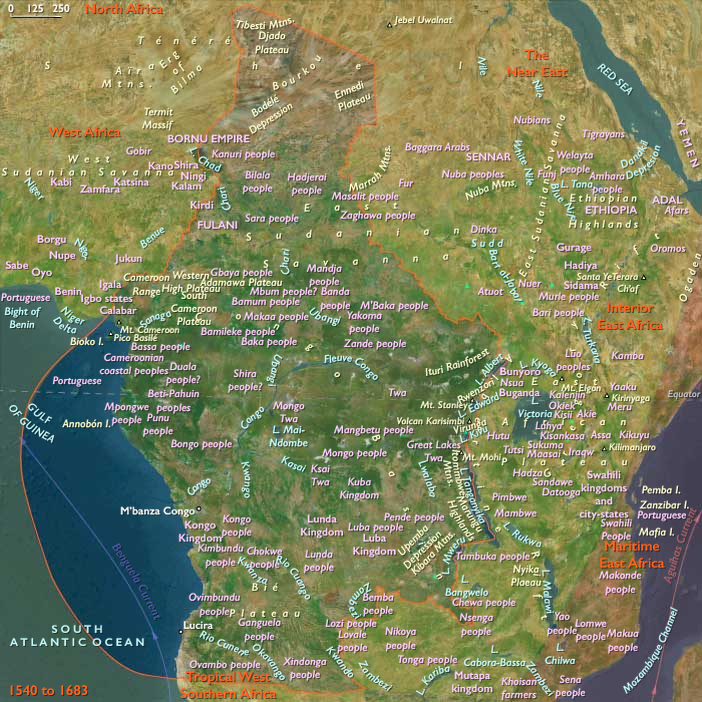
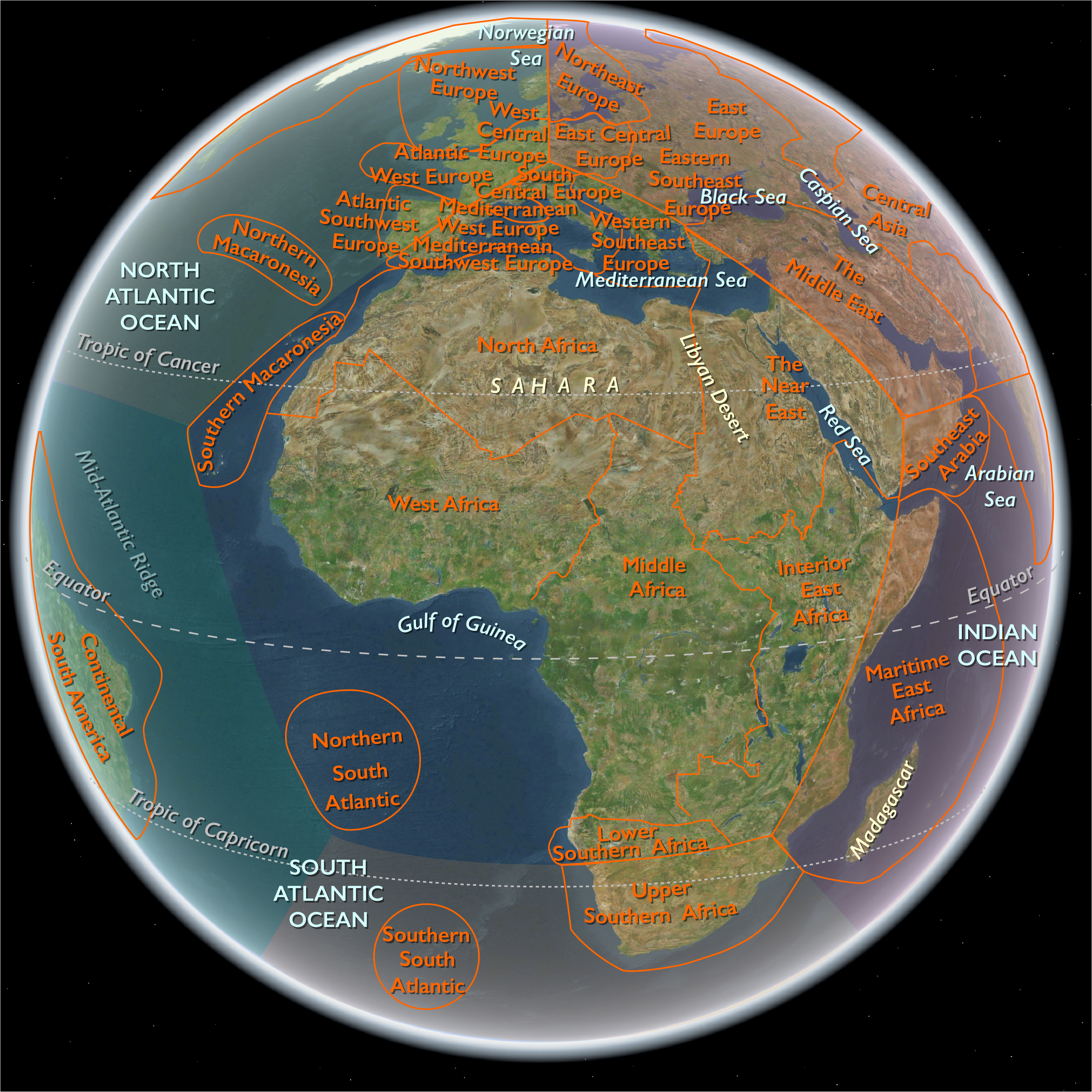
Interior East Africa (1540–1551 CE): The Climax and Reversal of Ahmad ibn Ibrahim's Jihad
Continued Struggle Against Ahmad ibn Ibrahim al-Ghazi
In the early 1540s, the Ethiopian Empire remained locked in a brutal struggle against the forces of the Adal Sultanate, led by the charismatic and formidable military commander Ahmad ibn Ibrahim al-Ghazi (Gragn). By 1540, Gragn had successfully overrun much of Ethiopia's central highlands—devastating Christian infrastructure, burning churches, and subjugating entire provinces. Emperor Lebna Dengel (Dawit II) was unable to mount effective resistance and was driven into hiding, eventually dying in 1540.
Portuguese Military Intervention and Turning Point
Responding urgently to Ethiopia's calls for help, Portugal dispatched a substantial military expedition under Cristóvão da Gama, son of the famed Portuguese explorer Vasco da Gama. Cristóvão arrived in Massawa in February 1541 with a force of around 400 musketeers, equipped with advanced firearms and artillery. Initially achieving a series of victories, Cristóvão da Gama's troops lifted the spirits of beleaguered Ethiopian resistance forces and marked the first major check on Gragn’s relentless advance.
However, after initial successes, Cristóvão da Gama himself was captured and executed by Gragn’s forces in August 1542, dealing a severe blow to Ethiopian-Portuguese morale and temporarily emboldening the Muslim forces.
Decisive Ethiopian-Portuguese Victory at Wayna Daga (1543)
In response to Cristóvão's execution, Emperor Gelawdewos (Claudius)—successor to Lebna Dengel—rallied Ethiopian forces and the surviving Portuguese soldiers for a final, decisive confrontation. On February 21, 1543, the combined Ethiopian-Portuguese army met Gragn’s forces at the pivotal Battle of Wayna Daga near Lake Tana. Using superior artillery and disciplined infantry tactics, Gelawdewos achieved a landmark victory, during which Ahmad ibn Ibrahim al-Ghazi was killed, effectively ending the military threat from Adal.
The significance of this victory extended far beyond the battlefield: it saved Ethiopian Christianity from potential annihilation, stabilized the empire, and dramatically shifted the regional balance of power.
Aftermath and Regional Consolidation
Despite this major victory, the immediate aftermath saw continued regional turmoil. Gragn’s death fractured the Adal Sultanate, plunging the Muslim states of the region into internal conflicts and weakening their capacity to pose a unified threat to the Ethiopian state. Meanwhile, the alliance with Portugal introduced new religious tensions, as Portuguese Jesuits, emboldened by their military contributions, sought to promote Roman Catholicism, eventually causing friction within Ethiopian society and royal circles.
Key Historical Developments
-
Emperor Lebna Dengel's death (1540), underscoring Ethiopia’s dire situation.
-
Arrival of Portuguese expedition under Cristóvão da Gama (1541), providing critical military support.
-
Temporary defeat and execution of Cristóvão da Gama by Ahmad Gragn’s forces (1542), signaling a low point for Ethiopian-Portuguese allies.
-
The decisive Ethiopian-Portuguese victory at the Battle of Wayna Daga (1543), resulting in Gragn’s death and significantly weakening the Adal Sultanate.
Long-Term Consequences and Historical Significance
The era from 1540 to 1551 marked a critical turning point in East African history. The defeat of Ahmad ibn Ibrahim al-Ghazi’s jihad preserved Ethiopia's Christian identity and sovereignty, but also heralded greater Portuguese and thus European involvement in the Horn of Africa. These interactions with Europe introduced new complexities, contributing to internal divisions within Ethiopia over religious and political alignments that would shape regional dynamics for generations.
Dawit II is killed in battle near Debre Damo on September 2.
Estêvão da Gama (eldest son of the famous navigator Vasco da Gama and now Portugal’s Viceroy of India), returns to Massawa on May 22, 1541, to rejoin the ships he has left here.
While at Massawa, he attempts to salvage something from this raid by dispatching an expeditionary force under his younger brother Cristavão to assist the beleaguered Emperor of Ethiopia, who is now Gelawdewos; the Portuguese are mindful of their need for a mainland ally in East Africa.
Four hundred Portuguese men-at-arms are selected, seventy of whom are also skilled artisans or engineers, and one hundred and thirty slaves for this expedition, equipped with about a thousand arquebuses, an equal number of pikes and several bombards.
After being landed at Massawa and Arqiqo, the next port south of Massawa, the men began their trek inland to Debarwa, the capital of the Bahr negus, or Ethiopian viceroy for the northern provinces.
The Portuguese reach Debarwa after a march of eleven days on July 20, to learn that the rainy season renders further travel impossible.
Cristavão will not allow his men to pass the months in idleness, and has them construct sleds for the bombards and mount raids on nearby villages that have accepted Ahmed Gragn's rule.
He also learns from the Bahr negus that Queen Sabla Wengel is camped nearby on top of a mountain that Ahmed has been unable to reduce by siege.
With one hundred men, he marches to the mountain, and invites the queen to join him; she does so, bringing her entourage of thirty men and fifty women, all of who are received with careful ceremony.
The Portuguese continue south once the rains end.
Gama, after months of being slowed by their equipment, decides to leave half of it in an arsenal on Debre Damo.
His army passes the Church of St. Romanos around Christmas of 1541.
Taddesse Tamrat, an Ethiopian historian writes, "The Muslim occupation of the Christian highlands under Ahmad Gragn lasted for little more than ten years, between 1531 and 1543. But the amount of destruction brought about in these years can only be estimated in terms of centuries."
Gama, after celebrating Epiphany in the province of Agame in January 1542, has his first encounter with the Muslim troops on February 2 at the Battle of Bacente, which Whiteway identifies with Amba Sonaut in Haramat.
The invaders had taken possession of a hill from which they made raids into the countryside.
Although Queen Sabla Wengel advises Gama to march around this hill, advising him to wait until her son Emperor Gelawdewos could arrive from Shewa and join him, he believes that failing to engage the invaders will make the natives distrust his troops, and that they would then stop bringing food and supplies.
Fortunately, the engagement is an unquestioned success, and Gama's men take the hill despite superior enemy numbers, losing only eight men.
Two Portuguese arrive at the end of February from a ship anchored at Massawa, escorted by six people native to the area.
Gama responds with a detachment of forty men to make contact, obtain supplies, and exchange news.
This group fails to reach the ship before it sails, and the only outcome is that these soldiers and their captain are absent for the next battle, which is against Ahmad Gragn himself.
The events at Bacente have alerted Ahmad Gragn, as Queen Sable Wengel had feared, that a hostile army has entered the area, and he marches north to confront it, meeting Gama at Jarte (which Whiteway identifies with the province of Wagarta).
The Imam makes the first contact, sending a messenger to Gama to demand that the Portuguese force either leave Ethiopia, join Ahmad Gragn, or be destroyed.
On the Imam's orders, the messenger produces the gift of a monk's habit, an expensive insult to Gama.
Gama responds with his own messenger, who delivers "a few lines in Arabic", stating that he had come to Ethiopia "by order of the great Lion of the Sea" and on the "following day he [Ahmad Gragn] would see what the Portuguese were worth", and delivers Gama's own insulting gift: a pair of "small tweezers for the eyebrows, and a very large mirror -- making him out [to be] a woman."
Two battles follow these exchanges at Jarta, the first on April 4 and the next on April 16.
The first battle is a victory for the Portuguese, although Gama loses one of his captains: Ahmad Gragn is wounded, which forces his troops to retire to the far side of the plain.
The Portuguese, finding their encampment on the battlefield becoming unbearable, move across the plain next to the enemy camp, which leads to the second battle.
This time, the Muslim army is even more soundly defeated, and according to Castanhoso, "The victory would have been complete this day had we only [had] a hundred horses to finish it."
Ahmad Gragn is forced to retreat further south, to a village Whiteway identifies as Wajarat.
With fortune against him, the local population now openly defies him by refusing to provide him supplies or soldiers.
Gama marches as far as Lake Ashangi, where, on the advice of Queen Sable Wengel, he makes camp on a hill in Wofla as the rainy season starts.