Gediminas
Grand Duke of Lithuania
Years: 1275 - 1341
Gediminas, also known as Hedzimin (c.1275 – December 1341), is Grand Duke of Lithuania from 1315 or 1316 until his death.
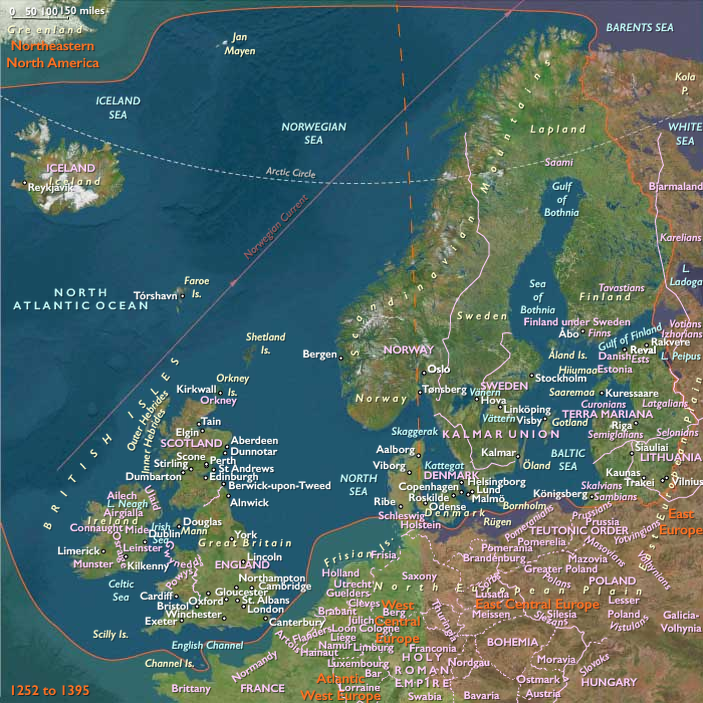
He is credited with founding this political entity and expanding its territory which, at the time of his death, spans the area ranging from the Baltic Sea to the Black Sea.
Also seen as one of the most significant individuals in early Lithuanian history, he is responsible for both building Vilnius, the capital of Lithuania, and the establishment of a dynasty that can be traced to other European monarchies such as Poland, Hungary and Bohemia.
As part of his legacy, he gains a reputation for being a champion of paganism, who successfully diverts attempts to Christianize his country by skillful negotiations with the Pope and other Christian rulers.

Related Events
Filter results
Showing 10 events out of 27 total
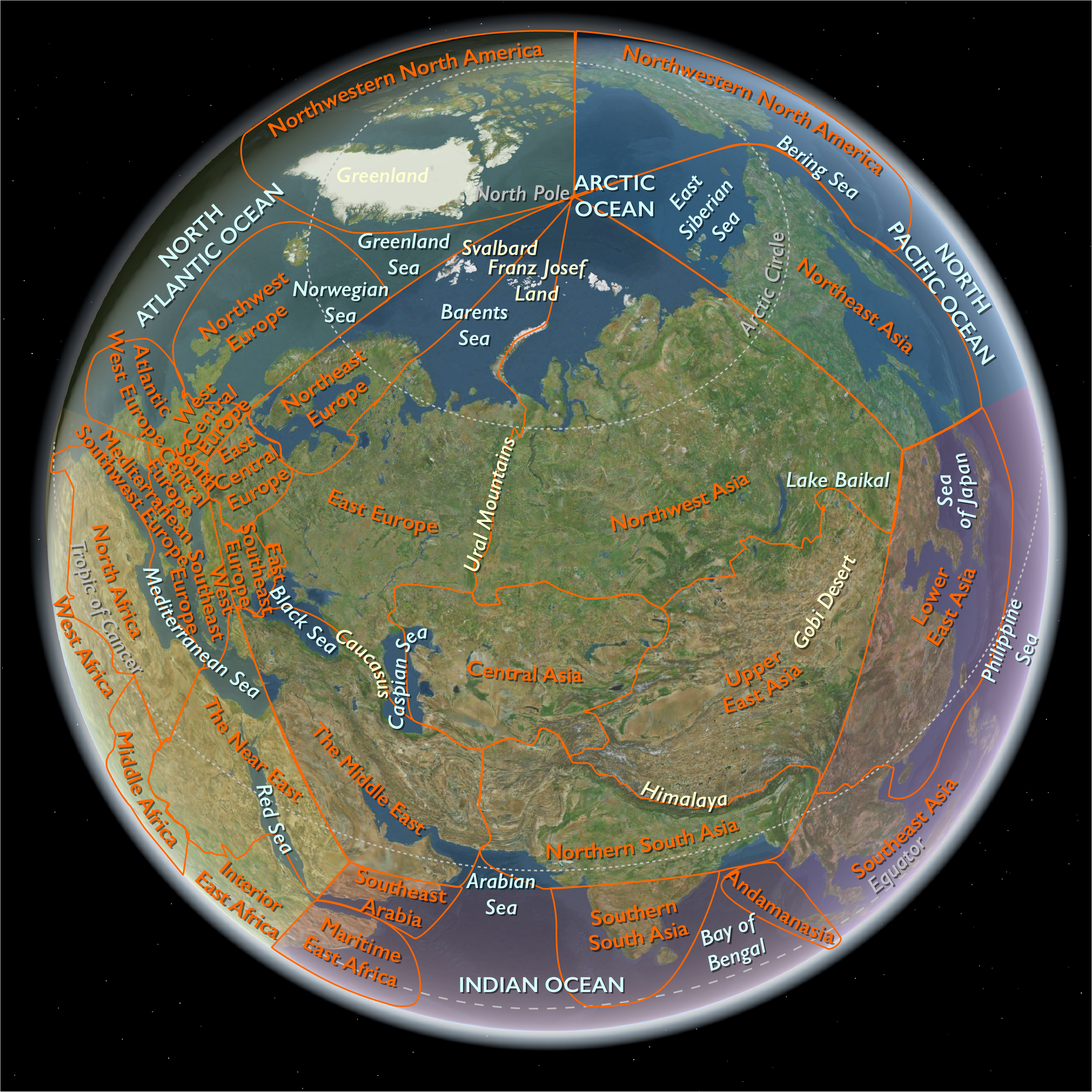
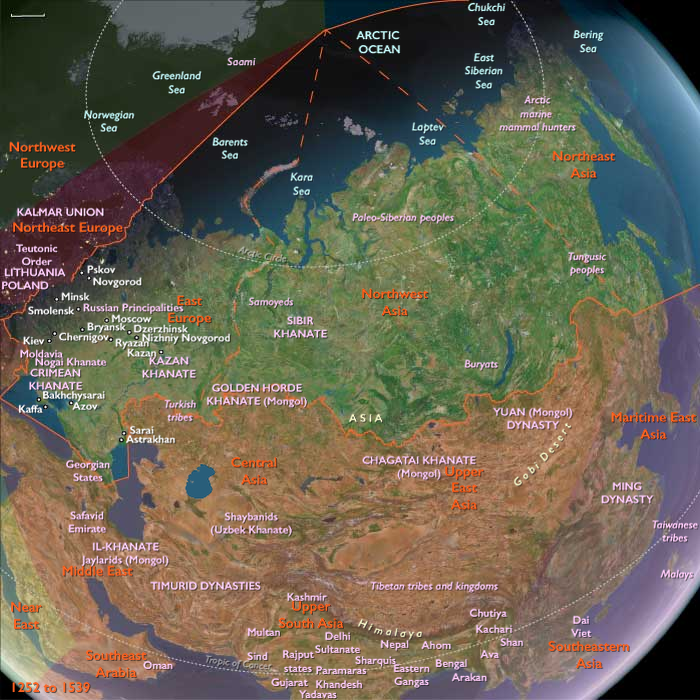
East Europe (1252 – 1395 CE): Mongol Suzerainty, Novgorod’s Fur Republic, and Lithuania’s Expansion
Geographic and Environmental Context
East Europe includes Belarus, Ukraine, and the European portion of Russia (including the sixteen Russian republics west of the Urals).
-
Anchors: the forest and forest-steppe zones of the Dnieper, Volga–Oka, and Upper Dvina basins; the steppe corridor north of the Black Sea; and the Novgorod–Pskov lakelands tied to the Baltic.
-
Strategic axes: Dnieper–Desna, Volga–Oka, Western Dvina, and Don; Baltic connectors through Novgorod and Pskov.
Climate and Environmental Shifts
-
Late Medieval Warm Period yielded to the early Little Ice Age after c. 1300: longer winters, more frequent spring floods, and shorter growing seasons on the northern fringe.
-
River freezes lengthened the winter over-ice transport season, facilitating fur and grain movement to urban markets.
Societies and Political Developments
-
Mongol conquest and the Golden Horde (Jochid ulus):
-
The Mongol campaigns (1237–1240) dismantled the Kievan Rus’ commonwealth. Principalities survived under Horde suzerainty—paying tribute (yasak), hosting basqaq agents, and using the Horde courier system (yam).
-
The Horde’s capitals at Sarai (lower Volga) coordinated levies and trade; steppe raids remained a constant frontier pressure.
-
-
Vladimir–Suzdal’, Tver’, and Moscow:
-
On the Volga–Oka, rival knyaz lines competed for the Horde’s patent (yarlik) to the grand princely title of Vladimir.
-
Moscow rose from a junior appanage: Ivan I “Kalita” (1325–1341) secured the tribute-collector role, attracting boyars and clergy; Dmitry Donskoy defeated Mamai’s army at Kulikovo Field (1380), a landmark of resistance, though Toqtamish burned Moscow (1382).
-
-
Novgorod and Pskov (veche republics):
-
The Novgorod Republic remained autonomous under Horde suzerainty by avoiding direct confrontation, governed by a popular assembly (veche) and posadniks.
-
It dominated the fur–wax–honey trades and dealt with the Hanseatic League via the kontor in Toruń/Visby; Pskov emerged as a semi-independent sister republic.
-
-
Galicia–Volhynia and the rise of Lithuania:
-
King Danylo (Daniel) of Galicia (crowned 1253) revived the southwestern Rus’ realm, but by the 14th c. the Grand Duchy of Lithuania absorbed most Rus’ lands.
-
Under Gediminas (1316–1341) and Algirdas (victory at Blue Waters, 1362), Lithuania took Kiev and the Dnieper marches; after the Union of Krewo (1385) and Christianization of Lithuania (1387), a Polish-Lithuanian dynastic bloc formed, ruling much of Belarus and Ukraine.
-
-
Steppe frontier:
-
Rus’ principalities, Lithuanian border castles, and later Moldavian and Wallachian states contested the Black Sea approaches amid shifting Horde factions.
-
Economy and Trade
-
Agrarian base: rye, oats, and barley dominated the forest zone; wheat and millet in the forest-steppe. Three-field rotation spread on the more southerly soils.
-
Fur economy: sable, marten, squirrel, and fox from taiga and mixed forests remained the premier export through Novgorod–Hanse channels and via Volga routes to Sarai.
-
Long-distance routes:
-
Volga corridor: grain, salt, fish, and crafted goods moved to the Horde markets and the Caspian.
-
Baltic corridor: Novgorod and Pskov exported furs, wax, and flax; imported silver, cloth, and salt through Hanseatic towns.
-
Dnieper–Black Sea traffic declined after the Mongol shock but partially revived under Lithuanian protection in the later 14th c.
-
-
Urban crafts & coinage: smithing, tanning, and milling flourished in river towns; silver grivna bars and later fractional pennies circulated alongside foreign denars and Prague groschen.
Subsistence and Technology
-
Agriculture & stock: ard and heavy plough on loams; horse and ox traction; beekeeping (forest apiculture) supplied wax and honey.
-
Fortifications: timber-earth ramparts and later stone kremlins (e.g., Moscow’s white-stone walls from 1367) secured capitals and river nodes.
-
Transport: river barges in ice-free seasons; winter sled-trains along frozen rivers and packed snow routes; Horde yam way-stations accelerated couriers and tribute convoys.
Movement and Interaction Corridors
-
Volga–Oka–Klyazma triangle: heartland of northeast Rus’ power (Vladimir, Moscow, Tver’).
-
Upper Dnieper–Pripet–Western Dvina: Lithuanian–Rus’ arteries binding Kiev, Smolensk, Polotsk, and Vilnius.
-
Novgorod–Ladoga–Neva: gateway to the Baltic and Hanse.
-
Steppe roads from Sarai to the Don/Lower Dnieper: conduits for tribute, trade, and raids.
Belief and Symbolism
-
Orthodox Christianity: the Metropolitan’s seat shifted from Kiev to Vladimir (1299) and effectively to Moscow (1325); monastic renewal under Sergius of Radonezh (d. 1392) anchored spiritual and agrarian colonization of the northeast.
-
Latin Christianity: strong in Galicia–Volhynia and later within Lithuanian–Polish spheres; cathedral foundations and mendicant houses appeared in frontier towns.
-
Mission & frontier faiths: St Stephen of Perm (d. 1396) evangelized among the Komi; in steppe zones, Islam advanced within the Horde elite while popular Tengrism persisted.
-
Cult and memory: chronicles, saints’ lives, and battle legends (e.g., Kulikovo) forged shared identities across fragmented polities.
Adaptation and Resilience
-
Political layering: veche republics, appanage principalities, Horde suzerainty, and Lithuanian grand-ducal rule coexisted—allowing trade and church life to continue despite warfare.
-
Route redundancy: when Dnieper routes faltered, Volga and Baltic corridors carried exchange; winter travel compensated for summer insecurity.
-
Monastic colonization: cleared forests, drained bogs, and created agricultural oases that stabilized settlement and provided safe havens.
-
Fiscal pragmatism: tribute arrangements with the Horde and yarlik politics bought breathing room for rising centers (notably Moscow).
Long-Term Significance
By 1395, East Europe had reconfigured its political geography:
-
The Golden Horde still dominated the steppe; yet its internal strife and Timur’s blows (1380s–1395) weakened control.
-
Lithuania ruled most southwestern Rus’ lands, while Moscow emerged as the chief collector and defender in the northeast.
-
Novgorod remained a Baltic fur-empire under veche rule.
-
The Orthodox Church and monastic networks provided cohesion—laying the spiritual and institutional groundwork for Muscovy’s 15th-century ascent and for a durable Lithuanian-Rus’ commonwealth across the Dnieper and Dvina.
The heartland of Rus', including Kiev, meanwhile becomes the territory of the Grand Duchy of Lithuania, ruled by Gediminas and his successors, after the semi-legendary Battle on the Irpein River.
Following the 1386 Union of Krewo, a dynastic union between Poland and Lithuania, much of what will become northern Ukraine is ruled by the increasingly Slavicised local Lithuanian nobles as part of the Grand Duchy of Lithuania.
The so-called Galicia–Volhynia Wars end by 1392.
Polish colonizers of depopulated lands in northern and central Ukraine soon found or re-found many towns.
Two German religious orders, the Teutonic Knights and the Livonian Brothers of the Sword, had In the early thirteenth century conquered much of the area that is now Estonia and Latvia, in addition to parts of Lithuania.
A number of small Baltic tribal groups had responded by uniting under the rule of Mindaugas (Myndowe) and soundly defeating the Livonians at Šiauliai in the Battle of Saule in 1236.
Mindaugas had in 1250, signed an agreement with the Teutonic Order and in 1251 had been baptized in their presence by the bishop of Chełmno (in Chełmno Land.)
Mindaugas had been crowned on July 6, 1253, as Grand Duke of Lithuania but was murdered ten years later by his nephew Treniota, which had resulted in great unrest and a return to paganism.
Lithuania will remain a pagan empire for another one hundred and twenty years, fighting against the Teutonic and Livonian Orders during the Northern Crusades to Christianize the land.
The Grand Duchy of Lithuania had been ravaged in 1241, 1259 and 1275 by raids from the Golden Horde.
The duchy had entered times of relative instability after Mindaugas' death, as reflected by the fact that seven Grand Dukes had held the title over the course of the next thirty-two years.
Little is known about this period, but the Gediminid dynasty had been founded in about 1280.
Despite the instability, the Grand Duchy did not disintegrate.
Vytenis had assumed power in 1295, and during the next twenty years will lay solid foundations for the Duchy to expand and grow under the leadership of Gediminas and his son Algirdas.
Relations between the Genoese and the Golden Horde remain tense until late 1312 when Toqta dies during preparations for a new military campaign against the Russian lands.
Some sources claim that he died without a male heir, but the Yuan shi and some Muslim sources state that he had at least three sons and one of them was murdered by supporters of Öz Beg', his nephew Although he was Shamanist, he was interested in Buddhism.
He is the last non-Muslim khan of Golden Horde.
Khan Tokhta had married Maria Palaiologina, who was born in 1297 as the bastard daughter of Emperor Andronikos II Palaiologos.
Their daughter Marija later marries Narimantas, who is the second son of Gediminas, the Grand Duke of Lithuania.
Narimantas is the Grand-Duke of Veliki Novgorod.
Vilnius, located on the Neris River and settled during the tenth century, becomes in 1323 the capital of the Grand Duchy of Lithuania.
Polish monarch Casimir III, known as “king of the peasants”, allows persecuted Jews to settle from 1334 in Poland, which lacks a middle class with the financial and commercial skills Jews can provide.
He confirms and improves the former privileges of Jews.
Married, apparently unhappily, to Aldona-Ona, the formerly pagan daughter of Gediminas, duke of Lithuania, Kazimierz also has many mistresses, about whom little is known; the most famous of them, the beautiful Esther, may have been invented by the chroniclers to explain the king's notable friendliness toward Jews.
A war had erupted between cousins Louis V of Germany and Frederick the Fair of Austria for the imperial crown after the death of Henry VII, Holy Roman Emperor, in August 1313.
The ambitious Pope John XXII sees himself as the ultimate judge and arbiter in the conflict.
When Louis V ignored papal decrees and assumed full imperial authority, the pope had excommunicated Louis and rallied European nobility against him.
The Margraviate of Brandenburg was ruled by the House of Ascania, which became extinct with the deaths of Waldemar in 1319 and Henry II in 1320.
The succession crisis caused a lot of confusion.
Louis V considered the margraviate vacant and, after his victory in the Battle of Mühldorf, appoints his son also named Louis as Margrave of Brandenburg in 1323.
That has created a common border between possessions of Louis V and Polish King Władysław I, who compete for influence in the Duchy of Silesia.
The Poles also regard Lubusz Land, which has been incorporated into Neumark (East Brandenburg), as their territory.
Thus, it does not take much encouragement from Pope John XXII to convince King Władysław to attack Brandenburg.
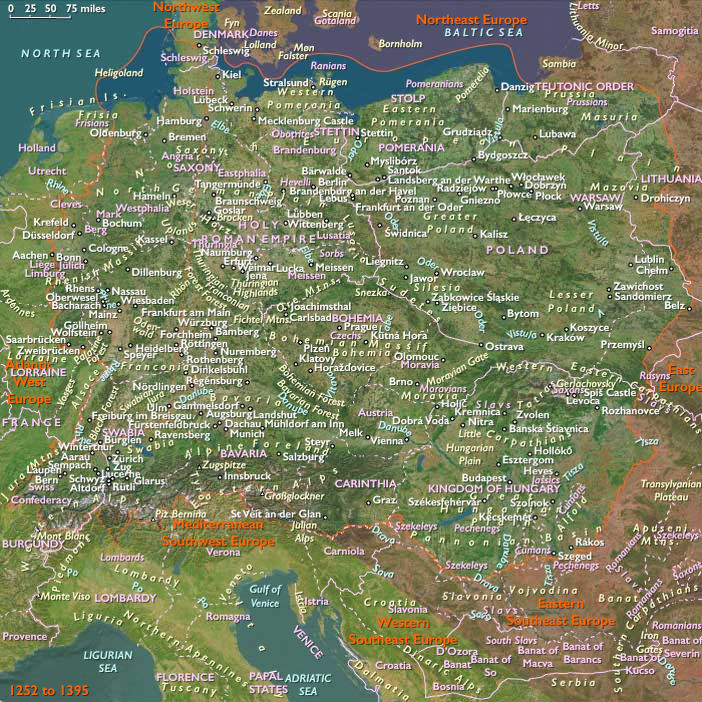
In late 1324 or early 1325, Gediminas of Lithuania had concluded a military alliance with Poland primarily directed against the Teutonic Knights, a crusading military order.
The alliance had been cemented by the marriage of Gediminas' daughter Aldona and Władysław's son Casimir.
In 1322, Gediminas had sent a letter to Pope John XXII with vague promises to convert to Christianity.
Seeing a potential new ally, the Pope had sent a delegation to Lithuania and by threat of excommunication had compelled the Teutonic Knights, who support Louis V of Germany, to make peace with Gediminas in August 1324.
The peace will remain in effect for four years until 1328.
On February 7, 1326, with the help of papal legates, Władysław I concludes an armistice at Łęczyca with the Teutonic Knights and three Masovian dukes which guarantees safe passage for the Lithuanian troops through Prussia and Masovia while they are in "Polish service".
The truce is to last to Christmas 1326 and, according to chronicler Detmar von Lübeck, papal legates even accompany the army to ensure the Knights observe the armistice.
On February 10, 1326, David of Hrodna leads twelve hundred Lithuanian men to join the Polish forces.
The joint Polish-Lithuanian army loots and robs Frankfurt, Berlin, and surrounding territories.
Thus, the pagans reach Central Europe and strike the Holy Roman Empire, which shocks western rulers.
Not meeting any organized resistance, they plunder churches and monasteries for about a month.
Reportedly, they take six thousand prisoners as slaves and much booty.
The loot is large enough to allow Samogitian duke Margiris to pay twenty thousand florins to King John of Bohemia when he raids Medvėgalis in 1329.
German chronicles, including Nikolaus von Jeroschin, vividly describe atrocities committed by the invaders.
They are particularly scandalized by pagan Lithuanians who show no respect for Christian symbols, establishments, or personnel.
Reportedly distraught by Lithuanian cruelty, Masurian nobleman Andrew Gost ambushes and kills David of Hrodna and their way back to Lithuania.
The raid on the Neumark region is a successful military campaign and brings much loot, but it is not a political success.
The raid further antagonizes Poland and the Teutonic Knights.
The tension soon turns into the Polish–Teutonic War (1326–32).
Silesian Piasts turn against Poland and recognize the suzerainty of King John of Bohemia.
The alliance between the Pope and the pagan Lithuanians, subjects of the Lithuanian Crusade, scandalizes western rulers and damaged the Pope's reputation.
Louis will succeed in 1328 in installing Antipope Nicholas V.
The Polish–Lithuanian alliance, which will survive to 1331, ruins the Lithuanian alliance with the Duchy of Masovia, which has oscillated between Poland, Lithuania, and the Teutonic Knights in attempt to maintain its independence.
Gediminas' hopes of creating a Polish–Lithuanian–Hungarian alliance against the Teutonic–Bohemian alliance do not materialize.
Instead, the raid encourages John of Bohemia to join the Lithuanian Crusade and capture Medvėgalis in 1329.
The Polish-Lithianian armies turn against the Teutonic Order in 1527, while in the south King John the Blind marches against Kraków.
Though he is urged by King Charles I of Hungary to retreat, he vassalizes many of the Duchies of Silesia.