Upper South Asia (621–478 BCE): Empires, Faiths, and Cultural Transformations
Rise of the Magadhan Empire
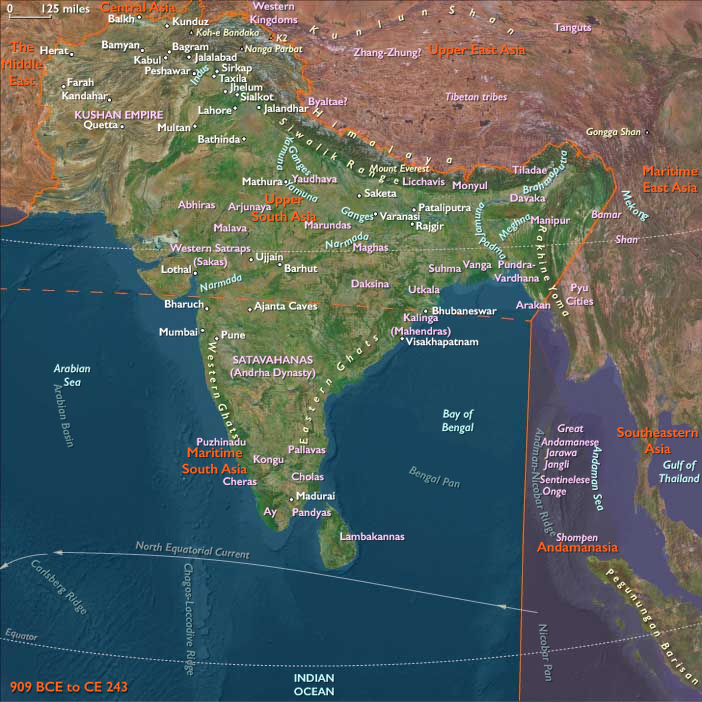
From 621 to 478 BCE, the region of Upper South Asia witnessed the rise of the powerful Magadhan Empire in the Gangetic plain, particularly in present-day Bihar. The Magadhan state, with its capitals initially at Rajgir and later at Pataliputra (modern-day Patna), gradually dominated surrounding territories through both diplomacy and military conquest. It eventually outpaced its neighbors, including the older kingdoms of Kuru and Panchala in Haryana and western Uttar Pradesh.
Emergence of Influential States
Concurrently, the age saw the prominence of influential states such as Avanti in western Madhya Pradesh, Kosala in eastern Uttar Pradesh, and Gandhara in the region corresponding to modern-day northern Pakistan and eastern Afghanistan. These states engaged in frequent conflicts and shifting alliances, shaping the region’s geopolitical landscape.
Persian Influence and the Achaemenid Empire
In this period, territories such as Gandhara, Balochistan, and significant parts of present-day Afghanistan were incorporated into the Achaemenid Persian Empire under rulers such as Cyrus the Great and Darius I. Persian rule brought significant administrative reforms, improved trade networks, standardized coinage, and introduced Zoroastrian religious ideas, leaving enduring influences in these western regions.
Religious Innovations: Buddhism, Jainism, and Zoroastrianism
This era was remarkable for the birth and rapid spread of major religious movements, notably Buddhism and Jainism. Siddhartha Gautama (the Buddha) and Mahavira (the founder of Jainism) actively preached across Northern South Asia, gaining substantial followings. Buddhism particularly found significant early patronage in Magadha.
Zoroastrianism, emerging from Persia, also impacted areas under Persian influence, particularly Gandhara and Balochistan, introducing new religious concepts and rituals that intermingled with local traditions.
Socio-Cultural and Caste Consolidation
The caste system became further entrenched, shaped increasingly by the Brahminical norms codified in the later Vedic texts. The division between the four major varnas—Brahmins, Kshatriyas, Vaishyas, and Shudras—solidified further, influencing all aspects of social and religious life.
Archaeological Developments and Urbanism
Material culture saw the flourishing of the Northern Black Polished Ware (NBPW), widely associated with urban centers and elite culture, indicative of growing economic prosperity. The influential city of Taxila in present-day Punjab, Pakistan, emerged as a prominent educational and trade hub, reflecting a vibrant cultural and economic exchange extending to Central and West Asia.
Himalayan and Northeastern Interactions
The Himalayan territories—including modern-day Himachal Pradesh, Uttarakhand, Nepal, Bhutan, Ladakh, and present-day Sikkim—continued robust interactions with lowland kingdoms, facilitating the movement of goods, religious ideas, and cultural practices. Simultaneously, the northeastern regions of Assam, Arunachal Pradesh, Nagaland, Manipur, Meghalaya, Tripura, Mizoram, and adjacent areas of Bangladesh and northwestern Myanmar developed distinctive regional identities and engaged in cultural exchanges with the Gangetic heartlands.
Cultural and Artistic Flourishing
The period witnessed remarkable artistic and architectural advancements. Influenced by religious developments, early Buddhist stupas and Jain temples began to dot the landscape, accompanied by sophisticated sculptures and artworks embodying religious and cultural ideals.
Peoples and Ethnic Dynamics
Ethnic groups such as the Pashtuns and Tajiks emerged distinctly in historical records during this period, especially within territories influenced by Persian culture and administration, adding further complexity and diversity to the region's demographic composition.
Legacy of the Age
The era from 621 to 478 BCE proved transformative for Upper South Asia, setting foundations for future imperial, religious, and cultural trajectories. The political dominance of Magadha, the advent of Buddhism and Jainism, and Persian administrative influences indelibly shaped the historical, social, and religious landscapes of the region.