Fulk I
Count of Anjou
Years: 870 - 942
Fulk I of Anjou (c. 870 – 942), called 'the Red' (Latin: Rufus) (French: Le Roux), holds the county of Anjou first as Viscount then Count until his death.
Related Events
Filter results
Showing 3 events out of 3 total
Viking Devastation of Brittany and the Fall of Nantes (Early 10th Century)
At the beginning of the 10th century, Brittany comes under renewed heavy Viking attacks, leading to territorial losses and political fragmentation. By 914, the Vikings seize Nantes, dealing a major blow to the once-powerful Breton kingdom.
Brittany’s Loss of Eastern Territories
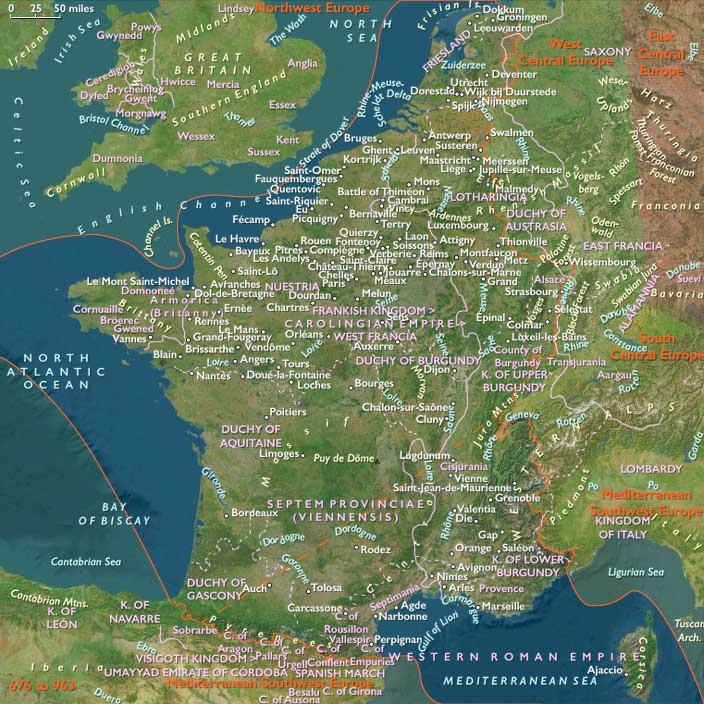
- Brittany had already lost control over Normandy and Anjou, with Normandy falling under Rollo’s rule after the Treaty of Saint-Clair-sur-Epte (911).
- The County of Nantes, previously part of Breton control, had been granted to Fulk I ("the Red"), Count of Anjou, in 909 by the Carolingian rulers of West Francia.
- This shift in authority weakens Breton resistance against further Viking incursions.
The Fall of Nantes to the Vikings (914)
- In 914, Viking forces seize Nantes, reversing Fulk’s earlier efforts to restore Carolingian control over the region.
- Nantes, one of the wealthiest and most strategically important cities in Brittany, falls into Viking hands, becoming a base for further raids into the Loire Valley and the interior of Brittany.
- The capture of Nantes marks the beginning of a prolonged Norse presence in the region, forcing both Breton and Frankish leaders to contend with a major Viking stronghold.
Consequences of the Viking Invasions in Brittany
-
Brittany’s Declining Power
- The kingdom is now reduced in size, having lost Normandy, Anjou, and now Nantes.
- Viking raids prevent the emergence of a strong central authority, leaving the region fractured and vulnerable.
-
Anjou’s Rise Under Fulk the Red
- With Nantes lost, Fulk I of Anjou shifts his focus toward consolidating power in Anjou, laying the groundwork for the future rise of the House of Anjou.
-
Nantes as a Viking Base
- The Vikings use Nantes as a stronghold for further raids along the Loire and into the interior of West Francia.
- Their control of river routes ensures that their influence remains strong in the region for years to come.
Conclusion: The Fragmentation of Brittany
The loss of Nantes in 914, following the earlier loss of Normandy and Anjou, weakens Brittany significantly, ensuring that Viking and Frankish forces will continue to shape the region’s political landscape. The region remains politically divided, with local rulers struggling to contain further Norse incursions, while Frankish influence in Brittany wanes.
Atlantic West Europe (916–927): Emergence of Regional Powers and Continued Carolingian Decline
Between 916 and 927, Atlantic West Europe witnessed the continued erosion of Carolingian royal authority, the consolidation and expansion of regional powers, especially Normandy, Flanders, Aquitaine, Anjou, and the Burgundian kingdoms, and the beginnings of political stabilization following the era of Viking raids.
Political and Military Developments
-
West Francia: Enduring Instability
- King Charles the Simple (r. 898–922) struggled against increasingly powerful nobles, ultimately losing his throne after being deposed in 922, leading to civil unrest and further fragmentation of royal power.
- Robert I, count of Paris, briefly became king (922–923) but was killed in battle against Charles’ supporters; Rudolph of Burgundy succeeded him, bringing Burgundy into a more prominent political role in West Francia.
-
Normandy: Consolidation under Rollo
- Duke Rollo (r. 911–927) successfully transformed the Viking-controlled territory into the stable Duchy of Normandy, integrating local populations and establishing Rouen as a major center of power and trade.
-
Flanders and Anjou: Strengthening Territorial Control
- Arnulf I of Flanders (r. 918–965) solidified territorial gains, enhancing Flanders' military and economic capabilities, particularly through fortifications and expanding trade networks.
- In Anjou, Fulk I the Red (r. 898–942) reinforced his authority through strategic marriages and aggressive territorial expansion along the Loire.
-
Aquitaine: Stability and Cultural Patronage
- William II of Aquitaine (r. 918–926) continued his predecessor's efforts, reinforcing regional governance, supporting religious institutions, and providing stability in southern and western France.
-
Upper and Lower Burgundy: Internal Stability
- Rudolph II of Upper Burgundy (r. 912–937) managed internal stability, while Lower Burgundy (Provence) under Louis the Blind (until 928) experienced weakening central control, allowing regional nobles greater independence.
Economic and Social Developments
-
Growth of Regional Economies
- Economic revival was evident, particularly in Normandy, Flanders, and Aquitaine, where stability fostered agricultural improvements, trade expansion, and urban growth.
- Rouen, Bruges, Tours, and Nantes strengthened their roles as commercial hubs and fortifications, benefiting from growing local markets and increased political stability.
-
Integration of Viking Settlers
- In Normandy, the integration of Norse settlers encouraged agricultural and commercial development, leading to improved economic conditions and increased cultural blending with local Frankish populations.
Religious and Cultural Developments
-
Expansion of Cluniac Influence
- The Abbey of Cluny, founded in 910, significantly increased its influence, promoting monastic reform and religious independence, particularly across Burgundy, Aquitaine, and the Loire Valley.
-
Monastic and Scholarly Revival
- Monastic centers continued to preserve classical and religious manuscripts, supporting early signs of intellectual revival and education, especially in prominent monasteries like Saint-Martin of Tours and Cluny Abbey.
Legacy and Significance
By 927, Atlantic West Europe was increasingly characterized by powerful regional principalities rather than centralized royal control:
- The weakening Carolingian monarchy ceded practical authority to regional rulers in Normandy, Flanders, Anjou, Aquitaine, and Burgundy.
- The Duchy of Normandy firmly established itself, foreshadowing its later expansionist role, notably the Norman conquest of England in the following century.
- Regional economic stabilization, particularly through revived trade and fortified towns, paved the way for the urban revival of the High Middle Ages.
- Cluniac monasticism deepened religious reform and cultural vitality, significantly shaping medieval European spirituality.
This era set critical foundations for the political, economic, and cultural contours that defined Atlantic West Europe through the High Middle Ages.

Atlantic West Europe (928–939): Dynastic Realignments and Rising Regional Powers
From 928 to 939, Atlantic West Europe experienced significant dynastic shifts, deepened fragmentation of royal authority, and the consolidation of regional principalities, particularly in Normandy, Aquitaine, Burgundy, Anjou, and Flanders. Political instability persisted, but economic recovery and cultural growth were increasingly evident.
Political and Military Developments
-
West Francia: Continued Fragmentation
- King Rudolph of Burgundy (r. 923–936) struggled to assert royal authority, facing powerful regional magnates. Upon his death, Louis IV ("d'Outremer"), son of the exiled Charles the Simple, returned from England to claim the throne (936), attempting to restore Carolingian legitimacy amidst growing noble independence.
-
Normandy: Establishment of Ducal Authority
- William Longsword (r. 927–942), son of Rollo, succeeded in consolidating Normandy’s internal governance, securing stronger territorial control and building diplomatic relationships with neighboring Frankish lords, notably marrying into Breton nobility.
-
Aquitaine: Strengthened Ducal Autonomy
- Ebalus Manzer (r. 927–935) and William III ("Towhead") (r. 935–963) maintained internal cohesion in Aquitaine, preserving regional autonomy and promoting stability through patronage of religious institutions and strategic alliances.
-
Flanders and Anjou: Territorial Consolidation
- Arnulf I of Flanders (r. 918–965) further strengthened his control, fortifying key cities such as Ghent and Bruges, enhancing their economic and strategic positions in the region.
- Fulk I ("the Red") of Anjou (r. 898–942) continued aggressive expansion along the Loire Valley, establishing a foundation for future Angevin prominence.
-
Burgundian Realignments
- Rudolph II, King of Upper Burgundy, extended his influence into northern Italy (931), briefly combining the crowns of Upper Burgundy and Italy. Upon his death (937), regional power dynamics shifted as his son Conrad succeeded him, focusing more inwardly on Burgundian affairs.
Economic and Social Developments
-
Urban and Commercial Growth
- Economic activity expanded significantly, notably in Flanders (Bruges, Ghent) and Normandy (Rouen), where strengthened political stability and maritime trade enhanced commercial vitality.
- Agricultural expansion continued across central France and Aquitaine, supporting population growth and early urbanization.
-
Integration and Cultural Fusion
- In Normandy, Norse settlers integrated further, blending culturally with local Franks, enhancing economic productivity and social cohesion.
Religious and Cultural Developments
-
Expansion of Cluniac Reform
- The Cluniac monastic reform continued to spread rapidly, influencing religious life across Aquitaine, Burgundy, and the Loire Valley, advocating spiritual renewal and ecclesiastical autonomy from secular control.
-
Monastic Scholarship and Education
- Monastic centers, notably Tours, Cluny, and Auxerre, expanded their educational role, preserving classical knowledge and fostering early scholastic developments.
Legacy and Significance
By 939, Atlantic West Europe had witnessed:
- Continued erosion of centralized Carolingian authority, increasingly replaced by independent regional principalities in Normandy, Flanders, Aquitaine, Burgundy, and Anjou.
- Solidified regional identities and political structures, setting the stage for later medieval geopolitical configurations.
- Strengthened economic recovery and trade expansion, particularly in maritime and agricultural economies.
- Growing cultural dynamism driven by monastic reform and intellectual revival, laying essential foundations for the cultural renaissance of the High Middle Ages.
These developments collectively reinforced the regional principalities that characterized Atlantic West Europe’s trajectory into the mid and late medieval periods.