Frederick the Fair
Duke of Austria and Styria
Years: 1289 - 1330
Frederick the Handsome (German: Friedrich der Schöne) or the Fair (c. 1289 – 13 January 1330), from the House of Habsburg, is Duke of Austria and Styria from 1308 as Frederick I as well as King of Germany (King of the Romans) from 1314 (anti-king until 1325) as Frederick III until his death.


Related Events
Filter results
Showing 10 events out of 26 total
Zengi is killed on his return to Iraq to repress a revolt in 1146, while besieging the fortress of Qal Ja'bari held by a Frankish slave named Yarankash who bears him a personal grudge.
Zengi’s forces are scattered, but Zengi's two sons are able to regain control and to divide informally the empire.
Yaranqash had stabbed the atabeg numerous times and then fled to the fortress of Dawsar, and then from there to Damascus.
The governor, Mu'in ad-Din Unur, had had him arrested and sent him to Zengi's son Nur ad-Din in Aleppo.
Nur ad-Din sends him along to …
…his elder brother Saif ad-Din Ghazi I in Mosul, who has him executed.
Saif ad-Din had first to fight to secure his position in Mosul.
Two years before, the Seljuq sultan Ghiyath ad-Din Mas'ud had named his cadet son Alp-Suleiman-Shah b. Muhammad b. Malik Shah as overlord of Zengi, but the latter had neutralized him and carried with him at the siege.
At Zengi's death, Alp-Suleiman-Shah had tried to exploit the ensuing disorder to gain the power in Mosul.
Two of Zengi's advisors, the head of the diwan al-Din Muhammad Jemal and hajab Amir Salah al-Din Muhammad al-Yaghisiyani, took the side of Saif ad-Din: taking advantage of the inexperience of the young Seljuc, giving Saif ad-Din the time necessary to take control of Mosul.
When Alp-Suleiman-Shah appeared in Mosul, he had been arrested and imprisoned in the citadel, where he will remain a prisoner until 1160.
The crusaders' campaign is not only ill advised and mistakenly conceived but badly executed.
Nur ad-Din, together with Saif ad-Din, arrives with Muslim reinforcements and cuts off the crusader's route to their previous position.
Unur, however refuses them entrance, using the presence of Zangi's sons to convince the Franks to release the siege.
The local crusader lords refuse to carry on with the siege, and the three kings have no choice but to abandon the city.
On July 28, after a five-day siege, with Nur ad-Din's forces nearing the city, it becomes evident that the crusader army is dangerously exposed, and a retreat to Jerusalem is ordered, though for their entire retreat they will be followed by Turkish archers who constantly harass them.
This humiliating failure is attributable largely to the conflicting interests of the participants.
Each of the Christian forces feels betrayed by the other and mutual distrust will be fostered for a generation due to the defeat.
The Muslims, on the other hand, receive enormous encouragement by their triumph over another major Western expedition.
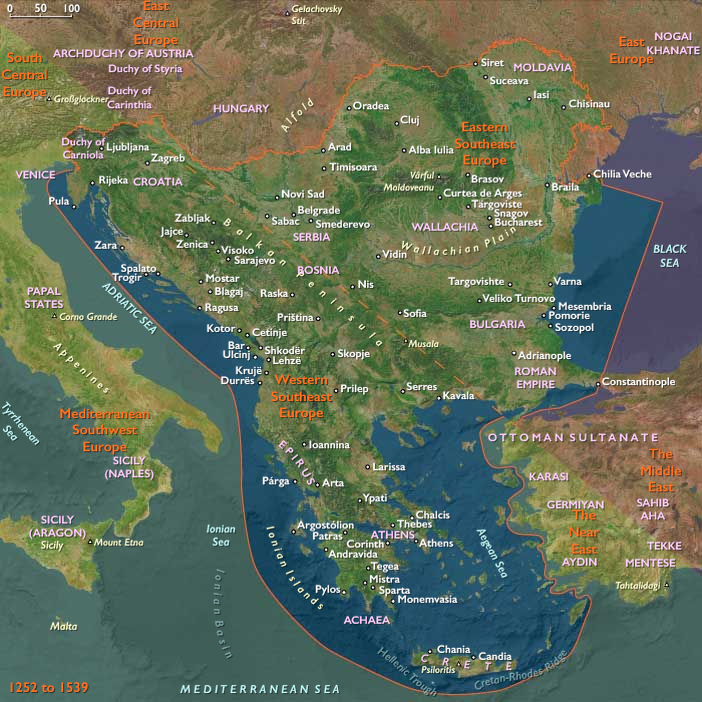
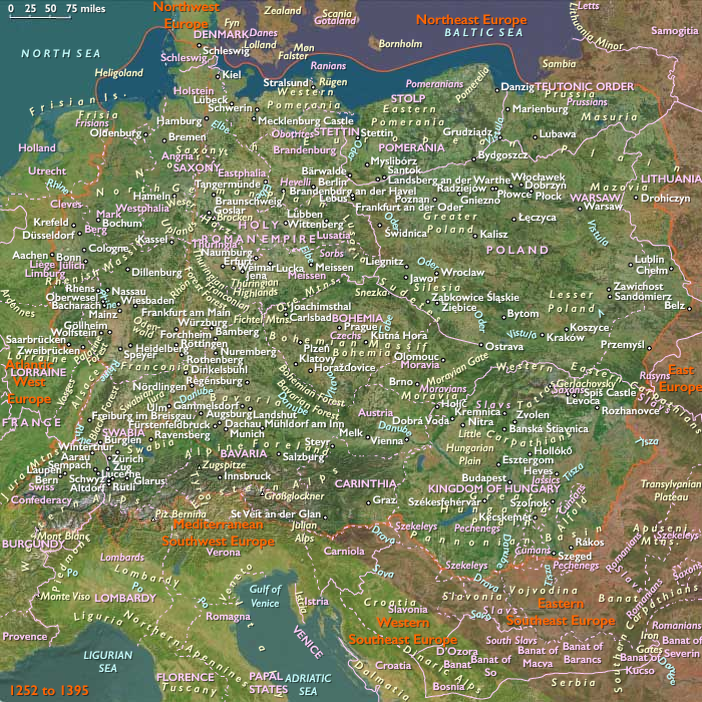
East Central Europe (1312–1323 CE): Consolidation of Angevin Hungary, Habsburg-Bavarian Rivalries, Polish Fragmentation, Bohemian Stabilization, and Urban Expansion
Between 1312 and 1323 CE, East Central Europe underwent significant realignments marked by the decisive establishment of Angevin rule in Hungary under Charles Robert of Anjou, sustained political consolidation of Austria under the Habsburg dynasty, continued fragmentation and local autonomy in Poland, and the gradual stabilization of Bohemia under the House of Luxembourg. Meanwhile, urban and economic expansion persisted, notably within flourishing Hanseatic cities and principalities such as Brunswick-Wolfenbüttel, enhancing regional prosperity and laying critical foundations for subsequent geopolitical developments.
Political and Military Developments
Establishment of Angevin Rule in Hungary
-
After prolonged internal struggles, Charles Robert of Anjou (Charles I of Hungary, r. 1308–1342) decisively secured his authority with his victory at the Battle of Rozgony (1312) against rebellious oligarchic magnates.
-
Charles Robert significantly consolidated royal authority, initiated administrative and economic reforms, and stabilized Hungary after decades of fragmentation and internal unrest.
Continued Habsburg Dominance and Bavarian Rivalries
-
In Austria, the Habsburg dukes Frederick the Fair (r. 1308–1330) and his brother Leopold I maintained stable rule, consolidating their family's political authority and territorial control, especially in Lower Austria, Styria, and Carinthia.
-
Intense dynastic rivalries developed with neighboring Bavarian Wittelsbachs, particularly with Duke Louis IV of Bavaria (later Emperor Louis IV), leading to increased political tension within the Holy Roman Empire.
Polish Duchies: Fragmentation and Local Autonomy
-
Poland remained politically fragmented into several independent Piast duchies, notably in Greater Poland, Lesser Poland, Silesia, and Mazovia. Despite continued internal divisions, these duchies maintained substantial local autonomy, economic prosperity, and urban growth through regional trade networks.
Bohemian Stabilization under the House of Luxembourg
-
Following Přemyslid extinction, Bohemia gradually stabilized under the House of Luxembourg when John of Luxembourg (r. 1310–1346) ascended the throne in 1310.
-
King John secured his authority through strategic marriages, military alliances, and regional diplomacy, laying foundations for future Bohemian prosperity and influence within Central Europe.
Growth of the Principality of Brunswick-Wolfenbüttel
-
Under Henry I of Brunswick-Wolfenbüttel (r. 1279–1322), the principality strengthened politically and economically. Its influential position was enhanced through strategic alliances, marriages, and economic growth, significantly raising its regional profile within East Central Europe.
Economic and Technological Developments
Continued Urban Expansion and Hanseatic Prosperity
-
Hanseatic League cities, notably Lübeck, Rostock, Toruń, Gdańsk, Wrocław, and Kraków, experienced sustained economic prosperity through extensive Baltic and inland trade.
-
Urban centers invested in improved infrastructure, expanded fortifications, and enhanced marketplaces, contributing significantly to regional prosperity and stability.
Agricultural Advances and Technological Improvements
-
Continued adoption of improved agricultural methods, including advanced plowing techniques, enhanced irrigation, and systematic crop rotation, significantly increased agricultural productivity and supported urban population growth and trade expansion.
Cultural and Artistic Developments
Bohemian Cultural Revival under Luxembourg Patronage
-
Under John of Luxembourg’s patronage, Bohemia’s cultural landscape revived, notably in Prague. Gothic architecture, manuscript production, and courtly culture flourished, promoting intellectual and artistic vitality across Bohemian territories.
Cultural Continuity and Patronage in Polish Duchies
-
Polish duchies, notably in Silesia, maintained strong cultural and artistic traditions. Monastic scriptoria continued literary and scholarly activities, preserving regional identity despite political divisions.
Hungarian Ecclesiastical and Royal Patronage
-
King Charles Robert supported ecclesiastical institutions in Hungary, fostering artistic and architectural projects. The Hungarian church, especially in Esztergom and Veszprém, remained culturally influential and central to intellectual life.
Settlement and Urban Development
Strengthened Urban Centers and Infrastructure
-
Major urban centers across East Central Europe expanded significantly. Cities such as Prague, Vienna, Kraków, Gdańsk, Lübeck, and Brunswick experienced rapid population growth, improved fortifications, marketplaces, and administrative buildings, facilitating sustained economic prosperity.
Expansion of Germanic Settlement (Ostsiedlung)
-
Continued Germanic colonization into Brandenburg, Mecklenburg, Lusatia, Silesia, and Mazovia reshaped demographic landscapes, urban patterns, and agricultural development, significantly influencing local economies and regional identities.
Social and Religious Developments
Ecclesiastical Strength and Social Stability
-
Ecclesiastical institutions, notably the Archbishopric of Salzburg and bishoprics of Passau, Bamberg, and Regensburg, continued strengthening regional authority, significantly influencing social structures, educational activities, and cultural patronage.
Strengthening of Aristocratic Autonomy
-
Aristocratic and noble authority remained robust, particularly in Poland and Hungary, with regional magnates wielding considerable political and economic influence. These powerful families deeply shaped local governance, social structures, and regional stability.
Long-Term Consequences and Historical Significance
The era 1312–1323 CE was pivotal in reshaping East Central Europe’s medieval trajectory. Angevin Hungary under Charles Robert established long-term political stability, profoundly affecting Hungarian governance and regional dynamics. Bohemia's stabilization under John of Luxembourg revitalized its political and cultural prominence. Continued fragmentation among Polish duchies reinforced local autonomy, limiting central governance but enhancing regional economic prosperity. The Habsburgs' stable rule in Austria and their rivalry with Bavaria shaped imperial politics significantly, while Brunswick-Wolfenbüttel emerged as an influential regional power. Collectively, these developments laid essential foundations for subsequent geopolitical realignments, economic expansions, and cultural achievements throughout East Central Europe.
Louis, Duke of Bavaria, (later to become Emperor Louis IV) was born in Munich, the son of Louis II, Duke of Upper Bavaria and Count Palatine of the Rhine, and Matilda, a daughter of King Rudolph I.
Though Louis had been partly educated in Vienna and had become co-regent of his brother Rudolf I in Upper Bavaria in 1301 with the support of his Habsburg mother and her brother, King Albert I, he has quarreled with the Habsburgs from 1307 over possessions in Lower Bavaria.
A civil war against his brother Rudolf due to new disputes on the partition of their lands had been ended on June 13, 1313, when peace was made at Munich.
While Rudolf retains the Electoral Palatinate, the treaty provides Louis with the opportunity to secure his election as German king when Henry of Luxembourg dies on August 24.
The question arises as to who will execute tutelage over the minor children of the late Lower Bavarian Dukes, thus also commanding the tremendous economic power of this region.
Their Upper Bavarian cousin, Duke Louis, is the choice within the several branches of the Bavarian line of the House of Wittelsbach, as well as the burghers of the Lower Bavarian cities.
The dukes’ widows and the local aristocracy prefer Duke Frederick I of Austria, the Fair, also Louis' cousin, both of whom had been raised and educated together in Vienna.
After Louis militarily occupies Landshut and Straubing, at this time the two most important towns of Bavaria,the ducal widows decide to call their children's Austrian cousin for assistance, although in the decade before, Lower Bavaria had bitterly fought Austria over lands, economic resources and sovereignty.
Finally, the decisive battle between Bavaria and Austria for control over these fertile and economically attractive lands is fought at Gammelsdorf on November 9, 1313.
The Upper Bavarians and troops deputized by the Lower Bavarian towns are led by Duke Louis, while the aristocracy and knighthood of Lower Bavaria and the Austrians are led by the Duke Frederick.
At the end of the day, Louis is victorious, the Austrians suffering a severe defeat.
Frederick is forced to renounce his tutelage over the Lower Bavarian dukes.
Louis, by his victory, brings to a halt for waht will be a long time the Habsburg quest to annex of parts of Bavaria.
Frederick the Fair of the House of Habsburg had been elected King of the Romans at Sachsenhausen (Frankfurt am Main) on October 19 by four of the electors, being crowned on November 25 at Bonn Minster.
Louis IV of the House of Wittelsbach had been elected King of the Romans at Sachsenhausen by five of the electors on October 20 , being crowned on November 25 at Aachen.
The loyalties of the German electors, seeking a king from another dynasty at the death of thirty-nine-year-old Emperor Henry VII on August 24, 1313, had been divided between Wittelsbach dynastic family member Louis, duke of Bavaria, and the Habsburg Frederick the Fair, duke of Austria, the choice of the majority.
Both have been elected king by their respective constituencies in 1314, and war ensues to settle the claim and decide who will be Holy Roman Emperor, a title both claimants assume.
Moreover, the papacy had become vacant upon the death of Clement V, thus obviating the pope’s rightful adjudication of contested elections.
The House of Habsburg had coveted the area around the Gotthard Pass as it offers the shortest passage to Italy, but the Confederates of Uri, Schwyz and Unterwalden, who had formalized the Swiss Confederacy in 1291, hold imperial freedom letters from former Habsburg emperors granting them local autonomy within the empire.
Tensions between the Habsburgs and Confederates had heightened in 1314 when Duke Louis IV of Bavaria (who will become Louis IV, Holy Roman Emperor) and Frederick the Handsome, a Habsburg prince, each claimed the crown of the Holy Roman Emperor.
The Confederates support Louis IV because they fear the Habsburgs will annex their lands, which they had tried to do in the late thirteenth century.
War eventually breaks out after the Confederates of Schwyz raid the Habsburg-protected Einsiedeln Abbey, as a result of a dispute regarding access to pastures.
Frederick's brother, Leopold of Austria, leads a large army, including a small number of knights, to crush the rebellious Confederates.
He plans a surprise attack from the south via Ägerisee (also known as Lake Äegen or Lake Aegeri) and the Morgarten Pass, counting on complete victory.
Johannes von Winterthur's chronicle of the battle puts the Austrian forces at twenty thousand, although that number is now believed to be inaccurate.
Another account, by Rudolf Hanhart, states that there were nine thousand men in the Austrian army, while historian Hans Delbrück states that the Austrian army consisted of only two thousand to three thousand men, but that these were mainly well-trained and -equipped knights.
The Confederates of Schwyz, supported by the Confederates of Uri, fear for their autonomy, but are not supported by the Confederates of Unterwalden, who expect the army to approach from the west near the village of Arth, where they have erected fortifications.
The size of the Confederate army is also disputed, with estimates ranging from fifteen hundred to around three thousand or four thousand.
Nevertheless, regardless of their size, the Confederate militia lacks the training of the Habsburg knights, who are also better equipped.
According to a legend recounted in Tait's Edinburgh Magazine in 1852, one Habsburg knight, Henry Huenenberg, recognizing the superiority of his force and possibly concerned that victory over a "rabble" would be a disgrace, or in an act of chivalry, shot an arrow with a message attached into the Confederates' camp, telling them that the Austrians would advance through Morgarten on November 15 and that they should return to their homes.
In response, the Confederates prepare a roadblock and an ambush at a point between Lake Ägerisee and Morgarten Pass, where a small path leads between a steep slope and a swamp.
When the Confederates attack from above with rocks, logs and halberds, the Austrian knights have no room to defend themselves and suffer a crushing defeat, while the foot soldiers in the rear flee back to the city of Zug.
About fifteen hundred Habsburg soldiers are killed in the attack.
According to Karl von Elgger, the Confederates, unfamiliar with the customs of battles between knights, brutally butchered retreating troops and everyone unable to flee.
He records that some infantry preferred to drown themselves in the lake rather than face the brutality of the Swiss.
The defeat of the Austrians ensures independence for the Swiss Confederation.