Frederick II
Holy Roman Emperor
Years: 1194 - 1250
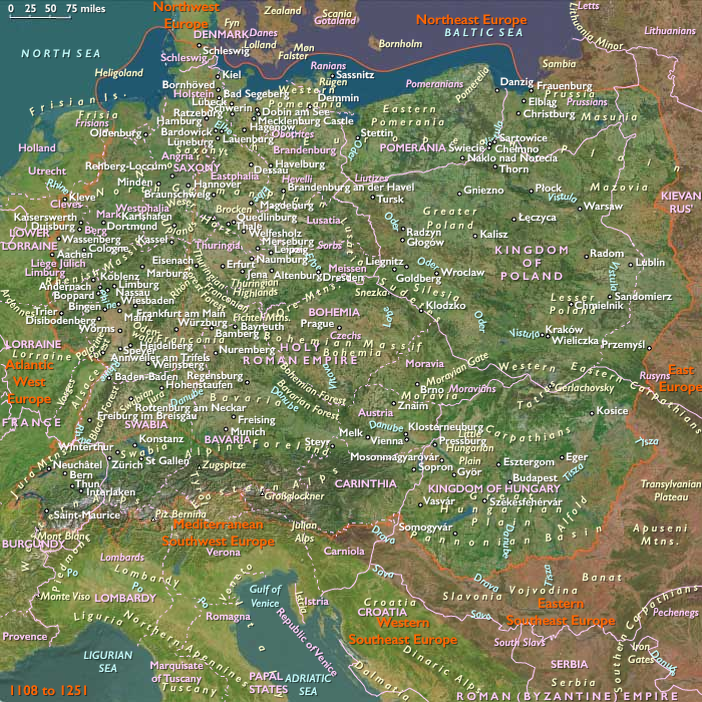
Frederick II (December 26, 1194 – December 13, 1250), is one of the most powerful Holy Roman Emperors of the Middle Ages and head of the House of Hohenstaufen.
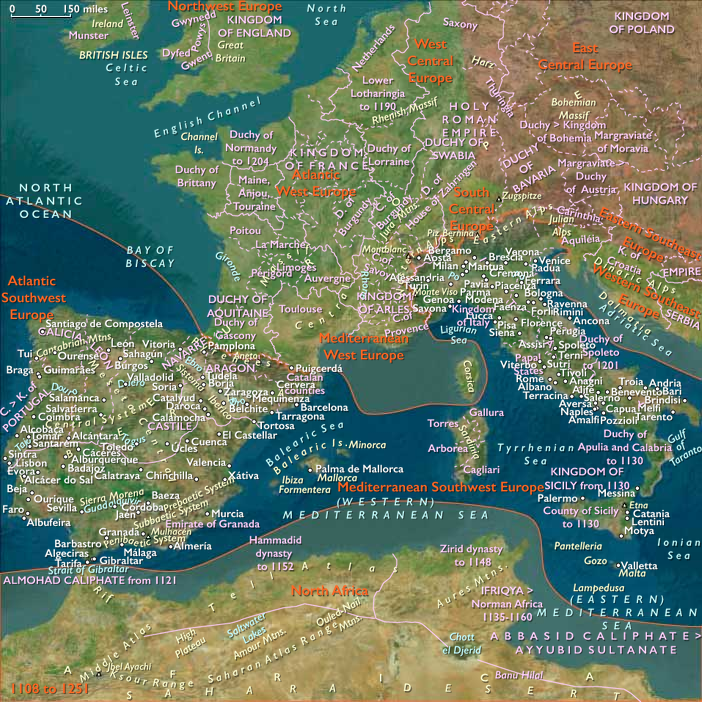
His political and cultural ambitions, based in Sicily and stretching through Italy to Germany, and even to Jerusalem, are enormous; however, his enemies, especially the popes, prevail, and his dynasty collapses soon after his death.
Viewing himself as a direct successor to the Roman Emperors of Antiquity, he is Emperor of the Romans from his papal coronation in 1220 until his death; he is also a claimant to the title of King of the Romans from 1212 and unopposed holder of that monarchy from 1215.
As such, he is King of Germany, of Italy, and of Burgundy.
At the age of three, he is crowned King of Sicily as a co-ruler with his mother, Constance of Hauteville, the daughter of Roger II of Sicily.
His other royal title is King of Jerusalem by virtue of marriage and his connection with the Sixth Crusade.
He is frequently at war with the Papacy, hemmed in between Frederick's lands in northern Italy and his Kingdom of Sicily (the Regno) to the south, and thus he is excommunicated four times and often vilified in pro-papal chronicles of the time and since.
Pope Gregory IX goes so far as to call him the Antichrist.
Speaking six languages (Latin, Sicilian, German, French, Greek and Arabic, Frederick is an avid patron of science and the arts.
He plays a major role in promoting literature through the Sicilian School of poetry.
His Sicilian royal court in Palermo, from around 1220 to his death, sees the first use of a literary form of an Italo-Romance language, Sicilian.
The poetry that emanates from the school has a significant influence on literature and on what is to become the modern Italian language.
The school and its poetry are saluted by Dante and his peers and predate by at least a century the use of the Tuscan idiom as the elite literary language of Italy.
After his death, his line quickly dies out and the House of Hohenstaufen comes to an end.