Rudolf has found it difficult to convince the Saxons to fight beyond their borders; they view him as a southerner and distrust him.
He is also frustrated by the apparent reluctance of the pope to recognize his cause.
In order to gain and maintain supporters, he is forced to grant large parts of the crown lands, as well as those of the church, to his followers.
Rudolf appears to be vulnerable after losing the support of some of the Saxon princes, and Henry decides to take advantage of this vulnerability and marches out against him in the winter of 1079-1080.
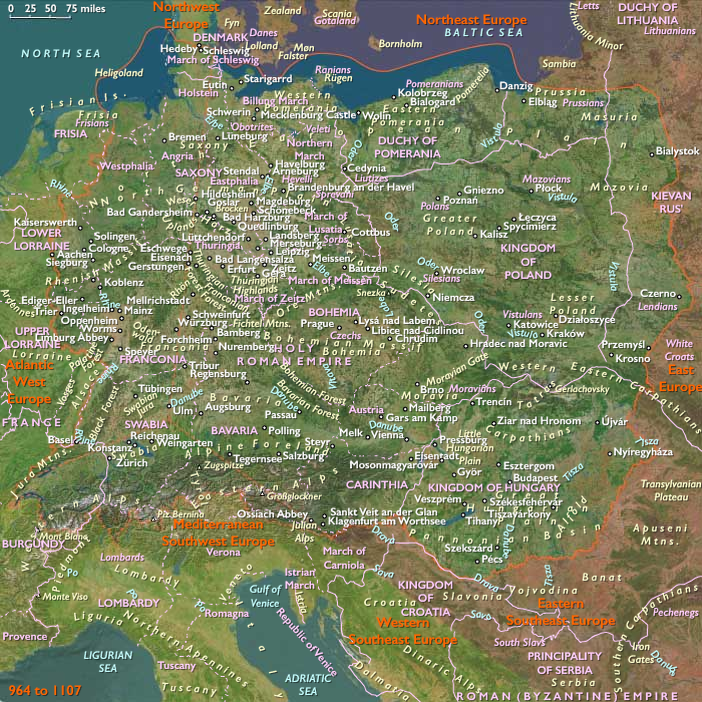
Rudolf seeks out Henry and meets him on January 27, 1080, at Flachheim between Eisenach and Mühlhausen in Thuringia.
Rudolf had arrayed his army on a hill behind a stream.
Rather than attack Rudolf and possibly get caught with his forces straddling the stream, Henry opts to march around the obstacle.
What happens in the gathering dark and the ensuing snowstorm is not certain.
On one hand, there are reports of the Saxons being attacked and driven off after duke Vratislaus II of Bohemia cuts down the Saxon standard during the snowstorm.
On the other hand, Ekkehard of Aura reports that Otto of Nordheim attacked and plundered Henry's camp before forcing the surrender of the Franconians and the Bohemians.
Berthold (possibly Berthold of Ratisbon) states that the armies became separated in the dark and that Rudolf was forced to withdraw to a neighboring village by the cold.
Vratislaus even succeeds in seizing Rudolf's golden sword, which will in the future be carried in front of Vratislaus on state occasions.
Rudolf returns to the field the next day, but Henry has withdrawn to Franconia and disbanded his army.
It is not clear if Henry was defeated or simply withdrew in the face of more resistance than he expected.
This is one of the very few times the Holy Roman Empire attempts to wage a midwinter military campaign in northern Europe.