François le Clerc
French privateer
Years: 1520 - 1563
François or Francis Le Clerc, known as Jambe de Bois ('Peg Leg'), is a 16th century French privateer, originally from Normandy.
He is credited as the first pirate in the modern era to have a "peg leg".
Related Events
Filter results
Showing 10 events out of 12 total
Isthmian America (1552–1563 CE): Wealth, Piracy, and the Fortification of the Isthmus
By the mid-sixteenth century, the trans-isthmian route between Nombre de Dios on the Caribbean and Panama City on the Pacific has become one of the Spanish Empire’s most valuable arteries, carrying immense treasure from Peru toward Spain. The enormous wealth passing along the Camino Real makes the region increasingly attractive to pirates and privateers, particularly English and French corsairs who target Spanish possessions and treasure fleets.
In 1554, a dramatic pirate raid underscores the vulnerability of the Spanish trans-isthmian route. French pirate François Le Clerc, also known as "Jambe de Bois" (Pegleg), leads a devastating attack on Nombre de Dios, plundering and partially destroying the town. This attack alarms the Spanish authorities, exposing the inadequacy of existing defenses and prompting urgent reinforcement.
In response, Spanish officials initiate a significant fortification project on the Caribbean coast, beginning construction of strengthened defenses at Nombre de Dios, and subsequently at nearby Portobelo, a more naturally defensible harbor. Portobelo's formidable fortifications are designed to secure the valuable treasure shipments, reflecting the heightened Spanish anxieties about piracy and foreign threats.
This era thus marks a pivotal shift as Spanish strategy moves from relying on secrecy and speed to embracing heavy fortifications and military preparedness to safeguard its critical interoceanic trade route.

François le Clerc, known as "Jambe de Bois" or "Peg Leg," hailed from Normandy and possessed a daring and audacious style.
He was notorious for being the first to board enemy vessels during attacks and raids. However, it was this bold approach that ultimately cost him a leg and severe damage to one arm while fighting the English at Guernsey in 1549.
While such an injury would have ended the careers of many pirates, le Clerc refused to retire.
Instead, he expanded the scope of his piracy by financing the voyages and attacks of other pirates.
Despite his wounds, le Clerc led major raids against the Spanish, earning the nickname "Pie de Palo" or "Peg Leg" from his adversaries.
He is credited as the first pirate in the modern era to sport a peg leg.
In 1553, le Clerc assumed overall command of seven pirate vessels and three royal ships, including his own, commanded by Jacques de Sores and Robert Blundel.
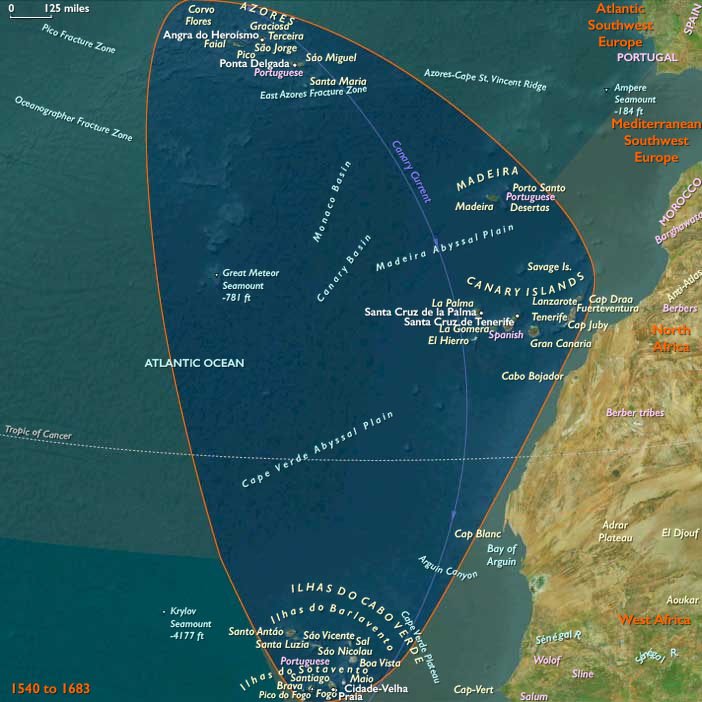
During the same year, he launched a successful attack on the port of Santa Cruz de La Palma in the Canary Islands, looting and setting it ablaze, causing extensive destruction.
Le Clerc’s strong pirate fleet, having sailed from the Canaries to raid San Germán in Puerto Rico, …
...methodically loots the ports of Hispaniola from south to north, stealing hides and cannon as they travel.
Le Clerc burns the colony of Yaguana (site of today's Port-au-Prince), to the ground, dealing a mortal blow to the Spanish settlement in western Hispaniola.
The Cahos Mountains, rising abruptly from the center of Hispaniola, will act as a formidable barrier to the small parties of Spaniards who attempt to re establish their settlements.
For the next half-century, the west will be largely abandoned.
On the return voyage, le Clerc and his corsairs plundered Las Palmas on Grand Canary Island and captured a Genoese carrack, seizing an even richer bounty.
Francois Le Clerc had set out from France in 1553 with three royal ships and a number of privateers under commission from Francis I of France, who is envious of the riches returning to Spain from the New World.
The seven-ship pirate fleet led by le Clerc sacks Santiago de Cuba in 1554, occupies it for a month, and leaves with eighty thousand pesos in treasure.
So completely devastated is Cuba's first capital that it will soon be completely eclipsed by Havana, never to recover its former prosperity.
Some accounts mention a raid on Santiago de Cuba by Jacques de Sores, a lieutenant or former lieutenant of le Clerc, although whether this is as part of the attack by le Clerc is not clear.
He may have used Cayo Romano and Cayo Coco in the archipelago of Jardines del Rey, adjacent to the northern Cuban coast, as a base of operations.
The first attack and resultant burning of Havana comes in 1555 at the hands of de Sores, leading a band of Huguenot pirates.
The number of ships that de Sores used in the attack varies in different accounts from two to twenty.
Nicknamed "The Exterminating Angel" ("L'Ange Exterminateur") de Sores takes Havana easily, plundering the city and burning much of it to the ground.
He also burns the shipping in the harbor and lays waste to much of the surrounding countryside, and seems to have found time to organize a play "to insult the pope".
After destroying the fortress of La Fuerza Vieja in today's Calle Tacón, he leaves without obtaining the enormous wealth he had hoped to find in Havana.
Le Clerc and his crew of three hundred and thirty men are the first Europeans to settle the island of Saint Lucia, and use the nearby Pigeon Island to target Spanish treasure galleons.
He forges an agreement with the Caribs, so that they will not attack his ship.
François Le Clerc has caused a great deal of damage to settlements along the coast of Panama while awaiting a Spanish treasure fleet carrying a cargo of bullion in 1560.
Such attacks have persuaded the Spanish Crown to fund the construction of the first fortresses in the main cities—not only to counteract the pirates and corsairs, but also to exert more control over commerce with the West Indies, and to limit the extensive contrabando (black market) that has arisen due to the trade restrictions imposed by the Casa de Contratación of Seville (the crown-controlled trading house that holds a monopoly on New World trade).