Francisco Pizarro
Spanish conquistador, conqueror of the Incan Empire and founder of Lima
Years: 1478 - 1541
Francisco Pizarro González (circa 1478 – 26 June 1541) is a Spanish conquistador who conquers the Incan Empire.
Pizarro González is born in Trujillo, Spain, the illegitimate son of Gonzalo Pizarro, an infantry colonel, and Francisca González, a woman of poor means.
His exact birth date is uncertain, but is believed to be sometime in 1478.
Scant attention is paid to his education and he grows up illiterate.
He is a distant cousin of Hernán Cortés.
On November 10, 1509, Pizarro sls from Spain to the New World with Alonzo de Ojeda on an expedition to Urabí.
He sails to Cartagena and joins the fleet of Martín Fernández de Enciso, and, in 1513, accompanies Balboa to the Pacific.
In 1514, he finds a supporter in Pedrarias Dávila, the Governor of Castilla de Oro, and is rewarded for his role in the arrest of Balboa with the positions of mayor and magistrate in Panama City, serving from 1519 to 1523.
Reports of Peru's riches and Cortés's success in Mexico tantalize Pizarro and he undertakes two expeditions to conquer the Incan Empire in 1524 and in 1526.
Both fail as a result of native hostilities, bad weather, and lack of provisions.
Pedro de los Ríos, the Governor of Panama, makes an effort to recall Pizarro, but the conquistador resists and remains in the south.
In April 1528, he reaches northern Peru and finds the natives rich in precious metals.
This discovery gives Pizarro the motivation to plan a third expedition to conquer Peru, and he returns to Panama to make arrangements, but the Governor refuses to grant permission for the project.
Pizarro retursto Spain to appeal directly to King Charles V. His plea is successful, and he receives not only a license for the proposed expedition, but also considerable authority over any lands conquered during the venture.
He is joined by family and friends, and the expedition leaves Panama in 1530.
When hostile natives along the coast threaten the expedition, Pizarro moves inland and founds the first Spanish settlement in Peru, San Miguel de Piura.
Inca Atahualpa refuses to tolerate a Spanish presence in his lands, but is captured by Pizarro during the Battle of Cajamarca on November 16, 1532.
A ransom for the emperor's release is demanded and Atahualpa fills a room with gold, but Pizarro charges him with various crimes and executes Atahualpa on July 26, 1533, much to the opposition of his associates, who think the conquistador is overstepping his authority.
The same year, Pizarro entersthe Incan capital of Cuzco, and the conquest of Peru is complete.
In January 1535, Pizarro founds the city of Lima, a project he considers his greatest achievement.
Quarrels between Pizarro and his longtime comrade-in-arms Diego Almagro culminate in the Battle of Las Salinas.
Almagro is captured and executed, and, on June 26, 1541, his embittered son assassinated Pizarro in Lima.
The conqueror of Peru is laid to rest in the Lima Cathedral.
Related Events
Filter results
Showing 10 events out of 160 total
Mediterranean Southwest Europe (1396–1539 CE): Aragonese Sea Lanes, Italian Renaissance, and Habsburg–Valois Wars
Geographic & Environmental Context
The subregion of Mediterranean Southwest Europe includes Italy (including Sardinia and Sicily), Malta, southern and eastern Spain (Andalusia, Murcia, Valencia, Catalonia), and the Balearic Islands. Anchors span the Po Valley and Venetian–Adriatic gateways, the Apennine spine with Tyrrhenian and Adriatic littorals, the grain and volcanic uplands of Sicily, the rugged Sardinian interior, Malta’s limestone plateau astride central sea-lanes, and Spain’s irrigated huertas and ports from Seville–Cádiz (Atlantic–Mediterranean hinge) through Valencia–Barcelonato the Balearics. Together, these corridors fed and armed Europe’s busiest inland sea.
Climate & Environmental Shifts
Under the Little Ice Age, winters were cooler and variability sharper:
-
Po Valley & northern Italy: alternating droughts and Po floods unsettled wheat/rice rotations; foggy winters extended.
-
Sicily, Sardinia, southern Spain: periodic droughts dented wheat and olive yields; citrus and pastoralism buffered shortfalls.
-
Valencian/Murcian huertas: canal and acequia irrigation moderated dry spells; occasional torrential floods (riadas) damaged terraces.
-
Balearics & Malta: thin soils and rainfall swings drove reliance on cisterns, terracing, and imported grain in lean years.
Subsistence & Settlement
-
Italy: Wheat, barley, vines, and olives dominated; rice spread in Lombardy; urban gardens ringed city-states.
-
Sicily & Sardinia: Grain, olives, vines, citrus, pastoral flocks; granaries supplied Italian and Iberian ports.
-
Southern & eastern Spain: Andalusian cereals, olives, vines; Valencia/Murcia grew rice, sugarcane, mulberry–silk; Catalan uplands raised sheep for wool.
-
Balearics & Malta: Mixed grain, olives, vines, goats; fisheries vital; harbors provisioned passing fleets.
Port cities—Venice, Genoa, Naples, Palermo, Barcelona, Valencia, Seville, Palma, Cagliari—functioned as collection and redistribution hubs for Mediterranean and, increasingly, Atlantic trade.
Technology & Material Culture
-
Irrigation & terracing: acequias, qanat-derived galleries, pozzos/cisterns, stone-walled benches stabilized yields on coasts and islands.
-
Maritime technology: galleys remained the workhorse; Italian and Iberian yards developed round-hulled naos and early caravels; bronze cannon transformed siege and naval warfare.
-
Manufactures: Florentine wool and silk; Venetian glass and print (Aldine press); Valencian silk and sugar; Catalan and Neapolitan shipyards.
-
Architecture & arts: Gothic to Renaissance transitions—Brunelleschi’s dome, Alberti’s façades, Venetian palazzi; Spanish Mudéjar and early Plateresque; island watchtowers and coastal walls.
Movement & Interaction Corridors
-
Aragonese thalassocracy: Barcelona–Valencia–Balearics–Sardinia–Sicily–Naples stitched a western Mediterranean network later inherited by Habsburg Spain.
-
Italian sea-lanes: Venice and Genoa collected Levantine and North African wares; peninsular roads (Via Emilia, Apennine passes) bound inland cities to ports.
-
Iberian hinge: Seville–Cádiz bridged Atlantic and Mediterranean circuits after 1492; Atlantic silver would later amplify these flows.
-
Island waypoints: Malta, Sardinia, and the Balearics provisioned convoys and guarded straits against corsairs.
Cultural & Symbolic Expressions
-
Renaissance humanism: Florence, Rome, and Venice fostered painting, sculpture, architecture, philology; courts of Naples, Ferrara, and Urbino radiated styles into Iberia and the islands.
-
Catholic Christendom: Papal Rome remained a pilgrimage and patronage center; confraternities, processions, and mendicant orders structured urban piety.
-
Iberian transformations: The Fall of Granada (1492) ended Nasrid rule; the Inquisition and expulsion/forced conversion reshaped Andalusian society; Valencian and Catalan towns mixed mercantile pragmatism with reforming currents.
-
Island identities: Genoese, Aragonese, and local elites fused on Corsica/Sardinia; Malta blended Sicilian, Catalan, and Arabic legacies—until 1530, when it became the fief of the Knights Hospitaller.
Environmental Adaptation & Resilience
-
Risk-spreading agriculture: cereal–legume rotations, vine–olive intercropping, and chestnut economies in uplands; rice paddies where water allowed.
-
Water management: canal dredging (Po/Adige), huerta maintenance (Valencia), terrace/cistern upkeep (Malta, Balearics, Ligurian and Amalfi coasts).
-
Urban buffers: state granaries, grain imports, and charitable confraternities mitigated dearth; fisheries and salted staples bridged bad harvests.
Technology & Power Shifts (Conflict Dynamics)
-
Hundred Years’ War (to 1453): peripheral raids reached Languedoc and Catalonia, nudging Aragonese naval policy.
-
Conquest of Naples (1442): Alfonso V of Aragon knit Naples to the Crown of Aragon’s sea empire.
-
Italian Wars (1494–1559): France, Spain, and the Empire fought over Italian hegemony—
-
Battle of Fornovo (1495) checked Charles VIII’s withdrawal;
-
Battle of Cerignola (1503) (Apulia) showcased gunpowder infantry, securing Spanish control in southern Italy;
-
Battle of Agnadello (1509) humbled Venice on the terraferma;
-
Battle of Pavia (1525) delivered a decisive Habsburg victory and Francis I’s capture;
-
the Sack of Rome (1527) shattered papal prestige and artists’ security.
-
-
Western Mediterranean contest: Barbary and Ottoman corsairs raided Sicily, Sardinia, Balearics, and Valencia; Rhodes (1522) fell to the Ottomans, redirecting the Hospitallers to Malta (1530); Preveza (1538) cemented Ottoman naval dominance in the eastern basin with echoes westward.
-
Iberian unification: The crowns of Aragon and Castile united (1479), projecting Spanish power across the peninsula, Italy, and the sea.
Transition
By 1539 CE, Mediterranean Southwest Europe was a crucible of power and culture. Habsburg Spain controlled Naples, Sicily, and Sardinia; Venice and Genoa mediated eastern and western trades under growing Habsburg and Ottoman pressure; Malta stood newly under the Knights as a central bastion; Valencia–Barcelona and Italian ports thrummed with commerce and shipbuilding. Despite climatic swings, terracing, irrigation, and maritime provisioning sustained populations. Renaissance patronage glowed even as Italian Wars and corsair/Ottoman threats remade the political seascape—setting up a long sixteenth century of Spanish predominance and Mediterranean contest.
Southwest Europe (1396–1539 CE)
Aragonese Sea Lanes, Italian Renaissance, and Habsburg–Valois Wars
Geography & Environmental Context
Southwest Europe encompassed Italy (including Sardinia and Sicily), Malta, southern and eastern Spain (Andalusia, Murcia, Valencia, Catalonia), and the Balearic Islands. Anchors spanned the Po Valley and Venetian–Adriatic gateways, the Apennine spine with Tyrrhenian and Adriatic littorals, the grain and volcanic uplands of Sicily, the rugged Sardinian interior, Malta’s limestone plateau astride central sea-lanes, and Spain’s irrigated huertas and ports from Seville–Cádiz (Atlantic–Mediterranean hinge) through Valencia–Barcelona to the Balearics.
Together these corridors provisioned, armed, and cultured Europe’s busiest inland sea.
Climate & Environmental Shifts
Under the Little Ice Age, winters cooled and variability intensified:
-
Po Valley & Lombardy: alternating droughts and Po floods unsettled rice and wheat rotations.
-
Sicily, Sardinia, southern Spain: recurrent droughts reduced grain and olive yields; citrus and pastoralism buffered loss.
-
Valencia–Murcia huertas: Acequia irrigation offset dry years, but torrential riadas periodically destroyed terraces.
-
Balearics & Malta: thin soils and rainfall swings required cisterns, terracing, and imported grain.
Subsistence & Settlement
-
Italy: Wheat, barley, vines, olives, and, in Lombardy, irrigated rice; urban gardens surrounded the city-states.
-
Sicily & Sardinia: Grain, olives, vines, citrus, and livestock; granaries provisioned Italian and Iberian ports.
-
Southern & eastern Spain: Andalusian cereals, olives, and vines; Valencian and Murcian sugarcane and mulberry–silk; Catalan wool flocks.
-
Islands: Grain, olives, vines, goats, and fisheries sustained mixed economies; harbors provisioned passing fleets.
Major ports—Venice, Genoa, Naples, Palermo, Barcelona, Valencia, Seville, Palma, Cagliari—served as collection hubs for Mediterranean and emerging Atlantic commerce.
Technology & Material Culture
-
Irrigation & terracing: Acequias, qanat-derived galleries, pozzos and cisterns, and stone-bench terraces stabilized yields on coasts and islands.
-
Maritime innovation: Galleys remained indispensable; Italian and Iberian shipyards developed round-hulled naos and early caravels; bronze cannon revolutionized siege and naval warfare.
-
Manufactures: Florentine wool and silk, Venetian glass and books (the Aldine Press), Valencian silk and sugar, Catalan and Neapolitan shipbuilding.
-
Architecture & arts: Gothic–Renaissance transitions—Brunelleschi’s dome, Alberti’s façades, Venetian palazzi; Spanish Mudéjar and early Plateresque; island watchtowers and coastal walls.
Movement & Interaction Corridors
-
Aragonese thalassocracy: The Barcelona–Valencia–Balearics–Sardinia–Sicily–Naples chain formed a western Mediterranean empire later absorbed by Habsburg Spain.
-
Italian sea-lanes: Venice and Genoa dominated Levantine and North African trade; Apennine passes linked inland production to ports.
-
Iberian hinge: Seville–Cádiz bridged Atlantic and Mediterranean routes after 1492, prefiguring global circuits of silver and spice.
-
Islands: Malta, Sardinia, and the Balearics provisioned convoys and guarded corsair-prone straits.
Cultural & Symbolic Expressions
-
Renaissance humanism: Florence, Rome, and Venice led Europe’s artistic renewal; courts of Naples, Ferrara, and Urbino radiated taste into Iberia and the islands.
-
Catholic Christendom: Rome remained pilgrimage center and patron of arts; confraternities and mendicant orders structured devotion.
-
Iberian transformations: The Fall of Granada (1492) ended Nasrid rule; the Inquisition and expulsions reshaped Andalusian society; Valencian and Catalan towns mixed mercantile realism with reformist thought.
-
Islands: Malta, blending Sicilian, Catalan, and Arabic legacies, was granted in 1530 to the Knights Hospitaller as a new crusading bastion.
Environmental Adaptation & Resilience
Cereal–legume rotations, vine–olive intercropping, chestnut economies in uplands, and rice paddies in irrigated lowlands spread risk.
Huerta canals and terrace systems were continuously maintained; state granaries and charitable confraternities mitigated dearth; fisheries and salted staples balanced harvest failures.
Technology & Power Shifts (Conflict Dynamics)
-
Aragonese expansion: Alfonso V (1442) united Naples with Aragon’s sea empire.
-
Italian Wars (1494–1559): France, Spain, and the Empire contested Italy—Fornovo (1495), Cerignola (1503), Agnadello (1509), Pavia (1525), and the Sack of Rome (1527) redefined European warfare and diplomacy.
-
Corsair & Ottoman pressure: Raids struck Sicily, Sardinia, Valencia, and the Balearics; Preveza (1538) confirmed Ottoman naval mastery in the east.
-
Iberian union: The crowns of Aragon and Castile (1479) created a Spanish monarchy projecting power across the peninsula and into the Mediterranean.
Transition
By 1539 CE, Southwest Europe was a crucible of power and culture. Habsburg Spain controlled Naples, Sicily, and Sardinia; Venice and Genoa mediated East–West trades under Ottoman pressure; Malta under the Knights became a bulwark; Valencia–Barcelona and Italian ports thrived on commerce and shipbuilding. Terracing, irrigation, and maritime provisioning sustained populations amid climatic volatility. Renaissance brilliance endured even as corsairs and cannon ushered in a new Mediterranean order.
Portuguese mariners are opening a route around Africa to the East in the fifteenth century.
At the same time as the Castilians, they have planted colonies in the Azores and in the Canary Islands (also Canaries; Spanish, Canarias), the latter of which have been assigned to Spain by papal decree.
The conquest of Granada allows the Catholic Kings to divert their attention to exploration, although Christopher Columbus's first voyage in 1492 is financed by foreign bankers.
In 1493 Pope Alexander VI (Rodrigo Borgia, a Catalan) formally approves the division of the unexplored world between Spain and Portugal.
The Treaty of Tordesillas, which Spain and Portugal sign one year later, moves the line of division westward and allows Portugal to claim Brazil.
New discoveries and conquests come in quick succession.
Vasco Núñez de Balboa reaches the Pacific in 1513, and the survivors of Ferdinand Magellan's expedition complete the circumnavigation of the globe in 1522.
In 1519 the conquistador Hernán Cortes subdues the Aztecs in Mexico with a handful of followers, and between 1531 and 1533 Francisco Pizarro overthrows the empire of the Incas and establishes Spanish dominion over Peru.
In 1493, when Columbus brought fifteen hundred colonists with him on his second voyage, a royal administrator had already been appointed for the Indies.
The Council of the Indies (Consejo de Indias), established in 1524, acts as an advisory board to the crown on colonial affairs, and the House of Trade (Casa de Contratacion) regulates trade with the colonies.
The newly established colonies are not Spanish but Castilian.
They are administered as appendages of Castile, and the Aragonese are prohibited from trading or settling there.
South America (1396–1539 CE)
Andean Empires, Forest Realms, and Southern Frontiers
Geographic Definition of South America
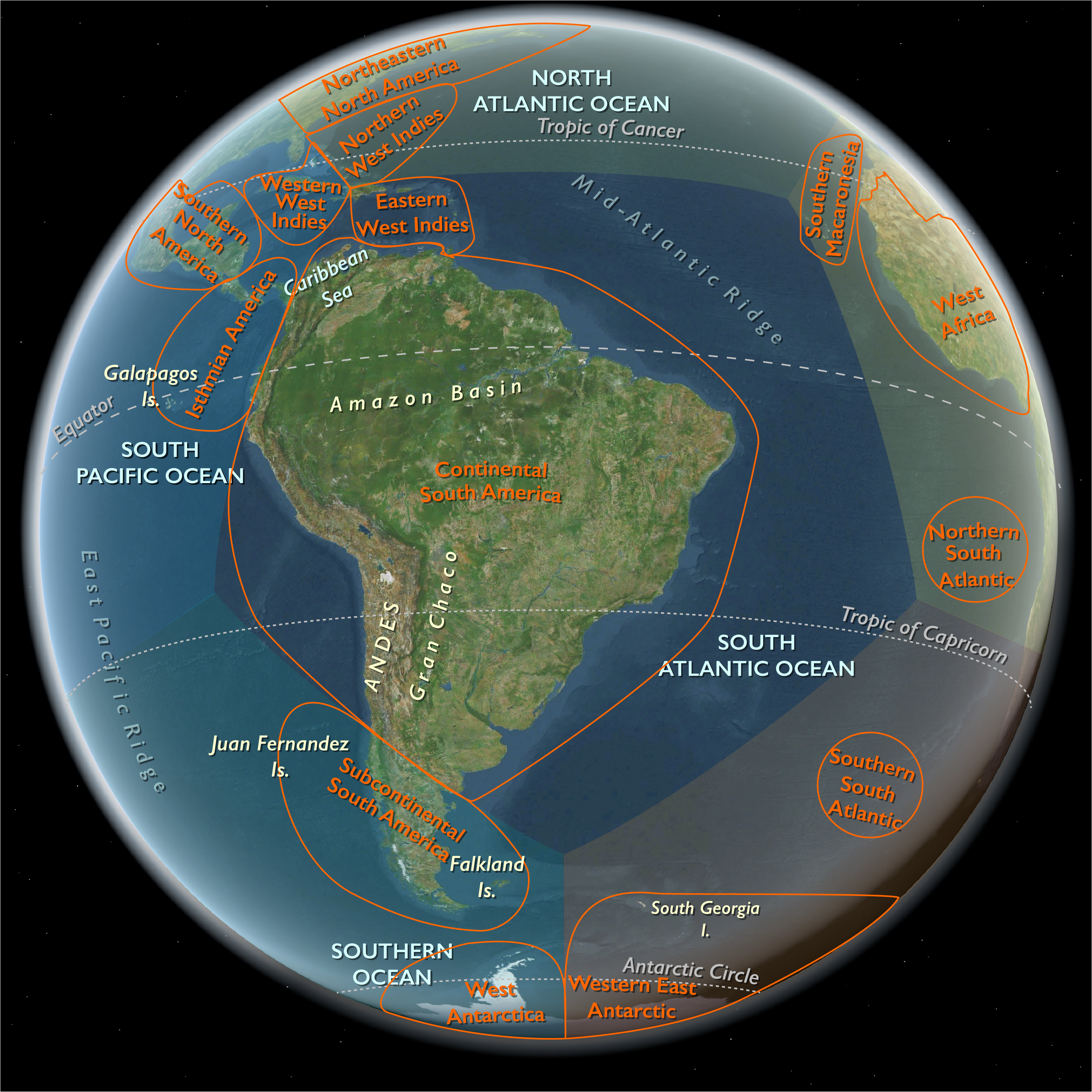
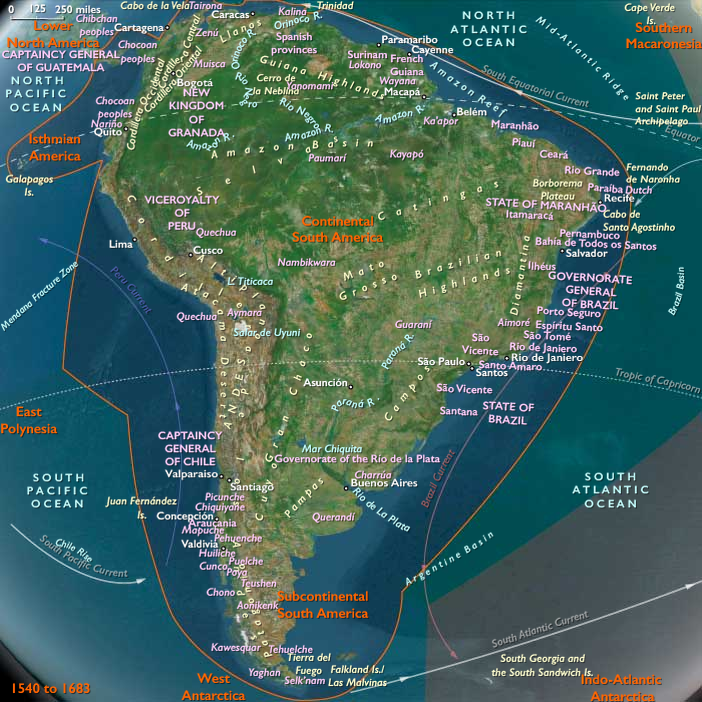
The region of South America includes all lands south of the Isthmus of Panama and comprises two subregions: South America Major—the entire continental span north of the Río Negro (Brazil, Uruguay, Paraguay, northern Argentina and northern Chile, Bolivia, Peru, Ecuador (excluding the Cape lands at the Isthmian boundary), Colombia (excluding the Darién), Venezuela, Guyana, Suriname, French Guiana)—and Peninsular South America, embracing southern Chile (including the Central Valley), southern Argentina (Patagonia south of the Río Negro and Río Grande), Tierra del Fuego, the Falkland Islands (Islas Malvinas), and the Juan Fernández Islands.
Anchors include the Andes cordillera and Altiplano, the Amazon basin, the Orinoco and Magdalena river systems, the Venezuelan Llanos, the Gran Chaco, the Uruguayan Pampas, the Guiana Shield, the Araucanian Andes, and the Strait of Magellan. Bounded by Isthmian America to the north and Subcontinental South America beyond the Río Negro, these ecologies linked Pacific highlands and Atlantic forests through riverine highways and mountain roads long before Europeans arrived.
Geography & Environmental Framework
The early Little Ice Age sharpened climatic contrasts across the continent.
In the Andes, cooler temperatures and episodic frosts shortened growing seasons on the Altiplano, while recurring El Niño cycles brought destructive floods and fishery collapses to the Pacific littoral. The Amazon and Orinoco basins alternated between decades of deluge and drought; the Gran Chaco swung between swollen floodplains and aridity; the Llanos and Pampas pulsed with seasonal waters. Far to the south, Patagonia and Tierra del Fuego grew colder and stormier, glaciers pressing into fjords while the Central Valley of Chile cycled through droughts and floods.
Despite these stresses, Indigenous systems—terraces and canals, terra preta gardens, floodplain fields, and mobile hunting grounds—sustained abundant populations from mountain to coast, forest to steppe.
Societies and Subsistence
Andean Empires and Highland Networks
The Inca Empire (Tawantinsuyu) reached its zenith in the fifteenth and early sixteenth centuries, uniting four administrative quarters from Quito to near Santiago around Cuzco. The imperial road, the Qhapaq Ñan, spanned over 30,000 kilometers, binding highlands to coastal valleys. Terraces, canals, and state storehouses (qollqas) supported maize, potato, quinoa, and coca across altitude zones; herds of llamas and alpacas supplied transport, fiber, and meat. Subordinate Aymara and Quechua polities—Lupaqa, Qulla, and others—kept local institutions within Inca oversight. Along the arid Pacific coast, irrigated valleys sustained dense populations; fishing communities harvested anchovy and shellfish, trading dried fish and salt to the highlands.
Lowland and Forest Civilizations
Beyond the Andes, tropical lowlands sustained intricate worlds of their own.
In the Amazon, Arawak, Tupí, and other language families cultivated manioc, maize, and beans in rotational fields, including anthropogenic terra preta soils enriched by charcoal and compost. Large villages, causeways, and canals attested to regional density; fishing, hunting, and foraging diversified diets. On the Guiana Shield, palm-thatched longhouses, hammocks, refined pottery, and featherwork marked vibrant material cultures. Along the Orinoco and Llanos, semi-nomadic horticulturalists balanced floodplain fields with canoe-borne trade. In the Gran Chaco and Uruguay–Paraguay riverlands, Guaraní and Charrúa societies combined horticulture, fishing, and hunting, forming riverine alliances.
Northern Andes and Caribbean Rim
In Colombia, chiefdoms such as the Muisca organized salt, emerald, and gold economies across the Bogotá highlands; paved roads linked maize and tuber fields to market towns. Quimbaya goldsmiths and Tairona builders in the Caribbean Sierra Nevada produced exquisite metallurgy and stone architecture, connecting mountain terraces to coastal fisheries.
Southern Frontiers of the Peninsula
South of the Bio-Bío, Mapuche communities cultivated maize, beans, and potatoes in dispersed lof kin groups, defending autonomy through fortified palisades and seasonal war bands. Across the Patagonian steppe, Tehuelchehunters ranged after guanaco and rhea with bows and bolas. In Tierra del Fuego, Yaghan and Kawésqar peoples sustained canoe-borne seal and shellfish economies, while inland Selk’nam hunters conducted communal hain initiations. The Falklands and Juan Fernández remained uninhabited refuges for seabirds and marine mammals.
Technology & Material Culture
Andean engineering and lowland ingenuity framed a continent-wide repertoire.
The Inca perfected cyclopean stone walls—Sacsayhuamán—and terraced sanctuaries—Machu Picchu—while rope suspension bridges spanned abysses; quipu knotted cords recorded tribute and census. Bronze, silver, and gold alloys formed tools and ritual vessels; alpaca and vicuña textiles indicated rank.
In forests and riverlands, dugout canoes, blowguns, polished stone adzes, and woven baskets underpinned daily life. Amazonian and Orinoco ceramics bore incised geometry and red slips; featherwork and body paint expressed cosmology. Among the Guaraní, woodcarving and music—flutes, rattles, chanted epics—reinforced communal identity. In the south, Mapuche weavers, Tehuelche leatherworkers, and Fuegian canoe-builders adapted craft to wind, ice, and grassland.
Movement & Interaction Corridors
Trade and communication linked coast, mountain, and forest in a continental web.
The Qhapaq Ñan moved armies, officials, and goods between Cuzco, Quito, and Lake Titicaca, tying highlands to coastal ports. Amazonian rivers carried pottery, salt, and smoked fish between forest polities; the Orinoco and Magdalena connected interior chiefdoms to Caribbean outlets. Guaraní and Tupí routes along the Paraná and Paraguay rivers joined Atlantic forests to Andean foothills. Southern trails crossed Araucanía and Patagonia, while canoe channels threaded Tierra del Fuego’s archipelagos.
After 1492, Atlantic and Pacific intrusions intersected these networks: Vicente Yáñez Pinzón reached the Amazon (1500); Pedro Álvares Cabral made landfall in Brazil (1500); Francisco Pizarro advanced into Peru by 1532, capturing Atahualpa at Cajamarca—events that foreshadowed a continental upheaval.
Cultural & Symbolic Expressions
Andean cosmology integrated empire and environment.
Inti (Sun), Viracocha (creator), and mountain spirits (apus) governed a universe of reciprocity; ritual labor (mit’a), feasts, and offerings upheld cosmic balance. Temples such as Qorikancha and shrines on snow peaks fused state and sacred.
In the forests, shamanic traditions flourished: visionary ceremonies with ayahuasca mediated ancestral spirits and healing. Guaraní mythic songs evoked Yvy Marane’ỹ—the “Land Without Evil”—guiding communal migrations and ethical life. In the south, Mapuche ritual (ngillatun) honored ngen spirits of place; Selk’nam hain initiations dramatized the ordering myths of kin and cosmos. Across the continent, art, chant, and ceremony merged ecology and law.
Environmental Adaptation & Resilience
Resilience lay in diversity and exchange.
Highland terraces, irrigation, and crop staggering cushioned frost; qollqa storehouses preserved grain for redistribution. Lowland shifting cultivation maintained soil fertility; terra preta fields proved regenerative. Guaraní and Charrúa mobility balanced fishing, farming, and hunting along river corridors. Southern canoe nomads and steppe hunters redistributed risk through seasonal movement and alliance. Ritual specialists interpreted droughts, floods, and quakes within sacred narratives that stabilized society in crisis.
Technology & Power Shifts (Conflict Dynamics)
By the early sixteenth century, European voyages redrew boundaries.
Portugal’s claim to Brazil under Tordesillas (1494) opened Atlantic coasts to sugar and enslaved labor, while Spain’s Andean campaigns dismantled Inca sovereignty. Epidemics—smallpox, measles, influenza—moved faster than armies, fracturing polities from Cuzco to Caracas and along the Caribbean rim. Yet resistance flared in highlands, forests, and southern plains: local leaders preserved languages, rituals, and communal lands beneath the first colonial impositions.
Transition (to 1540 CE)
By 1539 CE, South America stood on the threshold of the colonial age.
In the Andes, imperial roads and storehouses were being repurposed by Spain; along Brazil’s shores, Portuguese footholds took root. The Amazon, Orinoco, Guianas, and southern fjords still pulsed with autonomous Indigenous life, though disease and slave raiding had begun to spread inland.
From Altiplano terraces to blackwater channels, from lof fields to Fuegian hearths, this was a continent of breathtaking resilience—empires, chiefdoms, and forest–fjord communities alike sustained by ancient ecological knowledge. The next age would bring conquest, conversion, and coerced labor on a continental scale—the end of one world and the turbulent birth of another.
South America Major (1396–1539 CE)
Empires of the Andes and Forest Realms of the Lowlands
Geography & Environmental Framework
The subregion of South America Major encompasses all lands north of the Río Negro, extending across the full continental span of Brazil, Uruguay, Paraguay, northern Argentina and northern Chile, Bolivia, Peru, Ecuador (excluding the Cape lands at the Isthmian boundary), Colombia (excluding the Darién region, which belongs to Isthmian America), Venezuela, Guyana, Suriname, and French Guiana.
Anchors include the Andes cordillera and Altiplano, the Amazon basin, the Orinoco and Magdalena river systems, the Venezuelan Llanos, the Gran Chaco, the Uruguayan Pampas, and the Guiana Shield.
Bounded by Isthmian America to the north and Subcontinental South America to the south, this subregion forms the continental heartland of South America—linking the Pacific and Atlantic worlds through its intertwined highlands, forests, plains, and river systems.
Climate & Environmental Shifts
The onset of the Little Ice Age brought cooler highland conditions and altered rainfall patterns across the tropics and subtropics.
-
In the Andes, frost and drought shortened growing seasons on the Altiplano, but sophisticated terracing and irrigation buffered risk.
-
Along the Pacific coast, recurring El Niño events caused catastrophic floods and disruptions to fisheries.
-
The Amazon basin experienced alternating decades of heavy rainfall and drought, while the Gran Chaco swung between floodplain expansion and aridity.
-
The Llanos and Pampas remained productive savannas with seasonal pulses of water and grass.
Despite these fluctuations, complex agro-ecological systems maintained food surpluses and population density across mountain, forest, and plain.
Societies and Subsistence
Highland Empires and Andean Networks
The Inca Empire (Tawantinsuyu) reached its zenith in the fifteenth and early sixteenth centuries, stretching from Quito to Santiago. Centered in Cuzco, it integrated four great administrative quarters through the Qhapaq Ñan—an imperial road network spanning over 30,000 kilometers.
Agriculture flourished through terracing, canals, and storage systems: potatoes, quinoa, maize, and coca were cultivated across altitudinal zones. Herds of llamas and alpacas provided transport, wool, and meat. Subordinate Aymara and Quechua polities of the Altiplano—such as the Lupaqa and Qulla—maintained regional autonomy under Inca oversight.
Along the arid Pacific coast, irrigated valleys sustained large populations, while fishing towns harvested anchovy and shellfish, trading dried fish and salt to highland markets.
Lowland and Forest Civilizations
Beyond the Andes, the tropical lowlands sustained their own intricate worlds.
-
In the Amazon basin, Arawak, Tupí, and other language families cultivated manioc, maize, and beans in rotating terra preta gardens enriched by charcoal and compost. Extensive villages with causeways and canals testified to dense populations. Fishing, hunting, and gathering diversified diets.
-
In the Guiana Shield, communities built palm-thatched longhouses, weaving hammocks, pottery, and feather ornaments of extraordinary craftsmanship.
-
Along the Orinoco and Llanos, semi-nomadic horticulturalists balanced floodplain cultivation with hunting and canoe-borne trade.
-
In the Gran Chaco and Uruguay–Paraguay plains, Guaraní and Charrúa peoples combined horticulture, fishing, and hunting, forming alliances along major rivers.
Northern Andes and Caribbean Rim
In Colombia, chiefdoms such as the Muisca of the Bogotá highlands organized salt, emerald, and gold economies; maize and tuber cultivation supported towns linked by paved roads. Quimbaya goldsmiths and Tairona builders of the Caribbean Sierra Nevada crafted some of the hemisphere’s finest metallurgy and stone architecture, connected by trade to coastal fisheries and interior markets.
Technology & Material Culture
The Inca perfected stone architecture—cyclopean walls at Sacsayhuamán, terraced sanctuaries like Machu Picchu, and rope suspension bridges spanning mountain gorges. Quipu knotted cords recorded tribute and census data. Bronze, silver, and gold alloys produced tools, jewelry, and ritual vessels; textiles woven from alpaca and vicuña wool expressed rank and artistry.
In the forests and lowlands, technology was organic: dugout canoes, blowguns, and polished stone adzes shaped daily life. Ceramics in the Amazon and Orinoco basins featured geometric incisions and red slips; featherwork and body paint carried spiritual significance. Across the Guaraní world, woodcarving and music (flutes, rattles, chants) reinforced communal identity.
Movement & Interaction Corridors
Trade and communication linked coast, mountain, and forest in a continental web.
-
The Qhapaq Ñan carried goods, officials, and armies between Cuzco, Quito, and Lake Titicaca, connecting highlands to coastal ports.
-
Amazonian rivers served as highways for canoe-borne trade in pottery, salt, and smoked fish.
-
The Orinoco and Magdalena rivers connected interior chiefdoms to Caribbean outlets, while Guaraní and Tupí routes along the Paraná and Paraguay rivers linked Atlantic forests to the plateaus of Bolivia and Peru.
-
After 1492, Spanish and Portuguese expeditions entered these corridors from both coasts: Vicente Yáñez Pinzón reached the Amazon (1500), Pedro Álvares Cabral made landfall in Brazil (1500), and Francisco Pizarro advanced into Peru by 1532, capturing Atahualpa at Cajamarca.
Cultural & Symbolic Expressions
Andean cosmology integrated empire and environment.
Inti (the Sun), Viracocha (creator), and the mountain spirits (apus) governed a universe of reciprocity. Ritual labor (mit’a), feasts, and offerings upheld cosmic balance. Temples such as Qorikancha in Cuzco and shrines on Andean peaks embodied the union of state and sacred.
In the forests, shamanic traditions flourished: visionary ceremonies with ayahuasca revealed ancestral spirits and guided healing. Guaraní mythic songs evoked Yvy Marane’ỹ—the “Land Without Evil,” a spiritual homeland guiding communal migrations. Across the continent, art, song, and ritual merged cosmology with ecological stewardship.
Environmental Adaptation & Resilience
Resilience lay in diversity and exchange.
-
Highland terraces and irrigation stabilized yields against frost. Qollqa storehouses preserved grain for redistribution during drought.
-
Lowland shifting cultivation sustained soil fertility; terra preta fields proved regenerative.
-
Guaraní and Charrúa mobility across riverine networks balanced fishing, farming, and hunting.
-
Ritual specialists interpreted climate and disaster through sacred narrative, reinforcing social cohesion.
The result was a continent-wide mosaic of adaptation—mountain engineering, forest horticulture, and floodplain navigation—all interlocked in a dynamic equilibrium.
Technology & Power Shifts (Conflict Dynamics)
The early sixteenth century brought profound disruption.
Spanish and Portuguese voyages redefined continental boundaries: Portugal’s claim to Brazil under the Treaty of Tordesillas (1494) opened the Atlantic littoral to sugar cultivation and enslavement; Spain’s Andean campaigns dismantled the Inca imperial order. Epidemics—smallpox, measles, influenza—moved faster than armies, fracturing societies from Cuzco to Caracas. Yet resistance flared across the highlands and jungles: local leaders preserved languages, rituals, and communal land systems beneath the new colonial veneer.
Transition (to 1540 CE)
By 1539 CE, South America Major stood at the edge of irreversible change.
The Inca Empire had fallen, its roads and storehouses repurposed by Spain. In Brazil, Portuguese settlements were taking root along the coast. The Amazon, Orinoco, and Guiana Shield still pulsed with autonomous Indigenous life, but diseases and slave raids were spreading inland.
From the Altiplano terraces to the Amazon’s blackwater channels, this was a continent of breathtaking resilience—empires, chiefdoms, and forest communities alike sustained by ancient ecological knowledge. Yet the next age would bring conquest, conversion, and coerced labor on a continental scale, marking the end of one world and the violent creation of another.
Middle America (1396–1539 CE)
Isthmian Crossroads, Mesoamerican States, and the First Atlantic Conquests
Geographic Definition of Middle America
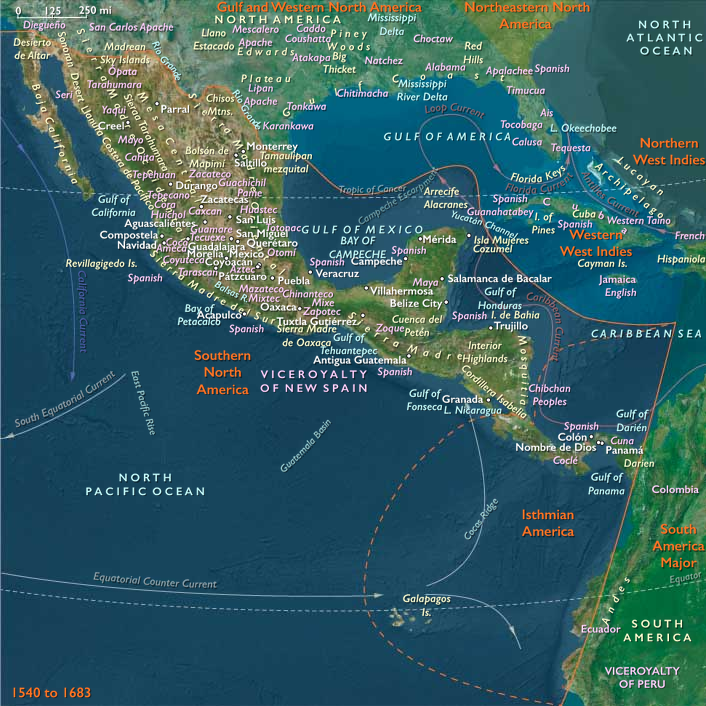
Middle America encompasses Isthmanian America—Costa Rica, Panama, the San Andrés Archipelago, the Galápagos Islands, and the Darién of Colombia with the Cape lands of Ecuador—and Southern North America—Mexico, Guatemala, Belize, Honduras, El Salvador, and Nicaragua.
Anchors include the Valley of Mexico, the Yucatán Peninsula, the Chiapas–Guatemalan cordillera, the Cordillera Central of Panama–Costa Rica, the Darién Gap, the Gulf of Panama, and the Pacific outliers of the Galápagos. Bounded by South America Major to the south (beginning beyond the Darién and Ecuador’s cape lands), this narrow continental hinge joined the Caribbean and Pacific, making it one of the most strategic corridors in the Americas.
Geography & Environmental Framework
The early Little Ice Age modestly cooled highlands while preserving tropical rainfall regimes.
Caribbean slopes remained humid; Pacific faces saw sharper dry seasons. Highland basins—from the Valley of Mexico to Antigua Guatemala—supported dense populations, while lowland coasts and floodplains favored cacao groves, salt pans, and fishing settlements. Offshore, the Galápagos oscillated with El Niño, their upwellings feeding seabird and turtle populations even in the absence of permanent human settlement.
Climate & Environmental Shifts
-
Highlands: Shorter growing seasons and frost risk in the Basin of Mexico and Guatemalan plateaus tested maize at altitude, but terrace and irrigation systems buffered yields.
-
Lowlands: Periodic drought affected Maya lowlands; hurricanes struck Caribbean coasts episodically; torrential rains inundated the Darién and Pacific estuaries.
-
Galápagos: El Niño brought rainfall pulses and disrupted marine upwelling cycles, altering rookery success.
Despite variability, societies mitigated risk through waterworks, multicropping, storage, and exchange.
Societies & Subsistence
Mesoamerican States and City-Regions (Southern North America)
-
Central Mexico: The Mexica (Aztecs) dominated the Basin of Mexico, their capital Tenochtitlan anchored by chinampas (raised-field “floating” gardens) yielding maize, beans, squash, amaranth, chilies, and flowers. Tribute maize, cacao, and cotton flowed along calzadas and causeways; ward-based calpulli organized labor and land.
-
Maya realms: After Mayapán’s collapse, smaller Maya polities in Yucatán and the Chiapas–Guatemalanhighlands sustained milpa agriculture, terrace fields, cacao orchards, and coastal fisheries. City-temple complexes, ball courts, and market towns persisted in flexible political mosaics.
-
Pacific & Gulf coasts: Estuarine villages combined maize horticulture with salt-making, shellfishing, and long-distance trade.
Isthmian Chiefdoms and Riverine Worlds (Isthmanian America)
-
Panama & Costa Rica: Chibchan and Cueva chiefdoms farmed maize, manioc, and cacao; gold–copper metallurgy, polished stone axes, and cotton textiles marked status. Dispersed hamlets and river villages linked floodplain fields to coastal fisheries.
-
Darién & Ecuador’s capes: Stilt-house communities managed riverine farming, fishing, and trade in cotton, salt, and shell ornaments between Caribbean and Pacific.
-
San Andrés & Galápagos: The archipelagoes remained uninhabited—waypoints in ecological and, by the sixteenth century, nautical networks.
Technology & Material Culture
-
Architecture & waterworks: Pyramids, palaces, and tzompantli precincts in stone; chinampa hydraulic systems; highland terraces and canals; stilt houses in floodplains.
-
Crafts & records: Polychrome pottery, featherwork, turquoise mosaics, and bark-paper codices recorded ritual and dynastic history.
-
Metallurgy & textiles: Isthmian gold–copper alloys, jade and shell ornaments; cotton weaving across lowlands and highlands.
-
Weapons & tools: Atlatl, obsidian blades, bows, shields; dugout canoes for coasting and river travel.
Movement & Interaction Corridors
-
Overland isthmus trails: Portage paths linked cacao zones, salt flats, and coasts—an overland bridge between the Caribbean and Pacific.
-
Mesoamerican trade: Mexica pochteca moved obsidian, cacao, cloth, and feathers across tribute routes radiating from Tenochtitlan; Maya merchants trafficked salt, jade, and cotton between Yucatán, highlands, and coasts.
-
River and coastal canoes: Navigated the Usumacinta, Grijalva, Motagua, Chagres, and Tuira, and along both littorals.
-
European intrusion: In 1510 Spaniards founded Santa María la Antigua del Darién; Vasco Núñez de Balboa crossed to the Pacific (1513). Hernán Cortés toppled the Mexica (1519–1521); Pedro de Alvarado and allies invaded Guatemala (1524); Nicaragua fell in the 1520s. From Panama, Pizarro and Almagro launched the Andean conquest.
Cultural & Symbolic Expressions
-
Mexica cosmology: Huitzilopochtli, Tlaloc, and solar order sustained imperial ritual—sacrifice renewed cosmic balance; the ball game dramatized conflict and renewal.
-
Maya traditions: Ancestor veneration, council houses (popol nah), divinatory almanacs, and painted codicesencoded history and prophecy.
-
Isthmian ritual: Shamanic healing, ancestor shrines, and prestige goldwork structured authority from Veraguasto Darién.
-
Across the isthmus and highlands, poetry, festivals, and mask-dances knit together cosmic cycles with communal time.
Environmental Adaptation & Resilience
-
Highlands: Terraces, irrigation, and chinampa intensification stabilized yields under frost and drought; surplus storage and tribute redistribution spread risk.
-
Lowlands & isthmus: Milpa rotations conserved soils; stilt houses mitigated floods; diversified diets—cacao, fish, palm fruits—balanced climate uncertainty.
-
Galápagos: Unpeopled ecosystems adapted to El Niño variability; rookeries persisted as part of a wider Pacific web.
Technology & Power Shifts (Conflict Dynamics)
The first Atlantic conquests cascaded through Middle America.
Cortés’s alliances—and epidemics—toppled the Mexica; Alvarado smashed highland Maya states; isthmian chiefdoms resisted but were overwhelmed by warfare, forced labor, and disease after 1510. From Panama, the bridge between seas became the staging ground for the Andean invasion. Yet pockets of autonomy survived in forests, mountains, and marshlands, where ritual and kin networks preserved identity beneath the new colonial order.
Transition (to 1540 CE)
By 1539 CE, Middle America stood transformed.
The Basin of Mexico was a Spanish capital; Guatemala and Nicaragua were colonial provinces; Panama had become the hinge of Spain’s oceanic empire. The Galápagos entered charts; the isthmus’s trails became imperial roads.
Still, Maya towns, Chibchan river villages, and refugee communities endured—maintaining languages, planting cycles, and ritual geographies in the interstices of conquest. Between two oceans, Middle America’s ancient corridors now carried a new world of ships, silver, and crosses—yet beneath them flowed the older currents of maize, cacao, and memory that would continue to shape the centuries to come.
Isthmian America (1396–1539 CE): Crossroads of Continents and Spanish Intrusion
Geographic & Environmental Context
The subregion of Isthmian America includes Costa Rica, Panama, the Galápagos Islands, the San Andrés Archipelago, and the northeastern edge of South America (the Darién of Colombia and the capes of Ecuador). Anchors included the Cordillera Central of Panama and Costa Rica, the Darién Gap, the coasts of the Gulf of Panama, and the Pacific outliers of the Galápagos. This narrow isthmus bound together Pacific and Caribbean, making it one of the most strategic corridors in the Americas.
Climate & Environmental Shifts
The Little Ice Age brought modest cooling but retained high rainfall across most of the isthmus. The Caribbean side experienced humid equatorial rains, while Pacific slopes endured a sharper dry season. The Galápagos were subject to El Niño cycles, alternately increasing rainfall and disrupting marine upwellings, affecting seabird and turtle populations. Hurricanes rarely reached the region, but torrential rains and flooding in the Darién constrained settlement.
Subsistence & Settlement
-
Panama and Costa Rica: Populated by Chibchan- and Cueva-speaking peoples who practiced maize, manioc, and cacao cultivation, combined with fishing, hunting, and foraging. Villages ranged from dispersed hamlets to larger chiefdom centers.
-
Darién: Supported riverine farming and fishing societies, with villages on raised platforms in flood-prone areas.
-
Capes of Ecuador: Hosted coastal farmers and fishers who traded cotton, salt, and shell ornaments.
-
Galápagos and San Andrés Archipelago: Uninhabited, though the Galápagos may have been visited intermittently by seafarers from Ecuador or northern Peru for turtles and fish.
Technology & Material Culture
Local crafts included polished stone axes, gold ornaments, and ceramics. Chibchan metallurgy blended hammered gold with copper alloys. Cacao served as both food and currency. Wooden dugout canoes carried people and goods between river mouths and along coasts. Shell beads, cotton cloth, and feather ornaments circulated through regional exchange.
Movement & Interaction Corridors
-
Canoes plied the Caribbean and Pacific coasts, linking river mouths and estuaries.
-
Trails across the Isthmus connected cacao-producing zones with salt flats, creating a vital overland passage between seas.
-
The Galápagos lay beyond normal voyaging networks but were ecologically connected by seabird migrations and turtle rookeries.
-
In 1510, Spaniards founded Santa María la Antigua del Darién, the first enduring European town on the mainland. From there, Vasco Núñez de Balboa crossed the Isthmus in 1513, becoming the first European to view the Pacific Ocean.
-
Expeditions under Francisco Pizarro and Diego de Almagro launched from Panama toward Peru in the 1520s and 1530s.
Cultural & Symbolic Expressions
Indigenous cosmologies emphasized ancestor veneration, shamanism, and sacred landscapes tied to rivers and mountains. Gold ornaments embodied prestige and ritual power. Spanish missionaries imposed crosses and chapels, though Indigenous rituals endured in villages and forests. Oral traditions preserved memory of migrations, river spirits, and ancestral origins.
Environmental Adaptation & Resilience
Communities adapted to flooding with stilt houses, diversified diets through riverine fishing and farming, and used cacao and trade networks to spread risk. In the Galápagos, seabirds and turtles exploited shifting upwellings and El Niño variability, sustaining unpeopled but vibrant ecosystems.
Transition
By 1539 CE, Isthmian America had become the launching point of Spanish conquest across the Andes and Pacific. Indigenous communities persisted in Costa Rica, Panama, and the Darién, though epidemics and violence had already begun devastating populations. The Galápagos remained uninhabited but entered Spanish charts. This narrow, strategic corridor—long an Indigenous crossroads—had become the hinge of Spain’s oceanic empire.
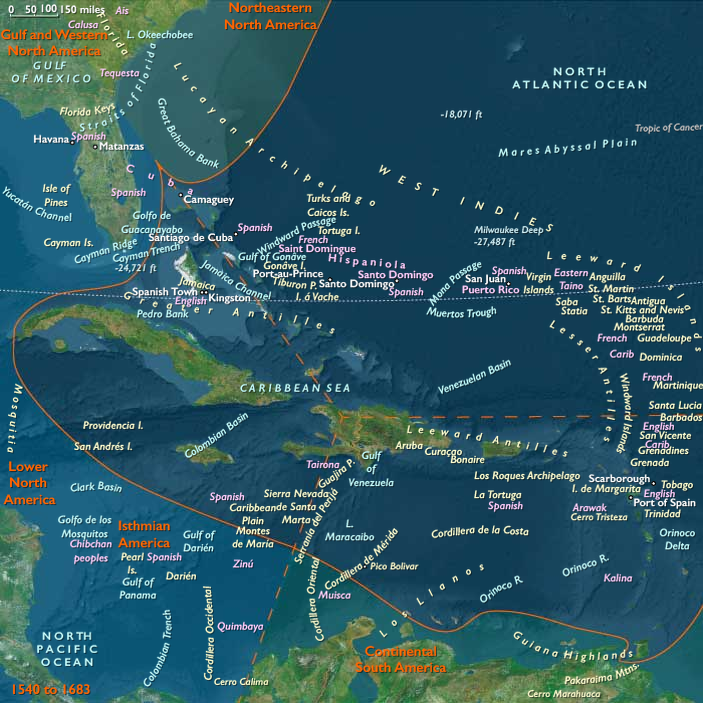
The choice finally falls on Diego Velazquez de Cuellar (governor of Hispaniola, 1511—21), Ovando's lieutenant and one of the wealthiest Spaniards in Hispaniola.
Although not as heroic or daring as later conquistadors such as Francisco Pizarro, conqueror of Peru, or as cunning as Hernán Cortés, conqueror of Mexico, Velazquez has achieved a reputation for courage and sagacity because of his role in subduing native caciques in Hispaniola.
From the start, Velazquez faces an outraged and hostile native population.
Led by Hatuey, a fugitive chieftain from Hispaniola, the natives of eastern Cuba resolve to resist the Spanish onslaught.
It is a futile gesture, for the peaceful Tainos lack the military skills and weapons to face the better armed and trained Spaniards.
Spanish horses and hounds, both unknown in Cuba, play a decisive role in terrorizing the indigenous peoples, who soon surrender or flee into the mountains to escape the wrath of the conquistadors.
Hatuey himself is captured, tried as a heretic and a rebel, and burned at the stake.
He induces groups of natives to lay down their weapons and work near the several new towns that he establishes throughout the island.
Among these are Baracoa, Bayamo, Trinidad, Sancti Spiritus, La Habana (hereafter, Havana), Puerto Principe, and Santiago de Cuba.
In this task, Velasquez is decisively aided by the work of Bartolome de Las Casas.
The Dominican friar precede the Spaniards into native villages on many occasions and succeeds in persuading the indigenous peoples to cooperate with the conquistadors.
Las Casas, however, is horrified by the massacre of the natives and becomes an outspoken critic of the conquest of Cuba.
He writes extensively, condemning the Spaniards' cruelty and claiming that the natives are rational and free and therefore entitled to retain their lands.
The Spanish Crown intends to develop the West Indies economically and thereby expand Spanish political, religious, and administrative influence in the region.