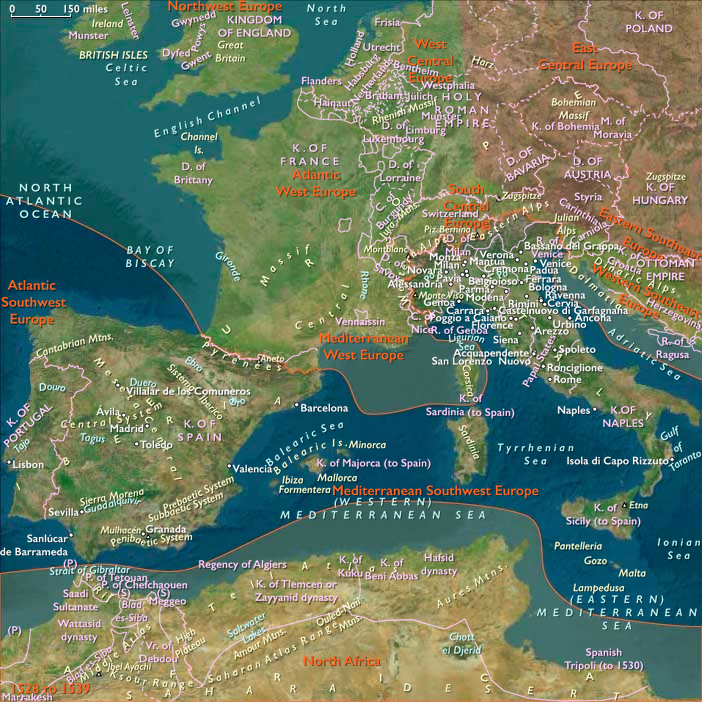
Baldassare Castiglione, with Francesco Maria della Rovere, had taken part in Pope Julius II's expedition against Venice, an episode in the Italian Wars: for this he had received the title of Conte di Novilara, a fief near Pesaro.
Francesco Maria having succeeded as duke of Urbino at Guidobaldo's death, Castiglione remains at his court.
Castiglione writes about his works and of those of other guests in letters to other princes, maintaining an activity very near to diplomacy, though in a literary form, as in his correspondence with Ludovico da Canossa.
He had been born into an illustrious Lombard family at Casatico, near Mantua, where his family had constructed an impressive palazzo.
The signoria (lordship) of Casatico (today part of the commune of Marcaria) had been assigned to an ancestor, one Baldasar da Castiglione, a friend of Ludovico II Gonzaga, Marquis of Mantua, in 1445.
The later Baldassare is related to Ludovico through his mother, Luigia Gonzaga.
In 1494, at the age of sixteen, Castiglione had begun his humanist studies in Milan, which will eventually inform his future writings.
However, in 1499, after the death of his father, Castiglione had left his studies and Milan to succeed his father as the head of their noble family.
Soon his duties seem to have included representative offices for the Gonzaga court; for instance, he accompanied his marquis for the Royal entry at Milan of Louis XII.
For the Gonzaga he had traveled quite often; during one of his missions to Rome, he had met Guidobaldo da Montefeltro, duke of Urbino, and in 1504 a reluctant Francesco Gonzaga had allowed him to leave and take up residence in that court.
Urbino is at this time the most refined and elegant among Italian courts, a meeting point of culture ably directed and managed by duchess Elisabetta Gonzaga and her sister-in-law Maria Emilia Pia.
The most constant guests include: Pietro Bembo, Giuliano de' Medici, Cardinal Bibbiena, Ottaviano and Federigo Fregoso, and Cesare Gonzaga, a cousin of both Castiglione and the duke.
The hosts and guests organize intellectual competitions which result n an interesting, stimulating cultural life producing brilliant literary activity.
In 1506, he had written (and played in) a pastoral play, his eclogue Tirsi, in which allusively, through the figures of three shepherds, he depicts the court of Urbino.
The work contains echoes of both ancient and contemporary poetry, recalling Poliziano and Sannazzaro as well as Virgil.