Fontes Pereira de Melo
Portuguese diplomat, politician, and enginee
Years: 1819 - 1887
António Maria de Fontes Pereira de Melo GCTE KGF (Lisbon, 1819 – Lisbon, 1887) was a Portuguese diplomat, politician, and engineer.
He is the son of João de Fontes Pereira de Melo and wife and first cousin Jacinta Venância Rosa da Cunha Matos.
Historically, he is a very important political figure, deputy, and in several occasions minister, six times Minister of Finance.
Related Events
Filter results
Showing 6 events out of 6 total
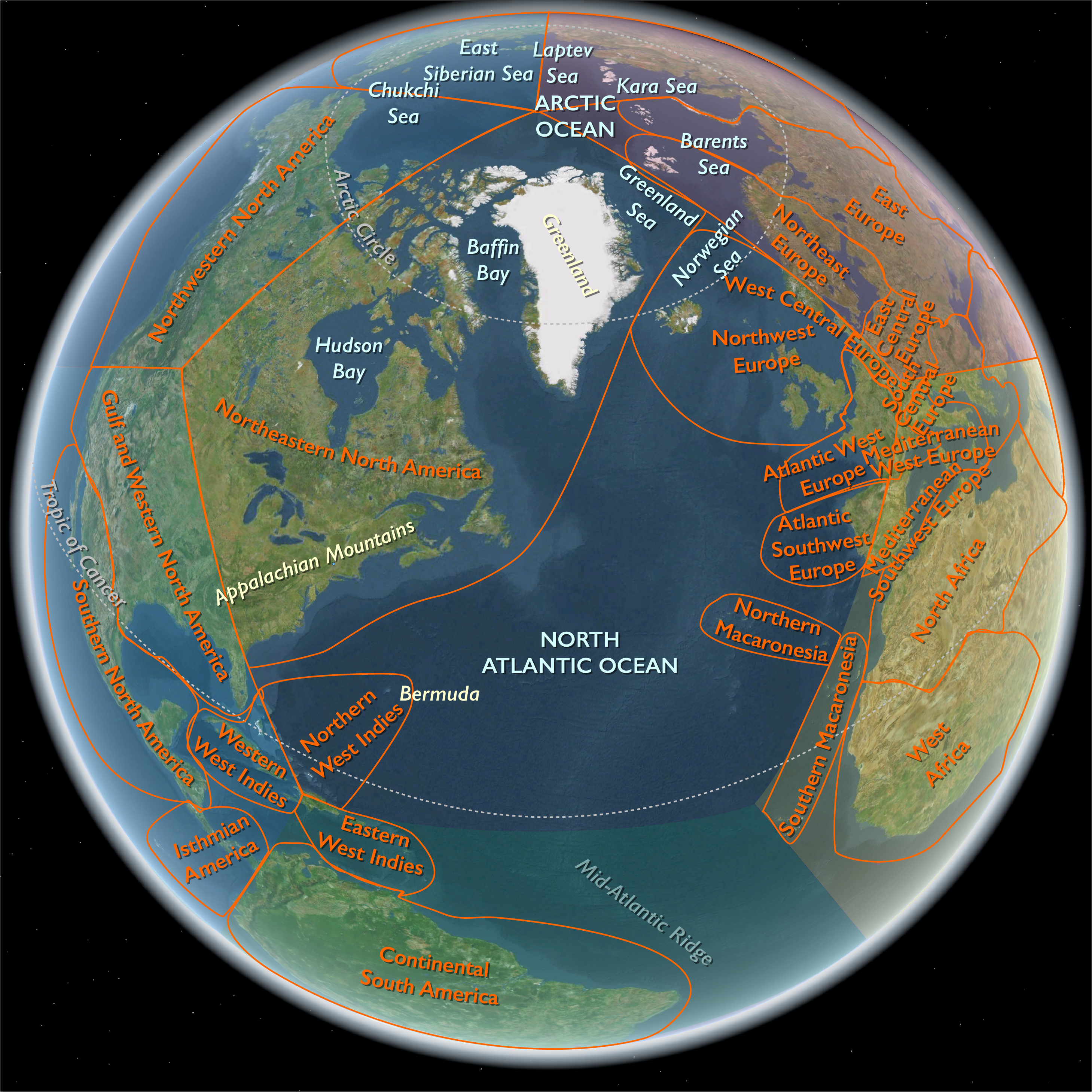
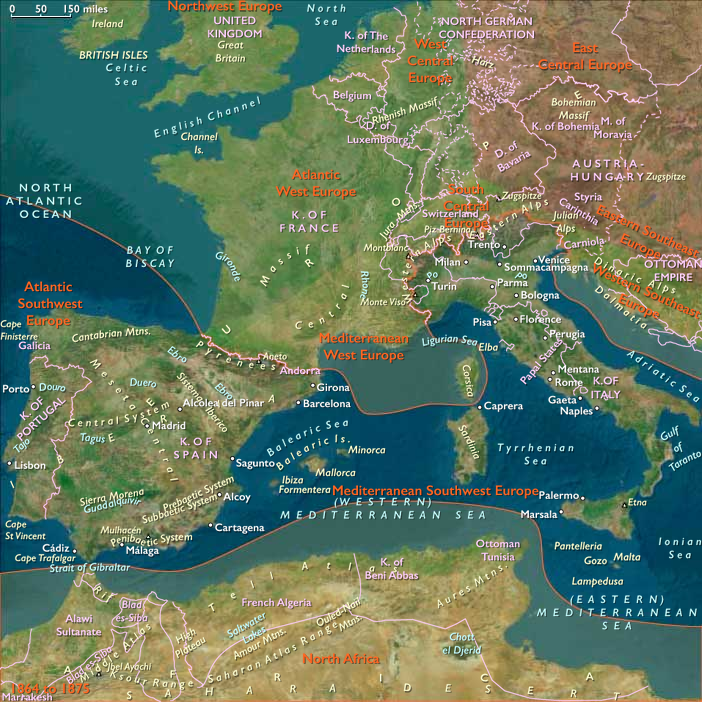
Atlantic Southwest Europe (1852–1863): Stability, Economic Expansion, and Growing Regionalism
Between 1852 and 1863, Atlantic Southwest Europe—including northern and central Portugal, Galicia, Asturias, Cantabria, northern León and Castile, northern Navarre, northern Rioja, and the Basque Country—experienced relative political stability, significant economic expansion, and a rise in regional identities. While liberal governments in Portugal and Spain sought political moderation, economic growth accelerated through industrialization, infrastructural improvements, and increased international trade. Simultaneously, regional autonomy movements, notably in the Basque territories and Galicia, deepened, shaping political discourse and cultural development.
Political and Military Developments
Portugal: Regeneration Era and Moderate Liberalism
-
Portugal entered the Regeneration Era (Regeneração), a period of stable government and moderate liberal reforms initiated by Prime Minister Fontes Pereira de Melo (from 1851 onward).
-
This era was marked by political pragmatism, infrastructural improvements (railways, roads, ports), and administrative modernization, reducing tensions after the Patuleia Revolt.
-
Northern Portugal, especially around Porto, benefited significantly from these reforms, fostering economic prosperity and social stability.
Spain: Moderate Liberalism and Ongoing Carlism
-
Under Queen Isabella II (1833–1868), Spain achieved relative stability through moderate liberal governments (Moderados). Prime Ministers like Leopoldo O'Donnell (1856–1863) promoted centralized governance, economic development, and infrastructure improvements, notably railways.
-
However, Carlism continued as a potent political and cultural force in the Basque Country, northern Navarre, and rural areas of northern Castile and León. Despite military suppression of prior rebellions, Carlist ideals—regional autonomy, traditional monarchy, and Catholic conservatism—remained influential.
Economic Developments: Expansion and Industrialization
Portuguese Economic Prosperity and Infrastructure
-
Portugal's economic growth accelerated through improved infrastructure, notably rail connections linking Porto and Lisbon, significantly enhancing commercial trade.
-
Northern cities like Porto, Braga, and Guimarães experienced robust industrial growth, particularly in textiles, leather goods, and wine exports (Port wine), increasingly integrated into British and northern European markets.
Northern Spanish Industrial and Commercial Boom
-
The Basque Country experienced notable industrial growth, centered around iron extraction, steel production, shipbuilding, and heavy industry, especially in Bilbao, reinforcing its role as a critical economic hub.
-
Cantabria, notably Santander, flourished through maritime commerce and shipbuilding, further integrated into international trading networks.
-
Galicia continued expanding maritime commerce and fishing industries, particularly in Vigo and A Coruña, benefiting from improved ports and transport connections.
Social and Urban Developments
Urbanization, Industrial Labor, and Social Tensions
-
Major urban centers—Porto, Bilbao, Santander, and Vigo—expanded rapidly, drawing rural migrants seeking industrial employment. Population growth and increased urban density amplified social inequalities and tensions between working-class laborers and emerging industrial elites.
-
Industrial conditions prompted early labor activism, with strikes and protests periodically occurring in Bilbao’s iron industry, Porto’s textile factories, and Galicia’s maritime sectors, advocating for improved working conditions, wages, and political representation.
Rural Stagnation and Increased Emigration
-
Rural Galicia, Asturias, and northern Castile and León continued facing poverty, agricultural stagnation, and demographic pressure, prompting intensified emigration to Brazil, Argentina, Cuba, and other parts of Latin America, reshaping regional demographics and economic structures.
Cultural and Religious Developments
Strengthening Regional Identities and Cultural Movements
-
Cultural and linguistic movements expanded significantly. Galician literature and folklore flourished through regional publications promoting Galician identity and language revitalization.
-
In the Basque territories, literary and linguistic activism increasingly asserted Basque cultural distinctiveness, emphasizing local traditions, folklore, and language revival efforts.
-
Northern Portugal experienced a vibrant Romantic literary scene, especially in Porto, characterized by cultural pride and renewed interest in historical narratives highlighting Portuguese identity.
Continued Influence of Catholicism
-
Catholicism retained strong influence throughout the region, particularly among rural populations in Galicia, Asturias, northern Castile, and the Basque Country, reinforcing conservative values amid liberal reforms.
-
Despite secular trends in education and urban middle-class culture, religious institutions remained socially influential, shaping community rituals, festivals, and moral values.
Legacy and Significance
The years 1852–1863 represented a period of relative stability, significant economic expansion, and cultural flourishing for Atlantic Southwest Europe. Portugal’s Regeneration Era and Spain’s moderate liberalism fostered political pragmatism, infrastructural improvement, and economic prosperity. Yet, increased urbanization and industrial growth also intensified social inequalities, fueling early labor movements. Meanwhile, regional cultural identities, notably in Galicia and the Basque Country, deepened significantly, asserting local autonomy and distinctiveness. These developments profoundly influenced subsequent political, social, and cultural trajectories throughout the region.
Atlantic Southwest Europe (1864–1875): Liberal Revolutions, Industrial Expansion, and Regional Turmoil
Between 1864 and 1875, Atlantic Southwest Europe—including northern and central Portugal, Galicia, Asturias, Cantabria, northern León and Castile, northern Navarre, northern Rioja, and the Basque Country—experienced renewed political upheaval, significant economic transformation, and growing regional tensions. This period was shaped by revolutionary changes in Spain culminating in the short-lived First Spanish Republic, continuing industrial expansion, increased labor activism, and intensified regional cultural movements, reflecting the era's broader European liberal trends.
Political and Military Developments
Spain: Revolution, Republic, and Restoration
-
In 1868, the Glorious Revolution overthrew Queen Isabella II, ushering in a period of intense political experimentation and instability.
-
Following the brief reign of Amadeo I (1870–1873), Spain established its First Republic in 1873, characterized by political turmoil and decentralized federalist aspirations, influencing regional politics significantly.
-
Persistent instability, Carlist insurrections in the Basque Country and Navarre (Third Carlist War, 1872–1876), and republican factionalism led to the Republic’s collapse in 1874, leading to the Bourbon Restoration under Alfonso XII (1874–1885).
Portugal: Stability Amidst Regionalism
-
Portugal maintained relative political stability under the ongoing Regeneration period led by Prime Minister Fontes Pereira de Melo. Moderate liberal governments continued infrastructural modernization and economic reforms.
-
Northern Portuguese regions, notably Porto, Braga, and Coimbra, experienced limited political unrest compared to Spain, benefiting from sustained economic and infrastructural improvements.
Economic Developments: Industrialization and Trade Expansion
Industrial Growth in Northern Spain
-
Economic expansion continued robustly, particularly in the Basque Country. Bilbao became Spain’s primary industrial center for iron mining and steel production, significantly modernizing its industries and infrastructure.
-
Cantabria, particularly Santander, flourished through maritime trade and commerce, increasingly connecting with British and European markets.
Portuguese Economic Diversification and Maritime Growth
-
Northern Portugal, especially Porto, Braga, and Guimarães, diversified economically through expanded textile manufacturing, wine exports (Port wine), and emerging industries like glass and ceramics production.
-
Railways expanded further, integrating Porto and Lisbon closely with international trading networks, strengthening Portugal’s economic stability and growth.
Social and Urban Developments
Urbanization and Social Inequalities
-
Industrial and commercial growth accelerated urbanization dramatically in Bilbao, Porto, Santander, and Vigo. This rapid expansion intensified socioeconomic disparities, creating pronounced working-class neighborhoods characterized by poverty and overcrowding.
-
Labor movements became increasingly visible, with workers in Bilbao’s steel industries, Vigo’s maritime trade, and Porto’s textile factories advocating labor rights, fair wages, and improved working conditions, resulting in numerous strikes and protests.
Rural Poverty and Emigration
-
Persistent rural stagnation, especially in Galicia, Asturias, and northern Castile-León, continued driving substantial emigration to the Americas, notably Brazil, Argentina, Mexico, and Cuba, reshaping demographic structures and regional economies significantly.
Cultural and Religious Developments
Regional Cultural Revivals and Autonomy Movements
-
Regional cultural identities strengthened substantially. Galician cultural movements flourished through literature, language revival, and folklore, promoting a distinctive Galician identity.
-
Basque nationalism and cultural revival intensified, particularly influenced by political instability and Carlist wars. Cultural organizations actively promoted Basque language preservation (Euskara), literature, and folklore, laying foundations for later political nationalism.
-
Northern Portuguese cultural institutions continued promoting Romantic nationalism, emphasizing historical heritage, Portuguese identity, and literary traditions prominently in cities like Porto and Coimbra.
Persistent Influence of Catholicism
-
Catholicism maintained a central social and cultural role across northern Spain and Portugal, providing stability amidst political turmoil. The Church remained influential in educational and social institutions, particularly in rural regions, sustaining traditional values and community cohesion.
Legacy and Significance
The years 1864–1875 were pivotal for Atlantic Southwest Europe, characterized by political upheaval, rapid industrial expansion, intensified labor movements, and burgeoning regional identities. Spain's revolutionary turmoil and the brief republican experiment profoundly impacted regional politics, while Portugal maintained relative stability, experiencing continued modernization and economic diversification. Increased urbanization, labor activism, and significant cultural revival movements in Galicia, the Basque Country, and northern Portugal underscored deepening regional identities, significantly shaping the region's subsequent political, economic, and cultural trajectories.
The Janeirinha Revolt and the End of the Regeneration (1868)
The Janeirinha Revolt, a protest movement against the tax on consumables, erupted on January 1, 1868, triggering immediate political upheaval and significant administrative reforms in Portugal. The movement gained widespread support in major cities, particularly Lisbon, Porto, and Braga. A large demonstration in Porto on January 1, 1868, as part of the uprising, led to the founding of the newspaper O Primeiro de Janeiro, named in commemoration of the event.
The revolt swiftly led to the fall of the government on January 4, 1868, resulting in the appointment of a new administration under António José d’Ávila. For many historians, the Janeirinha marked the end of the Regeneration, a political era that had brought relative stability to the Portuguese Constitutional Monarchy.
The Regeneration and Its Legacy (1851–1868)
The Regeneration (Regeneração) had begun following the military insurrection of May 1, 1851, which had led to the fall of Costa Cabral and the Septembrist government. Though initially led by Marshal João Carlos de Saldanha, the era’s defining figure was Fontes Pereira de Melo, who championed economic development and modernization, albeit through heavy fiscal policies that ultimately provoked public discontent.
While the Regeneration lacks a precise chronological boundary, it lasted for approximately seventeen years, shaping Portugal’s economic and infrastructural landscape. However, the Janeirinha Revolt not only led to the fall of the government but also reshaped Portugal’s political forces, leading to:
- The formation of the Reformist Party, which altered the country’s political dynamics.
- The onset of prolonged governmental instability, as political factions became increasingly fragmented.
- The definitive end of the stability imposed by the "Regenerador" movement, ushering in a more volatile period of governance.
Thus, while the Regeneration had been a period of progress and modernization, it ultimately fell victim to the fiscal burdens it had imposed, as growing dissatisfaction culminated in the Janeirinha Revolt, changing the course of Portuguese politics.
Marshal Saldanha’s Final Intervention: The 1870 Dictatorship
By 1870, Portugal was gripped by insurmountable financial difficulties, political turmoil, and street unrest, exacerbated by a succession of weak and ineffective governments. In response to the mounting crisis, the elderly Marshal João Carlos de Saldanha, a veteran of multiple political upheavals, once again asserted his authority over the nation.
Supported by the army, Saldanha established a supra-party dictatorship, intending to enforce political reforms and stabilize the government. His intervention, however, was a last, desperate attempt to impose order on an increasingly fractured political landscape.
Despite his efforts, Saldanha did not live to see the failure of his reforms, as his regime quickly unraveled under the weight of the same economic instability and political divisions that had necessitated his coup. His final bid to reshape Portugal’s political system ultimately proved fleeting, as the country remained mired in instability and governmental paralysis in the years that followed.
The Delagoa Bay Arbitration and the Reign of Luís I (1872–1889)
In 1872, the longstanding dispute between Great Britain and Portugal over Delagoa Bay, located on the coast of Mozambique, was submitted to the arbitration of French President Adolphe Thiers. On April 19, 1875, Thiers’s successor, Marshal Patrice de MacMahon, ruled in favor of Portugal, reaffirming its sovereignty over the strategically significant bay. This ruling secured Portugal’s foothold in southeastern Africa, though the broader decline of the Portuguese empire continued.
King Luís I: A Monarch Overshadowed by Stagnation
Luís I of Portugal was an intellectual and a poet, but he lacked the political acumen necessary for effective governance. Thrust onto the throne following the deaths of his brothers Pedro V and Fernando in 1861, he presided over a tedious and ineffective domestic reign, dominated by the system of rotativismo—the alternating rule of the Progressistas (Liberals) and Regeneradores (Conservatives). While Luís personally favored the Regeneradores, granting them an extended period in power after 1881, his rule did little to advance the country’s fortunes.
Despite a brief flirtation with the Spanish succession before the Franco-Prussian War (1870–1871), Luís’s reign was largely one of domestic stagnation. During his rule, Portugal continued to fall behind western European nations in key areas such as public education, political stability, technological progress, and economic development. As a result, the Portuguese monarchy became increasingly detached from the country’s pressing challenges, setting the stage for the growing unrest that would culminate in the 20th-century republican movement.
Atlantic Southwest Europe (1876–1887): Stability Restored, Economic Modernization, and Rising Regional Consciousness
From 1876 to 1887, Atlantic Southwest Europe—including northern and central Portugal, Galicia, Asturias, Cantabria, northern León and Castile, northern Navarre, northern Rioja, and the Basque Country—experienced relative political stability, vigorous economic modernization, and intensified regional cultural expressions. Following Spain’s Bourbon Restoration, the region saw renewed economic growth and infrastructural advancements, while Portugal continued moderate liberal reforms and commercial expansion. Simultaneously, regionalist and nationalist movements gained strength, significantly influencing cultural and social dynamics.
Political and Military Developments
Spain: The Bourbon Restoration
-
Under Alfonso XII (r. 1874–1885) and later regency of María Cristina of Austria (from 1885), Spain stabilized politically after decades of turbulence. The 1876 Constitution established a liberal-conservative alternation (Turno Pacífico), restoring centralized parliamentary monarchy.
-
The defeat of the Carlist movement in 1876 ended decades of intermittent warfare, integrating Basque and Navarrese territories fully into centralized Spanish governance while granting limited preservation of traditional fueros (regional rights).
Portugal: Continuing Regeneration Stability
-
Portugal remained stable politically under the ongoing Regeneration period, guided primarily by Prime Minister Fontes Pereira de Melo and moderate liberals. Economic development and infrastructural investments remained prioritized, fostering national cohesion and stability.
-
Northern Portuguese cities, notably Porto and Braga, enjoyed sustained urban and economic growth, facilitated by liberal governance focused on trade, commerce, and industrialization.
Economic Developments: Industrial Growth and Infrastructural Modernization
Expansion of Industrial and Maritime Economies
-
Bilbao’s industrial boom accelerated further, consolidating the Basque Country as Spain’s economic powerhouse. The iron and steel industries experienced rapid expansion, driven by growing demand from Britain, France, and the Americas.
-
Santander in Cantabria and Gijón in Asturias significantly expanded port facilities, enhancing maritime trade connections to Britain, Northern Europe, and the Americas, stimulating regional economic prosperity.
Portuguese Economic Diversification
-
Northern Portugal, especially Porto, Braga, and Guimarães, saw further diversification in textiles, ceramics, glass production, and port wine exports. Enhanced railway infrastructure connected northern Portugal efficiently with Lisbon and the Atlantic trade routes, greatly benefiting regional commerce.
-
Growth in Porto’s manufacturing and maritime sectors bolstered economic prosperity, reinforcing the city’s importance as a dynamic commercial hub.
Social and Urban Developments
Urbanization, Labor Activism, and Social Reform
-
Urban growth surged in major cities including Bilbao, Porto, Vigo, and Santander, reflecting significant economic opportunities but exacerbating socio-economic disparities and poor working conditions.
-
Labor movements intensified their advocacy efforts, particularly among steelworkers in Bilbao and textile workers in Porto. Workers' associations and trade unions increasingly organized strikes and demanded improved wages and conditions, influencing broader social policies.
Rural Distress and Emigration
-
Rural regions, notably Galicia, Asturias, and inland northern Castile-León, remained economically disadvantaged. Persistent poverty and limited agricultural productivity drove continued mass emigration, primarily toward Latin America (Argentina, Brazil, Cuba) and the United States, deeply reshaping regional demographics.
Cultural and Religious Developments
Regionalist Movements and Cultural Revival
-
Regionalist and nationalist sentiments strengthened further, particularly within Galicia and the Basque Country. Galician literature, folklore, and cultural institutions promoted distinctive regional identity, emphasizing linguistic and cultural uniqueness.
-
The Basque nationalist movement expanded under figures like Sabino Arana, who emerged prominently during this period, advocating political autonomy and cultural revival. Basque language schools, literature, and cultural associations flourished, significantly influencing regional identity politics.
Cultural Flourishing in Northern Portugal
-
Northern Portugal experienced sustained cultural vitality, particularly in Porto and Braga, characterized by growing literary and artistic output emphasizing Portuguese nationalism and regional pride.
-
Cultural institutions and educational reforms promoted a strong sense of Portuguese identity, enriched by historical consciousness, literary Romanticism, and emerging regionalist discourse.
Continued Influence of the Catholic Church
-
The Catholic Church maintained its influential role in social and educational domains throughout northern Portugal and Spain, acting as a stabilizing force in urban and rural communities alike. The Church’s conservative influence provided continuity and social cohesion, counterbalancing the secular liberalizing trends emerging in major urban centers.
Legacy and Significance
The years 1876–1887 marked a crucial period of political stability, economic modernization, and burgeoning regional consciousness in Atlantic Southwest Europe. Spain’s Bourbon Restoration provided essential stability following decades of conflict, while Portugal sustained moderate liberal governance and economic expansion. Urbanization and industrial growth reshaped social dynamics, fostering intensified labor movements and social reform efforts. Concurrently, heightened regionalist sentiments and cultural revivals, particularly pronounced in Galicia and the Basque Country, significantly influenced future nationalist movements and cultural identities. These developments set important foundations for continued regional autonomy struggles, socio-economic transformations, and enduring cultural distinctiveness into the twentieth century.