Ferdinand I of Portugal
King of Portugal and the Algarve
Years: 1345 - 1383
Ferdinand I (Portuguese: Fernando; October 31, 1345 – October 22, 1383), sometimes called the Handsome (o Formoso or o Belo) or occasionally the Inconstant (o Inconstante), is the King of Portugal and the Algarve from 1367 until his death.


Related Events
Filter results
Showing 10 events out of 23 total
As Luis de La Cerda's influence waned, other parties eagerly resumed their adventures in the Canary Islands.
Majorcan expeditions, now under the rule of Aragon, continued to explore the region.
In 1346, Jaume Ferrer set sail, aiming for Senegal but possibly making contact with the Canaries along the way.
Arnau Roger followed suit in 1352, and in 1366, Joan Mora led a royal-sponsored expedition, instructed to patrol for interlopers as well.
These expeditions, along with many unrecorded ones by Majorcans, merchants from Seville, and Lisbon, were primarily driven by commercial interests.
The main objective was capturing native islanders to be sold as slaves in European markets.
However, peaceful trade with the locals also took place, particularly for orchil and dragon's blood, valuable dyes for the European cloth industry, which grew abundantly on the islands.
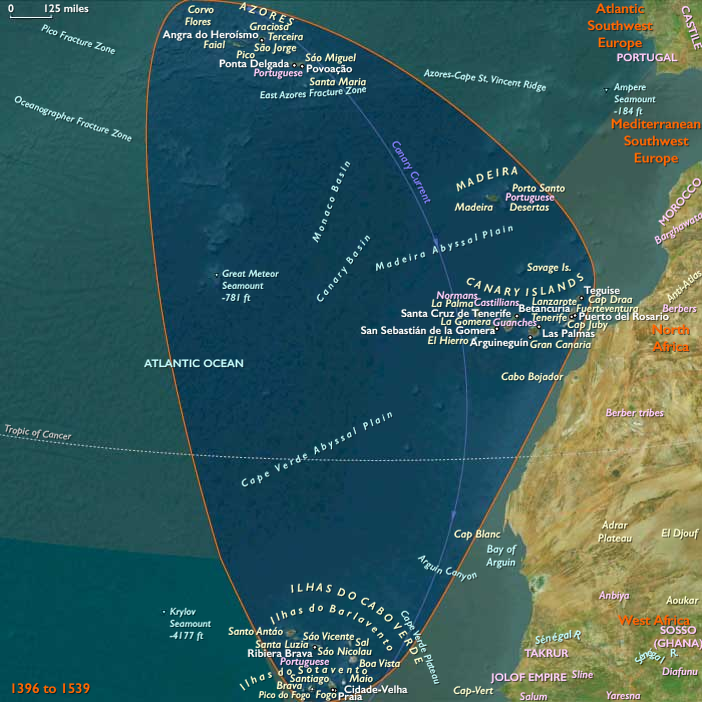
With these expeditions, geographic knowledge of the Canary Islands began to solidify.
In the 1367 portolan chart created by Domenico and Francesco Pizzigano, La Gomera and El Hierro were depicted.
The Catalan Atlas of 1375 provided an almost complete and accurate map of the Canaries, with only La Palma missing.
The Catalan Atlas listed the eleven islands in order from east to west: Graciosa (La Graciosa), Laregranza (Alegranza), Rocho (Roque), Insula de Lanzaroto Maloxelo (Lanzarote), Insula de li Vegi Marin (Lobos), Forteventura (Fuerteventura), Insula de Canaria (Gran Canaria), Insula del infernio (Tenerife), Insula de Gomera (La Gomera), and Insula de lo Fero (El Hierro).
During the dynastic wars between Portugal and Castile in the 1370s, Portuguese and Castilian privateers, engaged in conflict with each other, sought shelter or conducted slave-raiding expeditions in the Canary Islands.
Ferdinand I of Portugal, disregarding the 1344 bull, granted the islands of Lanzarote and La Gomera to the adventurer known as 'Lançarote da Franquia,' who some believe to be the seemingly ageless Lanceloto Malocello.
This Lanzarote attempted to seize control of the islands, leading to reported fights with "Guanches and Castilians."
Atlantic Southwest Europe (1360–1371 CE): Portuguese Stability under Pedro I and Ferdinand I, Castilian Turmoil and Civil Strife, and Navarrese Diplomatic Maneuvering
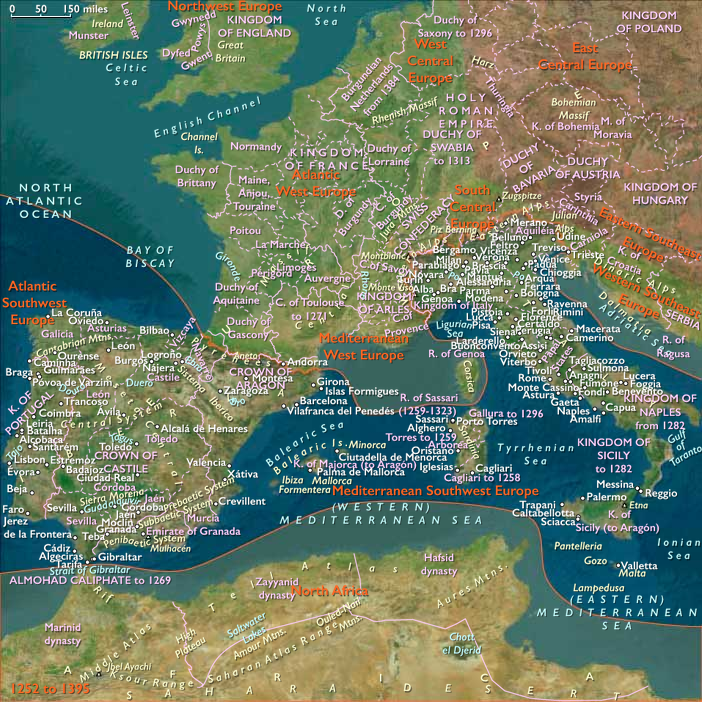
Between 1360 and 1371 CE, Atlantic Southwest Europe—including Galicia, northern and central Portugal, Asturias, Cantabria, and northern Spain south of the Franco-Spanish border (43.05548° N, 1.22924° W)—experienced contrasting developments amid a period marked by political turbulence in Castile, relative governance stability in Portugal, and skillful diplomatic neutrality in Navarre. Portugal, governed successively by King Pedro I (1357–1367 CE) and King Ferdinand I (1367–1383 CE), maintained stable administration and moderate economic recovery from the previous era’s devastation. Castile, deeply troubled by civil war and aristocratic conflicts under King Pedro I "the Cruel" (1350–1369 CE) and later Henry II (1369–1379 CE), faced severe internal instability and political transformation. Navarre, under King Charles II "the Bad" (1349–1387 CE), navigated carefully between rival powers, preserving regional autonomy, diplomatic flexibility, and stable governance.
Political and Military Developments
Portuguese Stability under Pedro I and Ferdinand I
Portugal enjoyed continued governance stability and administrative coherence under the late reign of King Pedro I, whose effective administration and judicial reforms sustained internal stability. His successor, King Ferdinand I, decisively maintained territorial integrity and economic recovery despite tensions arising from Castilian civil conflict. Ferdinand’s cautious diplomacy and strategic neutrality safeguarded Portuguese autonomy and prosperity.
Castilian Civil War and Dynastic Conflict
Castile endured severe internal turmoil characterized by intense civil conflict between Pedro I "the Cruel" and his half-brother, the future Henry II of Trastámara. Their protracted conflict culminated in Pedro’s death in 1369, bringing Henry II to power. This dynastic shift decisively altered Castilian governance, weakening central authority temporarily but ultimately laying foundations for future political realignments and territorial consolidation under the Trastámara dynasty.
Navarrese Diplomatic Prudence under Charles II
Navarre skillfully preserved diplomatic neutrality and regional autonomy under the prudent yet politically opportunistic leadership of King Charles II "the Bad." His strategic balancing of Castilian, French, and Aragonese interests decisively preserved Navarre’s territorial integrity and internal stability, ensuring continued regional autonomy amidst Iberian instability.
Economic Developments
Agricultural and Economic Recovery
Following the demographic devastation of the Black Death, the region’s agricultural productivity gradually recovered. Improved land management, revived cultivation practices (grains, olives, vineyards, citrus fruits, almonds), and livestock husbandry supported economic stabilization. Additionally, mining operations (especially gold and silver in Galicia and Asturias) steadily resumed, reinforcing regional economic resilience.
Maritime Commerce and Renewed Trade Expansion
Portuguese ports—especially Lisbon, Porto, Braga, and Coimbra—experienced gradual resurgence in maritime commerce, strengthening trade links with northern Europe (England, Flanders, Normandy, Brittany). Galicia, notably through A Coruña, similarly resumed robust maritime trade, significantly reinforcing regional economic recovery and commercial vitality.
Pilgrimage Recovery and Economic Revitalization
Pilgrimage to Santiago de Compostela regained strength, decisively contributing to the region’s economic and cultural renewal. Pilgrim influx supported hospitality, trade, artisanal industries, and infrastructure projects, reinforcing Galicia’s economic recovery and renewed cultural prominence.
Cultural and Religious Developments
Portuguese Cultural Continuity and Royal Patronage
Portugal sustained intellectual and cultural vibrancy under Pedro I and Ferdinand I. Royal patronage decisively promoted literature, education, and scholarly traditions. Monastic communities and universities maintained intellectual continuity, shaping Portuguese linguistic standardization, cultural identity, and intellectual heritage.
Galician Cultural Revival and Ecclesiastical Patronage
Galicia’s cultural life and intellectual traditions strongly recovered, significantly supported by renewed pilgrimage traffic to Santiago de Compostela. Ecclesiastical patronage sustained scholarly initiatives, architectural projects, manuscript preservation, and educational institutions, decisively reinforcing Galician cultural resilience and international prominence.
Monastic and Ecclesiastical Influence Amid Recovery
Monastic communities decisively contributed to regional renewal through scholarly activity, manuscript preservation, agricultural innovations, and educational reforms. Ecclesiastical authorities maintained significant influence over Iberian religious identity, social cohesion, and cultural resilience.
Persistent Cultural Syncretism and Local Traditions
Orthodox Christianity continued integrating indigenous Iberian and Celtic traditions, notably in rural Galicia and northern Portugal. Persistent cultural syncretism decisively reinforced distinctive regional identities, social cohesion, and cultural resilience amid broader political transformations.
Civic Identity and Governance
Portuguese Governance Stability and Civic Cohesion
Under Pedro I and Ferdinand I, Portugal decisively preserved governance stability, territorial integrity, and civic identity. Effective administration significantly solidified Portuguese national coherence, internal stability, and economic recovery, laying enduring foundations for Portugal’s medieval prosperity.
Castilian Political Transition and Regional Identity
Castile faced intense civil conflict and political upheaval during Pedro I’s final years and Henry II’s early reign. Despite instability, the Trastámara dynasty’s establishment decisively shaped future governance structures and strengthened Castilian regional identity and coherence, paving the way for later administrative reforms.
Navarrese Regional Autonomy and Diplomatic Stability
Navarre maintained regional autonomy, diplomatic neutrality, and stable governance under Charles II. Skillful diplomatic maneuvering significantly preserved territorial integrity, internal stability, and northern Iberian geopolitical coherence.
Notable Regional Groups and Settlements
-
Portuguese: Experienced governance stability, economic recovery, and cultural continuity under Pedro I and Ferdinand I, decisively shaping Portuguese national identity and medieval trajectory.
-
Castilians: Navigated severe civil conflict and political upheaval yet preserved regional coherence, frontier stability, and resilient governance structures, laying foundations for future stability under the Trastámara dynasty.
-
Galicians: Achieved economic revival, cultural resilience, and renewed prominence supported by pilgrimage traditions, maritime trade recovery, and ecclesiastical patronage.
-
Basques (Navarre): Skillfully preserved regional autonomy, diplomatic neutrality, and stable governance under Charles II, significantly shaping northern Iberian geopolitical stability.
Long-Term Significance and Legacy
Between 1360 and 1371 CE, Atlantic Southwest Europe:
-
Maintained Portuguese governance stability, economic recovery, and cultural vitality under Pedro I and Ferdinand I, decisively shaping Portugal’s historical trajectory and medieval prosperity.
-
Endured severe Castilian civil strife and dynastic change, yet preserved regional identity, territorial coherence, and resilient governance, laying foundations for future stability under the Trastámara dynasty.
-
Sustained Navarrese regional autonomy, diplomatic neutrality, and governance resilience under Charles II, significantly shaping northern Iberian geopolitical coherence.
-
Experienced economic revitalization, cultural renewal, and persistent governance stability following the devastation of the Black Death, decisively influencing the region’s enduring medieval legacy.
This pivotal era decisively influenced regional identities, governance stability, economic recovery, and cultural resilience, profoundly shaping Atlantic Southwest Europe’s historical trajectory.
The Accession of Ferdinand I of Portugal (1367)
On January 18, 1367, Ferdinand I, the 22-year-old son of the murdered King Peter I, ascended to the Portuguese throne. Known as "Ferdinand the Handsome" (Fernando o Formoso), his reign would be marked by dynastic struggles, military conflicts with Castile, and economic reforms.
The Legacy He Inherited
- Ferdinand I succeeded his father, Peter I (r. 1357–1367), whose reign had been defined by strict justice, revenge for Inês de Castro’s murder, and administrative centralization.
- His rule came at a time of growing tensions between Portugal and Castile, particularly regarding succession disputes and territorial ambitions.
- The kingdom was in a relatively strong position, thanks to Peter I’s stable governance and Portugal’s continued economic growth.
Challenges Ahead
- Ferdinand's reign would soon be dominated by the Fernandine Wars (1369–1382) against Castile, as he claimed the Castilian throne upon the death of King Peter of Castile in 1369.
- His foreign policies and multiple unsuccessful wars with Castile would weaken Portugal's stability and deplete its resources.
- His controversial marriage to Leonor Teles, a politically ambitious noblewoman, led to internal discontent and noble opposition.
- Despite his military failures, Ferdinand introduced important economic reforms, including measures to regulate trade, protect Portuguese merchants, and develop the navy.
A Controversial and Turbulent Reign
Ferdinand I’s rule, lasting until 1383, would prove to be one of the most unstable periods in Portuguese history, leading directly to the 1383–1385 crisis, which threatened the kingdom’s independence and ultimately resulted in the rise of the House of Avis.
The Fernandine Wars: Ferdinand I’s Failed Castilian Ambitions (1369–1371)
Upon ascending the Portuguese throne in 1367, Ferdinand I of Portugal sought to expand his influence in Castile, taking advantage of the ongoing civil war between Henry II of Trastámara and the murdered Peter I of Castile.
Ferdinand’s Claim to the Castilian Throne (1369)
- In 1369, Peter I of Castile was assassinated by his half-brother, Henry of Trastámara, after a long civil war.
- As Peter’s closest legitimate male relative, Ferdinand claimed the Castilian throne, receiving support from several Castilian towns that remained loyal to Peter’s lineage.
- Henry II, now King of Castile, viewed Ferdinand’s claim as a direct threat and invaded Portugal in late 1369.
The First Fernandine War (1369–1371): A Humiliating Defeat
- The war quickly turned against Ferdinand, as Henry II’s forces—bolstered by French support—proved superior in strategy and manpower.
- Ferdinand failed to rally enough Castilian nobles to his cause and suffered several military defeats.
- The war ended in 1371 with the Treaty of Alcoutim, in which:
- Ferdinand abandoned his claim to the Castilian throne.
- Portugal was forced to pay Castile reparations.
- Ferdinand agreed to marry Henry’s daughter, Leonor of Castile, to cement peace.
Political Fallout
- The treaty infuriated the Portuguese nobility, particularly when Ferdinand reneged on the arranged marriage and instead married Leonor Teles, a controversial and ambitious noblewoman.
- The failure of the war weakened Ferdinand’s credibility, yet he would continue to pursue Castilian ambitions, leading to two more Fernandine Wars (1372–1373, 1381–1382), further destabilizing Portugal.
This first disastrous war exposed Ferdinand’s military shortcomings and set Portugal on a path of continuous conflict with Castile, weakening the kingdom’s stability and paving the way for the crisis of 1383–1385, which would ultimately determine Portugal’s independence.
The Peace of Alcoutim (1371): Ferdinand I Abandons His Claim to Castile
After his humiliating defeat in the First Fernandine War (1369–1371) against Henry II of Castile, King Ferdinand I of Portugal was forced to negotiate peace to prevent further destruction.
Terms of the Peace Treaty (1371)
- Ferdinand formally renounced his claim to the Castilian throne, abandoning his support for towns that had remained loyal to Peter I of Castile.
- Portugal agreed to pay reparations to Castile.
- To secure the peace, Ferdinand pledged to marry Henry II’s daughter, Leonor of Castile, creating a dynastic alliance between the two kingdoms.
Ferdinand’s Betrayal of the Treaty
Despite the treaty’s terms, Ferdinand soon broke his engagement to Leonor of Castile, choosing instead to marry Leonor Teles de Meneses, a Portuguese noblewoman of ambitious and controversial reputation.
- His abandonment of the arranged marriage infuriated Castile, further damaging relations between the two kingdoms.
- This betrayal renewed hostilities and contributed to the outbreak of the Second Fernandine War (1372–1373).
- The Portuguese nobility was divided, as many saw his decision as reckless and politically dangerous.
Consequences of the Peace of Alcoutim
- While it ended immediate warfare, the treaty failed to establish a lasting peace between Portugal and Castile.
- Ferdinand’s personal ambitions and disregard for diplomatic agreements kept Portugal embroiled in conflict, weakening its stability and draining its resources.
- These tensions would culminate in the Portuguese crisis of 1383–1385, a succession dispute that ultimately led to the rise of the House of Avis and the consolidation of Portuguese independence.
Thus, the Peace of Alcoutim (1371), though a temporary truce, did little to prevent further wars, betrayals, and political instability in Portugal’s relations with Castile.
Even as the kingdoms of Portugal and Castile clashed in dynastic wars during the 1370s, privateers from both nations sought refuge and adventure amidst the Canary Islands.
Amidst the battles waged against one another, their ships occasionally strayed off course, finding shelter within the embrace of these mystical lands.
Ferdinand I of Portugal, defying the papal bull of 1344, granted Lanzarote and La Gomera to the enigmatic adventurer known as 'Lançarote da Franquia,' a figure rumored to be none other than the ageless Lanceloto Malocello himself.
Battles erupted, pitting Guanches against Castilians, as these islands became the battlegrounds of empires.
Atlantic Southwest Europe (1372–1383 CE): Portuguese Dynastic Crisis, Castilian Stability under Henry II, and Navarrese Diplomatic Maneuvering
Between 1372 and 1383 CE, Atlantic Southwest Europe—including Galicia, northern and central Portugal, Asturias, Cantabria, and northern Spain south of the Franco-Spanish border (43.05548° N, 1.22924° W)—faced significant political transitions marked by a severe dynastic crisis in Portugal, strengthening governance in Castile, and diplomatic resilience in Navarre. Portugal, governed by King Ferdinand I (1367–1383 CE), faced growing internal tensions culminating in a succession crisis. Castile experienced renewed political stability and territorial consolidation under King Henry II (1369–1379 CE) and subsequently his son King John I (1379–1390 CE), firmly establishing the Trastámara dynasty. Navarre, under King Charles II "the Bad" (1349–1387 CE), continued skillful diplomatic maneuvers to maintain regional autonomy amidst shifting Iberian alliances.
Political and Military Developments
Portuguese Dynastic Crisis under Ferdinand I
Portugal entered a severe dynastic and political crisis during the late reign of King Ferdinand I, whose failure to produce a legitimate male heir triggered intense internal rivalries. His daughter, Beatrice, married King John I of Castile in 1383, sparking tensions over Portugal’s sovereignty and succession. This union precipitated political instability and set the stage for a subsequent crisis that would culminate after Ferdinand’s death, dramatically reshaping Portuguese governance and national identity.
Castilian Stability and Governance Consolidation under Henry II and John I
Following civil strife, Castile decisively stabilized and consolidated its governance structures under King Henry II, founder of the Trastámara dynasty. Henry II’s reign significantly reinforced royal authority, administrative coherence, and territorial integrity. His son and successor, John I, continued these policies, maintaining Castilian stability, governance efficiency, and strengthened regional identity.
Navarrese Diplomatic Prudence under Charles II
Navarre maintained careful diplomatic neutrality and regional autonomy under the prudent yet politically agile leadership of King Charles II "the Bad." His diplomatic maneuvers, balancing Castilian, French, and Aragonese interests, significantly preserved Navarre’s territorial integrity, internal governance stability, and northern Iberian geopolitical coherence.
Economic Developments
Continued Agricultural and Economic Recovery
The region’s agriculture and economy continued recovery from earlier demographic crises. Improved cultivation techniques (grains, olives, vineyards, citrus fruits, almonds), livestock husbandry, artisanal crafts, and renewed mining activities (gold and silver in Galicia and Asturias) decisively reinforced economic resilience and stability.
Expansion and Stabilization of Maritime Commerce
Portuguese ports (Lisbon, Porto, Braga, Coimbra) decisively expanded maritime commerce, solidifying robust trade networks with northern Europe (England, Flanders, Normandy, Brittany). Galicia, particularly A Coruña, maintained vigorous maritime trade, reinforcing regional economic prosperity and international commercial connections.
Pilgrimage and Economic Continuity
Pilgrimage routes to Santiago de Compostela remained economically vibrant, significantly sustaining hospitality industries, trade, artisanal commerce, infrastructure development, and cultural exchanges. Continued pilgrimage reinforced Galicia’s economic resilience, cultural prominence, and regional identity.
Cultural and Religious Developments
Portuguese Cultural Continuity Amid Political Tensions
Despite growing dynastic uncertainty, Portugal maintained cultural vitality and intellectual traditions. Royal patronage of scholarly and literary activities continued, sustaining Portuguese linguistic standardization, cultural identity, and educational initiatives through this politically turbulent period.
Galician Cultural Resilience and Ecclesiastical Patronage
Galicia retained cultural prominence, decisively supported by Santiago de Compostela’s pilgrimage economy and ecclesiastical patronage. Monastic communities and cathedral authorities continued scholarly initiatives, manuscript preservation, architectural projects, and educational institutions, profoundly shaping Galician cultural identity and international recognition.
Monastic and Ecclesiastical Influence
Monastic communities decisively maintained scholarly traditions, manuscript preservation, agricultural innovations, and educational reforms. Ecclesiastical authorities significantly influenced Iberian religious identity, liturgical uniformity, and regional cultural coherence amid political and dynastic uncertainties.
Persistent Cultural Syncretism and Local Traditions
Orthodox Christianity continued integrating indigenous Iberian and Celtic traditions, notably in rural Galicia and northern Portugal. This cultural syncretism significantly reinforced regional identities, social cohesion, and cultural resilience amid broader political transformations.
Civic Identity and Governance
Portuguese Governance Crisis and Civic Tensions
Portugal’s late reign of Ferdinand I saw escalating civic tensions resulting from dynastic uncertainties and the unpopular Castilian union through Beatrice’s marriage to King John I of Castile. Civic identities increasingly polarized, foreshadowing the imminent succession crisis and internal conflicts following Ferdinand’s death.
Castilian Governance Stability and Territorial Coherence
Castile achieved decisive governance stability, territorial integrity, and reinforced regional identity under Henry II and John I. Effective administrative reforms, consolidation of royal authority, and strengthened frontier security significantly solidified Castilian national coherence and governance stability.
Navarrese Regional Autonomy and Diplomatic Stability
Navarre decisively preserved regional autonomy, diplomatic neutrality, and governance stability under Charles II. Skillful diplomatic maneuvering significantly preserved territorial integrity, internal stability, and northern Iberian geopolitical coherence.
Notable Regional Groups and Settlements
-
Portuguese: Faced escalating internal tensions and dynastic uncertainty during Ferdinand I’s reign, significantly reshaping Portugal’s medieval governance trajectory and setting the stage for future national developments.
-
Castilians: Achieved significant governance stability, territorial integrity, and regional coherence under the Trastámara dynasty’s rule (Henry II and John I), decisively shaping Castile’s enduring medieval legacy.
-
Galicians: Retained economic vibrancy, cultural resilience, and international prominence, significantly reinforced by sustained pilgrimage activity, maritime commerce, and ecclesiastical patronage.
-
Basques (Navarre): Skillfully preserved regional autonomy, diplomatic neutrality, and stable governance under Charles II, significantly influencing northern Iberian geopolitical stability.
Long-Term Significance and Legacy
Between 1372 and 1383 CE, Atlantic Southwest Europe:
-
Entered a critical dynastic crisis in Portugal, significantly reshaping future governance structures, civic identities, and national trajectories following Ferdinand I’s reign.
-
Achieved decisive Castilian governance stability, territorial integrity, and strengthened regional identity under Henry II and John I, significantly influencing Iberian geopolitical stability.
-
Maintained Navarrese regional autonomy, diplomatic neutrality, and governance resilience under Charles II, decisively shaping northern Iberian political coherence.
-
Experienced sustained economic recovery, cultural resilience, and persistent governance structures despite political uncertainty, profoundly influencing the region’s enduring medieval legacy.
This pivotal era decisively influenced regional identities, governance stability, economic continuity, and cultural resilience, profoundly shaping Atlantic Southwest Europe’s historical trajectory.
The Economic Recovery of Portugal Under Fernando I (1367–1383)
By the time Fernando I ascended the Portuguese throne in 1367, the kingdom was still reeling from the devastating effects of the Black Death (1348–1349), which had severely disrupted economic productivity and caused widespread labor shortages. To counter these challenges, Fernando enacted sweeping economic reforms, aimed at revitalizing agriculture and maritime trade.
The Law of the Sesmarias (1375): Agricultural Revival
To stimulate food production and rebuild the country’s wealth, Fernando I issued the Law of the Sesmarias in 1375, which:
- Obliged all landowners to cultivate unused land or else sell or rent it to someone willing to do so.
- Mandated that all unemployed individuals take up agricultural work, ensuring that no able-bodied person remained idle.
- Increased food production, helping stabilize Portugal’s economy in the wake of the plague’s labor shortages.
These measures revitalized Portuguese agriculture, leading to a more self-sufficient economy and a stronger tax base for the monarchy.
Maritime Expansion and the Merchant Fleet
Recognizing Portugal’s geographical advantage in Atlantic trade, Fernando I also took decisive steps to strengthen the Portuguese merchant fleet:
- Shipbuilding Incentives – Allowed shipbuilders constructing vessels over 100 tons to cut timber from royal forests, reducing the cost of large-scale ship production.
- Tax Reductions for Trade – Granted partial tax exemptions on the first voyage of any merchant ship over 100 tons, encouraging investment in larger, more capable vessels.
- Maritime Insurance System – Established a state-backed maritime insurance company, requiring shipowners of vessels over 50 tons to contribute 2% of their profits. In return, they received compensation in the event of shipwrecks, reducing the financial risks of seaborne trade.
Legacy: Strengthening Portugal’s Economic and Maritime Power
Through these policies, Fernando I rebuilt Portugal’s agricultural base and laid the foundations for the kingdom’s future naval and commercial expansion.
- The Law of the Sesmarias restored economic stability and productivity, reinforcing Portugal’s agricultural self-sufficiency.
- The promotion of shipbuilding and the merchant fleet helped position Portugal as a maritime power, setting the stage for the later Age of Exploration.
- The creation of a maritime insurance system marked an early innovation in risk management, reflecting Portugal’s increasing dependence on sea-based commerce.
Despite his political challenges, Fernando’s economic and naval policies strengthened Portugal’s long-term development, ensuring its resilience and growth in the late medieval period.
The 1383–1385 Crisis: The Struggle for Portugal’s Throne
The death of King Fernando I of Portugal in 1383 triggered a succession crisis that threatened the independence of Portugal. His only heir, Beatriz of Portugal, was married to Juan I of Castile, raising fears that the Portuguese crown would fall under Castilian rule.
The Unpopular Regency of Leonor Teles
According to the marriage writ, until Beatriz and Juan I had a child, Portugal would be ruled by a regency under Fernando’s widow, Queen Leonor Teles. However, Leonor was deeply unpopular:
- She was a Castilian by birth, fueling Portuguese fears of Castilian dominance.
- Many believed she intended to surrender Portugal’s independence to Castile.
- Portuguese nobles and urban elites saw her rule as illegitimate and dangerous.
João of Avis and the Assassination of Count Andeiro (December 1383)
The most powerful rival to Leonor’s rule was João, Master of the Order of Avis, an illegitimate son of King Pedro I (r. 1357–1367) and a staunch defender of Portuguese independence.
- On December 6, 1383, João led a coup in Lisbon, storming the royal palace.
- He personally killed Count Andeiro, a Galician noble who had served as Fernando’s chancellor and was widely despised as a Castilian agent.
- With Count Andeiro dead, Queen Leonor fled to Alenquer, a town traditionally held by Portugal’s queens.
Juan I of Castile Invades (January 1384) and Leonor Abdicates
From Alenquer, Leonor Teles appealed to Juan I of Castile for military aid. In January 1384, the Castilian king invaded Portugal, intent on securing his wife's claim to the Portuguese throne.
However, Leonor’s position became untenable, and she was forced to abdicate as regent. After her removal, Juan I took direct control of the Castilian war effort.
João of Avis Proclaimed Defender of Portugal
In Lisbon, the people rejected Castilian rule and proclaimed João of Avis as "Governor and Defender of the Realm" (Regedor e Defensor do Reino). He quickly:
- Mobilized Portuguese forces to resist Castile.
- Sent an embassy to England to recruit soldiers and secure support, leveraging the Anglo-Portuguese allianceformalized in 1386.
This marked the beginning of the Portuguese Interregnum (1383–1385), culminating in João’s victory at the Battle of Aljubarrota (1385) and his ascension as King João I, securing Portugal’s independence from Castile and founding the House of Avis.
The Castilian Succession Crisis and the Turbulent Reign of Ferdinand I of Portugal (1367–1372)
When Ferdinand I of Portugal (r. 1367–1383) ascended to the throne upon his father Peter I’s death in 1367, his reign was soon entangled in dynastic conflicts with Castile, resulting in three Fernandine Wars (1369–1382) and political instability.
The Claim to the Castilian Throne (1369–1371)
- In 1369, King Peter of Castile was assassinated by his illegitimate half-brother, Henry of Trastámara, who then seized the throne as Henry II of Castile.
- As a great-grandson of Sancho IV of Castile through the female line, Ferdinand of Portugal laid claim to the Castilian throne, competing with:
- Peter IV of Aragon
- Charles II of Navarre
- John of Gaunt, Duke of Lancaster, who had married Constance of Castile, the eldest daughter of Peter I of Castile, in 1370.
- Henry II, already in control of Castile, took the field to defend his claim, leading to an indecisive conflict between the rival claimants.
The Peace of Alcoutim and the Broken Marriage Pact (1371)
- In 1371, Pope Gregory XI mediated a settlement, resulting in the Peace of Alcoutim, which included:
- Ferdinand’s renunciation of his claim to Castile.
- The betrothal of Ferdinand to Leonor of Castile, a daughter of Henry II, to seal the peace.
- However, before the marriage could take place, Ferdinand fell in love with Leonor Telles de Menezes, the wife of one of his courtiers.
- Ferdinand had her first marriage annulled and married her instead, causing:
- A major scandal in Portugal.
- A revolt among the Portuguese nobility, who opposed the union.
- Political repercussions with Castile, as the broken marriage agreement angered Henry II.
The Second Fernandine War (1372): Ferdinand’s Secret Treaty and Castilian Retaliation
- Despite his peace treaty with Castile, Ferdinand secretly allied with John of Gaunt, hoping to expel Henry II from the Castilian throne.
- In 1372, Henry II discovered this betrayal and invaded Portugal, marching on Lisbon.
- Ferdinand was forced to surrender, and the peace terms required him to:
- Hand over several Portuguese castles to Castile.
- Break his alliance with John of Gaunt, leaving his former ally without Portuguese support.
Aftermath and Further Conflict
- Though peace was temporarily restored, Ferdinand’s political miscalculations and diplomatic failures left Portugal increasingly vulnerable.
- His continued interference in Castilian affairs led to further wars and internal instability, culminating in the Third Fernandine War (1381–1382).
- His marriage to Leonor Telles remained deeply unpopular, and after his death in 1383, Portugal entered a succession crisis (1383–1385) that threatened its independence.
Ferdinand I’s reign was marked by reckless ambition, failed diplomacy, and military setbacks, ultimately weakening Portugal’s position and setting the stage for the rise of the House of Avis.