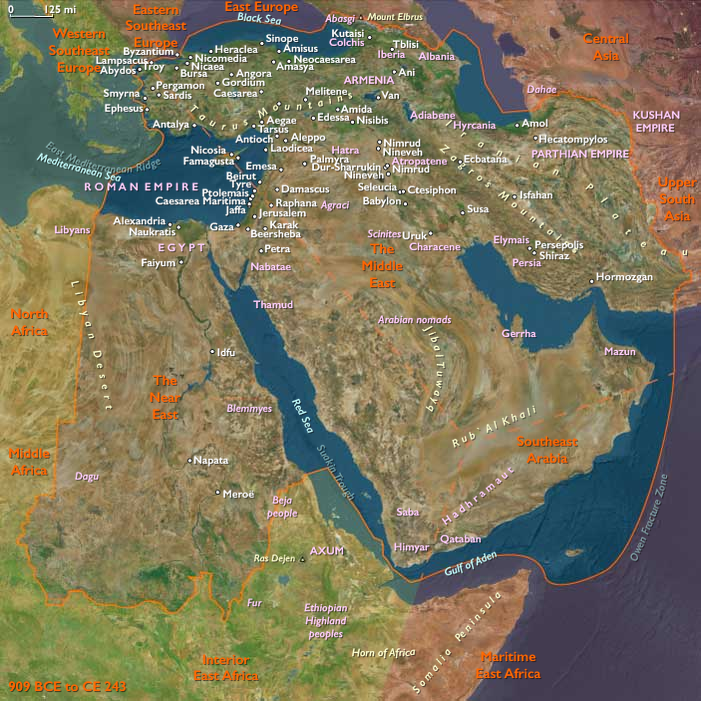
This year 333 BCE inaugurates the Hellenistic Age in the eastern Mediterranean and the Middle East, when Alexander III of Macedon overthrows the Persian Empire and carries Macedonian arms to India.
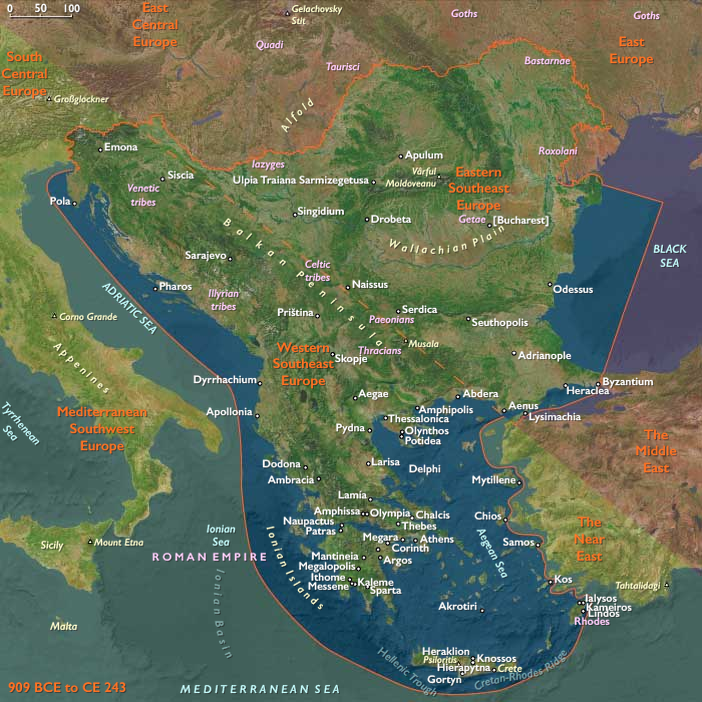
The Illyrians have established a coherent political entity under the Celtic threat but in the late fourth century fall under Macedonian influence.
Illyrian tribal leaders and soldiers accompany Alexander on his conquest of Persia, and the Thracians provide Alexander with valuable light-armed troops during his conquests.
Alexander's ten-year campaign in Asia, and the Macedonian conquest of the Persian empire, will become the stuff of legend.
The Macedonian army campaigns in Asia Minor, the Levant, Egypt, Assyria, Babylonia and Persia, winning notable battles at the Granicus, the Issus and Gaugamela, before the final collapse in 330 BCE of Darius's rule.
Alexander thus becomes ruler of the extensive Persian domains, although his rule over most of the territory is far from secure.
Alexander continues campaigning in central Asia in the following years, before crossing into the Indian subcontinent.
The Macedonian army becomes increasingly unhappy, however, and eventually mutinies, forcing Alexander to turn back.
Alexander, using both military and administrative skills to build his empire, is able to integrate the various peoples he has conquered into a unified empire by devising appropriate forms of administration in each region.
In Egypt, he becomes the pharaoh; in Mesopotamia, he becomes the great king.
In Persia, however, he keeps the indigenous administrative system intact under joint Persian and Macedonian rule.
He establishes hundreds of new settlements, encouraging his men to marry local women.
In addition, he manipulates the local religions to legitimize his own rule.
Alexander, in creating his empire, changes the face of the world.
He lives for only thirteen years after his accession to the throne, but he uses this time to create the largest empire ever seen, having perhaps a greater impact on Western civilization than any other man of the ancient world.
As with many great men, his life is shrouded in myth and legend.
Alexander spends his final years attempting to consolidate his empire and planning future campaigns but, probably exhausted by years of hard campaigning, he dies in Babylon at thirty-three of a malarial fever in 323 BCE.
The highest men in Alexander's command, including generals Perdiccas, Ptolemy Soter, Seleucus, Antigonus Monophthalmus, and Antipater, claim his legacy.
Antipater, regent of Macedonia during Alexander's campaign, becomes regent of the Macedonian Empire for Alexander's only adult male relative: his feeble-minded half-brother, who “rules” as Philip III with Roxana's infant son by Alexander, Alexander IV Aegeus.
With the questions of immediate rulership and regency satisfied, the Lamian War in Greece intervenes and postpones the final question of the Alexandrian succession.
Fought by a coalition of Greek cities including Athens and the Aetolian League against Macedon and its ally Boeotia, the Lamian War, or the Hellenic War (323–322 BCE), ends in a Macedonian victory.
The Partition of Babylon, which designates the attribution of the territories of Alexander the Great between his generals after his death, is a result of a compromise, essentially brokered by Eumenes, following a conflict of opinion between the party of Meleager, who wishes to give full power to Philip III of Macedon, and the party of Perdiccas, who wishes to wait for the birth of the heir of Alexander (the future Alexander IV of Macedon) to give him the throne under the control of a regent.
Under the agreement, Philip III becomes king, but Perdiccas, as a regent, rules.
Perdiccas, as regent, manages the repartition of the territories between the former generals and satraps of Alexander.
Meleager and about three hundred of his partisans are eliminated by Perdiccas soon after.
Alexanders’ successors in the ensuing eras will use the satrapies as bases in a struggle to acquire the whole.