Northwest Europe (1576–1587 CE): Religious Conflicts, Maritime Triumphs, and Cultural Vitality
England: Catholic Threats and Maritime Rivalries
The latter years of Queen Elizabeth I's reign saw escalating tensions due to Catholic conspiracies and external threats. Elizabeth’s Protestant regime faced the persistent threat of plots supported by Catholic monarchies, notably Spain. The exposure and execution of Mary, Queen of Scots in 1587 for her involvement in the Babington Plot marked a significant climax, solidifying Elizabeth’s Protestant rule but severely intensifying conflict with Catholic Europe, particularly Spain.
The period also witnessed growing maritime confrontations, led notably by Sir Francis Drake, whose circumnavigation of the globe (1577–1580) and aggressive raids against Spanish territories established England as an emerging naval power and competitor in global exploration and trade.
Gaol fever, or "jail fever," believed to have been typhus, became notorious during this period. Common in English prisons, it occurred frequently when prisoners were crowded into filthy, dark cells where lice thrived. Following the assizes held at Oxford in 1577, later called the Black Assize, over three hundred people died from gaol fever, including Sir Robert Bell, Lord Chief Baron of the Exchequer. Another notable outbreak was the Black Assize of Exeter in 1586.
Scotland: Regency Struggles and Protestant Consolidation
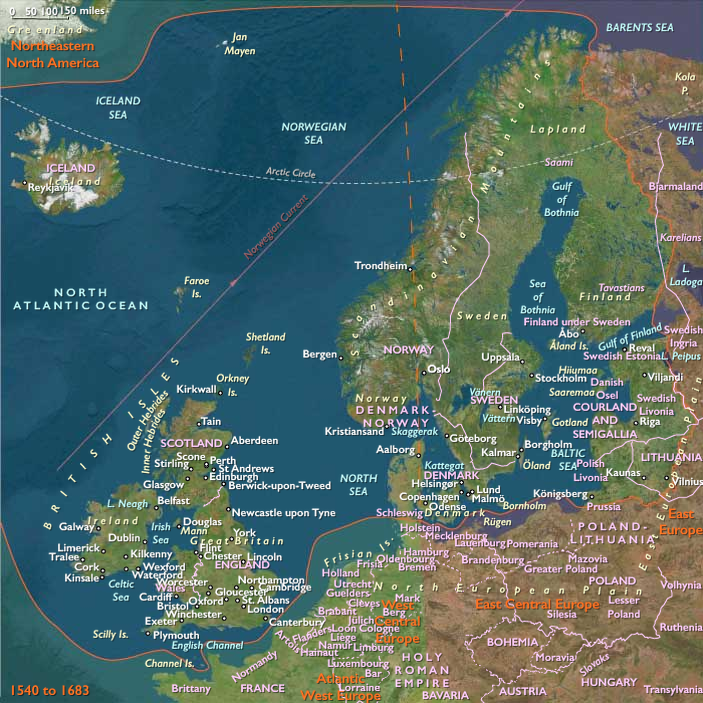
In Scotland, the minority of James VI continued under turbulent regencies, notably those of the Earl of Morton and later Esmé Stewart, Duke of Lennox. Political intrigue and religious factionalism dominated James’s early reign, but Protestantism remained ascendant. The Kirk maintained its strong Calvinist orientation, reinforcing its influence on Scottish society and governance.
Ireland: Gaelic Resistance and English Plantation
English expansion and plantation policies intensified in Ireland, sparking fierce resistance among Gaelic lords. Revolts such as the Second Desmond Rebellion (1579–1583) led by Gerald Fitzgerald, Earl of Desmond, were brutally suppressed, resulting in widespread land confiscations and increased English colonization, particularly in Munster. These actions deepened English administrative control but exacerbated local resentment and resistance.
Scandinavia: Stability under Lutheranism and Economic Prosperity
In Denmark-Norway, King Frederick II continued to foster economic stability and centralized authority. His reign, marked by peace and the prosperous Baltic trade, bolstered Denmark's economic foundation and solidified Lutheran ecclesiastical structures. Iceland remained firmly integrated within the Danish administrative and Lutheran religious framework.
Cultural and Intellectual Flourishing
The Elizabethan cultural renaissance continued to flourish, further enriching literary, artistic, and scholarly pursuits. This era saw significant works by dramatists such as Christopher Marlowe, whose plays contributed to the burgeoning English theatrical tradition. Intellectual endeavors were reinforced by the establishment of institutions promoting humanist learning and scholarship.
Maritime Exploration and Naval Ambitions
Maritime expansion characterized this period with increased English voyages that expanded commerce and geopolitical influence. Naval commanders like Sir Walter Raleigh established initial colonial efforts, notably at Roanoke (1585), marking the beginnings of England’s imperial ambitions despite initial failures. These maritime ventures further intensified rivalry with Spain, setting the stage for future conflicts.
Legacy of the Era
By 1587 CE, Northwest Europe had experienced significant political and religious confrontations, notably marked by the execution of Mary, Queen of Scots. Maritime exploration and colonial ambitions expanded dramatically, reinforcing England’s naval power and commercial reach. Cultural achievements flourished, underpinning a vibrant era whose legacies would profoundly shape subsequent historical developments.