Emperor Xiaowen of Northern Wei
emperor of the Chinese/Xianbei dynasty Northern Wei
Years: 467 - 499
Emperor Xiaowen of Northern Wei (October 13, 467 – April 26, 499), personal name né Tuoba Hong, later Yuan Hong, is an emperor of the Chinese/Xianbei dynasty Northern Wei from September 20, 471 to April 26, 499.
Emperor Xiaowen implements a drastic policy of sinicization, intending to centralize the government and make the multi-ethnic state more easy to govern.
These policies include changing artistic styles to reflect Chinese preferences and forcing the population to speak the language and to wear Chinese clothes.
He compels his own Xianbei people and others to adopt Chinese surnames, and changes his own family surname from Tuoba to Yuan.
He also encourages intermarriage between Xianbei and Han.
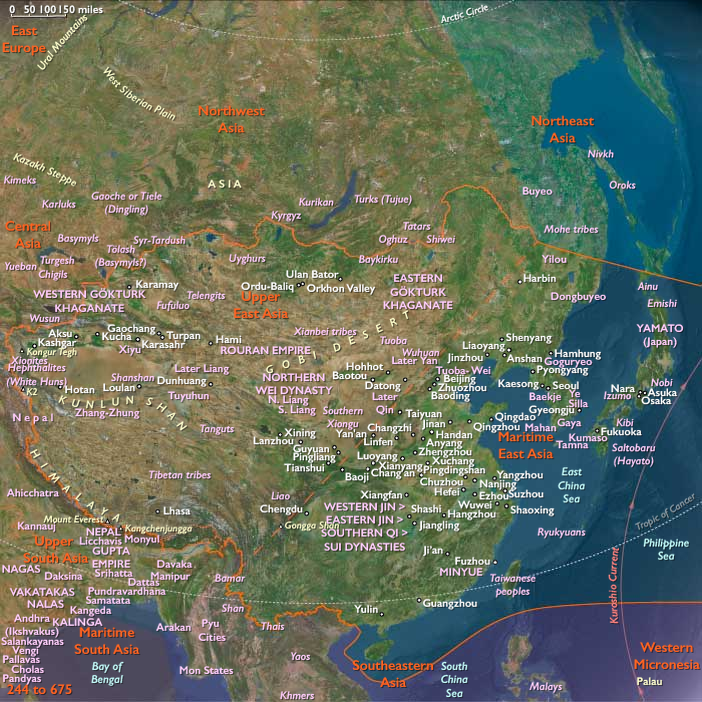
In 494, Emperor Xiaowen moves the Northern Wei capital from Pingcheng (in modern Datong, Shanxi) to Luoyang, a city long acknowledged as a major center in Chinese history.
The shift in the capital is mirrored by a shift in tactics from active defense to passive defense against the Rouran.
While the capital is moved to Luoyang, the military elite remain centered at the old capital, widening the differences between the administration and the military.
The population at the old capital remains fiercely conservative, while the population at Luoyang are much more eager to adopt Xiaowen's policies of sinicization.
His reforms are met with resistance by the Xianbei elite.
In 496, two plots by Xianbei nobles, one centered around his crown prince Yuan Xun, and one centered around his distant uncle Yuan Yi.
By 497, Xiaowen has destroyed the conspiracies and forced Yuan Xun to commit suicide.
Unfortunately for Emperor Xiaowen, his sinicization policies have their downsides, leading to incompetent nobles being put into positions of power, with capable men of low birth not being able to advance in his government.
Further, his wholesale adoption of Han culture and fine arts causes the nobles to be corrupt in order to afford the lifestyles of the Han elite, leading to further erosion to effective rule.
By the time of his grandson Emperor Xiaoming, Northern Wei is in substantial upheaval due to agrarian revolts, and by 534 has been divided into two halves, each of which will soon be taken over by warlords.
One of Xiaowen's enduring legacies is the establishment of the equal-field system in China, a system of government-allotted land that will last until the An Shi Rebellion in the mid Tang Dynasty (618–907).