Emperor Taizong of Tang
founder of the Tang Dynasty of China
Years: 598 - 649
Emperor Taizong of Tang (January 28, 598 – July 10, 649), personal name Li Shimin, is the second emperor of the Tang Dynasty of China, ruling from 626 to 649.
As he encourages his father, Li Yuan (later Emperor Gaozu) to rise against Sui Dynasty rule at Taiyuan in 617 and subsequently defeats several of his most important rivals, he is ceremonially regarded as a co-founder of the dynasty along with Emperor Gaozu.
He is typically considered as one of the (if not the) greatest emperors in Chinese history.
Throughout the rest of Chinese history, Emperor Taizong's reign is regarded as the exemplary model against which all other emperors are measured, and his "Reign of Zhenguan" is considered a golden age of Chinese history and required study for future crown princes.
During his reign, Tang China flourishes economically and militarily.
For more than a century after his death, Tang China enjoys peace and prosperity.
During Taizong's reign, Tang is the largest and the strongest nation in the world.
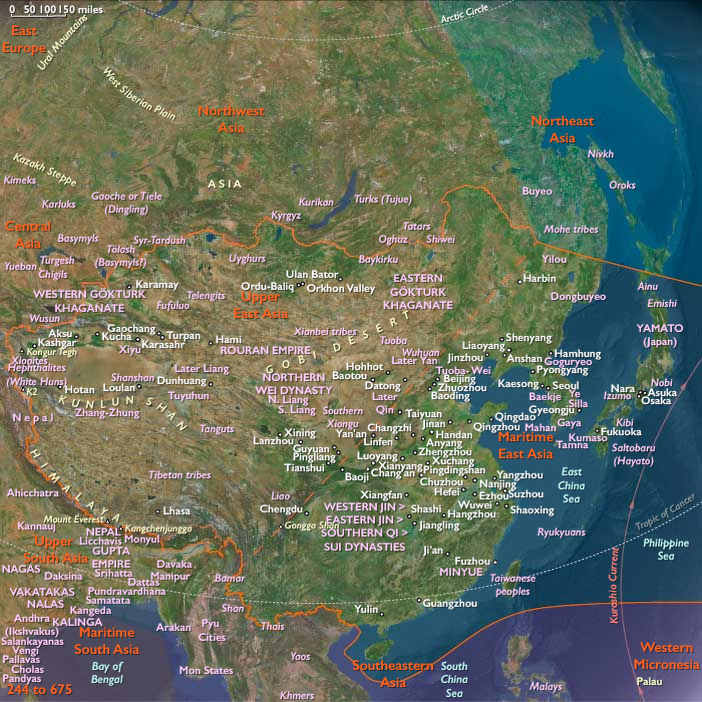
It coves most of the territory of present-day China, Vietnam and much of Central Asia as far as eastern Kazakhstan.
It lays the foundation for Xuanzong's reign, which is considered Tang China's greatest era.
In 630, Emperor Taizong sends his general Li Jing against Eastern Tujue (proto Turks)-- to which Tang had once submitted—defeating and capturing its Jiali Khan Ashina Duobi and destroying Eastern Tujue power.
This makes Tang the dominant power in East and Central Asia, and Emperor Taizong subsequently takes the title of Tian Kehan ("Heavenly Khan").
He also launches a series of campaigns against the oasis states of the Tarim Basin, and against the armies of their main ally, the Western Tujue.
During his reign, Tang armies annex Karakhoja in 640, Karasahr in 644 and Kucha in 648.
Unlike many of the nobility of the time, Emperor Taizong is a frank rationalist, openly scorning superstitions and claims of signs from the heavens.
He also modifies important rites in order to ease the burden of agricultural labor.
The modern Chinese historian Bo Yang opined that Emperor Taizong achieved greatness by enduring criticism which others would find difficult to accept whie trying hard not to abuse his absolute power (using Emperor Yang of Sui as a negative example), as well as through his employment of capable chancellors such as Fang Xuanling, Du Ruhui and Wei Zheng.
Emperor Taizong's wife Empress Zhangsun also proved to be a capable assistant.