Emperor Kōmei
emperor of Japan
Years: 1831 - 1867
Emperor Kōmei (July 22, 1831 – January 30, 1867) is the 121st emperor of Japan, according to the traditional order of succession.
Kōmei's reign spans the years from 1846 through 1867, corresponding to the final years of the Edo period.
During his reign there is much internal turmoil as a result of Japan's first major contact with the United States, which occurs under Commodore Perry in 1853 and 1854, and the subsequent forced re-opening of Japan to western nations, ending a two hundred and twenty-year period of national seclusion.
Emperor Kōmei does not care much for anything foreign, and he opposes opening Japan to Western powers.
His reign will continue to be dominated by insurrection and partisan conflicts eventually culminating in the collapse of the Tokugawa shogunate shortly after his death and the Meiji Restoration in the beginning of the reign of his son and successor Emperor Meiji.
Related Events
Filter results
Showing 10 events out of 13 total
Members of the Chōshū han of western Japan who travel to England in 1863 to study at University College London, the five students are the first of many successive groups of Japanese students who will travel overseas in the late Bakumatsu and early Meiji eras.
All five students will later rise to prominent positions in Japanese political and civil life.
The Chōshū han, based what is now known as Yamaguchi Prefecture, is eager to acquire better knowledge of the western nations and gain access to military technology in order to strengthen the domain in its struggle to overthrow the Tokugawa shogunate.
The decision by Chōshū han elders to sponsor five promising students to study overseas comes in the middle of growing domestic political tensions and in the wake of reports from the First Japanese Embassy to Europe that had returned in January 1863.
At the time of the students departure it us still illegal to leave Japan and travel overseas due to the shogunate's maritime seclusion policy (sakoku or, as it is known at this time, kaikin).
This policy will finally be abolished in 1866.
Belligerent opposition to European and American influence had erupted into open conflict when the Emperor Kōmei, breaking with centuries of imperial tradition, began to take an active role in matters of state and issued on March 11 and April 11, 1863 his "Order to expel barbarians" (Jōi jikkō no chokumei).
The Chōshū clan, under the daimyō Mōri Takachika, begin to take action to expel all foreigners after the deadline of the 10th day of the 5th month, by the traditional Japanese calendar.
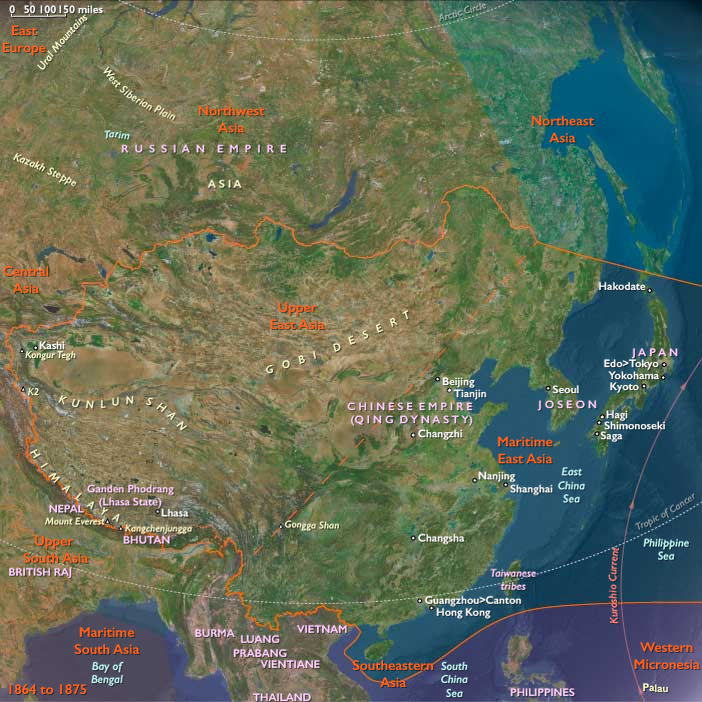
Openly defying the shogunate, Takachika had ordered his forces to fire without warning on all foreign ships traversing Shimonoseki Strait.
This strategic but treacherous six hundred-meter waterway separates the islands of Honshū and Kyūshū and provides a passage connecting the Inland Sea with the Sea of Japan.
Even before tensions escalate in Shimonoseki Strait, foreign diplomats and military experts, notably U.S. Foreign Minister to Japan Robert Pruyn and U.S. Navy Captain David McDougal are aware of the precarious state of affairs in Japan.
McDougal writes a letter to the Secretary of the Navy, Gideon Welles, dated June 12, 1863, stating, "General opinion is that the government of Japan is on the eve of revolution, the principal object of which is the expulsion of foreigners."
The first attack occurs on June 25, 1863, soon after the Imperial "Order to expel barbarians" comes into effect.
The U.S. merchant steamer SS Pembroke, under Captain Simon Cooper, is riding at anchor outside Shimonoseki Strait when intercepted and fired upon by two European-built warships belonging to the rebel forces.
The crew of one enemy vessel taunts the frantic American seamen with a loud and unnerving cry: "Revere the Emperor and expel the barbarians!" (sonnō jōi).
Under incessant cannon fire, Pembroke manages to get underway and escape through the adjacent Bungo Strait with only slight damage and no casualties.
The next day, the French naval dispatch steamer Kien Chan is also riding at anchor outside the strait, when rebel Japanese artillery atop the bluffs surrounding Shimonoseki open fire on her.
Kien Chan sustains damage to its engine and suffers four casualties before escaping to the open ocean.
The Chōshū students disguised as English sailors are put aboard the Jardine, Matheson & Co. vessel Chelswick for a thousand ryō each with the reluctant agreement of the ship's captain, J. S. Gower.
The five depart Yokohama on June 27, 1863, bound for Shanghai where they will be sheltered on an opium storage ship before dividing into two groups for the extended voyage around the Cape of Good Hope to London.
While Inoue Masaru, Yamao Yōzō and Endō Kinsuke travel to Europe as passengers on the 915 ton three-masted tea clipper Whiteadder, Inoue Kaoru and Itō Hirobumi, destined to be two of the greatest Japanese statesmen of the age, are mistakenly assumed to be eager to earn their passage as crew and are put to work as deckhands on a grueling one hundred and thirty-day day journey aboard the 525 ton sailing ship Pegasus.
Her skipper, Captain François de Casembroot, is convinced that Lord Mori will not dare fire on his vessel due to the strength of his ship and longstanding relations between the Netherlands and Japan.
But Takachika does just that, pounding Medusa with more than thirty shells and killing or wounding nine seamen.
De Casembroot returns fire and runs the rebel gauntlet at full speed, fearful of endangering the life of the Dutch Consul General, who is on board.
Within a short time, the Japanese warlord has managed to fire on the flags of most of the nations with consulates in Japan.
The Chōshū clan is equipped with mostly antiquated cannons firing cannonballs, but also some modern armament, such as five 8-inch (200 mm) Dahlgren guns, which had been presented to Japan by the United States, and three steam warships of American construction: the bark Daniel Webster of six guns, the brig Lanrick, or Kosei, with ten guns, and the steamer Lancefield, or Koshin, of four guns.
McDougal sinks two enemy vessels and severely damages another one, along with inflicting some forty Japanese casualties.
The Wyoming suffers extensive damage, four crew dead and seven wounded, one later dying of his injuries.
The two Japanese steamers sunk by the Wyoming will be raised again by Chōshū in 1864 and attached to the harbor of Hagi.
The battle does not deter the Choshu clan, and the shore batteries remain intact.
The shelling of foreign ships continues.
The French force consists of marines and two warships, the aviso Tancrède and the Admiral's flagship, Semiramis.
With two hundred and fifty men, under Captain Benjamin Jaurès, they sweepinto Shimonoseki and destroy a small town, together with at least one artillery emplacement.
The intervention is supported by the French plenipotentiary in Japan, Duchesne de Bellecourt, but the French government, once informed, will strongly criticize their representatives in Japan for taking such bellicose steps, for the reason that France has much more important military commitments to honor in other parts of the world, and cannot afford a conflict in Japan.
Duchesne de Bellecourt will be relieved from his position in 1864.
Jaurès also will be congratulated by the Shogunal government for taking such decisive steps against anti-foreign forces, and will be awarded a special banner.
The British are trying to extract a payment from the daimyō of Satsuma following the Namamugi Incident of 1862, in which British people had been attacked (one killed, two wounded) by Satsuma samurai for not showing the proper respect for the daimyō's regent, Shimazu Hisamitsu.
The naval bombardment claims five lives among the people of Satsuma (the city had been evacuated in anticipation of the conflict), and thirteen lives among the British (including Captain Josling of the British flagship Euryalus, and his second-in-command Commander Wilmot, both decapitated by the same cannonball).
Material losses are considerable, with around five hundred wood-and-paper houses burnt in Kagoshima (about five percent of Kagoshima's urban area), the Ryukyuan embassy destroyed, and the three Satsuma steamships and five Ryukyuan junks destroyed.
The Satsuma forces are slowly pushed back; however the fact that the British are not expecting such armed resistance means that their ships run low on food and ammunition, forcing a premature retreat of the British navy.
The encounter is face-saving for Satsuma, and is even claimed as a victory by the Japanese side, considering the relative number of casualties.
The British ships do not land troops or seize cannons (which would have signaled the absolute defeat of Satsuma), Kuper having decided that enough is enough.
Months have dragged by with no end in sight to the growing dilemma.
By May 1864, various bellicose Japanese factions have destroyed thousands of dollars in foreign property, including homes, churches and shipping.
This wanton destruction includes the U.S. Legation in Edo, which houses Minister Robert Pruyn.