Edward VII
King of the United Kingdom and the British Dominions and Emperor of India
Years: 1841 - 1910
Edward VII (Albert Edward; 9 November 1841 – 6 May 1910) is King of the United Kingdom and the British Dominions and Emperor of India from 22 January 1901 until his death in 1910.
He is the first British monarch of the House of Saxe-Coburg and Gotha, which is renamed the House of Windsor by his son, George V. Before his accession to the throne, he serves as heir apparent and holds the title of Prince of Wales for longer than any of his predecessors.
During the long reign of his mother, Queen Victoria, he is largely excluded from political power and comes to personify the fashionable, leisured elite.
The Edwardian era, which covers Edward's reign and is named after him, coincides with the start of a new century and heralds significant changes in technology and society, including powered flight and the rise of socialism.
Edward plays a role in the modernization of the British Home Fleet, the reform of the Army Medical Services, and the reorganization of the British Army after the Second Boer War.
Edward fosters good relations between Great Britain and other European countries, especially France, for which he is popularly called "Peacemaker."

Related Events
Filter results
Showing 9 events out of 9 total
Side-whiskers and goatees disappear in the United Kingdom by the mid 1870s, after which men tend to be clean-shaven or to wear a mustache only.
The Homburg felt hat, introduced in the 1870s, is popularized by the Prince of Wales (later King Edward VII) after he visits Bad Homburg in Hesse, Germany, and brings back a hat of this style, characterized by a single dent running down the center of the crown (called a "gutter crown"), a stiff brim shaped in a "kettle curl", a bound edge trim, and a grosgrain hatband.
The original Homburg is of slightly more generous proportions than the modern version.
Also popular at this time for sports and country wear in Britain is the deerstalker cap (which Sir Arthur Conan Doyle will immortalize in his Sherlock Holmes stories).
A cantilever railway bridge nine miles (fourteen kilometers) west of central Edinburgh, it is considered as a symbol of Scotland (having been voted Scotland's greatest man-made wonder in 2016), and is a UNESCO World Heritage Site.
It's designers are the English engineers Sir John Fowler and Sir Benjamin Baker.
It is sometimes referred to as the Forth Rail Bridge (to distinguish it from the adjacent Forth Road Bridge), although this will never be its official name.
Construction of the bridge began in 1882 and it is opened by the Duke of Rothesay, the future Edward VII.
The bridge carries the Edinburgh–Aberdeen line across the Forth between the villages of South Queensferry and North Queensferry and has a total length of 8,094 feet (2,467 meters).
When it opens it has the longest single cantilever bridge span in the world, until 1919 when the Quebec Bridge in Canada will be completed.
It continues to be the world's second-longest single cantilever span, with a span of 1,709 feet (521 meters).
Northwest Europe (1900–1911): Edwardian Transformation, Imperial Struggles, and Social Reforms
The End of the Victorian Era and Edwardian Beginnings
The death of Queen Victoria in January 1901 marked the symbolic close of the Victorian age. Her son, Edward VII (1901–1910), ascended the throne, inaugurating the Edwardian era. Unlike his mother’s stern and symbolic image, Edward VII embraced modernity, elegance, and social vitality, reflecting Britain’s increasingly cosmopolitan character. His reign coincided with significant transformations—political, social, and technological—that set Britain on the path toward modernity.
The Boer War and Imperial Difficulties
The Second Boer War (1899–1902) continued into the early Edwardian period, profoundly shaping British politics and imperial policy. Initially expecting an easy victory, Britain faced unexpectedly fierce guerrilla resistance from Boer commandos. Despite their vastly inferior numbers—only 410,000 Afrikaners—the Boers waged a tenacious guerrilla campaign, inflicting heavy casualties and revealing deep deficiencies within the British Army’s structure, training, and command.
Historian Andrew Roberts later emphasized the authoritarian nature of the Boer republics, particularly President Paul Kruger’s restrictive Transvaal administration, which denied citizenship and political rights to non-Boer “Uitlanders,” despite their economic contributions. British efforts to protect Uitlander rights had escalated tensions into war.
Although Britain eventually secured victory through superior numbers, weaponry, and often-brutal tactics—including internment of Boer civilians in concentration camps—the conflict severely damaged Britain’s international reputation, prompting domestic introspection regarding military efficiency and imperial morality.
Liberal Ascendancy and Social Reform under Campbell-Bannerman and Asquith
After years of Conservative dominance under Lord Salisbury (Prime Minister 1886–92, 1895–1902) and his nephew Arthur Balfour (1902–1905), the British public decisively shifted towards Liberalism. Under Liberal Prime Ministers Sir Henry Campbell-Bannerman (1905–1908) and subsequently H. H. Asquith (1908–1916), Britain undertook significant domestic reforms, laying foundations for the modern welfare state.
The Liberal government’s landmark social legislation included:
-
Old Age Pensions Act (1908): providing state pensions to alleviate poverty among the elderly.
-
National Insurance Act (1911): introducing compulsory health and unemployment insurance for workers.
-
People’s Budget (1909): proposed by Chancellor David Lloyd George, imposing higher taxes on wealthy landowners to fund welfare reforms, prompting intense political controversy with the Conservative-dominated House of Lords.
These reforms, driven by moral urgency and political pragmatism, sought to address poverty and social inequalities exacerbated by rapid industrialization.
Constitutional Crisis and the Parliament Act of 1911
The confrontation between Liberals and Conservatives peaked with the Constitutional Crisis of 1909–1911. The Conservative-controlled House of Lords repeatedly blocked the People’s Budget, challenging Commons supremacy. Prime Minister Asquith responded by calling two general elections in 1910, resulting in Liberal-led coalitions. Ultimately, the Liberals enacted the Parliament Act of 1911, drastically reducing the Lords’ power by eliminating their absolute veto over financial legislation and significantly curbing their legislative powers.
This crisis profoundly reshaped British governance, affirming democratic principles and dramatically altering the constitutional balance.
The Rise of the Labour Party and Changing Class Dynamics
The Edwardian era saw profound shifts in British politics, marked by the rising influence of the working class. The Labour Party, formed in 1900 as the Labour Representation Committee, gained parliamentary representation by 1906, emerging as a major political force advocating workers’ rights and social justice. Labour’s growth reflected increasingly assertive trade unions, rising working-class consciousness, and dissatisfaction with traditional Liberal and Conservative elites.
The Irish Question and Continuing Tensions
Ireland remained a divisive political issue. Despite earlier failed Home Rule efforts under Gladstone, Irish nationalists intensified demands for self-government. The Irish Parliamentary Party, now under John Redmond, sustained pressure for Home Rule, while Ulster Protestants vehemently opposed it. Although postponed by constitutional battles, the issue of Irish Home Rule loomed large, portending future conflicts.
Women’s Suffrage Movement and Changing Gender Roles
The campaign for women’s suffrage intensified dramatically during the Edwardian era. Organizations like the Women’s Social and Political Union (WSPU), founded in 1903 by Emmeline Pankhurst, adopted militant tactics, gaining national prominence. Their confrontational approach—public demonstrations, hunger strikes, and acts of civil disobedience—provoked public debate and political pressure, significantly advancing the suffrage cause, despite resistance from traditional political establishments.
Imperial Rivalries and Diplomatic Realignments
Internationally, Britain faced mounting challenges to its imperial hegemony. Germany’s aggressive naval expansion under Kaiser Wilhelm II posed serious threats to British naval supremacy, provoking deep anxiety in British policy circles. Britain gradually abandoned its traditional "splendid isolation," engaging in cautious diplomatic realignments:
-
Anglo-Japanese Alliance (1902): Britain’s first formal alliance, securing its Asian interests.
-
Entente Cordiale with France (1904): resolving colonial disputes and marking a diplomatic shift.
-
Anglo-Russian Entente (1907): defusing Central Asian tensions and completing the Triple Entente with France and Russia, forming strategic diplomatic counterweights against Germany.
These alliances marked Britain’s reluctant shift toward Continental engagement, driven by strategic necessity amid rising geopolitical tensions.
Cultural and Artistic Transformations: Edwardian Elegance and Arts and Crafts
Culturally, the Edwardian period embraced sophistication and elegance, contrasting with Victorian austerity. Social elites pursued leisure and luxury, epitomized by grand London society balls and the international popularity of King Edward VII’s cosmopolitan lifestyle. Meanwhile, the Arts and Crafts Movement, inspired by designer and socialist thinker William Morris, continued influencing Victorian taste, advocating artisanal quality and aesthetic simplicity, significantly shaping design, architecture, and decorative arts.
Technological Progress and Economic Competition
Technological advances accelerated, fueling Britain’s economic prosperity and social modernization. The era saw rapid electrification, expanded railway networks, widespread automobile adoption, and early aviation experiments. Yet, industrial competition intensified significantly from Germany and America, challenging Britain’s global economic leadership and prompting concerns about industrial stagnation and economic decline.
Military Reforms and Naval Arms Race
The Boer War’s painful lessons led Britain to significant military reforms. The Haldane Reforms (1906–1912), under War Secretary Richard Haldane, restructured the British Army into an expeditionary force and a reserve-based Territorial Force, significantly modernizing military organization.
Simultaneously, Britain engaged in a costly naval arms race with Germany, symbolized by the revolutionary HMS Dreadnought (1906), sparking accelerated battleship construction by both powers, intensifying tensions that presaged World War I.
Scandinavian and Icelandic National Developments
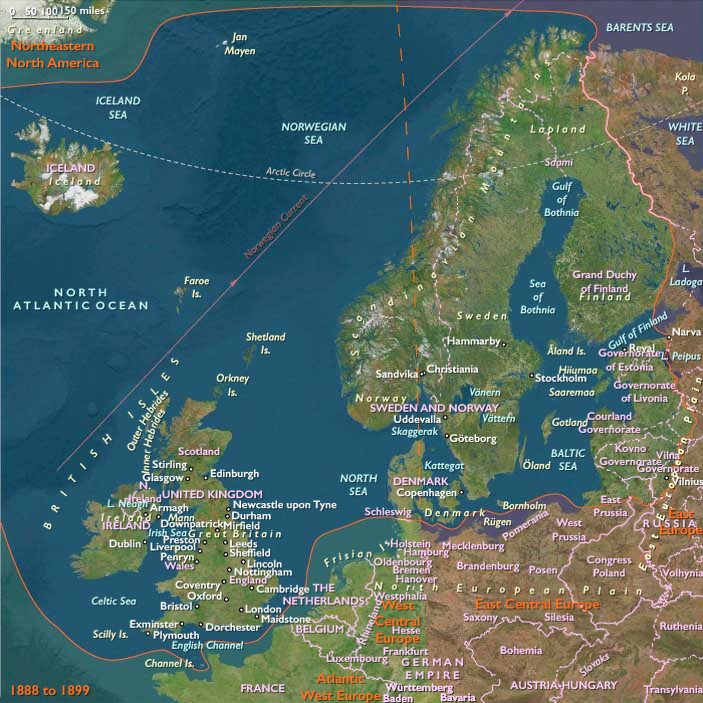
Northern Europe remained relatively stable. In 1905, Norway peacefully achieved independence from Sweden, asserting its distinct national identity. Iceland’s nationalist aspirations strengthened, pursuing increasing autonomy under Danish rule. Denmark itself pursued domestic stability, emphasizing internal reform and cautious neutrality.
Cultural Flourishing and Edwardian Literature
Literature flourished, reflecting Edwardian social tensions and complexities. Prominent authors like George Bernard Shaw, E.M. Forster, and H.G. Wells explored social inequalities, class tensions, and modern anxieties, enriching Britain’s cultural and intellectual landscape.
Conclusion: Transition to Modernity
From 1900 to 1911, Northwest Europe, particularly Britain, underwent profound transformations. The Edwardian era replaced Victorian certainties with greater openness and complexity. Social reforms laid early foundations of the welfare state, while constitutional crises reshaped political power. Imperial rivalries, military reform, and diplomatic realignment reflected Britain’s global insecurities, presaging the conflicts ahead. The rise of Labour, intensifying suffrage movements, and shifting gender roles demonstrated fundamental social changes. Collectively, these developments marked Britain’s turbulent passage from Victorian tradition to twentieth-century modernity, setting the stage for the profound upheavals soon to follow.
The Prince of Wales is the victim of an attempted assassination when fifteen-year-old Jean-Baptiste Sipido shoots at him in protest over the Second Boer War on his way to Denmark through Belgium on April 4, 1900.
Sipido, though obviously guilty, will be acquitted by a Belgian court because he was underage.
The perceived laxity of the Belgian authorities, combined with British disgust at Belgian atrocities in the Congo, worsen the already poor relations between the United Kingdom and the Continent.
However, in the next ten years, Edward's affability and popularity, as well as his use of family connections, will assist Britain in building European alliances.
Hubert Cecil Booth patents an electric vacuum cleaner, one of the first powered vacuum cleaners, in the United Kingdom on August 30, 1901.
Before Booth introduced his version of the vacuum cleaner, cleaning machines blew or brushed dirt away, instead of sucking it up.
As Booth will recall decades later, in 1901 he had attended "a demonstration of an American machine by its inventor" at the Empire Music Hall in London.
The inventor is not named, but Booth's description of the machine conforms fairly closely to American inventor John S. Thurman’s blown air design.
Booth had watched a demonstration of the device, which blew dust off the chairs, and thought that "...if the system could be reversed, and a filter inserted between the suction apparatus and the outside air, whereby the dust would be retained in a receptacle, the real solution of the hygienic removal of dust would be obtained."
He tested the idea by laying a handkerchief on the seat of a restaurant chair, putting his mouth to the handkerchief, and then trying to suck up as much dust as he could onto the handkerchief. Upon seeing the dust and dirt collected on the underside of the handkerchief, he realized the idea could work.
Booth has created a large device, driven by an internal combustion engine.
Nicknamed the "Puffing Billy", Booth's first petrol-powered, horse-drawn vacuum cleaner relies upon air drawn by a piston pump through a cloth filter.
It does not contain any brushes; all the cleaning is done by suction through long tubes with nozzles on the ends.
Although the machine is too bulky to be brought into the building, its principles of operation ire essentially the same as the vacuum cleaners of today.
He follows this up with an electric-powered model, but both designs are extremely bulky, and have to be transported by horse and carriage.
The term "vacuum cleaner" is first used by the company set up to market Booth's invention, in its first issued prospectus of 1901.
Booth initially does not attempt to sell his machine, but rather sells cleaning services.
The vans of the British Vacuum Cleaner Company (BVCC) are bright red; uniformed operators haul hose off the van and route it through the windows of a building to reach all the rooms inside.
Gaining the royal seal of approval, Booth's motorized vacuum cleaner is used to clean the carpets of Westminster Abbey prior to Edward VII's coronation in 1901.
The device is used by the Royal Navy to improve the level of sanitation in the naval barracks.
It is also used in businesses such as theaters and shops, although the device is too large to be feasibly used as a domestic appliance.
Booth receives his first patents on February 18 and August 30, 1901.
Booth founds Goblin, his company to sell vacuum cleaning services, and will refine his invention over the next several decades.
Though Goblin will lose out to competition from Hoover in the household vacuum market, his company will successfully turn its focus to the industrial market, building ever-larger models for factories and warehouses.
Booth's company, now BVC, lives on today as a unit of pneumatic tube system maker Quirepace Ltd.
Queen Victoria, Great Britain's longest serving monarch, dies on January 22, 1901, at Osborne House on the Isle Wight, and "Bertie", the longest-serving Prince of Wales, succeeds his mother to become King Edward VII of the United Kingdom at the age of fifty-nine.
The funeral of Queen Victoria is held at St George's Chapel, Windsor Castle, on February 2, 1910.
Edward VII opens his first parliament of the United Kingdom on February 14, 1901.