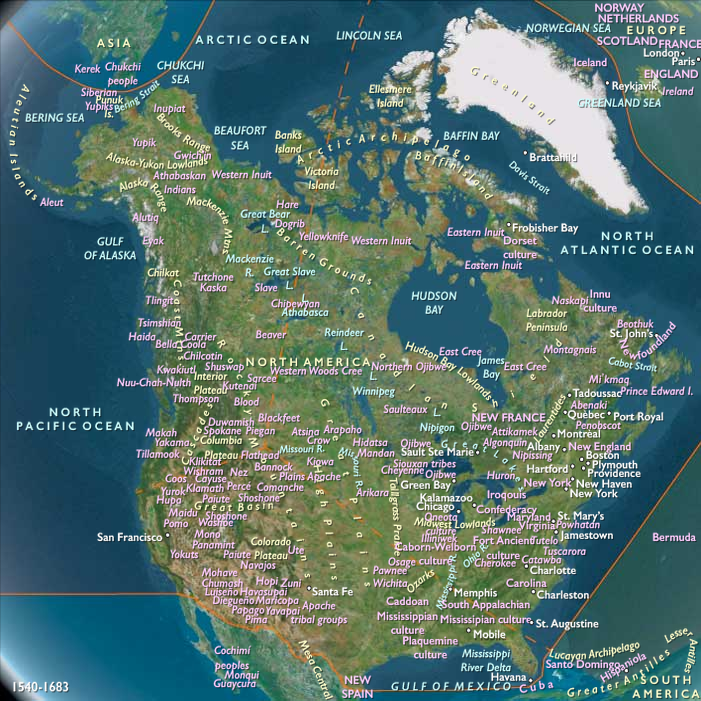
Carolina’s 1663 charter had granted the Lords Proprietor title to all of the land from the southern border of the Virginia Colony at thirty-six degrees north to thirty-one degrees north (along the coast of present-day Georgia).
The charter had been revised slightly in 1665, with the northerly boundary extended to thirty-six degrees thirty minutes north to include the lands of settlers along the Albemarle Sound who had left the Virginia Colony.
Likewise, the southern boundary had been moved south to twenty-nine degrees north, just south of present-day Daytona Beach, Florida, which had the effect of including the existing Spanish settlement at St. Augustine.
The charter also granted all the land, between these northerly and southerly bounds, from the Atlantic, westward to the shores of the Pacific Ocean.
The Lords Proprietor named in the charter are: Edward Hyde, 1st Earl of Clarendon; George Monck, 1st Duke of Albemarle; William Craven, 1st Earl of Craven; John Berkeley, 1st Baron Berkeley of Stratton; Anthony Ashley Cooper, 1st Earl of Shaftesbury; Sir George Carteret; Sir William Berkeley (brother of John); and Sir John Colleton.
Of the eight, the one who demonstrates the most active interest in Carolina is Lord Shaftesbury, who, with the assistance of his secretary, the philosopher John Locke, has drafted the Fundamental Constitutions of Carolina, a plan for government of the colony heavily influenced by the ideas of the English political scientist, James Harrington.
Some of the other Lords Proprietor also have interests in other colonies: for instance, John Berkeley and George Carteret hold stakes in the Province of New Jersey, and William Berkeley has an interest in Virginia.
Operating under their royal charter, the Lords Proprietor are able to exercise their authority with nearly the independence of the king himself.
The actual government consists of a governor, a powerful council, on which half of the councilors are appointed by the Lords Proprietor themselves, and a relatively weak, popularly elected assembly.
Although the Lost Colony on Roanoke Island represented the first English attempt at settlement in the Carolina territory, the first permanent English settlement had not been not established until 1653, when emigrants from the Virginia Colony, with others from New England and Bermuda, settled at the mouths of the Chowan and Roanoke Rivers, on the shores of Albemarle Sound, in the northeastern corner of present-day North Carolina.
The Albemarle Settlements, pre-empting the royal charter by ten years, comes to be known in Virginia as "Rogues' Harbor".