Duncan I of Scotland
King of Alba
Years: 1001 - 1040
Donnchad mac Crinain (anglicised as Duncan I, and nicknamed An t-Ilgarach, "the Diseased" or "the Sick"; ca.
1001 – 14 August 1040) is king of Scotland (Alba) from 1034 to 1040.
He is the historical basis of the "King Duncan" in Shakespeare's play Macbeth.
Related Events
Filter results
Showing 10 events out of 14 total
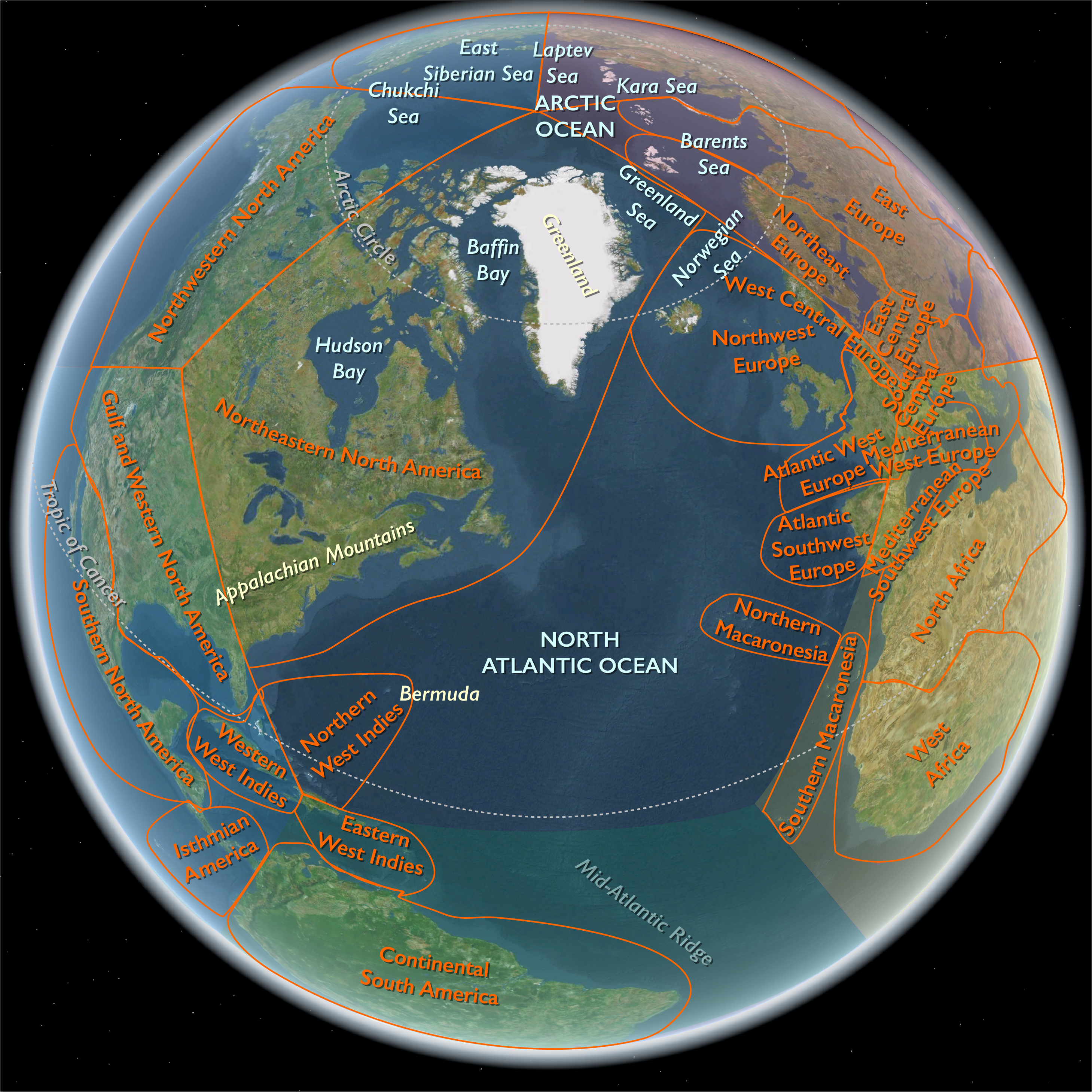
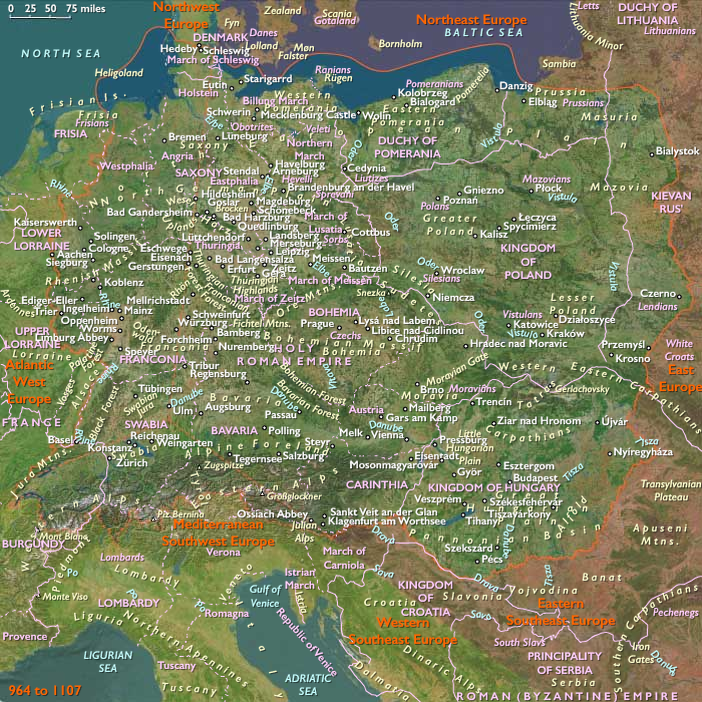
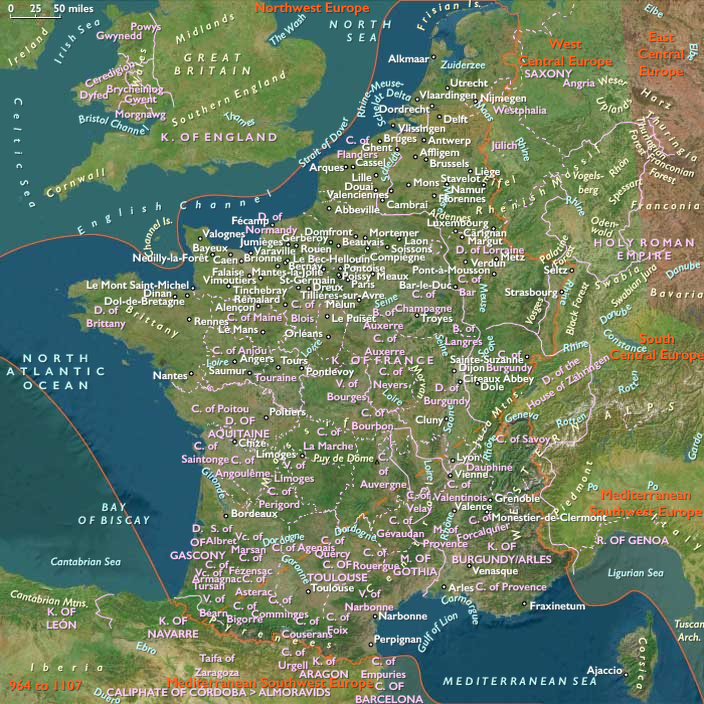
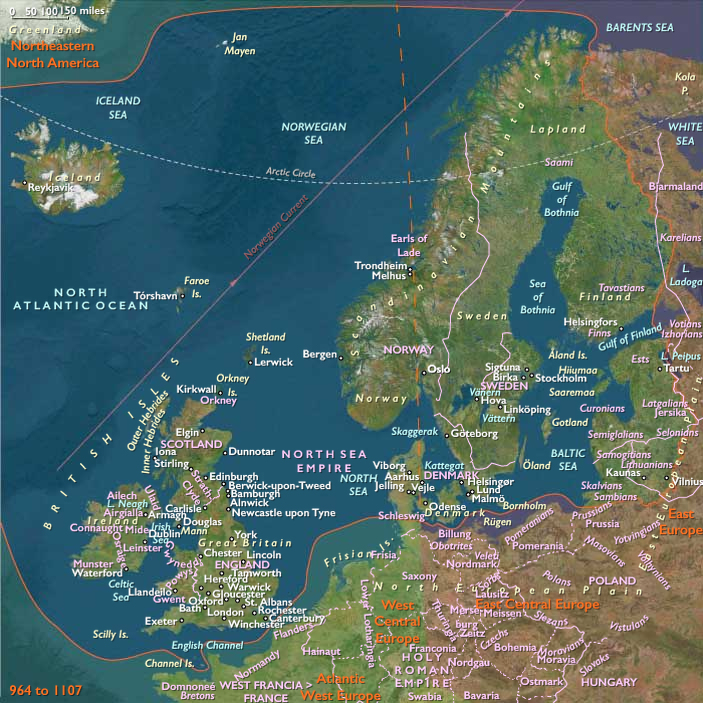
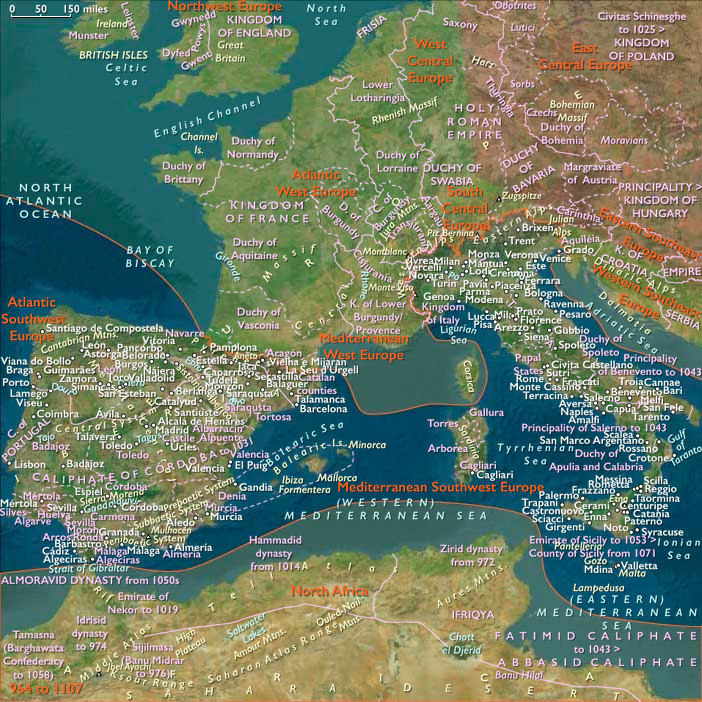
Northwest Europe (1024–1035 CE): Consolidation, Succession, and New Alliances
England: Consolidation Under Cnut the Great
From 1024–1035 CE, Cnut the Great (r. 1016–1035) firmly established his rule in England, bringing a period of unprecedented stability after years of turmoil. Cnut effectively combined Danish and English governance, marrying Æthelred the Unready’s widow, Emma of Normandy, which helped legitimize his claim and stabilize Anglo-Saxon acceptance of Danish rule. He carefully maintained balanced relationships between his realms in England, Denmark, and Norway, thus solidifying the "North Sea Empire."
In this decade, England benefited from peace, renewed trade, and the implementation of strong, centralized government. Cnut respected and adapted existing Anglo-Saxon administrative structures, issuing laws reflecting both Danish and English traditions, and successfully integrated Danish nobility into the English ruling class, facilitating cultural exchanges and reducing ethnic tensions.
Scotland: Malcolm II’s Continued Rule
In Scotland, Malcolm II (r. 1005–1034) maintained a stable and assertive reign, strengthening central royal authority. By 1031, he had secured recognition of Scottish overlordship over the kingdom of Strathclyde, decisively influencing Scotland’s territorial cohesion. Malcolm’s death in 1034 would lead to a complex succession, as he was succeeded by his grandson Duncan I, setting the stage for significant internal strife in subsequent decades.
Ireland: Fragmentation after Brian Boru’s Legacy
Following the death of Brian Boru (1014), Ireland remained politically fractured. Throughout 1024–1035, no singular high king emerged to replace Brian's dominance. Rather, Ireland was divided into competing regional kingdoms, notably Munster, Leinster, Connacht, and Ulster. Each pursued autonomy, often forming short-lived alliances or engaging in intermittent warfare. Despite instability, Ireland continued as a vital center of monastic scholarship and cultural vitality, preserving rich traditions and literary heritage.
Norway and Denmark: Cnut’s North Sea Empire
In 1028, Cnut expanded his authority to Norway, solidifying his North Sea Empire. He secured recognition as king of Norway after expelling the Norwegian king, Olaf Haraldsson (later known as Saint Olaf). This remarkable consolidation brought England, Denmark, and Norway under a single monarch, marking a pinnacle of Danish influence in Northwest Europe. Eric Haakonsson, Earl of Northumbria, remained a crucial ally and administrator in England and the northern territories until his death around 1024. Cnut’s vast empire fostered unprecedented cross-cultural contact and trade, shaping regional politics significantly.
Iceland and the Norse Atlantic Settlements: Stability and Cultural Growth
During 1024–1035, Iceland continued to benefit from stable governance under the Althing system and newly-established Christian institutions. Its religious transition facilitated deeper European connections, enhancing literary activities, including the growth of sagas and genealogical literature. Norse communities in the Faroes, Orkney, and Shetland remained stable, economically active, and culturally vibrant, maintaining significant autonomy and ongoing trade networks linking them closely with the North Sea Empire.
Intellectual and Religious Life
This period witnessed notable religious developments. The veneration of Saint Olaf Haraldsson, killed at the Battle of Stiklestad (1030) after attempting to regain Norway, quickly spread throughout Scandinavia and England, significantly influencing religious practices and pilgrimages. Olaf’s martyrdom and subsequent canonization greatly bolstered Christianization in Scandinavia, reinforcing cultural integration within Cnut’s domains.
In England, monastic communities flourished under stable royal patronage. Intellectual life continued to prosper through chronicles, such as continued entries in the Anglo-Saxon Chronicle, which recorded key contemporary events and offered valuable historical insights.
Succession Crisis after Cnut’s Death
The stability achieved by Cnut unraveled swiftly following his death in 1035. He was succeeded briefly by his sons Harold Harefoot and Harthacnut, whose rivalries and ineffective rule resulted in renewed uncertainty and eventual disintegration of the North Sea Empire. This succession crisis set the stage for England’s political instability and increased local tensions in the ensuing decades.
Legacy of the Era
By the close of 1035 CE, Northwest Europe had experienced remarkable political unification under Cnut’s North Sea Empire, alongside continuing fragmentation in Ireland and gradual stabilization in Scotland. Iceland and the Norse settlements thrived culturally and economically, bolstered by stable institutions and Christianization. The death of Cnut in 1035 marked a turning point, ushering in a new phase of fragmentation and power struggles that would reshape regional dynamics profoundly in subsequent decades.
Máel Coluim, or Malcolm II, dies in 1034, Marianus Scotus giving the date as November 25, 1034.
The king lists say that he died at Glamis, variously describing him as a "most glorious" or "most victorious" king.
The Annals of Tigernach report that "Máel Coluim mac Cináeda, king of Scotland, the honour of all the west of Europe, died."
The Prophecy of Berchán, perhaps the inspiration for John of Fordun and Andrew of Wyntoun's accounts where Máel Coluim is killed fighting bandits, says that he died by violence, fighting "the parricides", suggested to be the sons of Máel Brigte of Moray.
Perhaps the most notable feature of Máel Coluim's death is the account of Marianus, matched by the silence of the Irish annals, which tells us that Malcolm II’s grandson Donnchad I became king and ruled for five years and nine months.
Given that his death in 1040 is described as being "at an immature age" in the Annals of Tigernach, he must have been a young man in 1034.
The absence of any opposition suggests that Máel Coluim had dealt thoroughly with any likely opposition in his own lifetime.
Northwest Europe (1036–1047 CE): Fragmentation, Power Struggles, and Dynastic Change
England: Decline of Cnut’s Empire
The stability achieved under Cnut the Great rapidly dissolved following his death in 1035, plunging England into political uncertainty and dynastic struggles. Cnut's sons—Harold Harefoot and Harthacnut—contended bitterly for the throne, fracturing royal authority and generating instability throughout England from 1036 to 1042.
Initially, Harold Harefoot claimed power, ruling England from 1035 to 1040. His short reign was turbulent and marked by internal rivalries, particularly with his half-brother Harthacnut, son of Emma of Normandy. Harold’s sudden death in 1040 allowed Harthacnut, already king of Denmark, to assume the English throne. However, Harthacnut’s harsh taxation and authoritarian rule quickly alienated the nobility and populace, exacerbating England’s internal divisions.
In 1042, following Harthacnut’s sudden death, the English nobility, eager for stability, restored the Anglo-Saxon lineage by placing Edward the Confessor, son of Æthelred the Unready and Emma of Normandy, on the throne. Edward’s accession marked the end of Danish rule in England and the restoration of the House of Wessex. His reign, though beginning amid uncertainty, laid foundations for relative peace and stability, reviving English cultural and political identity.
Scotland: Instability and Dynastic Transition
Scotland witnessed critical dynastic shifts following the death of Malcolm II in 1034. Malcolm’s grandson, Duncan I, ascended the throne, attempting to sustain his predecessor’s achievements. However, Duncan’s rule faced immediate opposition from rival claimants. His brief reign was plagued by instability, culminating in his defeat and death at the hands of Macbeth, the Mormaer (Earl) of Moray, in 1040.
Macbeth’s subsequent rise as King of Scotland (1040–1057) initiated a period of relative internal stability and strong governance. Contrary to later portrayals in Shakespeare’s drama, Macbeth’s historical reign brought notable prosperity and strengthened royal authority, benefiting from diplomatic and religious ties with Europe, notably Rome.
Ireland: Persistent Fragmentation
Throughout 1036–1047, Ireland continued to grapple with political fragmentation following the absence of a dominant High King after Brian Boru’s death in 1014. Various regional kings, particularly in Munster, Connacht, Leinster, and Ulster, vied for dominance without achieving national unity. Intermittent alliances and conflicts marked the political landscape. Despite this political instability, Ireland’s monastic tradition remained vibrant, ensuring cultural and scholarly continuity.
Norway and Denmark: Return to Separate Kingdoms
Cnut’s death had shattered the cohesion of his North Sea Empire. In Norway, after years of foreign rule, local authority was reestablished. Following the martyrdom and subsequent canonization of Olaf Haraldsson (Saint Olaf) in 1030, Norway’s identity and unity strengthened around his cult. Olaf’s son, Magnus the Good, assumed the throne in 1035, and by 1042, Magnus had also secured Denmark, temporarily uniting the two kingdoms. Magnus’s brief but successful reign restored Scandinavian autonomy, distancing Norway and Denmark from English affairs.
Iceland and Norse Atlantic Communities
During 1036–1047, Iceland continued to prosper under its unique parliamentary system, the Althing, and stable Christian institutions. The island’s population expanded, and its saga literature developed significantly, solidifying Iceland’s cultural identity. Similarly, Norse communities in the Faroes, Shetland, and Orkney experienced cultural stability and economic vitality, thriving through fishing, farming, and extensive maritime trade networks linking Scandinavia, Scotland, and Ireland.
Cultural and Religious Developments
This period witnessed significant religious consolidation. The veneration of Saint Olaf flourished widely across Scandinavia and Britain, becoming central to Northern European spirituality. The popularization of Olaf’s cult significantly contributed to the further Christianization of Norway and strengthened cultural ties across the North Sea region.
In England, the accession of Edward the Confessor in 1042 spurred renewed interest in Anglo-Saxon culture, law, and piety. His patronage would later lead to significant ecclesiastical reforms and religious revivals. The period also saw increased interactions with continental Europe, notably Normandy, influencing English architecture, culture, and political structures.
Legacy of the Era
By 1047 CE, Northwest Europe had experienced profound dynastic and political realignments. The collapse of Cnut’s empire returned England, Norway, and Denmark to independent governance, each reestablishing distinct identities. In Scotland, Macbeth’s rule provided renewed stability following a turbulent succession. Ireland’s enduring fragmentation contrasted sharply with regional stability elsewhere, yet continued to sustain rich cultural traditions. Iceland and the Norse Atlantic communities flourished culturally and economically, enhancing their distinct regional identities.
Thus, this period served as a transitional phase, reshaping regional alliances and identities, setting the stage for critical developments in Northwest Europe’s medieval history.
Thorfinn had ruled alone in Orkney until the return in in about 1037 of his nephew Rognvald Brusason.
Rognvald had received the favor of King Magnus the Good, who has granted him Brusi's share of the islands and the third which Olaf Haraldsson had claimed after Einar's death.
Thorfinn agrees to this division, but presents the transfer of the third claimed by the Norwegian king as a gift to Rognvald in return for aid in Thorfinn's wars in the Hebrides and the Irish Sea.
King Sigtrygg Silkbeard had died in 1035 or 1036, and the kingship in Dublin had come to Echmarcach mac Ragnaill, who in 1038 is challenged by Imar mac Arailt and driven out.
This instability in Dublin can only have helped Thorfinn and Rognvald, who raid far and wide and establish their rule over some part of the lands around the Irish Sea.
They are said to have won a major victory beside Vattenfjord, perhaps Loch Vatten on the west coast of the Isle of Skye.
The Earls are said to have raided in England, with mixed success.
The Orkneyinga Saga says that a dispute between Thorfinn the Mighty, Earl of Orkney, and Karl Hundason began when Karl Hundason became "King of Scots" and claimed Caithness.
In the war that ensued, …
…Thorfinn defeated Karl in a sea-battle off Deerness at the east end of the Orkney Mainland.
Then, …
…Karl's nephew Mutatan or Muddan, appointed to rule Caithness for him, was killed at Thurso by Thorkel the Fosterer, who had been Thorfinn’s foster father.
Finally, …
…a great battle at Tarbat Ness on the south side of the Dornoch Firth ended with Karl defeated and fugitive or dead.
Thorfinn, the saga says, then marched south through Scotland as far as Fife, burning and plundering as he passed.
A later note in the saga claims that Thorfinn won nine Scottish earldoms.
The identity of Karl Hundason, unknown to Scots and Irish sources, has long been a matter of dispute, and it is far from clear that the matter is settled.
The most common assumption is that Karl Hundason was an insulting byname ("Churl, son of a Dog") given to Mac Bethad by his enemies.
Skene's suggestion that he was Donnchad mac Crínáin has been revived in recent years.
Lastly, the idea that the whole affair is a poetic invention has been raised.
Whoever Karl son of Hundi may have been, it appears that the saga is reporting a local conflict with a Scots ruler of Moray or …