Dionysius II of Syracuse
ruler of Syracuse
Years: 397BCE - 343BCE
Dionysius the Younger or Dionysius II (ca.
397 BCE – 343 BC) rules Syracuse, Sicily from 367 BCE to 357 BCE and again from 346 BCE to 344 BCE.
Related Events
Filter results
Showing 10 events out of 12 total
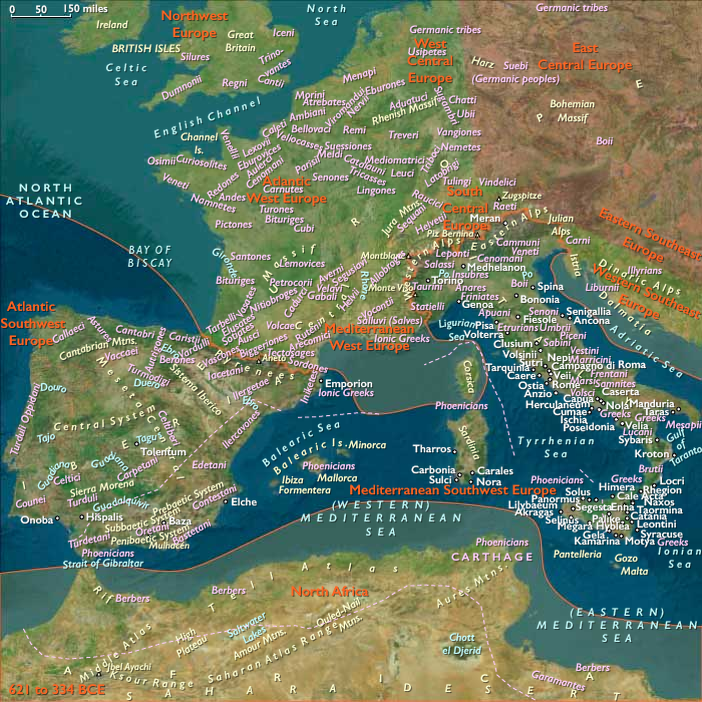
Mediterranean Southwest Europe (477–334 BCE): Iberian Artistry and Regional Power Shifts
The age 477–334 BCE in Mediterranean Southwest Europe is defined by artistic cultural achievements in Iberia, evolving political and territorial dynamics in Italy, Sicily, and conflicts involving emerging powers like Rome and Carthage.
Iberian Culture and Art
The Iberian Peninsula witnesses significant cultural and artistic achievements, especially from the ancient Iberian people known as the Bastetani or Bastuli. Their territory spans present-day Almería, Granada, Albacete, eastern Málaga, southeastern Jaén in Andalusia, and western Murcia. Prominent towns include Baria (present-day Villaricos), Bailo (Cádiz), Abdera, Sexi, Malaca, and Carteia. Notably, Iberian sculpture reaches a high point with the creation of iconic works such as the Lady of Baza (la Dama de Baza), a limestone female figure displaying traces of painted stucco decoration discovered in 1971 near Granada.
Another significant Iberian sculpture is the famous Lady of Elche, a Phoenician-influenced, polychrome stone bust depicting a regal woman from around the fourth century BCE. This sculpture, believed to have associations with the Carthaginian goddess Tanit, demonstrates a blend of Iberian craftsmanship and Hellenistic artistic influences. Its construction, featuring an aperture at the rear, suggests it likely functioned as a funerary urn.
Etruscan and Roman Transformations
Throughout this period, the power of the Etruscans steadily declines, challenged by incursions from both Rome and Celtic tribes. The city of Veii, a rich Etruscan center, falls to Rome in 396 BCE after a prolonged siege led by General Marcus Furius Camillus. Subsequently, Roman territorial expansion continues, notably with the capture of Sutri and Nepi in 387 BCE, followed by Caere and its port of Pyrgi in 384 BCE.
Additionally, in response to increasing social tensions, Rome undergoes significant political restructuring. The plebeian class gains greater political rights, most notably after 367 BCE, when one of the two Roman consuls is consistently chosen from the plebeians, allowing broader representation in the Senate.
Greek Colonization and Sicilian Conflicts
Sicily remains a focal point of Greek colonization and conflicts during this age. Notably, the Greek city of Poseidonia falls under domination by the Lucanians before 400 BCE, subsequently renamed Paestum. Furthermore, conflicts between Greek colonies such as Selinus and Segesta draw in Carthaginian involvement. The Second Sicilian War (410–404 BCE) begins after Carthage, under Hannibal Mago, intervenes to support Segesta, dramatically shaping Sicilian geopolitics.
In 344 BCE, Timoleon of Corinth intervenes decisively in Sicilian affairs, defeating the tyrant Hicetas and a Carthaginian army at the Battle of the Crimissus, resulting in a peace treaty in 338 BCE that restricts Carthaginian influence in Sicily.
Roman-Latin and Samnite Wars
The era is also marked by critical military conflicts, such as the Latin War (340–338 BCE), which concludes with the dissolution of the Latin League and the expansion of Roman territorial control. Concurrently, the First Samnite War (343–341 BCE) sees Rome drawn into conflict with the warlike Samnites, initially siding with the city-state of Capua. Although this first conflict ends quickly, it foreshadows prolonged future struggles between Rome and Samnium.
Celtic Expansion
Celtic tribes, notably the Senones, significantly impact northern Italy, crossing the Alps around 400 BCE. By 390 BCE, under King Brennus, they sack Rome after defeating Roman forces at the Allia River, causing extensive destruction and prompting a costly Roman tribute.
Legacy of the Era
The age 477–334 BCE profoundly shapes Mediterranean Southwest Europe, characterized by significant artistic achievements, shifting geopolitical landscapes in Italy and Sicily, the rise of Rome as a dominant regional power, and ongoing cultural integration influenced by Iberian, Greek, Roman, and Carthaginian interactions. These developments lay the groundwork for the subsequent classical civilizations and the broader historical trajectory of the region.
Syracuse, despite the mandatory payments to Carthage, prospers during the long reign of Dionysius, a patron of the arts who has erected many buildings and has made his fleet the most powerful in the Mediterranean.
His troops, in support of Sparta, continue in the early 360s BCE to operate against Thebes.
Dionysius launches a fourth war against Carthage, scoring victories until …
…Dionysius dies during the blockade of Lilybaeum (present Marsala), which permits a Carthaginian victory.
Dionysius II, Dionysius' son and successor as tyrant, halts the conflict in 367 on the same unfavorable terms established after his father's defeat in the third war with Carthage from 383 BCE to about 375 BCE.
Dion, a former minister and a relative of the older Dionysius by marriage, had invited Plato back to Sicily in order to undertake the philosophical and scientific education of the young Dionysius and generally to educate him to become a constitutional king.
Plato had accepted.
Perhaps he intended to foster the establishment of a philosopher-king, as set forth in his "Republic."
However, Plato's experiment ends in failure the following year with the dismissal of both counselors; Dion goes into exile and Plato returns to Athens.
Dionysius, weak and ineffectual, lacks the vigor to maintain the military autocracy he has inherited, ruling precariously in Syracuse and southern Italy.
Dionysius II of Syracuse sends help to Sparta, enabling it to recover control over some formerly subject communities in 365, but that is about the limit of his interference in mainland Greek affairs.
Plato returns to Syracuse in 361 BCE, but his visit with Dionysius proves even more disastrous than the first, and he returns to the Academy the following year.
Xenocrates, a student of Plato’s, may have accompanied him in the latter's political adventures in Sicily.
Mediterranean Southwest Europe (357–346 BCE): Dynastic Struggles in Syracuse and Etruscan Artistic Flourishing
The era 357–346 BCE in Mediterranean Southwest Europe is defined by political upheaval in Syracuse, as well as continued cultural and artistic vitality among the Etruscans, marking an intersection of intense political drama and sustained artistic tradition.
Syracuse: Dynastic Conflict and the Rise and Fall of Dion
Following a decade of relative peace under Dionysius the Younger, the Syracusan autocracy is violently disrupted when his exiled uncle Dion, in 357 BCE, gathers an army of fifteen hundred mercenaries on the island of Zacynthus and returns to Sicily to challenge the ruling regime. Dion's arrival ignites a short but brutal civil conflict that results in Dionysius the Younger’s rapid expulsion. Welcomed joyfully by the people of Syracuse, Dion initially assumes control, forcing Dionysius to flee to the southern Italian city of Locri.
Yet Dion’s rule proves unstable. Shortly after establishing authority, he is again banished amid political rivalries, only to be recalled once more in a continuing struggle for power. His turbulent leadership comes to an abrupt end when, in 354 BCE, he is assassinated by an Athenian conspirator, plunging Syracuse into a renewed period of civil war. These internal conflicts severely weaken Syracuse, undermining its regional prominence and leaving it vulnerable to ongoing power struggles.
Etruscan Artistic Flourishing: The "Ficoroni Cista"
Despite political turmoil in Sicily, Etruscan culture continues to thrive artistically in central Italy, highlighted by the creation of the renowned "Ficoroni Cista" around 350 BCE. This extraordinary bronze container, notable for its intricately adorned lid with ornamental figures, represents the sophisticated craftsmanship of Etruscan artists, though some historians suggest the possibility of its production in Rome. Originally intended for an Etruscan tomb, the cista reflects the cultural and artistic interplay between Rome and Etruria during this period.
The Ficoroni Cista stands as a significant testament to Etruscan artistic excellence and cultural resilience, even as Etruscan political and military power faces ongoing challenges from Rome and neighboring peoples.
Legacy of the Era
The era 357–346 BCE underscores critical dynastic struggles in Syracuse, highlighting the vulnerabilities and complexities of Greek colonial governance, while concurrently demonstrating enduring Etruscan cultural vitality through continued artistic production. These developments shape Mediterranean Southwest Europe’s historical trajectory, influencing future political alignments and cultural interactions across Italy and Sicily.
Dionysius' son Dionysius the Younger sees a decade of peace before his autocracy is challenged by his exiled uncle, Dion, who in 357 assembles a force of fifteen hundred mercenaries at Zacynthus and sails to Sicily, where, in a brief, bloody civil war, he drives Dionysius from his kingdom and is received with demonstrations of joy.
His deposed kinsman flees to Locri.
After a short period of rule in Syracuse, Dion is again banished and again recalled.
After an Athenian assassinates him in 354, a period of civil war follows.
Mediterranean Southwest Europe (345–334 BCE): Conflicts in Sicily, the Latin War, and the Samnite Wars
The era 345–334 BCE in Mediterranean Southwest Europe is marked by continued conflicts in Sicily, significant shifts in Rome’s internal political structure, the critical Latin War, and early phases of Rome's prolonged conflict with the Samnites.
Timoleon’s Intervention in Sicily
Responding to appeals from Syracuse for assistance against ongoing internal strife and external threats from Sparta and Carthage, Timoleon of Corinth arrives in Sicily in 344 BCE. Swiftly gaining control of Syracuse by 343 BCE, Timoleon reestablishes democratic governance based on the laws of Diocles. He then decisively defeats the forces of Hicetas, tyrant of Leontini, and a Carthaginian army at the battle of the Crimissus. By 338 BCE, Carthage agrees to limit its influence in Sicily west of the Halycus (Platani) River, pledging no further support to local tyrants.
Roman Political and Territorial Transformations
In Rome, the Latin War (340–338 BCE) reshapes regional politics significantly. This conflict between the Roman Republic and the Latin League concludes with the league's dissolution and the extension of Roman influence throughout Latium. The territories of defeated Latin states become partially incorporated into Roman jurisdiction, with their peoples receiving varying degrees of citizenship and rights.
Further political transformations occur within Rome as plebeians gain increasingly influential positions. After 367 BCE, one of Rome’s two consuls is consistently drawn from the plebeian class, gradually enabling plebeian entry into the Senate.
The First Samnite War
The early stages of the First Samnite War (traditionally dated 343–341 BCE, though its historicity is debated), are sparked when the Samnites attack the Sidicini and subsequently threaten the powerful city-state of Capua in Campania. Capua appeals to Rome, resulting in Roman military intervention under consul Lucius Aemilius Mamercinus Privernas in 341 BCE. Rome initially ravages Samnite territory, leading the Samnites to sue for peace. The Romans withdraw after agreeing to renew their earlier treaty with the Samnites, marking the end of this brief conflict.
Cultural and Artistic Continuity
Artistic achievements continue during this period. The Ficoroni Cista, created around 350 BCE, exemplifies Etruscan craftsmanship, although possibly produced in Rome. Such artifacts demonstrate the enduring cultural vitality amidst political upheaval.
Legacy of the Era
The era 345–334 BCE significantly influences Mediterranean Southwest Europe, featuring critical shifts in Roman territorial control, decisive conflict resolution in Sicily, and foundational developments for future Roman expansion through internal reforms and external alliances. These events set crucial precedents for Rome’s ascendancy as a dominant Mediterranean power.