Diogo Fernandes Pereira
Portuguese navigator
Years: 1450 - 1515
Diogo Fernandes Pereira, sometimes called simply Diogo Fernandes, is a sixteenth-century Portuguese navigator, originally from Setúbal, Portugal.
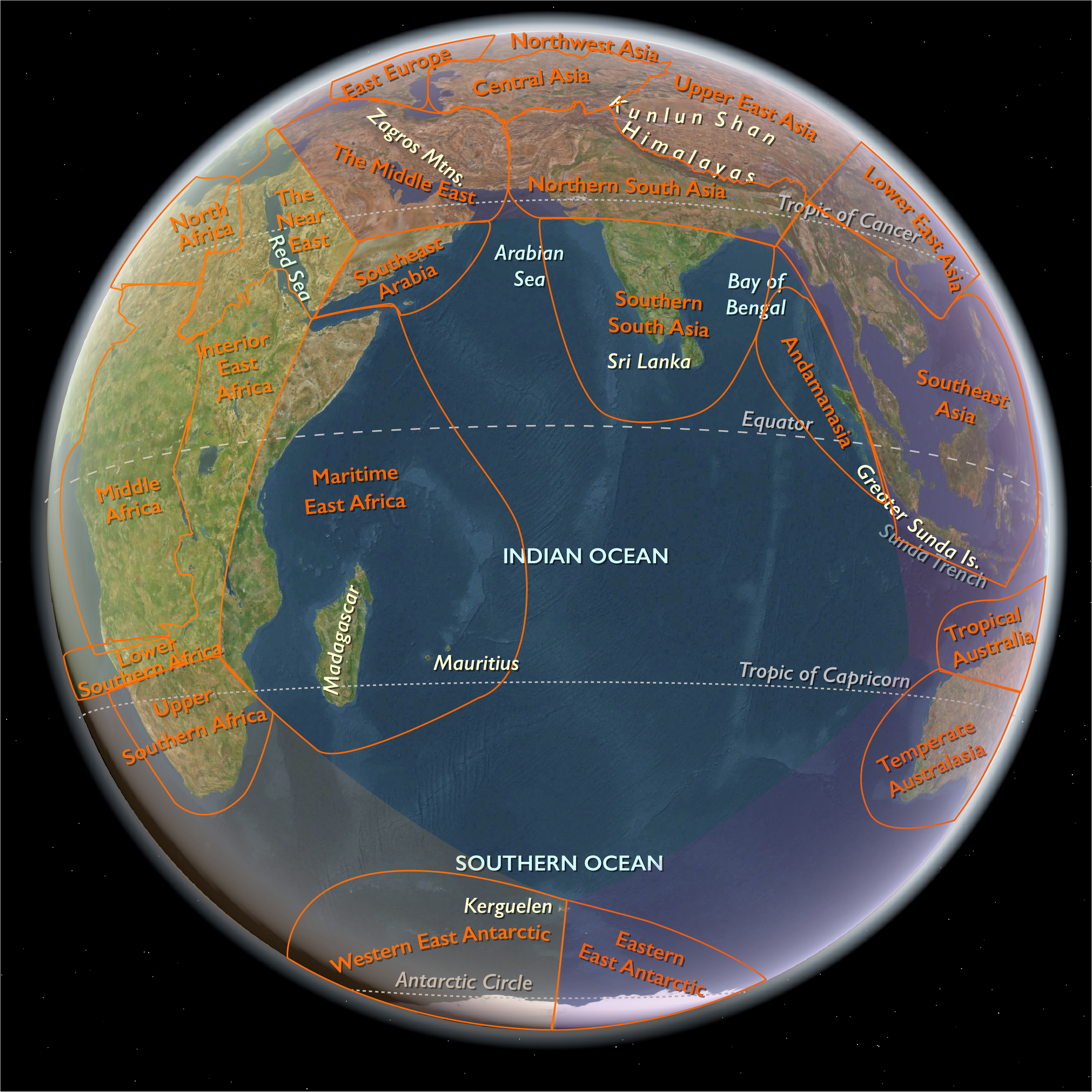
Diogo Fernandes is the first known European captain to visit the island of Socotra in 1503 and the discoverer of the Mascarenes archipelago (Réunion, Mauritius, and Rodrigues) in 1507.
He may also have been the first European to sail east of Madagascar island (the 'outer route' to the East Indies).
Related Events
Filter results
Showing 10 events out of 43 total
Diogo Fernandes Pereira had been appointed master and captain (a very unusual combination) of a Setúbal ship bound for India, in 1503.
Known lists for the armada and the chronicles do not actually give his ship a name, but just call it "the ship from/of Setúbal", a strong suggestion that it might have been privately outfitted by the merchant community of the city of Setúbal and captained by one of their own.
Diogo Fernandes Pereira's name is usually given simply as 'Diogo Fernandes'.
He is sometimes referred to as Diogo Fernandes de Setúbal (his hometown), to distinguish him from another Indian Ocean adventurer of this period with a similar name, known as Diogo Fernandes de Beja.
A Portuguese seaman of obscure background, he served as master on several ships: as third officer, below the pilot and captain, a position that requires trained navigational expertise.
He may have served as pilot on other occasions.
The Setúbal ship had originally been assigned to the third squadron of the Fifth Portuguese Armada, under the vice-admiral António de Saldanha, but navigational errors on Saldanha's part had led to the separation of the ships shortly after Cape Verde.
Diogo Fernandes had been forced to sail on alone.
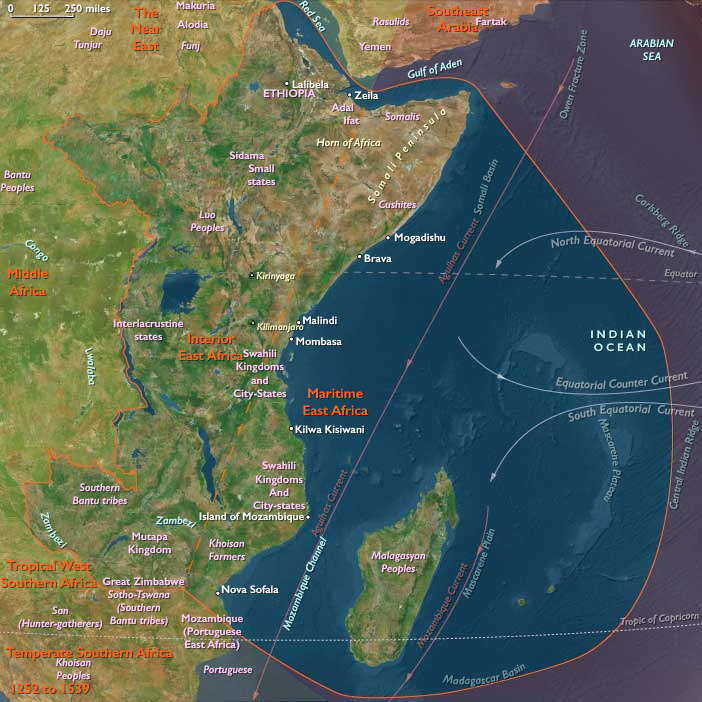
The chronicler Gaspar Correia (p. 418) claims that after doubling the Cape of Good Hope by himself, Fernandes did not turn into the Mozambique Channel, but rather pushed east, sailing under the island of Madagascar, and then turned north, sailing up east of Madagascar.
This would make him the first known ship to sail the 'outer route' to the East Indies.
(Although there remains the possibility that Diogo Dias also did precisely that in 1500.)
Although Correia's account is not corroborated by other chroniclers, Diogo Fernandes Pereira seems to almost certainly have missed Mozambique Island, the usual collection point for Portuguese ships, and where one of his squadron, Rui Lourenço Ravasco, was known to be waiting.
Instead, we next hear of Fernandes up near Cape Guardafui, which strongly suggests that he did take the outer route, as, sailing north by that route, he would not have sighted African coast before the horn.
António de Saldanha is still stuck in South Africa (he leaves his own note at the watering hole in Mossel Bay in in October.
Rui Lourenço Ravasco had meanwhile left Mozambique Island and moored his ship in Kilwa, waiting for his captain.
The summer monsoon winds are long gone, so there is no hope of an Indian Ocean crossing this year.
The captains of the third squadron, stuck in Africa until the next summer, content themselves with plucking prizes.
Rui Lourenço Ravasco has quickly made a nuisance of himself.
He had grabbed a few ships off Kilwa, before being reminded that Vasco da Gama had already extorted 'tribute' from Kilwa and thus the city is protected.
Sailing up to Zanzibar to find more prey, ...
…Ravasco is challenged by the Zanzibari fleet, but gets the better of it and seizes a few more ships.
The sheikh of Zanzibar agrees to submit and pay a yearly "tribute" of one hundred maticals (gold coins) to the King of Portugal.
Ravasco is said to have proceeded to Portuguese-allied Malindi, to find it under siege by the army of Mombassa.
Ravasco jumps into the fray and captures a fleet that has come from Brava to assist the Mombassans.
Finding several leading nobles of Barawa aboard, ...
...Ravasco compels their ransom and extorts an annual tribute from the Somali city.
By this time, Saldanha, who has been taking some prizes of his own, has also reached Malindi, finally catching up with Ravasco.
They proceed together to ...
…attack Mombassa.
They don't reduce the city to tribute, but nonetheless compel the ruler of Mombassa to agree to withdraw his troops and make peace with the sultan of Malindi.
With much of the East African coast having paid them off, Saldanha and Ravasco they proceed north to the Gulf of Aden to look for new targets.
It has been frequently hypothesized that Mauritius was first discovered by the Arabs.
The first historical evidence of the existence of an island now known as Mauritius is on a map produced in 1502 by the Italian cartographer Alberto Cantino, who shows three islands that are thought to represent the Mascarenes (Mauritius, …
…Rodrigues and …
…Réunion; he calls them Dina Margabin, Dina Arobi.
The three uninhabited islands, located five hundred miles (eight hundred and five kilometers) east of Madagascar, are encountered by chance during a Portuguese exploratory expedition of the coast of the Bay of Bengal led by Tristão da Cunha.
The expedition runs into a cyclone and is forced to change course.
Thus, the ship Cirne of the captain Diogo Fernandes Pereira comes into view of Réunion island on February 9, 1507.
They call the island "Santa Apolonia" ("Saint Apollonia") in honor of that day’s saint.
Mauritius, encountered during the same expedition, receives the name of "Cirne" and Rodrigues that of "Diogo Fernandes".
Five years later, the islands are visited by Dom Pedro de Mascarenhas, after whom the whole region will be named in 1528.
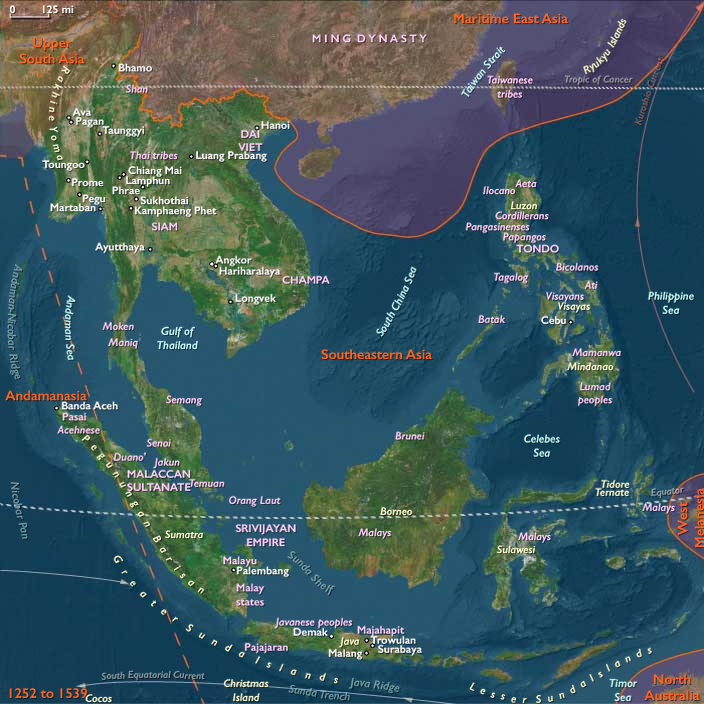
The Portuguese take no interest in these isolated islands, being that they are already established in Asia in Goa, on the coast of Malabar, on the island of Ceylon and on the Malaysian coast.
Their main African base is in Mozambique; the Portuguese navigators therefore prefer to use the Mozambique Channel to go to India.
The Comoros at the north end of the channel prove to be a more practical port of call.
Thus no permanent colony is established on the island by the Portuguese.
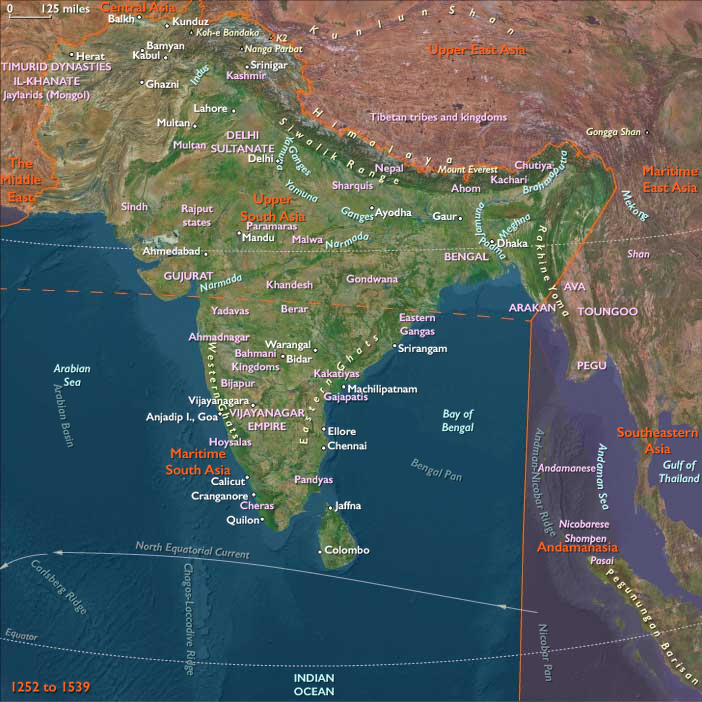
The spice trade linking India to Egypt, and thence Venice, had been seriously diminished and prices had shot up following the bombardment of Calicut in 1500–01 by the second Portuguese India Armada under Pedro Cabral.
Arab shipping is also being attacked directly: an Egyptian ship had been robbed and sunk by the Portuguese in 1503 as it was returning from India.
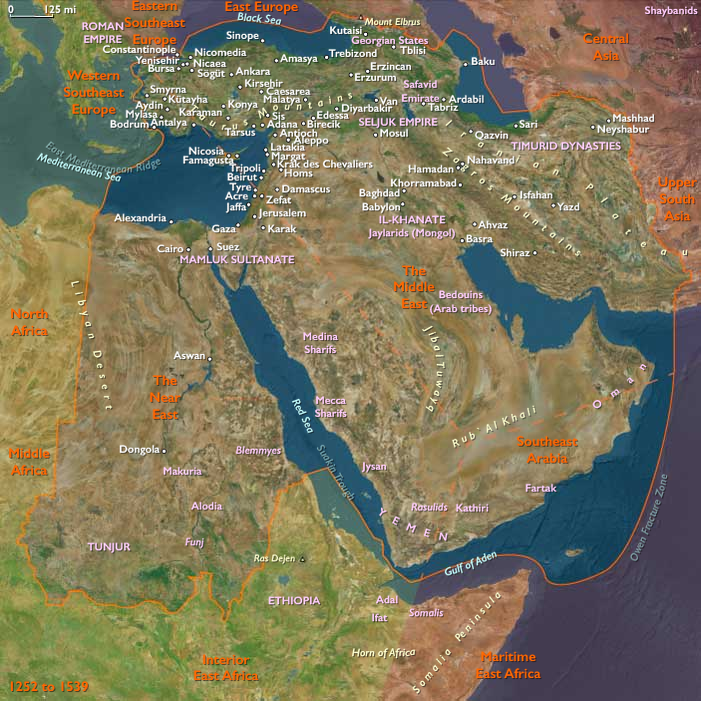
The Mamluk Sultan Qansuh al-Ghurii in 1504 first sends an envoy to the Pope, in the person of the Grand Prior of the Saint Catherine's Monastery, warning that if the Pope does not stop the exactions of the Portuguese against Muslims, he will bring ruin to the Christian Holy Place in the Levant and to the Christians living in his realm.
The Venetians, who share common interests with the Mamluks in the spice trade and desire to eliminate the Portuguese challenge if possible, send envoy Francesco Teldi, posing as a jewel buyer, as envoy to Cairo.
Teldi tries to find a level of cooperation between the two realms, encouraging the Mamluks to block Portuguese maritime movements.
The Venetians claim they cannot intervene directly, and encourage the Mamluk Sultan to take action by getting into contact with Indian princes at Cochin and Cananor to entice them not to trade with the Portuguese, and the Sultans of Calicut and Cambay to fight against them.
Some sort of alliance is thus concluded between the Venetians and the Mamluks against the Portuguese.
There will be claims, voiced during the War of the League of Cambrai, that the Venetians had supplied the Mamluks with weapons and skilled shipwrights.
The cavalry-oriented Mamluks have little inclination for naval operations, but the Portuguese keep blockading the Red Sea, and arresting Muslim merchant ships.