Northwest Europe (1168–1179 CE): Expansion, Conflict, and Cultural Evolution
England: Legal and Political Reforms
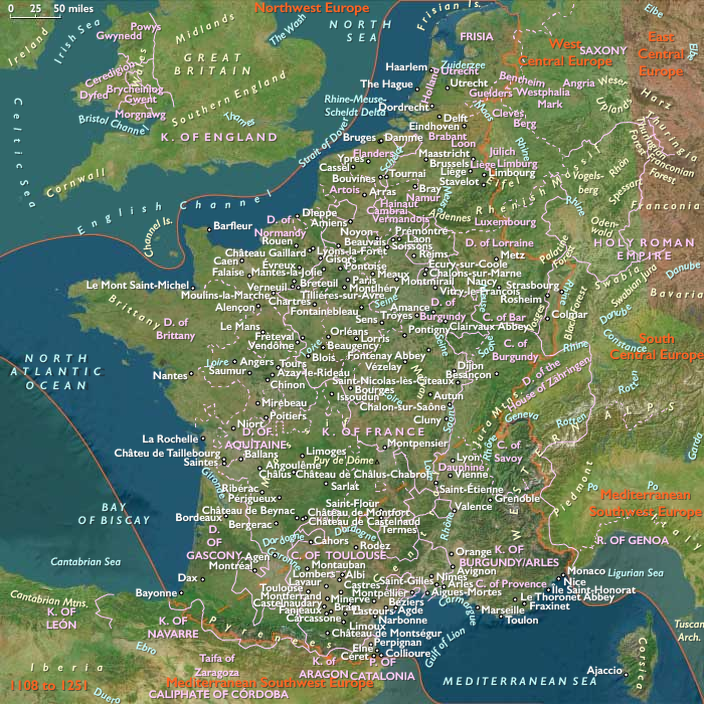
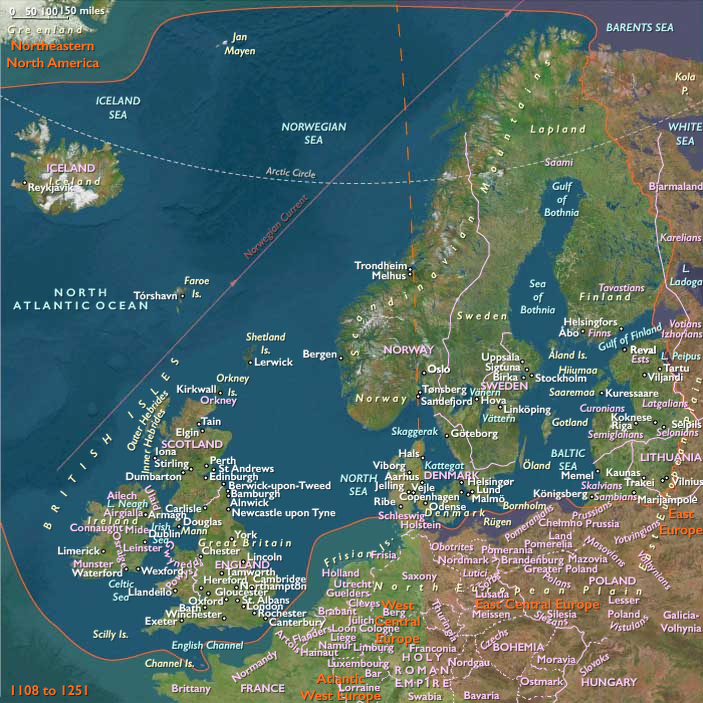
Under Henry II (r. 1154–1189), England experienced notable advances in legal and administrative reform. By 1170, Henry's efforts culminated in significant developments in common law, laying foundations for modern judicial practice. The infamous murder of Thomas Becket, Archbishop of Canterbury, in 1170 by knights loyal to Henry, however, severely tarnished his reputation. Becket's martyrdom sparked widespread outrage and eventually forced Henry into public penance, highlighting tensions between secular and ecclesiastical authority. The Revolt of 1173–74 ended in victory for Henry, who reconciled with his sons and other rebels, consolidating his rule.
Scotland: Further Consolidation under William the Lion
William I of Scotland, known as William the Lion (r. 1165–1214), focused his early reign on solidifying royal authority. In 1174, his support for a rebellion against Henry II of England resulted in his capture and subsequent imprisonment at Falaise in Normandy. Under the Treaty of Falaise (1174), Scotland was temporarily reduced to English vassalage, requiring William to acknowledge Henry as his feudal overlord and transfer several Scottish castles, including Berwick and Edinburgh, to English control. Although humiliating, William's eventual return to Scotland enabled him to strengthen central authority domestically.
Ireland: Norman Incursions and Expanding Influence
Ireland witnessed a significant turning point with the Cambro-Norman invasion initiated in 1169 by Richard de Clare (Strongbow), invited by the exiled king of Leinster, Diarmait Mac Murchada. This invasion, originating from Wales, marked the beginning of sustained Anglo-Norman dominance in Ireland. By 1171, English King Henry II himself led an expedition to assert dominance, establishing the Lordship of Ireland as part of his northwest European empire. This period marked profound political and cultural shifts within Ireland, setting the stage for centuries of Anglo-Irish conflict and cooperation.
Denmark: Stability and Expansion under Valdemar I
Valdemar I (the Great) continued consolidating Danish power, stabilizing internal governance after decades of conflict. His reign was characterized by increased influence over the Baltic region, notably demonstrated by successful military campaigns against the pagan Wends. Valdemar promoted the spread of Christianity, aligning closely with the Church to bolster royal authority, thereby stabilizing and strengthening the Danish kingdom.
Norway: Continued Civil Unrest and Royal Strife
Norway remained mired in ongoing internal conflicts, with various claimants vying for royal power. King Magnus V Erlingsson continued his struggle to establish centralized control, supported by influential ecclesiastical and aristocratic factions. The era was marked by intermittent violence and limited progress towards stable governance.
Iceland and the North Atlantic: Cultural Flourishing
In Iceland, cultural and literary traditions continued to flourish. The Althing provided stable governance, preserving local autonomy and maintaining continuity in societal practices. The literary corpus continued to grow, with Icelandic sagas and historical writings capturing regional culture and preserving the memories of past generations.
Religious and Cultural Expansion
Monasticism continued to thrive throughout Northwest Europe, driven primarily by Cistercian and Benedictine orders. New monasteries appeared regularly, playing critical roles in agriculture, education, and the preservation of knowledge. The martyrdom of Thomas Becket, in particular, spurred pilgrimage movements and devotional practices that further strengthened ecclesiastical influence.
Legacy of the Era
By 1179 CE, Northwest Europe had undergone significant political and cultural transformations. England's legal and administrative reforms under Henry II laid enduring governmental foundations, despite ecclesiastical tensions. Scotland and Ireland experienced critical shifts in power dynamics influenced by English and Norman incursions. Denmark enjoyed increased stability and expansion under Valdemar I, while Norway continued to grapple with internal strife. Meanwhile, Iceland remained culturally vibrant and stable, unaffected by broader geopolitical struggles, reinforcing its unique role in preserving the region’s heritage.