Denis of Portugal
King of Portugal
Years: 1261 - 1325
Denis (Lisbon, 9 October 1261 – 7 January 1325 in Santarém), called the Farmer King (Rei Lavrador), is King of Portugal and the Algarve.
The eldest son of Afonso III of Portugal by his second wife, Beatrice of Castile and grandson of king Alfonso X of Castile (known as the Wise), Denis succeeds his father in 1279.

Related Events
Filter results
Showing 10 events out of 18 total
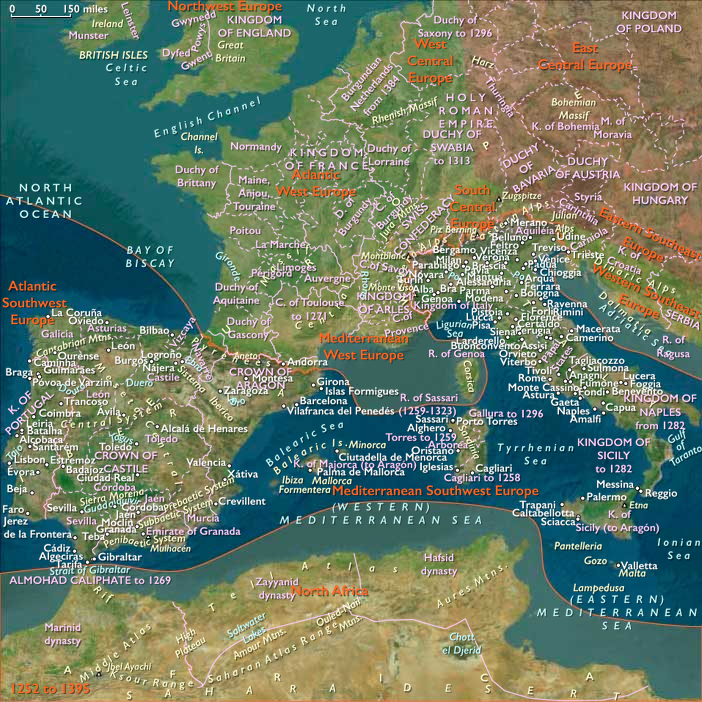
Atlantic Southwest Europe (1252 – 1395 CE): Wool, Iron, Wine, and the Atlantic Turn
Geographic and Environmental Context
Atlantic Southwest Europe includes Portugal’s Lisbon, Beira, Minho, Trás-os-Montes, and Spain’s Galicia, Asturias, Cantabria, Basque Country, Castile and León, northern Rioja, and northern Navarra.
-
Anchors: the Cantabrian coast (A Coruña–Gijón–Santander–Bilbao–San Sebastián), the Douro/Minho estuaries, and the Meseta–Cantabrian passes binding the plateau to Atlantic ports.
Climate and Environmental Shifts
-
Little Ice Age onset (~1300) brought cooler, wetter weather; stormier Bay of Biscay; good fisheries persisted.
-
Black Death (1348–1352) hit towns hard; ports recovered quickest via maritime trade.
Societies and Political Developments
-
Castile and León unified under Alfonso X (r. 1252–1284), then fractured and reconsolidated amid the Trastámara coup (Pedro I vs Enrique II, 1366–1369).
-
Portugal strengthened under Afonso III and Dinis (reforestation of Leiria for ship timber; University of Coimbra 1290), then defended independence in the Crisis of 1383–1385; João I and Aljubarrota (1385) sealed the Anglo-Portuguese alliance (Treaty of Windsor, 1386).
-
Navarre navigated between France and Castile; Basque towns (Bilbao, charter 1300; San Sebastián) grew as maritime communes.
Economy and Trade
-
Wool complex: Castilian wool—organized by the Mesta (founded 1273)—flowed through Burgos, León, and Cantabrian ports to Flanders and England.
-
Basque iron & shipbuilding: forges supplied anchors, nails, artillery shot; yards built cogs and naos for Atlantic service and whaling.
-
Wine & salt fish: Douro/Minho wines, Galician/Portuguese salt fish (cod, sardine) and tuna moved north; Lisbon/Porto emerged as major entrepôts.
-
Finance & law: municipal fueros, urban consulates, and English–Portuguese treaties stabilized credit, convoys, and tariffs.
Subsistence and Technology
-
Mixed Atlantic polyculture (rye/wheat, vines, chestnuts, cattle); stern-rudder hulls, improved rigging, magnetic compass and portolan practice diffused into Iberian waters.
Movement and Interaction Corridors
-
Sea: Lisbon ⇄ London/Bristol; Cantabria ⇄ Flanders; Galicia ⇄ Brittany; pilgrim sailings to Santiago.
-
Land: Meseta passes fed Burgos, León, Salamanca; Douro road/river linked Castile to Porto.
Belief and Symbolism
-
Cathedrals and monasteries in Santiago, León, Burgos, Salamanca; confraternities of sailors and merchants venerating St. James and St. Nicholas kept social cohesion in plague decades.
Adaptation and Resilience
-
Route redundancy (many ports, multiple passes), portfolio exports (wool–iron–wine–fish–salt), and crown–town compacts hedged risk from war, weather, and plague.
Long-Term Significance
By 1395, the Atlantic façade from Lisbon to San Sebastián had become a maritime-industrial platform: wool, iron, wine, and shipbuilding—backed by Portugal’s English alliance—set the stage for the 15th-century Atlantic turn and overseas exploration.
King Denis and the Resolution of the Church-Crown Conflict (1279–1325)
The long-standing conflict between the Portuguese Crown and the Church over property rights was finally settled during the reign of King Denis (r. 1279–1325). Determined to assert royal authority over the kingdom’s land and resources, Denis took decisive action to curb the Church’s unchecked accumulation of property.
The Deamortization Laws and Excommunication (1284–1285)
- In 1284, King Denis launched a new round of inquiries into Church landholdings.
- The following year (1285), he issued deamortization laws, which prohibited the Church and religious orders from purchasing land and required them to sell all properties acquired since the start of his reign.
- This action led to Denis’s excommunication, following the precedent of his father (Afonso III) and grandfather (Afonso II), both of whom had clashed with the papacy over land reform.
- Unlike his predecessors, however, Denis refused to submit to papal authority, securing once and for all the Portuguese Crown’s control over royal patrimony.
The Nationalization of Military Orders
Denis’s assertion of royal supremacy over land extended to military-religious orders, which had amassed vast wealth and influence during the Reconquista. By nationalizing these orders, Denis ensured that their resources would serve the kingdom rather than remain under foreign or papal control.
- The Order of Avis (1280s) – Originally a Castilian military order (the Calatravans), the knights became effectively Portuguese when King Afonso II granted them the town of Avis. Under Denis, the Order of Avis remained a dedicated military force, later playing a key role in Portugal’s independence from Castile.
- The Order of Saint James (Santiago) (1288) – Although founded in Castile, the Portuguese knights of the order elected their own master in 1288, effectively separating themselves from Castilian control.
- The Suppression of the Templars and the Order of Christ (1312) – When Pope Clement V dissolved the Templars, their immense landholdings were initially transferred to the Hospitallers. However, King Denis successfully petitioned the pope to grant the Templars’ Portuguese wealth to a new military-religious order, the Order of Christ, founded in 1319 and originally based at Castro Marim before moving to Tomar.
The Legacy of the Military Orders
After their nationalization, most of these military-religious orders transitioned into chivalric landowning institutions, becoming quasi-celibate noble orders responsible for governing vast estates. However, two orders retained military significance:
- The Order of Avis remained a combat-ready force, playing a major role in securing Portugal’s independence from Castile.
- The Order of Christ retained military and religious functions, but more importantly, its vast wealth later funded Prince Henry the Navigator’s early voyages of discovery, financing Portugal’s maritime expansion in the 15th century.
Conclusion
King Denis’s bold assertion of royal control over land, wealth, and military orders ensured that Portugal’s resources remained under the Crown’s authority rather than the Church’s influence. His reforms not only strengthened the monarchy but also laid the foundations for Portugal’s later dominance in exploration and global trade.
Afonso IV of Portugal: Reforms and the Victory at Río Salado (1325–1357)
Afonso IV of Portugal continued the development policies of his father, King Denis, while also taking significant steps to strengthen royal justice and defend the Iberian Christian kingdoms against external threats.
Judicial Reforms and Governance
One of Afonso IV’s key domestic policies was his reform of the judicial system:
- He dismissed corrupt local judges and replaced them with royally appointed magistrates, ensuring a more centralized and fair system of justice.
- These judicial reforms strengthened royal authority over local governance, reducing the influence of powerful noble factions and corrupt officials.
The Battle of Río Salado (1340): A Christian Victory
In 1340, a large Muslim army—comprising Marinid forces from North Africa and troops from the Emirate of Granada—landed in the Iberian Peninsula, posing a significant threat to Christian rule. Recognizing the danger, Afonso IV allied himself with Alfonso XI of Castile and Pedro IV of Aragon to confront the invasion.
- Afonso IV sent a Portuguese fleet under Admiral Manuel Pessanha to blockade Cádiz, cutting off Muslim reinforcements.
- Meanwhile, he personally led an army overland to join Alfonso XI’s Castilian forces.
- On October 30, 1340, the combined Christian armies decisively defeated the Marinid and Granadan forces at the Battle of Río Salado, marking one of the most significant victories of the Reconquista.
Afonso IV’s Legacy
Afonso IV’s reign reinforced Portugal’s internal stability through his judicial reforms and strengthened Christian Iberia’s defense against external threats. His participation in the Battle of Río Salado solidified Portugal’s military reputation and strengthened its ties with Castile, securing the kingdom’s place in the ongoing Reconquista
King Denis and the Foundations of Portugal’s National Identity (1279–1325)
King Denis of Portugal (r. 1279–1325) was a visionary ruler who strengthened the kingdom’s economy, navy, language, and education, laying the groundwork for Portugal’s future maritime expansion and cultural identity.
Economic Reforms: Colonization, Markets, and a National Economy
- Denis chartered numerous settlements on lands conquered from the Moors, encouraging colonization and agricultural development.
- To stimulate trade and economic integration, he authorized fairs and markets in each new settlement, fostering a national economy that connected urban and rural communities.
The Foundations of Portugal’s Naval Power
- Recognizing the strategic importance of maritime strength, Denis established Portugal’s first organized navy.
- In 1317, he hired the Genoese admiral Emanuele Pessagno (Manuel Pessanha in Portuguese), granting him the title of hereditary admiral of Portugal. This decision marked the beginning of Portugal’s naval tradition, which would later lead to the Age of Exploration.
- To promote maritime commerce, he negotiated a trade agreement with Edward II of England in 1303, allowing Portuguese merchants and ships access to English ports under secure trading privileges.
Portuguese as a National Language
- Denis played a crucial role in shaping Portugal’s linguistic identity by decreeing that all official documents be written in Portuguese, rather than Latin.
- This measure established Portuguese as the official language of administration, reinforcing a distinct national identity.
Advancement of Higher Learning: The University of Coimbra
- In 1290, Denis founded Portugal’s first higher-learning institution, modeled after the "General Studies" centers in León and Aragon.
- Originally located in Lisbon, the institution was relocated to Coimbra in 1308, where it remained except for a brief period (1521–1537).
- This center evolved into the University of Coimbra, which became Portugal’s premier institution of higher education.
Legacy: The Architect of Portugal’s Future
King Denis’s policies in trade, naval development, language, and education were instrumental in shaping Portugal’s national identity and future maritime ambitions. His reign strengthened the economy, centralized governance, and laid the foundation for Portugal’s later dominance in global exploration and trade.
King Denis of Portugal: The Farmer King and the Foundations of Maritime Expansion (1279–1325)
With the boundaries of Portugal firmly established, its kings began focusing on the economic, cultural, and political development of the realm. This shift was particularly evident during the reign of King Denis (Dinis), known as "O Lavrador" (The Farmer), whose agricultural and economic policies helped lay the groundwork for Portugal’s future prosperity.
Agricultural and Economic Reforms
King Denis actively promoted agriculture to strengthen the kingdom’s self-sufficiency and economic base:
- Noble Incentives for Land Development – He decreed that nobles would not lose their standing if they drained wetlands, settled colonists, and planted forests, encouraging them to invest in land cultivation rather than warfare.
- Expansion of Pine Forests – He initiated the planting of pine forests, particularly the famous Pinhal de Leiria, which provided timber for shipbuilding, an early sign of Portugal’s nascent maritime ambitions.
- Agricultural Colonization – Denis encouraged the settlement of unused lands, reinforcing Portugal’s agricultural expansion and demographic growth.
Strengthening Shipbuilding and Maritime Interests
Recognizing the strategic importance of the sea, Denis promoted shipbuilding, setting the stage for Portugal’s later exploratory and naval dominance. His reign marked an early royal interest in maritime expansion, with the Crown looking toward the Atlantic and beyond for future conquest and commerce.
The Foundations of Portugal’s Golden Age
Through his agricultural policies, shipbuilding initiatives, and economic reforms, King Denis solidified Portugal’s internal strength, paving the way for the Age of Exploration. His vision helped transform Portugal from a land-focused feudal kingdom into an emerging maritime power, whose descendants would launch the great voyages of discovery in the 15th and 16th centuries.
The Resolution of the Church-Crown Conflict and the Triumph of the Portuguese Monarchy (1262)
The prolonged interdict imposed on Portugal due to Afonso III’s defiance of the papacy had a particularly devastating impact on the clergy, who suffered more than the laity from the suspension of religious services and church revenues. Recognizing the unsustainability of the conflict, Pope Urban IV took steps to resolve the dispute.
The Papal Settlement (1262): Legitimizing Dinis and Ending the Crisis
- In 1262, Pope Urban IV legalized the disputed marriage between Afonso III and Beatriz de Guzmán, which had originally triggered the papal condemnation.
- The Pope also legitimized their son, Dinis, securing his place as the rightful heir to the Portuguese throne.
- This effectively ended the struggle for supremacy between the Church and Crown, reinforcing the monarchy’s authority over ecclesiastical affairs in Portugal.
The Strength of the Portuguese Monarchy
By the mid-13th century, the Portuguese monarchy had emerged as the dominant force in the kingdom, achieving victory over the nobility, the Church, and external claimants. This triumph was due to several key factors:
- Defense of National Interests – The monarchy positioned itself as the protector of Portugal’s independence, securing broad popular support.
- Municipal and Military Support – The towns and municipalities, as well as the military orders, aligned with the king, helping to weaken feudal aristocratic resistance.
- Military Prestige – Success in the Moorish and Castilian wars had strengthened the royal armies, elevating the monarchy’s reputation as a victorious and unifying force.
Legacy: The Rise of a Strong, Centralized Monarchy
With the legitimacy of Dinis secured and Portugal’s territorial sovereignty recognized, the House of Burgundy firmly established royal authority. The groundwork laid by Afonso III allowed his successor, King Dinis (r. 1279–1325), to further develop Portugal’s economy, military, and administrative structure, leading the kingdom into a period of prosperity and stability.
Portugal Secures Its Final Borders and Full Independence (1263)
In 1263, Alfonso X of Castile formally renounced his claim to suzerainty over the Algarve, bringing an end to the longstanding territorial dispute between Castile and Portugal. With this recognition:
- Portugal’s European borders were finalized, reaching their modern territorial limits.
- The kingdom achieved full sovereignty, no longer subject to any foreign feudal claims.
- Lisbon was officially recognized as the permanent capital, solidifying its status as the political and economic center of Portugal.
Afonso III’s Later Years and the Rebellion of Dinis
Although Afonso III reigned until 1279, his later years were not entirely peaceful.
- His assertive policies against the nobility and the Church, as well as his economic reforms, created tensions within the royal court.
- His son and heir, Dinis, dissatisfied with certain aspects of his father’s rule, rebelled against him, challenging his authority in his final years.
Despite this dynastic conflict, Afonso III’s reign marked the completion of Portugal’s territorial consolidation and the strengthening of the monarchy’s independence from both Castile and the Papacy. His legacy would be continued by Dinis, who would later earn the title "O Lavrador" (The Farmer King) for his agricultural, economic, and cultural advancements.
Atlantic Southwest Europe (1276–1287 CE): Portuguese Governance Consolidation, Castilian Dynastic and Intellectual Tensions, and Navarrese Diplomatic Continuity
Between 1276 and 1287 CE, Atlantic Southwest Europe—including Galicia, northern and central Portugal, Asturias, Cantabria, and northern Spain south of the Franco-Spanish border (43.05548° N, 1.22924° W)—experienced a period of internal governance refinement, cultural vigor, and diplomatic complexity. Portugal, transitioning from King Afonso III (d. 1279 CE) to his son King Dinis (1279–1325 CE), significantly enhanced administrative centralization and legal reforms. Castile, still under the culturally influential yet politically challenged reign of King Alfonso X "the Wise" (1252–1284 CE), faced growing dynastic and aristocratic tensions. Navarre, under Queen Joan I (1274–1305 CE), skillfully maintained diplomatic neutrality, regional autonomy, and stable governance amid shifting Iberian alliances.
Political and Military Developments
Portuguese Governance and Legal Reforms under King Dinis
Following the death of Afonso III (1279 CE), his son, King Dinis, decisively continued centralizing royal administration and governance reforms. King Dinis implemented significant legal codifications and territorial organization, strengthening frontier security, administrative efficiency, and civic coherence. His effective governance significantly reinforced Portuguese national identity, territorial integrity, and internal stability.
Castilian Dynastic and Aristocratic Tensions under Alfonso X
Castile faced significant internal challenges during the later years of Alfonso X’s reign, marked by dynastic disputes, aristocratic opposition, and growing regional tensions. Despite his profound cultural influence and administrative reforms, Alfonso’s governance faced substantial resistance, complicating Castilian political stability. Nevertheless, his legal and intellectual legacy significantly influenced regional identity, culture, and governance structures.
Navarre’s Diplomatic Stability under Queen Joan I
In Navarre, Queen Joan I decisively preserved diplomatic neutrality, regional autonomy, and governance coherence, skillfully navigating complex relations with Castile, Aragón, and southern territories. Joan’s effective leadership significantly supported Navarre’s territorial integrity, internal stability, and northern Iberian political resilience amid broader geopolitical challenges.
Economic Developments
Continued Agricultural Prosperity
The region maintained robust agricultural productivity, decisively supported by advanced irrigation and diversified cultivation methods (grains, olives, vineyards, citrus fruits, almonds). Thriving livestock husbandry, artisanal crafts, and significant mining operations (gold and silver, particularly from Galicia and Asturias) reinforced regional economic resilience and demographic stability.
Expansion of Maritime Commerce and Trade Networks
Portuguese ports—particularly Lisbon, Porto, Braga, and Coimbra—decisively expanded maritime commerce, enhancing commercial connections with northern European markets (England, Flanders, Normandy, Brittany). Galicia, notably through A Coruña, maintained active maritime trade, reinforcing regional economic autonomy and prosperity.
Pilgrimage-Driven Economic Vitality
Pilgrimage to Santiago de Compostela continued supporting regional economic stability, significantly sustaining hospitality industries, artisanal commerce, international cultural exchanges, and infrastructural developments. Continued pilgrimage activity reinforced Galicia’s economic resilience, cultural prominence, and regional identity.
Cultural and Religious Developments
Castilian Intellectual Renaissance Amid Political Challenges
Despite internal political tensions, Castilian intellectual activity continued flourishing under Alfonso X’s patronage. Scholarly pursuits, manuscript production, historiography, legal codifications, and cultural institutions decisively shaped Castilian identity, intellectual heritage, and European-wide recognition.
Galician Cultural Continuity and Ecclesiastical Patronage
Galicia maintained vibrant cultural resilience, decisively supported by Santiago de Compostela’s pilgrimage prominence. Ecclesiastical patronage significantly supported scholarly activities, architectural projects, manuscript preservation, and educational institutions, profoundly shaping Galician cultural identity and international prominence.
Monastic Intellectual Contributions and Ecclesiastical Influence
Monastic communities continued vibrant intellectual traditions, manuscript preservation, agricultural innovations, and educational reforms. Ecclesiastical authorities significantly influenced Iberian religious identity, liturgical uniformity, ecclesiastical discipline, and regional cultural cohesion.
Persistent Cultural Syncretism and Local Traditions
Orthodox Christianity continued integrating indigenous Iberian and Celtic traditions, notably in rural Galicia and northern Portugal. Persistent cultural syncretism decisively reinforced distinctive regional identities, social cohesion, and cultural resilience amid broader political transformations.
Civic Identity and Governance
Portuguese Administrative Centralization and Civic Coherence
Under King Dinis, Portugal decisively continued centralizing royal administration, significantly strengthening territorial governance, legal codifications, civic stability, and national identity. His effective governance significantly reinforced Portuguese territorial integrity, internal stability, and enduring medieval trajectory.
Castilian Dynastic Complexity and Regional Identity
Despite internal dynastic and aristocratic tensions, Alfonso X’s reign significantly shaped Castilian regional identity, administrative coherence, and intellectual legacy. His cultural influence decisively reinforced Castilian civic identity and governance structures, despite immediate political instability.
Navarrese Regional Autonomy and Diplomatic Continuity
Navarre, under Queen Joan I, maintained resilient regional autonomy, diplomatic neutrality, and stable governance amid shifting Iberian alliances. Joan’s prudent governance decisively preserved territorial integrity, internal stability, and northern Iberian geopolitical coherence.
Notable Regional Groups and Settlements
-
Portuguese: Decisively strengthened territorial governance, administrative coherence, and civic stability under King Dinis, significantly shaping Portuguese national identity and enduring medieval legacy.
-
Castilians: Sustained cultural prominence and administrative coherence amid dynastic complexities under Alfonso X, significantly influencing Iberian intellectual heritage and regional identity.
-
Galicians: Maintained vibrant cultural resilience and economic stability, decisively reinforced by pilgrimage traditions, maritime commerce, and ecclesiastical patronage.
-
Basques (Navarre): Preserved regional autonomy, diplomatic neutrality, and stable governance under Queen Joan I, significantly influencing northern Iberian political stability.
Long-Term Significance and Legacy
Between 1276 and 1287 CE, Atlantic Southwest Europe:
-
Experienced decisive Portuguese administrative centralization, territorial governance, and civic stability under King Dinis, significantly shaping Portugal’s enduring medieval trajectory.
-
Navigated complex Castilian dynastic tensions while sustaining significant intellectual and cultural advancements under Alfonso X, decisively shaping Castilian identity and regional coherence.
-
Maintained Navarre’s regional autonomy, diplomatic neutrality, and governance stability under Joan I, significantly shaping northern Iberian geopolitical stability.
-
Sustained economic prosperity, pilgrimage-driven cultural prominence, maritime commerce, and resilient local governance, decisively influencing Atlantic Southwest Europe’s enduring historical legacy.
This pivotal era decisively influenced regional identities, territorial governance stability, diplomatic alignments, and cultural resilience, profoundly shaping Atlantic Southwest Europe’s medieval historical trajectory.
The Accession of King Denis (1279) and the Legacy of Afonso III
On February 16, 1279, Afonso III of Portugal—a monarch known for his administrative reforms, economic policies, and cultural advancements—passed away, leaving the throne to his son, Denis (Dinis I).
Afonso III’s Legacy: Foundations of a Strong Monarchy
During his reign, Afonso III:
- Completed Portugal’s territorial expansion, becoming the first king to use the title "King of Portugal and the Algarve."
- Strengthened royal authority by limiting the power of the nobility and increasing the influence of municipalities and the cortes.
- Encouraged commerce through trade agreements, including one with England in 1303, which expanded Portuguese access to international markets.
- Promoted Portuguese as an administrative language, helping to unify the kingdom culturally.
The Accession of Denis (r. 1279–1325): The Farmer King
Denis, the son of Afonso III and Beatriz de Guzmán, inherited a stable and centralized kingdom. As king, he would become known as "O Lavrador" (The Farmer King) for his agricultural, economic, and maritime policies.
With Denis’s accession, Portugal entered a new phase of economic prosperity, administrative consolidation, and cultural flourishing, building on the reforms of his father to strengthen the monarchy and national identity.
Atlantic Southwest Europe (1288–1299 CE): Portuguese Governance Flourishing, Castilian Stability Restoration, and Navarrese Diplomatic Resilience
Between 1288 and 1299 CE, Atlantic Southwest Europe—including Galicia, northern and central Portugal, Asturias, Cantabria, and northern Spain south of the Franco-Spanish border (43.05548° N, 1.22924° W)—experienced increased political stability, administrative centralization, and cultural continuity. Portugal flourished significantly under King Dinis (1279–1325 CE), who advanced royal authority, governance reforms, and cultural patronage. Castile, under King Sancho IV "the Brave" (1284–1295 CE) and his son Ferdinand IV (1295–1312 CE), decisively restored internal political stability after dynastic tensions. Navarre, still under Queen Joan I (1274–1305 CE), continued carefully balancing diplomatic neutrality, regional autonomy, and internal governance stability amid shifting Iberian alliances.
Political and Military Developments
Portuguese Governance Flourishing under King Dinis
Under King Dinis, Portugal decisively consolidated royal governance, significantly enhancing territorial administration, legal codifications, and frontier security. His progressive policies, including agricultural and settlement initiatives, advanced Portuguese economic vitality, civic coherence, and national identity. King Dinis' effective governance significantly secured Portuguese internal stability, laying firm foundations for enduring medieval prosperity.
Castilian Restoration of Political Stability under Sancho IV
Following Alfonso X’s turbulent reign, his son Sancho IV "the Brave" decisively restored political stability and internal governance coherence within Castile. Despite initial aristocratic resistance, Sancho IV effectively reinforced Castilian administration, legal structures, and frontier defenses. Upon his death in 1295, Castile faced renewed challenges under his young son Ferdinand IV, yet foundational governance stability remained intact.
Navarre’s Diplomatic Continuity under Queen Joan I
Under Queen Joan I, Navarre carefully preserved diplomatic neutrality, regional autonomy, and stable governance structures. Joan’s prudent leadership decisively maintained Navarrese territorial integrity, internal stability, and northern Iberian geopolitical coherence, skillfully balancing relations with Castile, Aragón, and southern territories.
Economic Developments
Agricultural Innovations and Sustained Prosperity
Regional agriculture remained robust, decisively supported by King Dinis’ policies encouraging land reclamation, new settlements, and irrigation enhancements. Diverse cultivation practices (grains, olives, vineyards, citrus, almonds), livestock husbandry, artisanal production, and active mining operations (gold and silver, particularly from Galicia and Asturias) significantly reinforced economic resilience and demographic stability.
Maritime Commerce and Trade Expansion
Portuguese coastal ports, notably Lisbon, Porto, Braga, and Coimbra, significantly expanded maritime commerce, reinforcing economic ties with northern Europe (England, Flanders, Normandy, Brittany). Galicia, especially through A Coruña, continued active maritime trade, decisively reinforcing regional economic autonomy and prosperity.
Pilgrimage-Driven Economic Continuity
Pilgrimage routes to Santiago de Compostela continued robustly, significantly supporting hospitality industries, artisanal commerce, infrastructure developments, and cultural exchanges. Continued pilgrimage flows decisively reinforced Galicia’s economic resilience, cultural prominence, and regional identity.
Cultural and Religious Developments
Portuguese Cultural and Intellectual Patronage
King Dinis significantly advanced Portuguese intellectual and cultural activities, patronizing literature, poetry, educational institutions, and scholarly traditions. His reign decisively shaped Portuguese cultural identity, linguistic standardization, and intellectual heritage, profoundly influencing Portugal’s medieval cultural trajectory.
Galician Cultural Resilience and Ecclesiastical Patronage
Galicia maintained vibrant cultural continuity, decisively supported by Santiago de Compostela’s international pilgrimage significance. Ecclesiastical patronage significantly supported scholarly initiatives, architectural projects, manuscript preservation, and educational institutions, profoundly shaping Galician cultural identity and international prominence.
Monastic Intellectual Contributions and Ecclesiastical Influence
Monastic communities sustained vibrant scholarly traditions, manuscript preservation, agricultural innovations, and educational reforms. Ecclesiastical authorities significantly influenced Iberian religious identity, liturgical uniformity, ecclesiastical discipline, and regional cultural coherence.
Persistent Cultural Syncretism and Local Traditions
Orthodox Christianity continued integrating indigenous Iberian and Celtic traditions, notably in rural Galicia and northern Portugal. Persistent cultural syncretism decisively reinforced distinctive regional identities, social cohesion, and cultural resilience amid broader political transformations.
Civic Identity and Governance
Portuguese Territorial Governance and Civic Stability
Under King Dinis, Portugal decisively strengthened territorial governance, administrative coherence, and civic stability. His effective governance significantly solidified Portuguese national identity, territorial integrity, and internal stability, establishing enduring foundations for Portugal’s medieval prosperity and historical trajectory.
Castilian Civic Restoration and Governance Stability
Under Sancho IV, Castile decisively restored internal political stability, administrative coherence, and clearly defined regional identity following earlier dynastic challenges. His reign significantly reinforced Castilian civic identity, territorial governance, and Iberian geopolitical stability, laying foundational structures for future governance developments.
Navarrese Regional Autonomy and Diplomatic Neutrality
Under Joan I, Navarre maintained resilient regional autonomy, diplomatic neutrality, and governance stability amid shifting Iberian alliances. Joan’s careful diplomatic strategies decisively preserved territorial integrity, internal governance stability, and northern Iberian geopolitical coherence.
Notable Regional Groups and Settlements
-
Portuguese: Experienced decisive governance flourishing, territorial stability, and cultural vitality under King Dinis, significantly shaping Portuguese national identity and enduring medieval trajectory.
-
Castilians: Decisively restored internal political stability, administrative coherence, and regional identity under Sancho IV, significantly influencing Iberian geopolitical stability and regional coherence.
-
Galicians: Sustained cultural prominence and economic resilience, significantly reinforced by pilgrimage traditions, maritime trade, and ecclesiastical patronage.
-
Basques (Navarre): Maintained regional autonomy, diplomatic neutrality, and stable governance under Queen Joan I, significantly shaping northern Iberian geopolitical coherence.
Long-Term Significance and Legacy
Between 1288 and 1299 CE, Atlantic Southwest Europe:
-
Achieved decisive Portuguese governance stability, territorial administration, and cultural vitality under King Dinis, significantly shaping Portugal’s medieval identity and historical trajectory.
-
Experienced Castilian restoration of political stability, administrative coherence, and clearly defined regional identity under Sancho IV, decisively influencing Iberian geopolitical stability.
-
Maintained Navarre’s regional autonomy, diplomatic neutrality, and governance stability under Joan I, significantly shaping northern Iberian political dynamics.
-
Sustained robust economic prosperity, pilgrimage-driven cultural prominence, maritime commerce, and resilient local governance, decisively influencing Atlantic Southwest Europe’s enduring medieval legacy.
This pivotal era decisively influenced regional identities, territorial governance stability, diplomatic alignments, and cultural resilience, profoundly shaping Atlantic Southwest Europe’s medieval historical trajectory.